In another striking display of decoupling, bitcoin aggressively breached the $71,000 threshold during the morning session on March 4, 2026. As the most dire geopolitical forecasts for the Middle East conflict began to materialize, the top cryptocurrency surged from its $68,000 floor to a peak of $71,837 on Bitstamp.
This near 8% vertical climb occurred in just over one hour, a move that stood in sharp contrast to the sea of red across global equity markets, where indices continued to tumble for the third consecutive day. The momentum rippled through the broader digital asset landscape as ethereum reclaimed the psychological $2,000 level while BNB climbed 4.6% to reach $652.
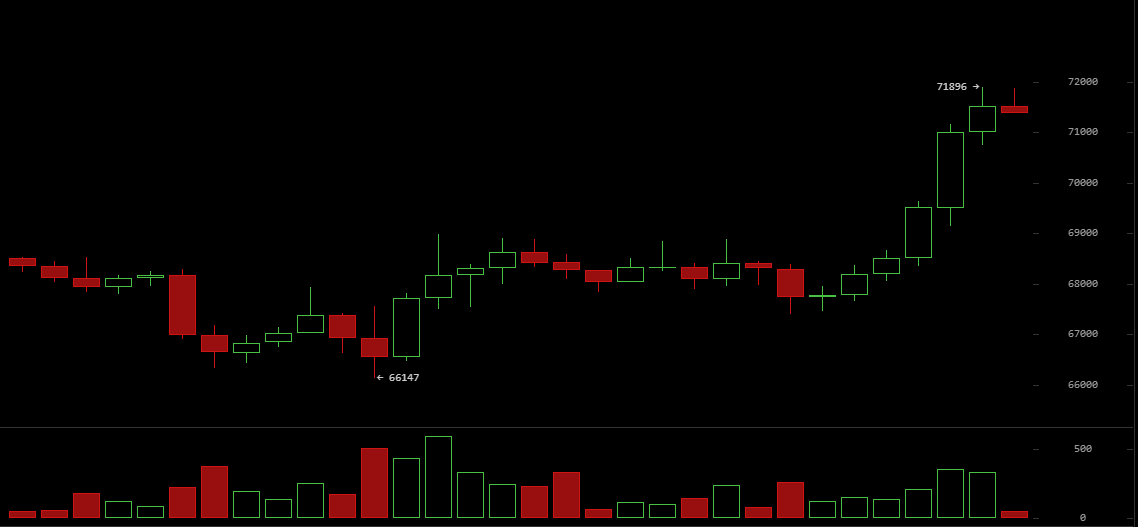
XRP mirrored its Monday peak by rising from $1.35 to $1.41, while assets like SOL, BCH, LINK and WBT all posted gains exceeding 5%. While the majority of the market turned green, gold-backed tokens XAUT and PAXG became unusual laggards, both retreating by over 2% as investors seemingly rotated capital out of traditional “hard” tokenized assets and directly into bitcoin’s volatility-fueled growth.
This morning surge catapulted bitcoin’s market capitalization to $1.43 trillion—its highest valuation since Feb. 8—and pushed the total crypto economy toward the $2.5 trillion mark. This rally marks a decisive pivot from the weekend, when the market initially appeared to bear the brunt of the U.S. and Israel’s escalating strikes against Iran. While crypto finds its footing, traditional finance is reeling; South Korea’s KOSPI was hit particularly hard, plunging 12%, while Japan’s Nikkei retreated 3.9% as energy-dependent sectors dragged the index down.
The catalyst for this market fracture was Iran’s decision to play its most disruptive hand: the effective closure of the Strait of Hormuz. By blocking this vital artery for global trade, cargo and energy shipments have ground to a halt, leading to a violent spike in gas and oil prices. Although President Donald Trump has pledged to deploy U.S. Navy assets to protect ships and offer federal risk insurance to tankers, market analysts remain skeptical. Experts believe a cessation of hostilities is the only path to lowering energy prices, which are currently destabilizing a global economy still recovering from the 2025 tariff wars.
Meanwhile, the rapid price action on March 4 also triggered a massive short squeeze in the derivatives market. In a four-hour window, nearly $100 million in short positions were vaporized, compared to only $3.23 million in long liquidations. Overall, the bloodbath for bears reached over $154 million in shorts liquidated versus just $9.1 million in longs.
- What caused bitcoin to breach $71,000 on March 4, 2026? Bitcoin surged as geopolitical tensions in the Middle East escalated, pushing it from $68,000 to $71,837 in just over an hour.
- How did the bitcoin surge impact the broader cryptocurrency market? The rally led to significant gains across crypto assets, with ETH surpassing $2,000 and BNB rising 4.6%, while many other cryptocurrencies posted over 5% increases.
- What impact did the Middle East conflict have on global markets? Traditional equity markets suffered losses, with the South Korean KOSPI dropping 12% and Japan’s Nikkei retreating 3.9%, as energy prices soared due to Iran’s blockade of the Strait of Hormuz.
- What was the outcome of the derivatives market during this surge? A massive “short squeeze” liquidated nearly $100 million in short positions, highlighting the volatility and strength of bitcoin’s rally compared to minimal long liquidations.
免责声明:本文章仅代表作者个人观点,不代表本平台的立场和观点。本文章仅供信息分享,不构成对任何人的任何投资建议。用户与作者之间的任何争议,与本平台无关。如网页中刊载的文章或图片涉及侵权,请提供相关的权利证明和身份证明发送邮件到support@aicoin.com,本平台相关工作人员将会进行核查。


