Original Title: The「Investible」Crypto Tokens
Original Author: Ignas, DeFi Analyst
Original Translator: Saoirse, Foresight News
CoinGecko tracks 17,148 tokens.
But how many "investable" tokens truly meet the following criteria in the current crypto market environment?
1. Can bring returns to holders;
2. Have protocol revenue, even if it has not yet been distributed;
3. Strong narrative and market recognition, able to survive a bear market.
I attempted to clarify this issue.
Most of the data comes from DefiLlama, CoinMarketCap, and some protocols that reflect market enthusiasm (Dexu, Moni, Lunarcrush, etc.).
I processed the data using Claude Code to minimize personal bias—
I would have excluded some tokens (like XRP, ADA, BCH, etc.), but they have gone through multiple cycles and possess sufficient liquidity for sustained vitality.
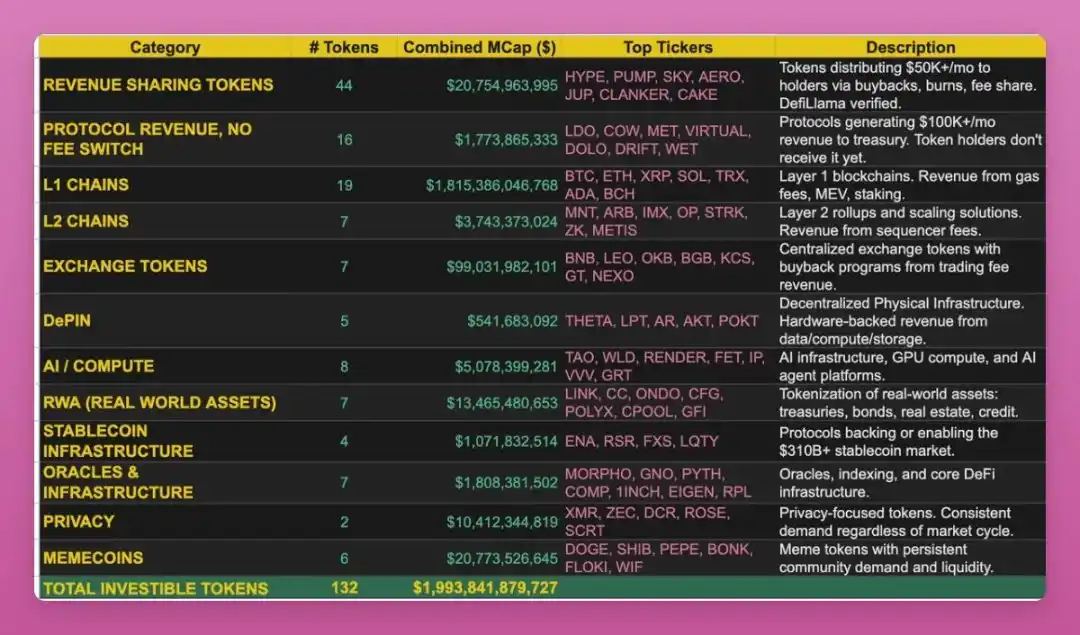
Claude still made quite a few errors; the debugging took ten times longer than writing the article, so the table data is for reference only (link at the end).
Final Results:
· A total of 12 categories and 132 investable tokens were screened;
· Among them, 45 provide dividends to holders (excluding those with extremely low returns);
· Annualized revenue flowing to holders: 1.8 billion dollars.
These classifications are entirely based on my subjective judgment of "survivability and future potential," which you may not agree with.
The first key finding: the truly investable crypto market is exceedingly small.
And the tokens that can genuinely earn money for holders are almost monopolized by two projects. More details will follow.
It’s somewhat amusing that, while compiling this list and checking each token one by one, I came to this conclusion:
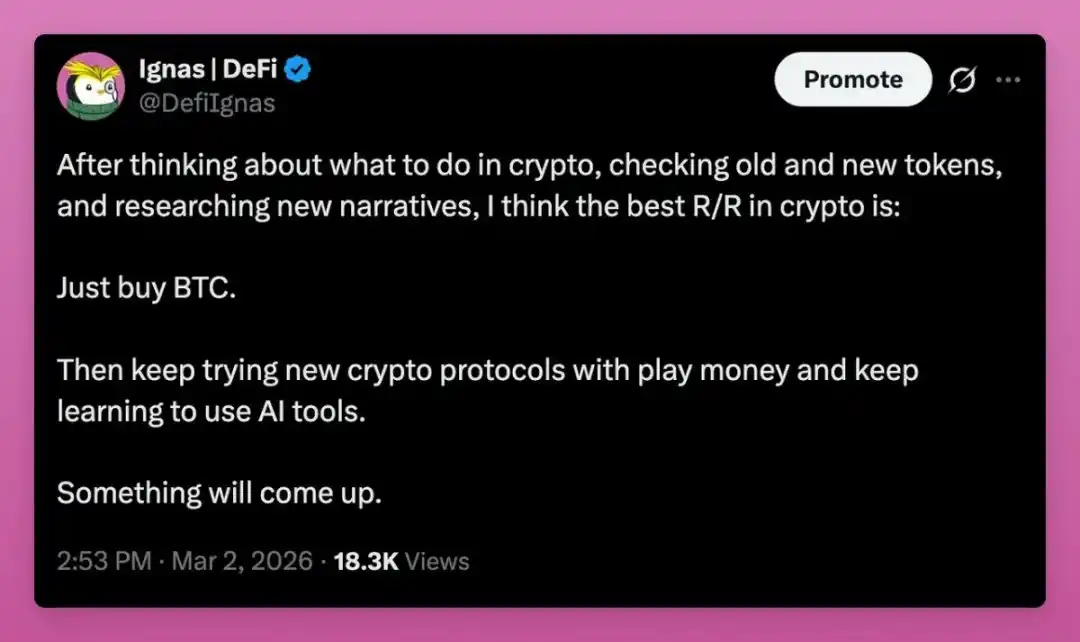
After repeatedly contemplating how to navigate the crypto space, reviewing new and old tokens, and studying new narratives, I believe the optimal risk-reward ratio (R/R) choice in the crypto world is:
Directly buying Bitcoin (BTC).
Then continuously trying new crypto protocols with "play money," while continuously learning to use AI tools.
New opportunities will always arise.
The Most Worthwhile Tokens to Invest In: Revenue-Sharing Types
The current mainstream narrative in the market is:
Projects without revenue will ultimately perish!
Even ETH finds it hard to escape this "value based on income" narrative.
Therefore, the most valuable tokens for investment are those that can share revenue with holders through buybacks, burns, transaction fees, and other methods.
I lowered the threshold to: DefiLlama shows holders’ revenue ≥ 50,000 dollars over 30 days.
These 45 tokens bring 153 million dollars in revenue to holders each month,
totaling 1.8 billion dollars annually.
Top 10 in revenue sharing:
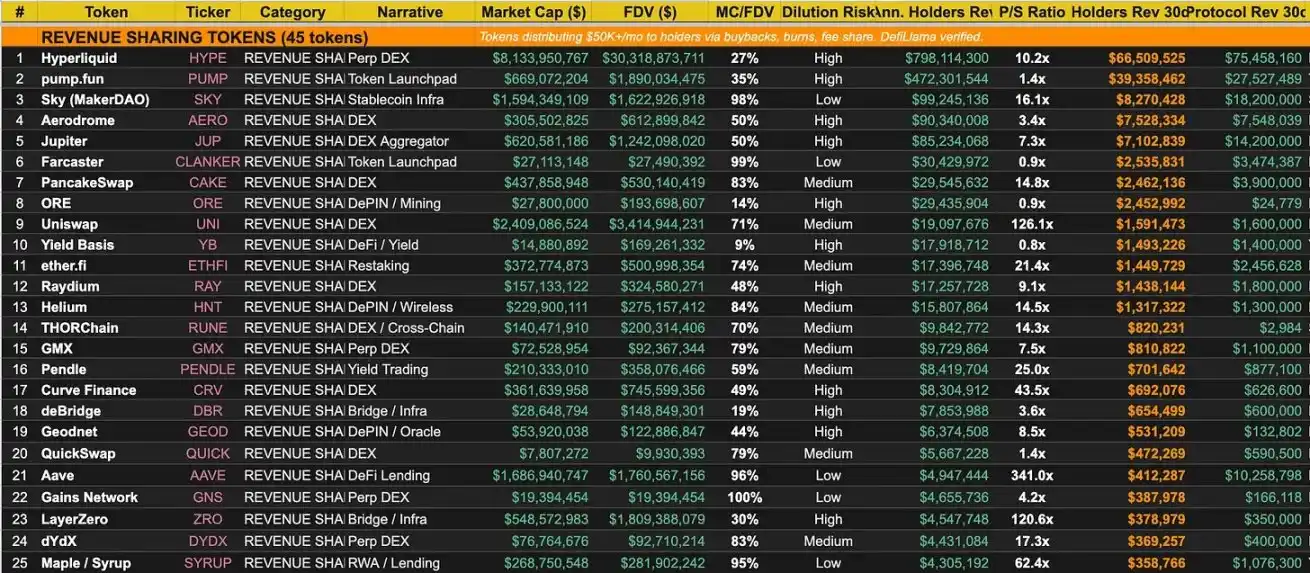
Note: Revenue sharing ≠ holders’ revenue on DefiLlama.
For example: EtherFi didn't make it onto the holders' revenue rankings, but it has buybacks.
Projects like Tron, a type of L1 public chain, have been categorized separately.
Beyond the top five, monthly revenue rapidly drops below 3 million dollars.
If the crypto market continues to trend toward the logic of "tokens = stocks,"
then the P/S (price-to-sales ratio, market cap / revenue) will become increasingly important.
· Pump.fun: 1.4 times
· Aerodrome: 3.4 times
By traditional financial standards, these are extremely cheap.
At the current revenue rate, the total market cap can be earned back in less than 3 years.
And:
· Uniswap: P/S as high as 121 times
· Aave: P/S even 341 times
Because the market valuations it receives far exceed "current revenue".
Aave recently finally started buybacks, but only distributes 412,000 dollars monthly while the protocol's monthly revenue is 10 million dollars. Future governance changes may alter this situation.
Tokens with the lowest P/S (price-to-sales ratio):
· Farcaster’s Clanker: 0.9 times
· ORE: 0.9 times
· Yield Basis: 0.8 times
· Pump.fun: 1.4 times
· QuickSwap: 1.4 times
They can all earn back their market cap from revenue within 3 years.
Most Important Conclusion:
Hyperliquid + Pump.fun = 69% of total holder revenue!
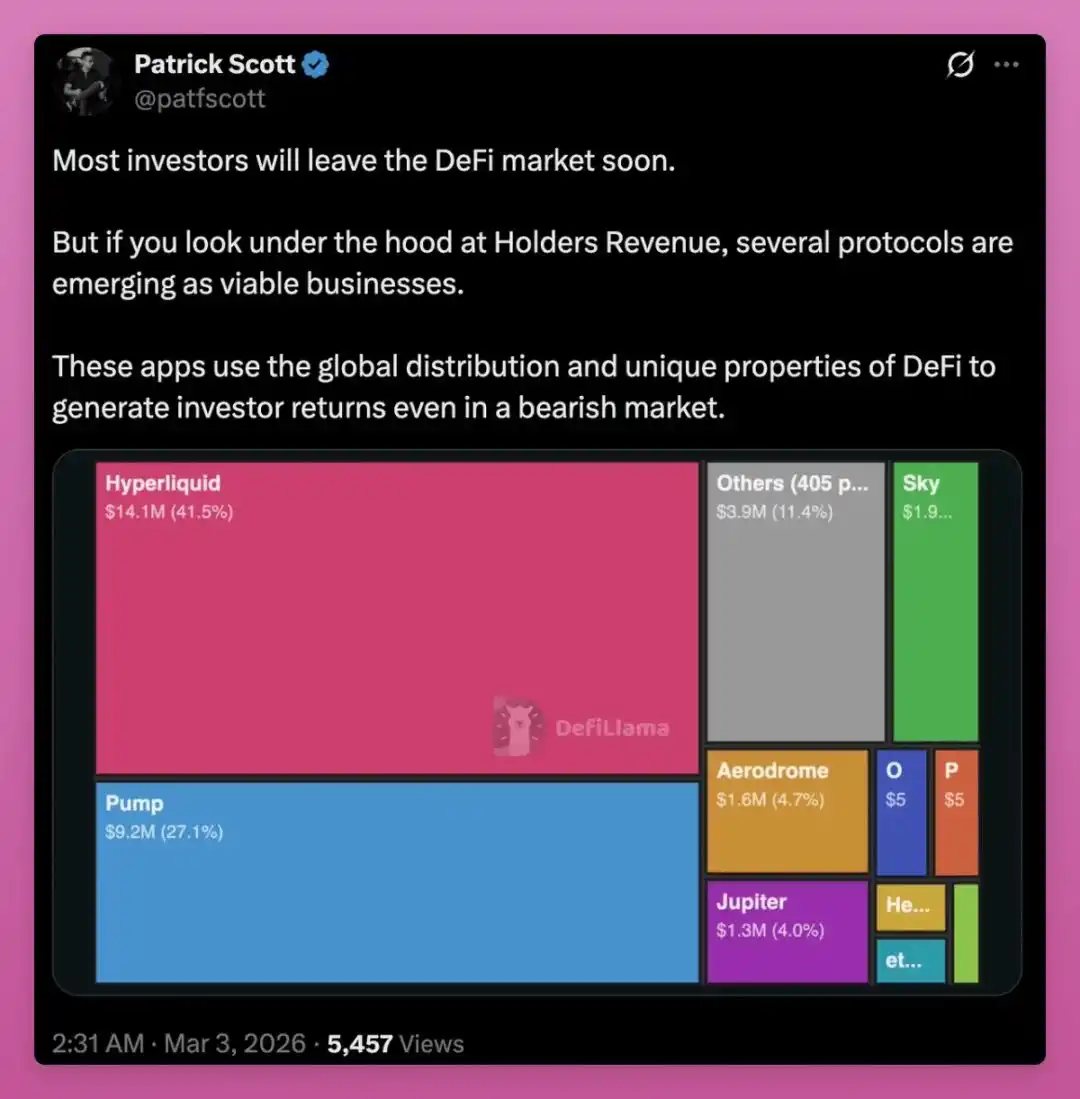
Among the 45 tokens, just two projects contributed over 2/3 of the cash flow.
This level of concentration is very thought-provoking.
Ansem's tweet succinctly summarizes the HYPE investment philosophy:
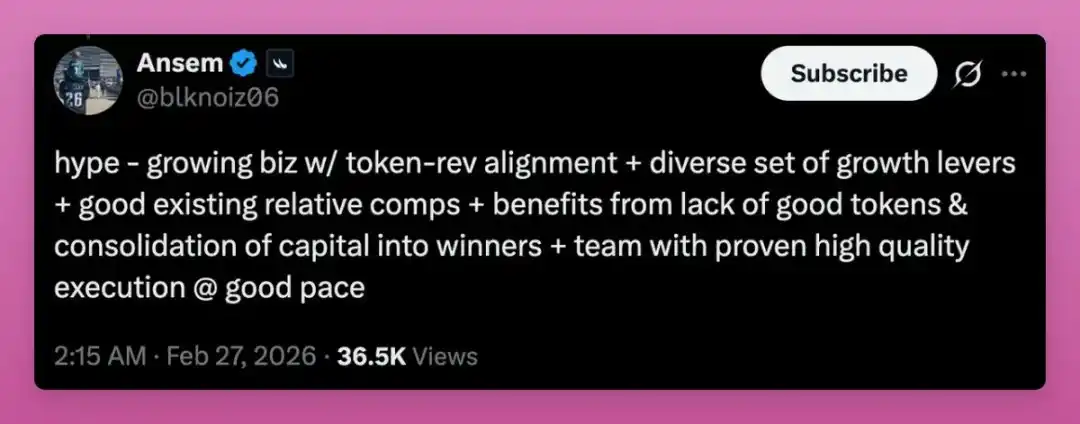
HYPE:
· Business is consistently growing, tokens are highly tied to revenue;
· There are diversified growth levers;
· Existing comparable projects perform well;
· Benefit from high-quality token scarcity and a market environment where funds concentrate on leading projects;
· Strong team execution, stable rhythm, and impressive past performance.
Projects with Protocol Revenue, But Not Yet Distributing Dividends
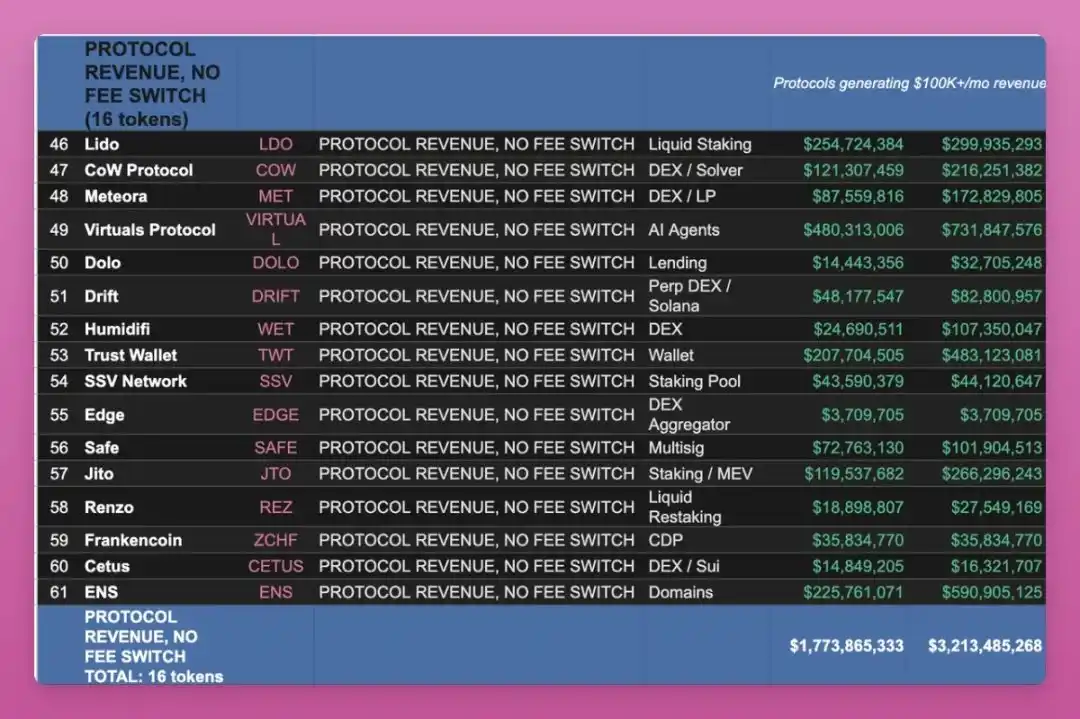
This category includes 16 tokens, each with protocol revenue ≥ 100,000 dollars monthly, with income retained in the treasury.
Top projects:
· Lido: 4.3 million dollars monthly, TVL 32 billion dollars (previously proposed staking dividends last year);
· CoW Protocol: 3 million dollars monthly;
· Meteora (Solana): 2 million dollars monthly;
· Virtuals Protocol: 1.4 million dollars monthly;
· Drift: 868,000 dollars monthly.
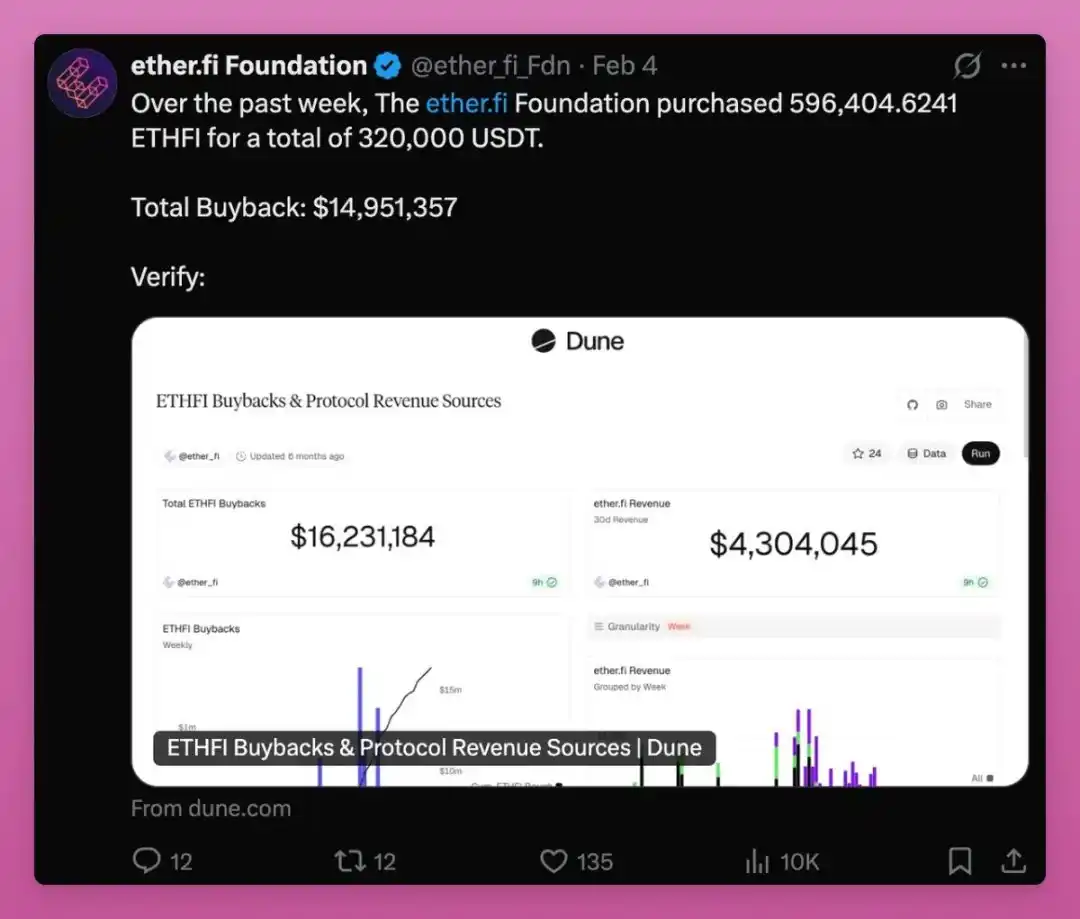
A comparison between Lido and ether.fi is quite interesting:
· Lido has 10 times the TVL and 3 times the revenue, but LDO holders get nothing;
· ether.fi distributes 1.5 million dollars monthly to holders via buybacks.
If you want to survive a bear market, you would prefer the one that gives you money.
The investment logic for this type of asset is:
These protocols will eventually turn on the "dividend switch."
Lido has been saying this for many years.
Jito has total fees of 5.3 million dollars monthly, but only 544,000 dollars go into the treasury.
The gap between total fees and holders’ revenue presents both an opportunity and a risk.
Overview of Other Sectors
Exchange tokens (7, total market cap 99 billion dollars, including BNB)
Can earn money regardless of bull or bear markets. CEX trading volume will decline, but will not go to zero.
· BNB: 85 billion dollars;
· LEO, OKB have barely declined during the 2022 and 2024 bear markets.
Many have buyback plans; they just aren’t reflected in the DefiLlama data.
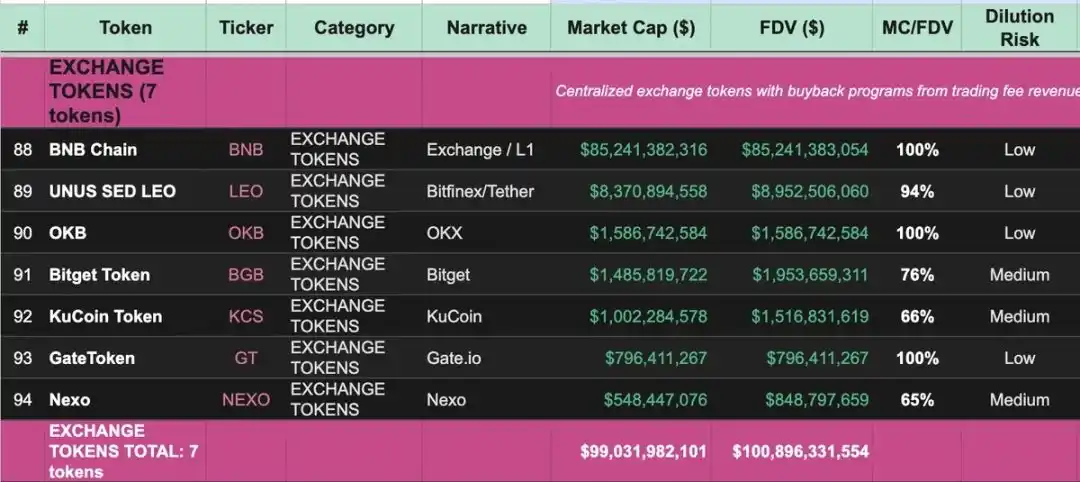
CEX token circulation rates are high, further reducing downside risk.
L1 Public Chains (19, total market cap 1.8 trillion dollars)
L1 is the foundational layer.
· BTC: 1.36 trillion dollars
· ETH: 245 billion dollars
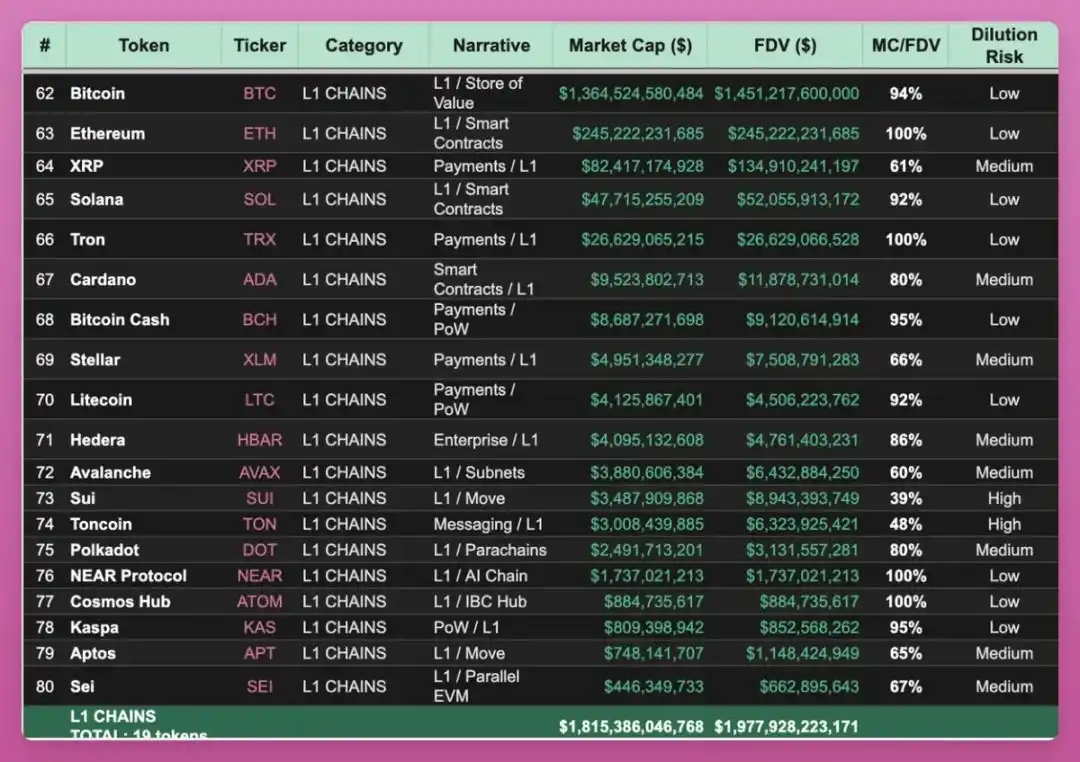
I have loosened the standards for XRP, ADA, and especially Cosmos, because they have survived multiple cycles, have believers and liquidity, and possess sustained vitality.
You may dislike Tron TRX, but it generates 26 million dollars in fees monthly—more than both Solana and Ethereum.
This cycle has also performed strongly; you can check the K-line yourself.
L1 public chains will not disappear, but valuation fluctuations will be immense. Hold at your own risk.
AI and Computing (8, total market cap 5.1 billion dollars)
Most have no actual income, with one exception:
Venice (VVV): The only AI token supported by subscriptions and API revenue through buybacks and burns, has burned 43% of its supply.
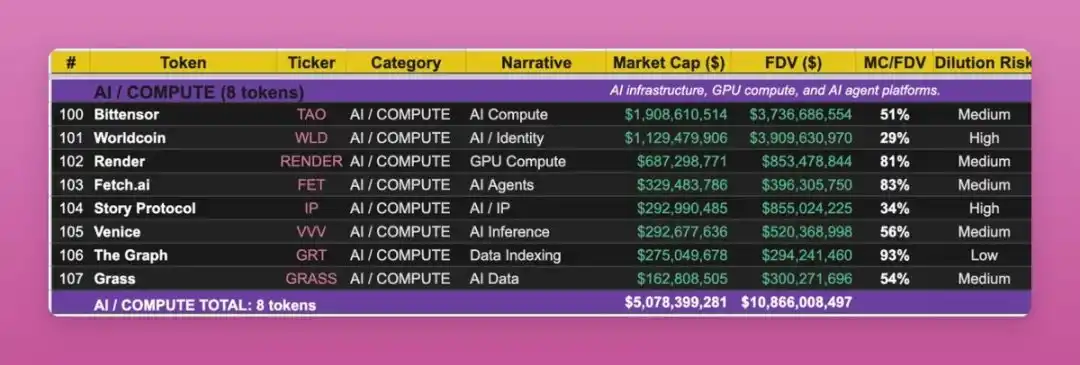
· Bittensor: 1.9 billion dollars market cap, 128 subnetworks, no protocol revenue;
· Render, Akash: sell GPU computing power, cheaper than centralized platforms;
· Grass: provides decentralized network data for AI training.
Note: Some AI tokens not listed are now surging, possibly suitable for short-term trading, but whether they can be considered "investable" is debatable.
RWA Asset Tokenization (7, total market cap 13.5 billion dollars)
Growing quietly; I believe the real RWA bull market has yet to come.
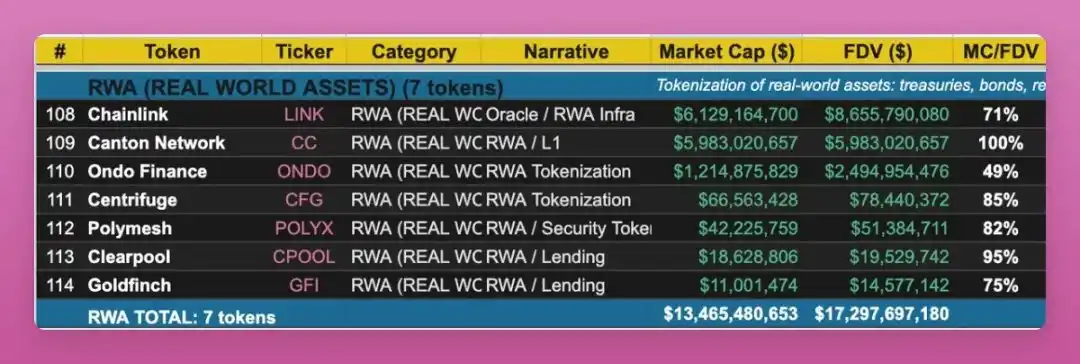
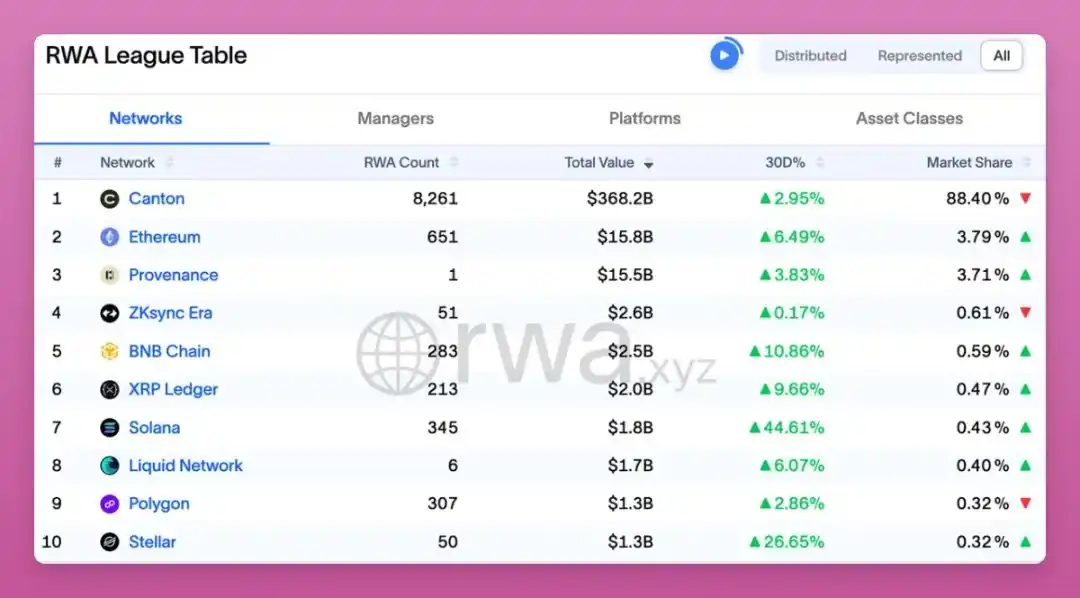
The Canton Network controls 88.57% of on-chain RWA, about 372 billion dollars in tokenized assets. However, real-world assets are not as straightforward as they appear.
Chainlink is the key oracle for RWA underpinnings, but LINK’s staking rewards come from inflation and fixed reward pools, not protocol revenue sharing.
Chainlink has good revenue, but it flows to node operators and the treasury, not directly to holders.
Privacy Tokens (2, total market cap 9.7 billion dollars)
High-risk sector: Either becoming increasingly important as regulation tightens, or being outright banned.
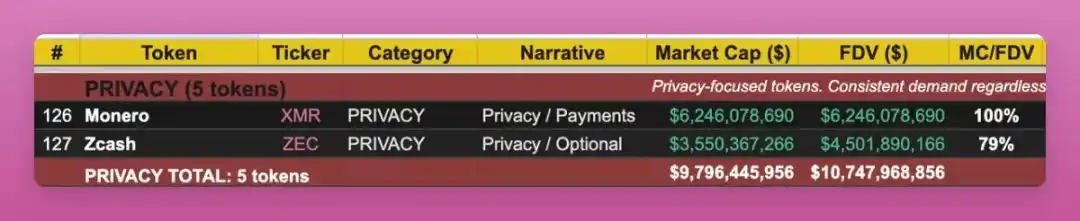
But demand remains stable regardless of bull or bear markets.
· Monero: 6.2 billion dollars
· Zcash: 3.6 billion dollars
Meme Coins (6, total market cap 2.08 billion dollars)
It might be controversial to categorize them as "investable."
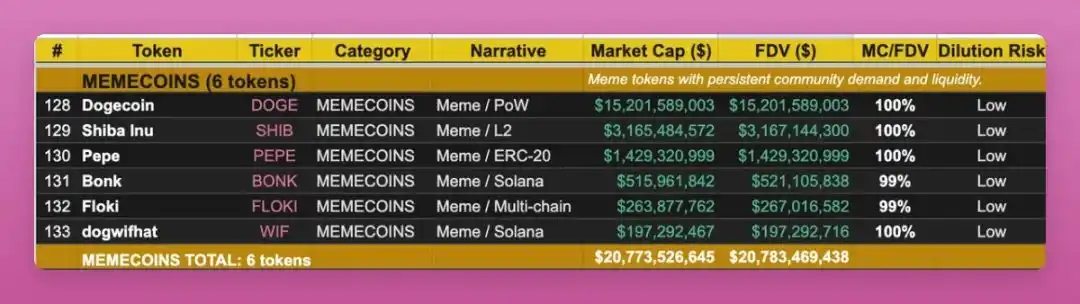
But like Bitcoin, they survive on community support.
· DOGE: 15.2 billion dollars market cap, exists for over ten years;
· SHIB, PEPE, BONK, FLOKI, WIF also made the list.
If the market rebounds, they may outperform high-yield tokens.
Because unlike income ceilings, they have no upper limits.
Moreover, they are almost fully circulated, presenting little selling pressure.
Other Categories
· L2 Public Chains (7, total market cap 3.7 billion dollars);
· DePIN (5, total market cap 500 million dollars): decentralized storage, data collection;
· Oracles / Infrastructure (7, total market cap 1.8 billion dollars);
· Stablecoin Infrastructure (4, total market cap 1.1 billion dollars): Ethena leads.
Super Profitable Projects Without Tokens
Some of the most profitable crypto businesses have no investable tokens at all.
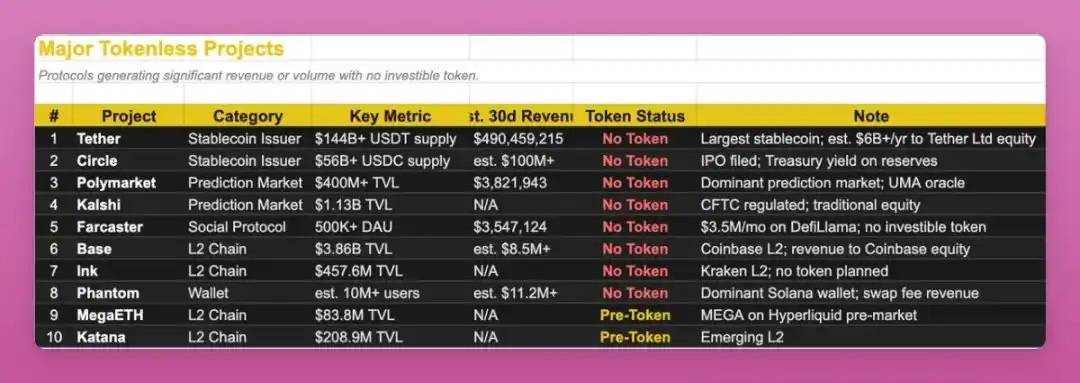
· Tether: annual revenue of over 6 billion dollars, more than the total of those 45 profit tokens, entirely for shareholders;
· Polymarket: monthly revenue of 3.8 million dollars, no tokens;
· Base: revenue goes to Coinbase shareholders, tokens may be issued in the future;
· Phantom: millions of users, very high transaction fees;
· Circle: issuer of USDC, revenue reflected in IPO;
· Kalshi: regulated by CFTC, no tokens;
· Farcaster: already acquired, expected airdrops have significantly decreased, but tokens may still be issued.
So, how to use this information?
The ideal holdings for a bear market meet four criteria:
1. Have holder revenue
2. Low P/S ratio (market cap / revenue)
3. High MC/FDV (market cap / fully diluted market cap)
4. Ongoing stable demand
Very few tokens can fully meet these criteria.
The closest candidate:
· PUMP: 1.4 times P/S, 33% MC/FDV
· AERO: 3.4 times, 50%
· JUP: 7.3 times, 51%
· SKY: 16 times, 98%
· CAKE: 15.1 times, 96%
Low-risk options:
Exchange tokens: LEO, OKB, GT
Almost fully circulated, supported by trading platform profit buybacks, performing most steadily in bear markets.
High-risk, high-reward:
HYPE: revenue far ahead, but MC/FDV is only 25%.
After Coingecko's new statistics excluded long-term illiquid and burned tokens, it dropped to 41%.
Tradable opportunities:
Watch for governance changes:
Bet on those with revenue but not yet distributing dividends to open the "dividend switch."
Key focus:
Lido, Meteora, Drift, CoW Protocol
Everything else hinges on belief.
Do you believe AI computing will go on-chain?
Do you believe RWA tokenization will continue to grow?
I believe it will, but are these tokens the right betting targets?
免责声明:本文章仅代表作者个人观点,不代表本平台的立场和观点。本文章仅供信息分享,不构成对任何人的任何投资建议。用户与作者之间的任何争议,与本平台无关。如网页中刊载的文章或图片涉及侵权,请提供相关的权利证明和身份证明发送邮件到support@aicoin.com,本平台相关工作人员将会进行核查。


