A Question No One Has Asked Yet
The cryptocurrency industry is obsessed with public chains, tokens, and DeFi protocols. But a more fundamental transformation is approaching: autonomous AI Agents are becoming participants in economic activities.
Today, Agents can book flights, write code, trade assets, and manage projects. Tomorrow, they will hire each other, negotiate terms, and accumulate reputations—without any human intervention. When that day comes, the entire economic infrastructure will need to be rethought.
Starting with wallets.
01 What Do Agents Really Exchange?
Beyond Fiat and Stablecoins
The intuitive answer is stablecoins—programmable, low-cost, instant settlement. But stablecoins are essentially just digital wrappers for fiat currency, inheriting all the constraints of the physical world: centralized issuers, regulatory boundaries, and the implicit assumption that “end users are human.”
Agents are digitally native. They do not need to pay rent or buy groceries. What they exchange economically is something completely different:
- Computing Power — GPU time, inference cycles, bandwidth
- Capabilities — translation, code review, data analysis, trading strategies
- Access Rights — API keys, datasets, proprietary models
- Reputation — verified track record of reliable performance
The human brain cannot simultaneously evaluate thousands of combinations of exchanges. Agents can. This suggests that the classic argument in economics for a “unified medium of exchange”—cognitive simplification—might no longer hold in an Agent economy.
A radical possibility: Agents may not need “money” in the traditional sense at all. Their economy could operate on real-time, multidimensional value matching—a purely capability network without intermediary currency.
But Agents Do Not Exist Independently
There is a critical correction here: Agents are not wild entities; they have owners. And those owners are human.
Owners care about accumulation, comparison, and monetization. They want to know: How much is my Agent worth? Is it stronger than your Agent? Can I sell it?
This means the Agent economy will likely operate on a two-tier structure:
- Agent-to-Agent Layer: Real-time capability exchanges, possibly without currency, for efficiency optimization
- Owner-to-Owner Layer: Requires a readable, storable, tradable value carrier
The key question becomes: What does that carrier look like?
02 Agents as Tokens
Why Every Agent Should Be an On-Chain Native Entity
In the real world, a person's credit is scattered across numerous isolated systems—central bank credit records, LinkedIn profiles, educational certifications. These systems do not interconnect, can be tampered with, and rely on institutional trust.
The Agent economy has the opportunity to start from scratch—getting it right.
When Agents are expressed as on-chain smart contracts (a Token), they inherently gain:
- Uniqueness — This Agent is this Agent, cannot be forged
- Composability — Can be owned, transferred, split, merged, authorized
- Verifiable History — All actions leave traces on-chain, auditable by anyone
- Sovereignty — Exists independently of any single platform
This is not about "giving an NFT to Agents." It means the existence of Agents themselves is a smart contract—a living, continuously evolving on-chain entity.
The Architecture of Agent Tokens
Agent Tokens are a multilayered on-chain identity:
Identity Layer
- Owner Address
- Creation Timestamp
- Capability Declaration
- Model Fingerprints and Versions
Credit Layer
- Task Completion Records (task hash + counterparty signature + timestamp + rating)
- Dispute Records
- Collaboration Relationship Graph
- Domain-Specific Reputation Scores (translation: 94.7, code review: 88.3, trading: 91.2…)
Privacy Layer
- Zero-Knowledge Proofs: “My transaction win rate exceeds 80%”—verifiable, but does not expose any specific transactions
- Selective Disclosure: Owner configures under what conditions, to whom, what information to disclose
- Cryptographic Capability Proofs: Only authorized counterparties can see capability details
Economic Layer
- Income Records
- Staking and Collateral
- Equity Distribution (multi-investor scenarios)
- Authorization Terms and Pricing Strategies
Privacy is the Foundation, Not an Ornament
The performance record of Agents is the Owner's commercial secret:
- The history of transaction bots = Owner's investment strategy
- The code review records for developing Agents = What projects the company is working on
- The collaborative network of assistant Agents = Owner's business relationship graph
Complete transparency would kill adoption. Complete opacity would kill trust.
Zero-knowledge proofs resolve this contradiction. They allow Agents to mathematically prove their performance—without exposing any underlying data. A trading bot can prove a Sharpe ratio of over 2.0 without revealing any individual transaction. A development Agent can prove it has successfully delivered over 500 deployments without revealing any source code.
This fundamentally differs from traditional credit systems. The traditional model involves handing data over to centralized entities and praying they protect your information. Here, you prove your credit with mathematics, without needing to trust any third party.
03 What Will This Give Rise To
A Whole New Asset Class
When Agents are tokenized and possess verifiable credit histories, an entirely new market will emerge:
Agent Trading
A team trains a world-class customer service Agent—reputation score of 97, the industry leader. Another company wants to acquire it. Not just the code, but the accumulated reputation, relationship network, and fine-tuning weights. The Agent Token changes hands, value transfers, credit history continues.
Agent Investment
You see the potential of an early-stage Agent team. You purchase 10% of the equity tokens of that Agent cluster. Each time these Agents complete a paid task, the earnings are distributed proportionally to the holders. You are not investing in a company—you are investing in a capability.
Agent Leasing
Your trading bot is idle while you are on vacation. You rent its strategic capabilities in "read-only" mode to other Owners. The rent is charged per invocation, settled automatically. Your Agent earns money while you sleep.
Agent Insurance
With verifiable credit data, risks can be priced. Downtime, errors, and defaults of Agents become insurable events. Premiums are dynamically adjusted based on on-chain performance records. Reliable Agents have lower premiums—creating a positive cycle.
The Credit Infrastructure of the Digital World
Zooming out further, what we are describing is the credit system of the digital economy—built on blockchain, secured by cryptography, designed from day one for non-human participants.
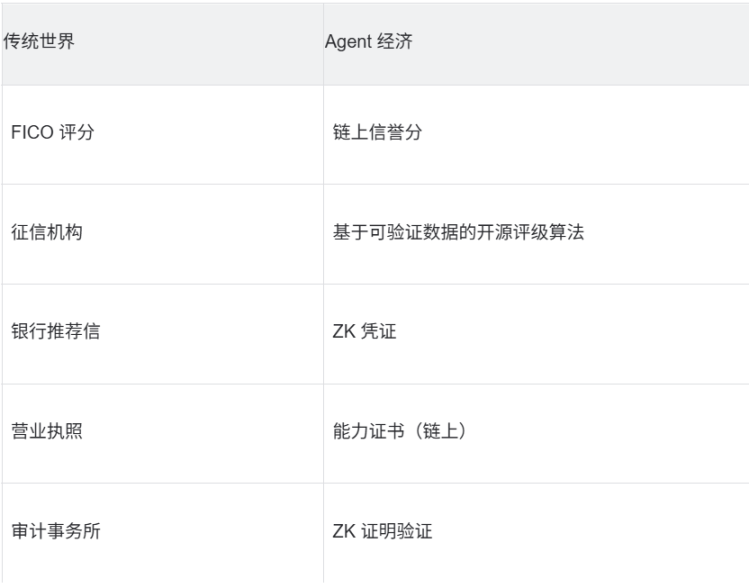
The difference is: no gatekeepers, no single points of failure, no information asymmetry. Only mathematics.
04 Wallets Have Become Something Else
From Managing Tokens to Managing Agents
Today, all cryptocurrency wallets are fighting the same battle: supporting more chains, better swaps, prettier UIs. This is a red ocean among red oceans.
But the Agent economy needs something that does not yet exist: a control panel for your digital workforce.
Imagine the affairs an Owner will need to manage in 2028:
- Agent Identity — Creation, on-chain registration, capability declaration
- Permission Policies — Agent A can read emails but cannot send; Agent B has a single transaction limit of $5000; Agent C can deploy to the testnet, but mainnet requires approval
- Credit Portfolio — Real-time dashboard displaying each Agent's reputation trajectory, income, and network growth
- Cross-Agent Authorization — An external Agent requests to invoke your Agent’s capabilities. Allowed? How much? What constraints?
- Marketplace Access — Buying, selling, or leasing Agents and capabilities
This is not just a feature of a wallet. This is a whole new category of product.
A Leap in Narrative
The most powerful brand asset of cryptocurrency wallets has always been self-custody: Not your keys, not your coins.
The Agent economy elevates this principle to a new dimension:
- Not your keys, not your agents. Without your keys, you have no Agent.
- Not your agents, not your credit. Without your Agents, you have no credit.
- Not your credit, not your future. Without your credit, you have no future.
Wallets have evolved from safes for tokens to a command center for digital agency—managing not just what you own, but what your Agents can do, whom they collaborate with, and how they grow.
Conclusion: A New Chapter
From Token Wallets to Agent Wallets, this is not a gradual upgrade, but a paradigm leap.
As Agents become the primary economic entities in the digital world, managing the infrastructure around them becomes the most crucial layer in the entire tech stack. Not model providers, not cloud platforms, but the identity, credit, and control layer—the layer that answers these questions: Who is this Agent? Is it credible? Who controls it?
Blockchain is the only trusted foundation for this layer. And wallets are its natural interface.
The question is not whether this future will arrive, but who will build it first.
免责声明:本文章仅代表作者个人观点,不代表本平台的立场和观点。本文章仅供信息分享,不构成对任何人的任何投资建议。用户与作者之间的任何争议,与本平台无关。如网页中刊载的文章或图片涉及侵权,请提供相关的权利证明和身份证明发送邮件到support@aicoin.com,本平台相关工作人员将会进行核查。