Just as the U.S. Securities and Exchange Commission (SEC) was still caught up in discussions on how to "regulate" the cryptocurrency industry, a seemingly impossible settlement quietly came to fruition. On March 5th local time, Tron founder Justin Sun proudly announced on social media that the SEC had officially dismissed all charges against him and all of his companies.
This lawsuit, which began in 2023, had placed Justin Sun on the edge of a cliff with charges of “fraud,” “market manipulation,” and other serious felonies. However, two years later, the plot not only reversed but also seemed somewhat dramatic — the SEC not only withdrew the lawsuit but did so in a “biased” manner, meaning that in the future there would be no chance of even "rehashing" the opportunity.
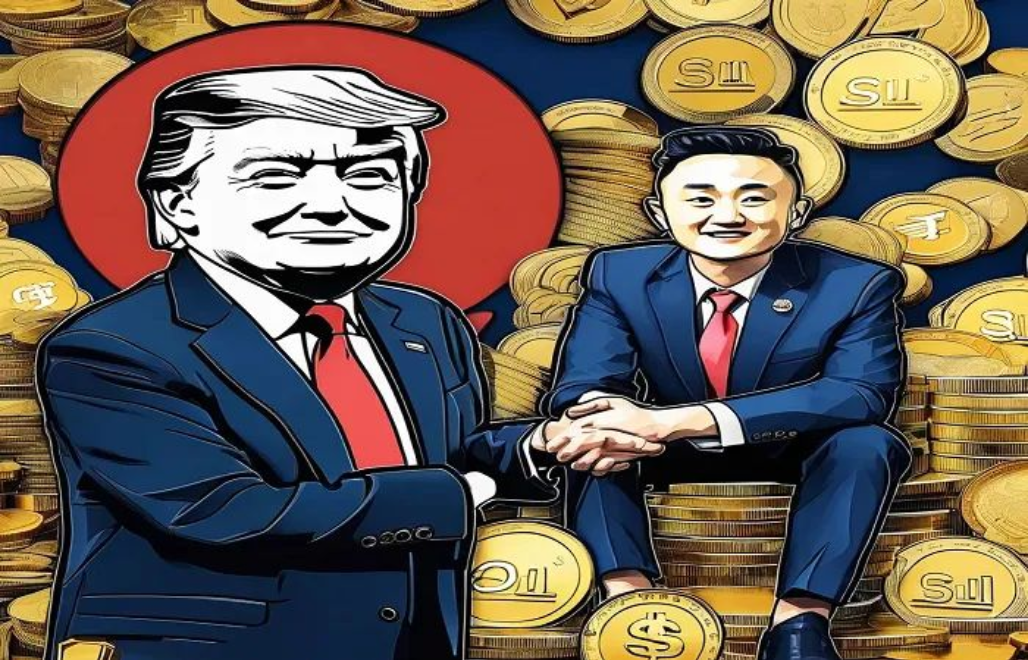
If you think this is just another routine operation of "spending money to extinguish disasters" in the crypto circle, you may have underestimated Justin Sun's ambition. Behind this victory is a subtle yet clear chain of interests: from Trump's campaign opponents, to the Trump's family's "guest of honor," and now to the "settlement target" of the SEC, Justin Sun has leveraged a textbook-level "political investment" to pry open a door leading to a safe zone for himself.
1. From "Defendant" to "Advisor": The Man Who Received a Watch from Trump
The turning point of the story did not happen in court but at Trump's golf club in Northern Virginia.
● In May 2025, a private dinner open only to the "top holders of the Trump token (TRUMP)" was held here. To gain entry, one had to prove oneself as the winner of this "pay-to-win game." And in this lineup of wealthy individuals, Justin Sun undoubtedly took the lead — he spent nearly $19 million to purchase over 1.43 million TRUMP tokens, becoming the largest holder of the token in the world.
● At this dinner, Justin Sun not only spoke but also received a rather "valuable" souvenir — a $100,000 Trump tourbillon watch. Trump even told him: "Everyone here is an early adopter, our young team is destined to achieve great things."
● From this moment on, Justin Sun’s identity has quietly transformed. He is no longer the "Brother Sun" marketing by riding on trending topics on Twitter, but an indispensable "core partner" in the Trump family crypto empire.
● This close relationship did not form overnight. As early as November 2024, Justin Sun had invested $30 million through Tron DAO into a crypto project supported by the Trump family, World Liberty Financial (WLFI), becoming the largest investor in the project. By the end of 2024, he was formally appointed as a project advisor for WLFI, providing so-called "insights and expertise" for a project born with a "political key."
2. USD1's "Tron Choice": When Political Resources Meet Business Closure
If buying tokens is a "demonstration of loyalty," then true deep binding is reflected in the deep integration of business.
● In June 2025, World Liberty Financial officially announced that a stablecoin pegged to the U.S. dollar, USD1, would be issued on Justin Sun's Tron blockchain. This is not a simple technical choice but a signal: the Trump family not only recognizes Justin Sun's money but also acknowledges his "standing in the community."
● It should be noted that the Tron network is already the largest issuance network for USDT, carrying over 50% of USDT circulation. For a nascent stablecoin like USD1, wanting to capture market share in a short period, hugging the "thigh" of Tron is undoubtedly the best shortcut.
● When Justin Sun met with Eric Trump, Trump's second son, in Dubai, he proclaimed: "The integration of USD1 will inject new vitality into the Tron ecosystem, allowing global users to easily participate in the global financial system via their mobile phones." To show his determination, he invested heavily and announced an additional $100 million investment in early 2026 to further support the TRUMP token, vowing to take it to the height of a "global brand."
● Thus, the relationship between Justin Sun and the Trump family has evolved from a simple transactional relationship to a strategic alliance of interest binding.
3. SEC's "Emergency Brake": Is it Judicial Fairness or Political Intervention?
Just as Justin Sun was getting closer to the Trump family, a regulatory earthquake was occurring in Washington across the ocean.
● In 2023, under the leadership of then-SEC Chairman Gary Gensler, the SEC launched a fierce assault against Justin Sun. The indictment clearly stated: Justin Sun and his companies conducted "wash trading" through market manipulation, performing over 600,000 virtual transactions within a short period, artificially inflating the price of TRX tokens and deceiving investors.
● According to the regulatory trend at the time, even if Justin Sun did not "go in," he would still face significant penalties. However, with Trump's return to the White House in 2025 and the change in SEC leadership, the tide changed completely. After the appointment of new SEC Chairman Paul Atkins, the enforcement attitude towards the crypto industry was significantly adjusted, not only rejecting lawsuits against industry giants like Binance, Ripple, and Coinbase, but also abruptly halting the case against Justin Sun.
● In 2025, the SEC suddenly filed a motion to suspend the lawsuit against Justin Sun, citing it was "considering potential solutions." By March 2026, the truth was revealed: Justin Sun only needed to pay a $10 million civil fine in exchange for the SEC's "biased" dismissal of all remaining charges.
● This result instantly triggered an explosion in Washington's political circle. U.S. Congresswoman Maxine Waters publicly questioned SEC Chairman Atkins at a hearing: "While you were exploring a settlement, Justin Sun was actively building relationships with Trump's family business circle, is that just a coincidence?" She pointed out the obvious suspicion of "political intervention" behind the shift in the SEC's enforcement attitude.
● Faced with pressing inquiries, Atkins could only evade with the reason of "unable to publicly discuss individual enforcement cases." But it's clear to discerning eyes that this "stalling tactic" only corroborated outside speculation: when the investigated party became a "close ally" of the presidential family, the investigation itself had already lost its original intensity.
4. The Deep Logic Behind the Settlement: An Expensive "Political Insurance"
● Looking back at Justin Sun's operations over the past two years, you will find that this is by no means a passive "laying down to win," but rather a meticulously planned crisis management and political gamble. While most people are still mocking him as someone who “is foolish with too much money” for his purchases of Buffett's lunch and banana art, Justin Sun has already stepped beyond pure "marketing thinking" and entered into a higher-level "power game."
● The funds he invested in Trump family projects, whether it is the $30 million WLFI investment or the $19 million TRUMP token purchase, are essentially expensive "political insurance fees." This money not only bought him a ticket to Trump's private dinner but also bought a "green card" to a policy safe haven.
● As criticized by the policy director of the financial reform organization Better Markets: "Considering the scale and audacity of the fraud allegations against Justin Sun, the SEC's settlement is merely a face-saving measure."
● In other words, although the SEC preserved its "victory" face, from the outside, this seemed more like a naked exchange of interests. Justin Sun, through supporting the Trump family's business landscape, indirectly resolved his greatest survival crisis faced in the U.S.
5. The Aftermath: The "Double Standards" of Crypto Regulation
● Justin Sun's "escape from disaster" undoubtedly holds benchmark significance for the entire cryptocurrency industry.
● It sends a dangerous signal to the market: in today's American political environment, compliance depends not only on the legal text but also on how close you are to the core of power. Those smaller projects that cannot afford millions of dollars "tickets" and do not have the opportunity to dine with the President still face significant regulatory pressures.
● Meanwhile, the Trump family's expansion in the crypto field continues. WLFI has not only issued a stablecoin but also applied for a national trust bank license from the U.S. Office of the Comptroller of the Currency, attempting to build a financial empire that integrates issuance, custody, and exchanges. Justin Sun, as an "advisor" and largest external investor in this empire, has deeply bound his business landscape with the U.S. political cycle.
For Justin Sun, the spring of March 2026 is undoubtedly warm. The SEC's decision to withdraw the lawsuit marks the end of a three-year regulatory nightmare for him.
However, the price of this victory is not just the $10 million fine, but rather the result of a series of complex and expensive "political investments." When he raised that tourbillon watch in Trump's golf club, the deal between power and capital was already written in stone.
As for whether this transaction has shaken the foundation of American justice and regulation, it may no longer be a concern for Justin Sun. After all, for this "king of crypto marketing," surviving and thriving is the hard truth.
Join our community, let's discuss and get stronger together!
Official Telegram community: https://t.me/aicoincn
AiCoin Chinese Twitter: https://x.com/AiCoinzh
OKX benefits group: https://aicoin.com/link/chat?cid=l61eM4owQ
Binance benefits group: https://aicoin.com/link/chat?cid=ynr7d1P6Z
免责声明:本文章仅代表作者个人观点,不代表本平台的立场和观点。本文章仅供信息分享,不构成对任何人的任何投资建议。用户与作者之间的任何争议,与本平台无关。如网页中刊载的文章或图片涉及侵权,请提供相关的权利证明和身份证明发送邮件到support@aicoin.com,本平台相关工作人员将会进行核查。


