Author: Amelia, DeniseI Biteye content team
Just after the Lantern Festival, the Tongyi Qianwen team is hit by a major upheaval among core personnel: Technical leader Lin Junyang has left, along with three other key figures: Post-training leader Yu Bowen, Qwen Code leader Hui Binyuan, and core contributors to Qwen3.5 & VL & Coder, Li Kaixin.
This is not an ordinary departure of a technical leader, but a systemic conflict regarding organizational structure, resource allocation, and open-source strategy. Biteye tries to restore the full picture of this personnel earthquake and raises a more fundamental question: How should large companies place their technical ideals in the AI era?
1. A Night of Bloodshed: Mass Departure of Core Members
Less than 24 hours after Qwen3.5, which was praised by Musk as having "incredible intelligence density," was released, Alibaba’s Tongyi Qianwen technical head Lin Junyang sent a brief farewell on X in the early hours:
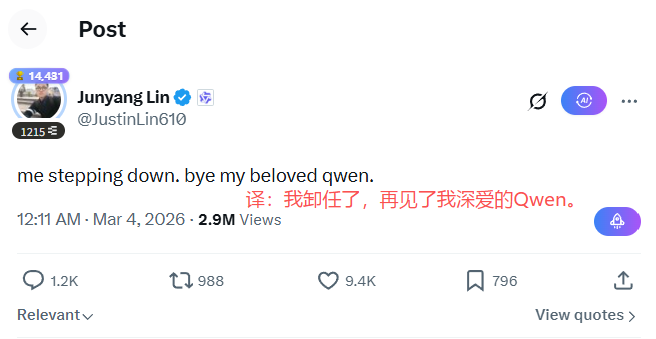
As of this writing, this post has received over 11,000 likes and more than 4.5 million views, with a comment section full of heartbreak.
Lin Junyang, Alibaba’s youngest P10-level tech talent at 32, has left.
Lin Junyang’s resume is a typical example of a new generation of AI talent in China.
Cross-industry background: Born in 1993, undergraduate degree in computer science from Peking University, but chose linguistics for his master's. Perhaps this experience, distinct from AI elites, gives him unique intuition about multimodal and semantic understanding.
Rapid rise at Alibaba: Joined DAMO Academy in 2019, leading the development of OFA and Chinese CLIP.
Leadership in Qwen: Appointed head of Tongyi Qianwen in 2022 and promoted to the youngest P10 in Alibaba history at the age of 32 in 2025.
Following him out are three others. Post-training leader Yu Bowen also left simultaneously. A few hours later, Qwen Code leader Hui Binyuan posted "me too" and changed his profile to former Qwen.
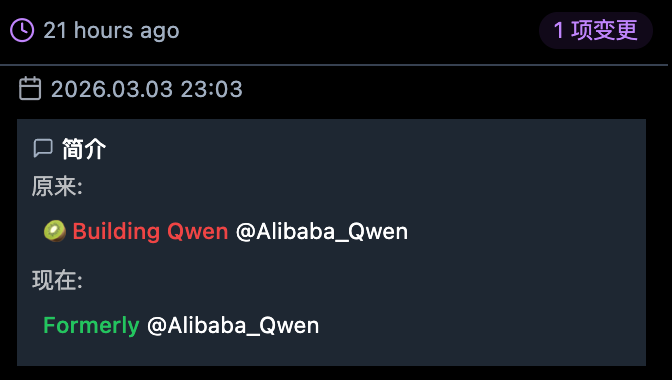
A few hours later, core contributor Kaixin Li of Qwen3.5 & VL & Coder also announced his departure and changed his Twitter profile to Pre Qwen.
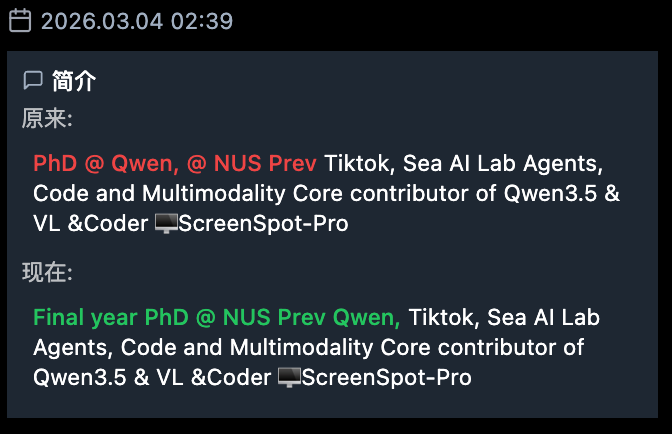
This star team, which has created over 1 billion downloads globally, with more than 200,000 derivative models, and consistently ranks at the top of the open-source large model list, seems to be disintegrating at a visible speed.
2. The Dilemma of Reasons: The Game Between Individuals and Big Companies in the AI Era
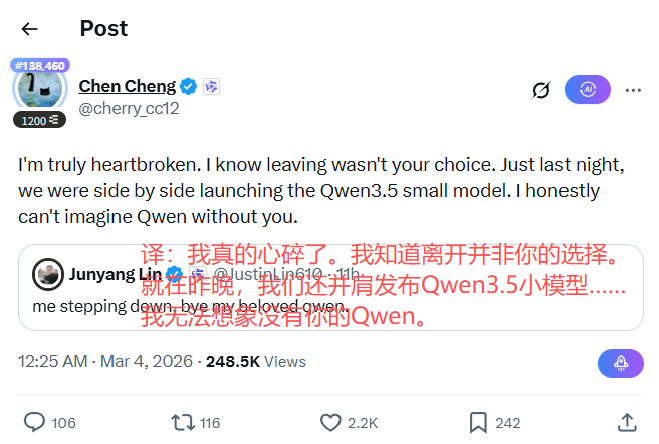
A tweet by Qwen team member @cherry_cc12 unveiled a glimpse of this turmoil. As internal meeting information gradually leaked, we pieced together the full picture of this mass departure.
2.1 Organizational Dilemma: From Special Forces to Assembly Line
The editor speculates that the original Qwen lab should have been a spearhead team of tech geeks, all of whom were special forces and multi-talented. Lin Junyang acted like a strengthened company commander, leading everyone into battle. However, it is rumored that the Qwen team plans to split from a "vertically integrated" system covering different training processes and modalities into separate horizontal division teams for pre-training, post-training, text, and multimodal tasks.
This is actually the approach of traditional internet companies. I guess Alibaba thinks this way: the early Qwen lab was an internally incubated project, and after a year, things have changed; I want to start applying the incubated projects on a large scale. How to improve efficiency? Break down each link into SOPs so that each link can improve efficiency, thereby increasing overall efficiency.
This thinking is surely outdated; if you look next door at OpenClaw, which has made quite an uproar, you'll realize that the game in the AI era has truly changed.
2.2 Resource Dilemma: Is there a resource or not?
On one side, there is "Qwen is the most important thing for the company," while on the other, the boss says "resources are hard to satisfy everyone." This contradictory statement resembles a leader who paints a rosy picture but never delivers. What does "Qwen is the highest priority" mean? What does "the Chinese CEO has done his utmost" mean? What does it mean that resources are being bottlenecked, attributing it to "information transmission processes"?
Who are they fooling? There are only two possibilities here.
First: The top management does not actually value Qwen that much; their engagement with Qwen is merely an investment motivated by AI FOMO.
Second: The top management is divided into two factions, one that values it and one that does not; those who do not value it start to impose various bottlenecks.
In summary, it is clear that some top-level executives only pay lip service to their commitment. Thus, the so-called highest-priority product line is unable to ensure even basic resource support.
2.3 The Struggle Between Individuals and Platforms: Who Can Override the Organization?
Among all the information that leaked, the most heart-wrenching is the HR remark: "We cannot place anyone on a pedestal; the company cannot accept irrational demands at all costs to retain someone."
Are they right? AI companies have been fiercely competing for talent: In 2024, the former technical soul of Qwen, Zhou Chang, left to start his own business and later quietly joined the ByteDance Seed team, where ByteDance offered a "sky-high offer" of 4-2 level + eight-digit annual salary. In 2025, Meta offered a staggering $200 million compensation package to poach Pang Ruoming from Apple, which included not only substantial stock but also milestones directly linked to technical breakthroughs. Doesn’t this HR conduct competitor research?
Are they wrong? This statement seems to contain the essence of thousands of years of Chinese philosophy: individuals cannot override the organization.
2.4 Political Struggle: Whose Side Are You On?
Internally, it was said "political factors were never considered," but it was also stated "we need to consider what position is most efficient for Zhou Hao." This is rather interesting; it seems to imply that Zhou Hao must be placed within this organization, but the question is where.
Those who have watched palace intrigue dramas know that it is not important who can get things done; it is more important who is obedient. A dose of workplace poison: for most professional managers, whether a person can actually solve a problem, and whether that person threatens my position, are equally weighted concerns. In a startup, you can soar high; in a big company, the safety of higher-ups may be more crucial than your abilities.
Think about it; take your time.
2.5 The Mismatch Between Open Source and Commercial Interests
The deeper tension arises from the misalignment between the paths of open source and commerce. Qwen has established a tremendous reputation in the global open-source community—with high download numbers, numerous derivative models, and significant international recognition.
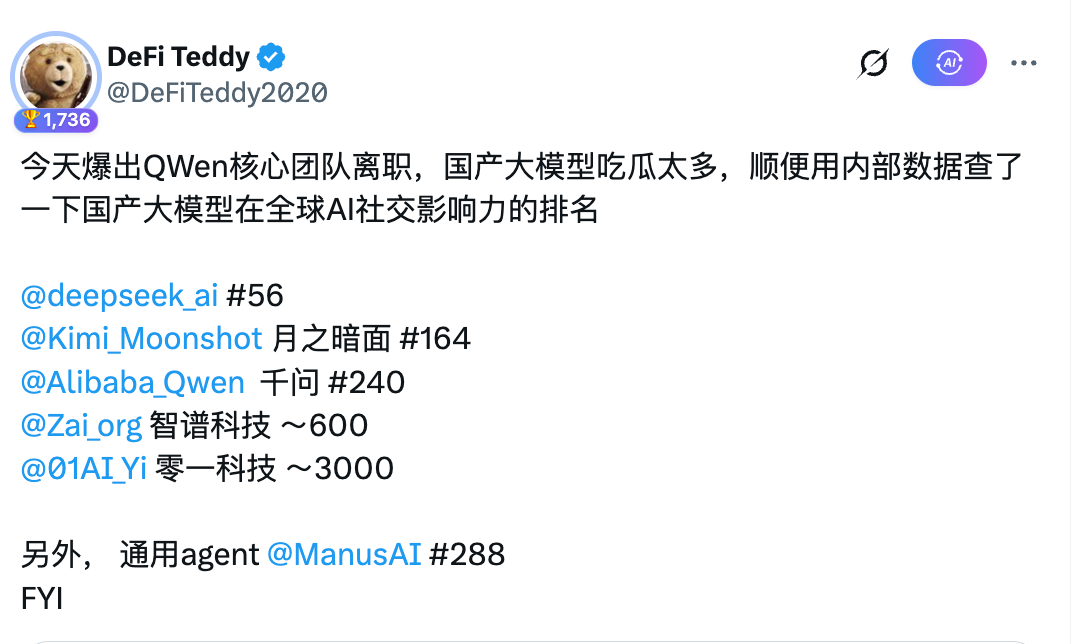
But what open source brings is not users or revenue. Now that Qwen has grown large, the company will naturally begin to question, "I've invested so much; you should give something back, right?"
3. Reflection: The AI Predicament of Large Companies
Honestly, it is not surprising that this incident happened at Alibaba. Have you all seen "The Annual Meeting Can't Be Stopped"? It is a script based on Alibaba. It has a classic line: "If you can't solve the problem, solve the person who raised it."
Alibaba's logic should be: No matter who is missing, Qwen will continue to run.
That line, "What we are doing is grand; over 100 people are definitely not enough; we need to expand," feels more like Alibaba not understanding AI; perhaps AI is also struggling to comprehend Alibaba. The neighbors in Web3 are also amused.
The internet era empowers individuals, pursuing standardized, procedural, and replicable organizational structures. Individuals are attached to platforms, and platforms define the rules.
The AI era is evolving into one where super individuals wield stronger bargaining power, even redefining platforms. AI innovation relies on small teams, high density, and rapid iteration in a "special forces model."
When large companies try to manage the creativity of the AI era with the organizational logic of the internet era, conflict is almost inevitable. The chaotic struggle within organizations is actually a collective confusion about how to manage geniuses.
When HR retorts to employees, "What price do you think you are worth?" those who can truly drive the future have long since voted with their feet.
免责声明:本文章仅代表作者个人观点,不代表本平台的立场和观点。本文章仅供信息分享,不构成对任何人的任何投资建议。用户与作者之间的任何争议,与本平台无关。如网页中刊载的文章或图片涉及侵权,请提供相关的权利证明和身份证明发送邮件到support@aicoin.com,本平台相关工作人员将会进行核查。


