Written by: Joel John, Siddharth, Saurabh Deshpande
Translated by: Saoirse, Foresight News
The fear and greed index of the crypto market has fallen to its historical low. But at the same time, the profitability of the industry has reached unprecedented heights.
Since 2018, according to DeFiLlama statistics, crypto-native protocols have generated a total of $74.8 billion in transaction fees. Nearly half — $31.4 billion — was created in the 18 months from January 2024 to June 2025.
Why, in an industry experiencing its best quarters in eight years, are people still filled with fear?
In the past two months, 12 projects have ceased operations: Entropy Protocol, Milkyway Protocol, Nifty Gateway, Rodeo, Forgotten Runiverse, Slingshot, Polynomial, Zerolend, Grix Finance, Parsec Finance, Angle Protocol, Step Finance. These are products created by passionate entrepreneurs we respect, which have endured for many years.
OKX, Mantra, Polygon Labs, Gemini, Binance have also conducted layoffs. Attendance at conferences is significantly diminished, venture capital is shifting towards AI, and developers are flocking to AI. The pessimistic sentiment in the industry is real. "If you're in crypto, quickly switch to AI," has become the mainstream voice.
But should you really switch? This question has occupied our thoughts over the past few weeks.
When a new technology emerges, the market initially gives it a high premium due to its novelty and grand vision. In the 19th century, nearly 6% of UK GDP was invested in railway stocks. By 2026, capital expenditures of mega cloud providers will account for 2% of US GDP.
But when reality sets in, technology valuations revert to rationality.
What truly matters is: can this industry prove itself useful during the return to normalcy?
In this article, I will deconstruct:
- How the revenue of the crypto industry has evolved;
- How strong the generated capital stickiness is;
- What the moat of this industry really is.
Ledger Study: A Major Shift in Revenue Patterns
Since the industry was born, crypto-native businesses have been profitable.
Exchanges like Bitmex, Binance, and Coinbase have long been raking in significant profits. However, they are centralized, held by a few, and their revenues are not disclosed.
DeFi-native protocols like Uniswap and Aave changed all that. You can verify every day how much money the protocols have actually earned. The valuation of tokens should reflect the economic activity supported by these fundamental components.
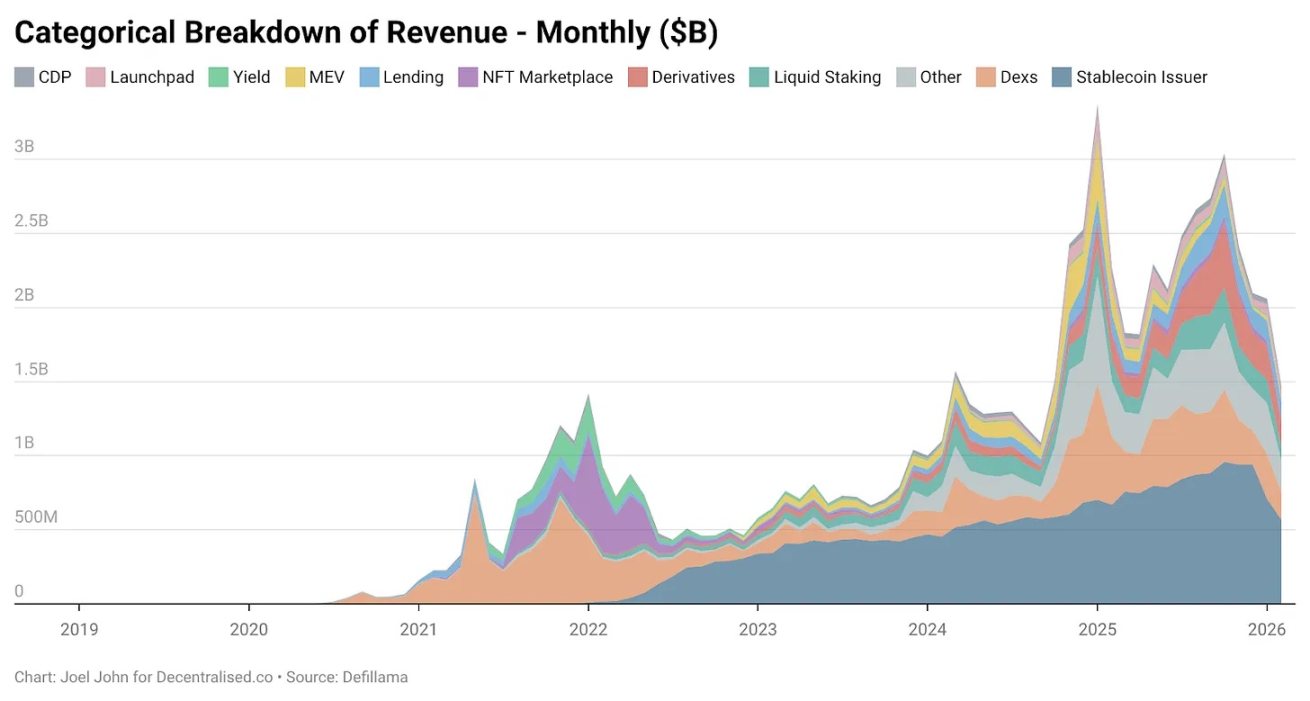
Until 2022, decentralized exchanges accounted for 28.4% of total industry revenue, generating $2.27 billion that year. The lending sector was also highly concentrated: Aave and Compound captured 82% of lending fees. At that time, everyone believed: there are leading players, but long-tail protocols also have opportunities to grow. The technology itself was novel enough to support high valuations.
Then came the phase of crypto expanding to the masses.
NFTs once represented a hopeful vision: cultural value priced on-chain. Celebrities changed their Twitter avatars, and ordinary people thought this would lead to mass adoption. OpenSea generated $1.55 billion in revenue that year, accounting for 71.7% of the NFT market.
Looking back, its $13 billion valuation does not seem unreasonable — it had the potential to become a long-term monopolist.
But fate and the market had other plans.
By 2025, the revenue share of NFTs was less than 1%. We experienced a bubble similar to “Beanie Babies,” but in the end, we didn't even have any physical memorabilia left.
(Note: Beanie Babies are a series of plush toys launched by Ty Inc. (founded by Ty Warner) in 1993, which became a prominent collectible craze and speculative bubble in the mid to late 1990s in America.)
In contrast, decentralized exchange revenues are growing, but valuations have plummeted. Last year, DEX generated $5.03 billion in fees, while lending platforms made $1.65 billion. Together, they accounted for 22.9% of total fees, well below 33.1% in 2022. Their economic activity has shrunk in proportion to a larger pie, and their valuations have significantly decreased.
So what is growing?
How has the crypto-native business model evolved from 2022 to the present? The answer lies in the data:
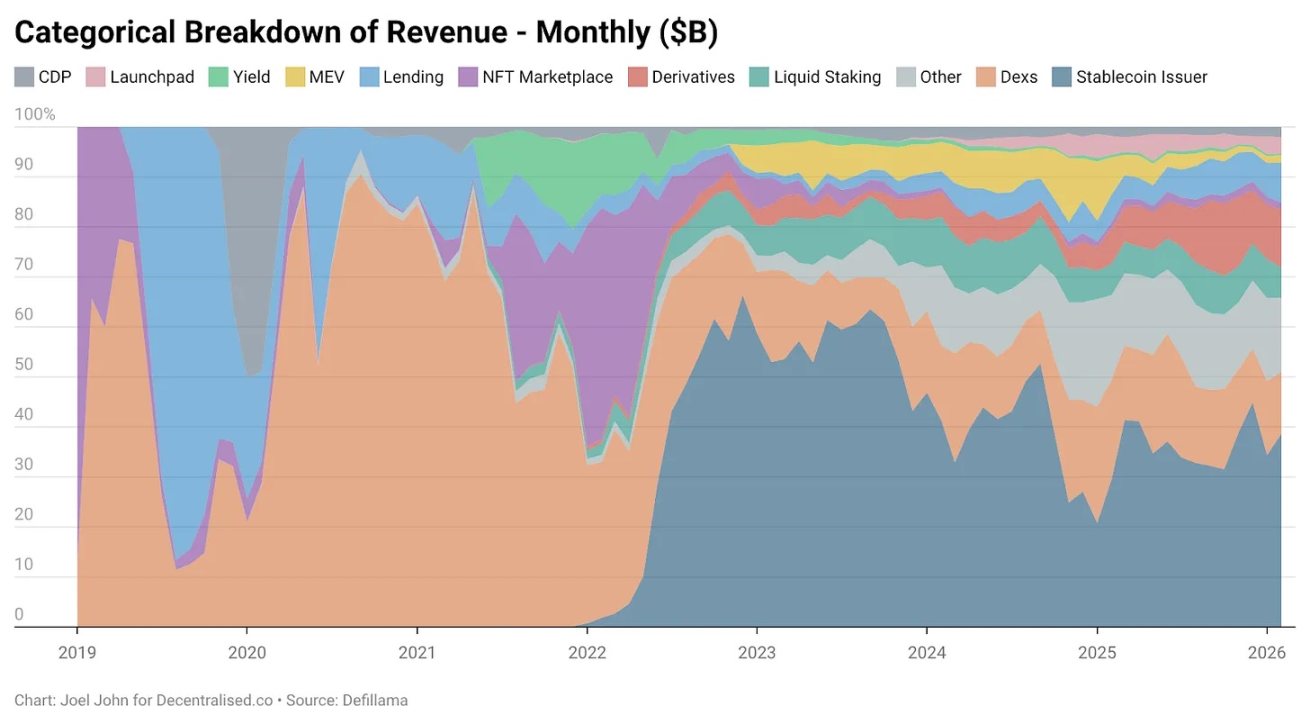
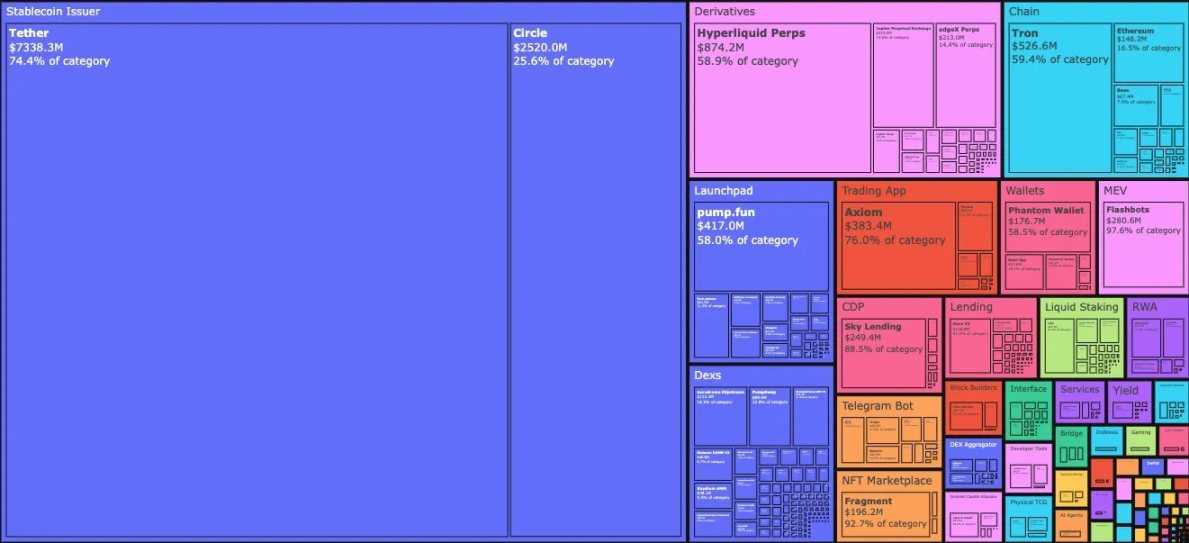
By January 2026, stablecoin issuers Tether and Circle took home 34.3% of the total fees in the industry. In other words: for every dollar the industry earns, 34 cents goes into the pockets of these two companies. Their revenue doubled from $4.95 billion at the beginning of 2023 to $9.89 billion in 2025, almost entirely from U.S. Treasury yield.
This is a financial product on par with banks, yet it has grown at the speed of a startup. Tether's revenue is nearly three times that of Circle.
Their rise comes from two forces:
- Demand
The Global South has consistently needed tools to hedge local inflation and transfer funds freely. The dollar, even as a digital dollar, fills this gap — something local currencies cannot do. Capital flight is a necessity, not an added feature.
- Cost Structure
Blockchain handles the operational aspects of the stablecoin business. Unlike traditional banks and fintech companies, Tether and Circle do not need to proportionately hire as issuance scales up. Issuing an additional $1 billion on-chain or transferring $100 billion between addresses comes with almost zero marginal cost.
Demand is strong, costs are kept extremely low. The combination makes stablecoin issuance one of the capital-efficient businesses in financial history.
The moat of stablecoins lies in: liquidity, compliance, time dividend. Few issuers can survive multiple cycles.
Tether and Circle take nearly 99% of the stablecoin issuance revenue. Why? Because they got in early. The network effects brought by multiple exchanges connecting are a legitimacy that technology alone cannot achieve. Tether originally launched on the Omni sidechain, slowly and clumsily, but it became easily accessible at OTC desks and exchanges.
This is a distribution barrier, not a technological one. This is a moat that crypto-native entrepreneurs find hard to replicate relying solely on code.
New Growth Engine: Explosion of Trading Applications
We mentioned in previous articles: crypto is essentially a trading economy. But at that time, we did not expect that products based on trading bots and interfaces on Telegram would grow so quickly.
In January 2025, these two sectors generated $575 million in fees in just one month. The reason is simple: this is what users truly want.
Meme coin trading and perpetual contract exchanges allow users to profit quickly. To pursue high returns, they are willing to pay high fees.
From 2022 to 2025, this sector skyrocketed from accounting for 1% of total revenue to over 15%.
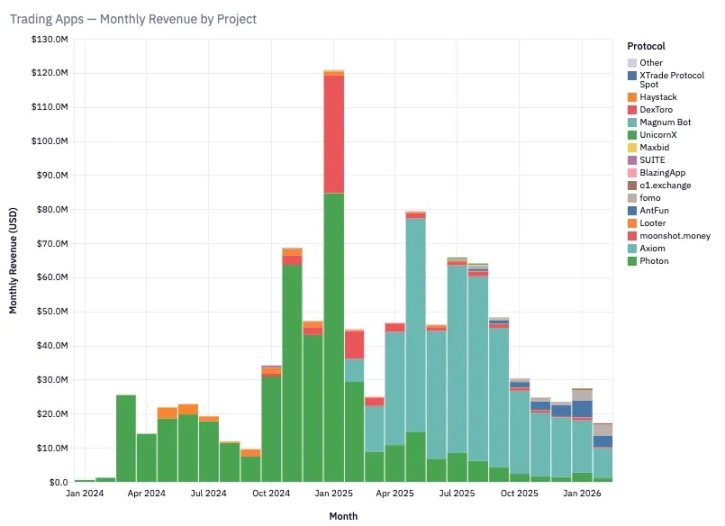
Products like TryFomo and Moonshot focus on end users and have made millions. The technology is not complex; the key is: aggregating and packaging crypto-native foundational components to create a better user experience. Once tools like Privy mature, developers no longer need to incentivize liquidity or worry about wallet management. The foundational components we were excited about in 2022 have now matured. Applications like BullX and Photon are built upon them.
From January 2024 to February 2026, this sector generated $1.93 billion in fees. However, meme assets have a fatal weakness: they are lightweight applications, with strong seasonality.
Does this sound familiar?
NFTs and Web3 games also experienced a similar explosion, followed by collapse. This cyclicality is both a bug and a feature of the industry.
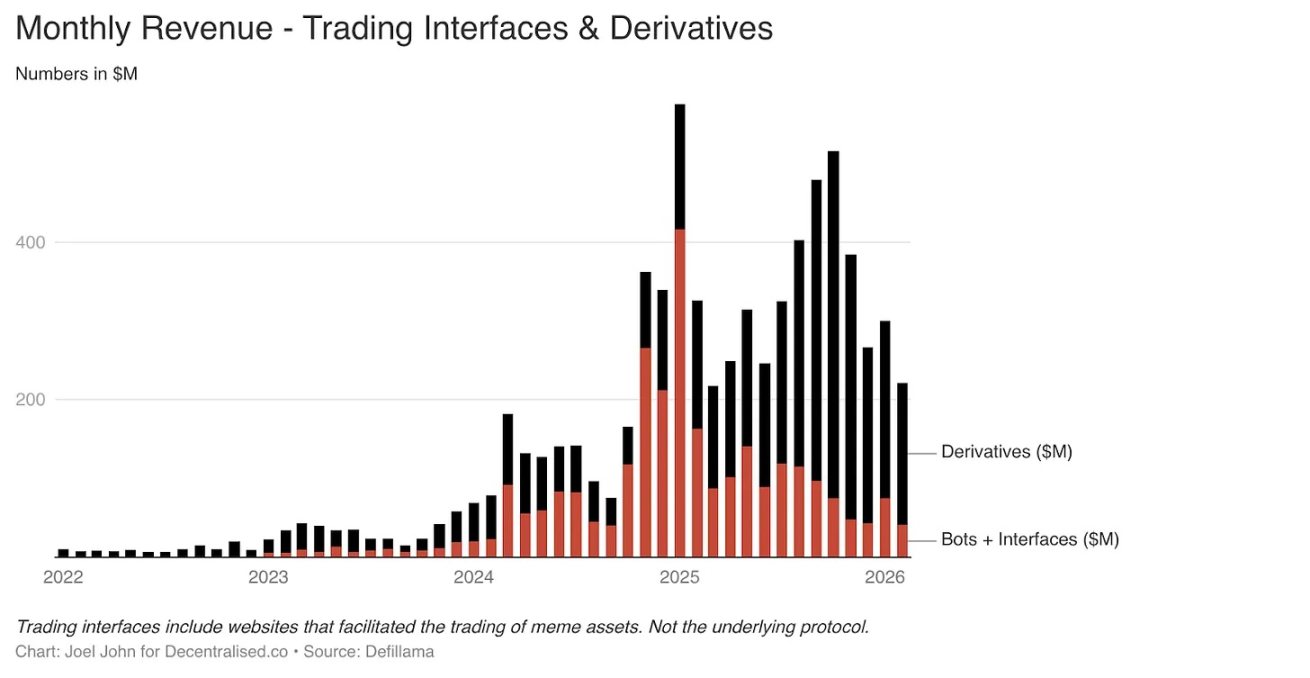
Perpetual contract exchanges (and later prediction markets) represent another new direction with more long-term potential.
PumpFun democratized asset issuance through meme coins, but the game was not fair. Eventually, the market woke up: meme coins will die.
The dream of becoming rich overnight by buying a humorous token shattered. People do not want to manage a bunch of random tokens; they want risk exposure.
Perpetual contracts provide that.
You can trade Bitcoin, Solana, or Ethereum with high leverage. Market makers and traders looking for alternatives to centralized channels flood in. The core of this category is liquidity.
Hyperliquid became a leader because its order book depth is comparable to centralized exchanges. Without this peer-to-peer experience, users have no reason to switch. Over the past three years, Hyperliquid and Jupiter have captured most of the fees in this sector.
Perpetual contract exchanges and trading platforms have torn away the shameful veil of the crypto industry: the real way to make money is to extract small fees from high-frequency trading. Meme trading platforms and perpetual exchanges are "dopamine machines" that package and sell risks. Part of this will mature into core financial foundational components — in the future, globally, trading goods, stocks, and digital assets will be possible on weekends as well.
Blockchain-native applications have replicated what Robinhood and Binance already offered: risk channels.
Hungry Fat Protocols: Valuations of Public Chains and DeFi Plummet
Up until now, I have not mentioned underlying public chains. Because their stories are completely different: they are victims of novelty premiums and are now trending towards discount.
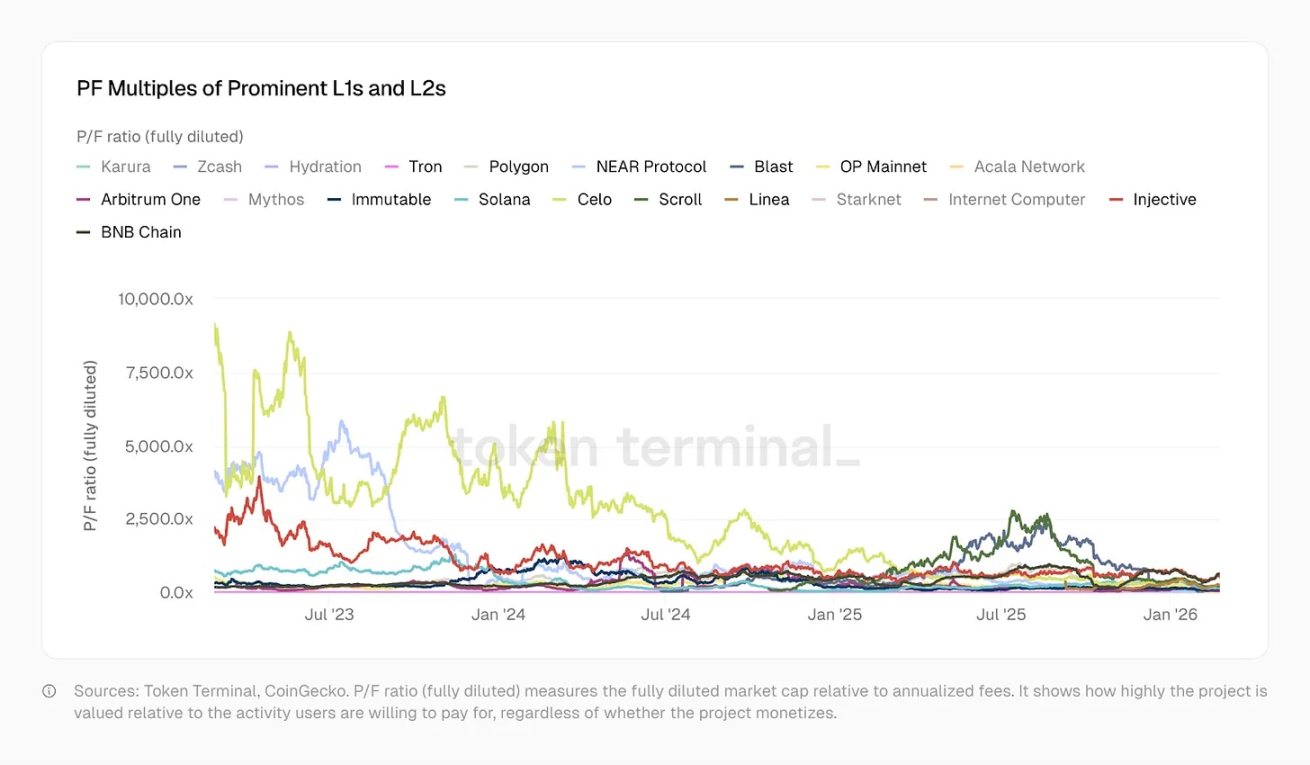
In January 2023:
- Optimism fee multiples (PF) were 465 times
- Solana 706 times
- Arbitrum and BNB about 206 times
Today:
- Solana 138 times
- Arbitrum 62 times
- OP 37 times
- Polygon down to only 20 times, close to traditional fintech companies
- Tron, supporting the stablecoin ecosystem, also only 10.2 times
These public chains have supported more complex products in recent years, with more users, better liquidity, and richer financial applications. But their fee multiples have dropped significantly, reflecting a shift in market attitudes.
Historically, Layer1 and Layer2 have had extremely high valuation premiums compared to independent infrastructure. If this premium had been used well, it could have created new economies and funded developers to build truly useful applications. However, open-source + tokenization is too easy, leading to fifty identical projects across thirty public chains, with very poor interoperability.
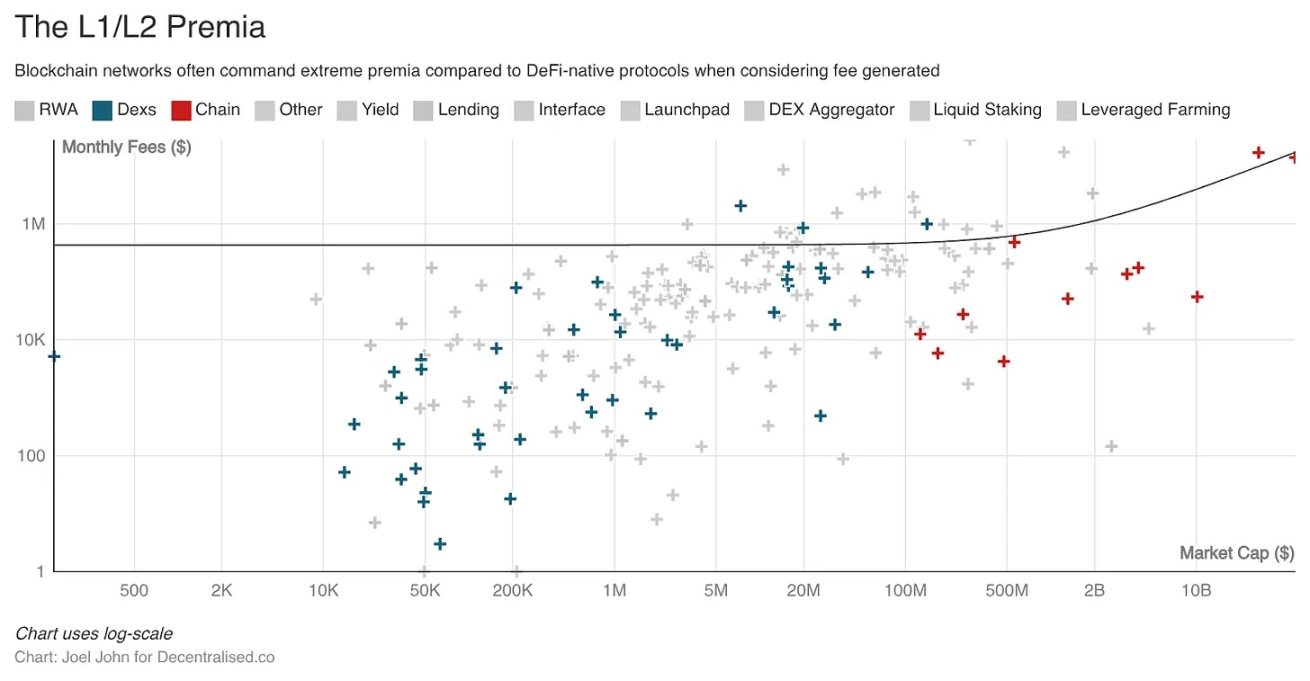
The fate of DeFi foundational components is even worse.
With too many choices for investors and the novelty fading, even with increased economic activity, valuations can still be halved.
Kamino, Euler, Fluid, Meteora, PumpSwap have emerged, with fee multiples far below their 2022 levels. Some DEX fee multiples have even dropped to 1 time.
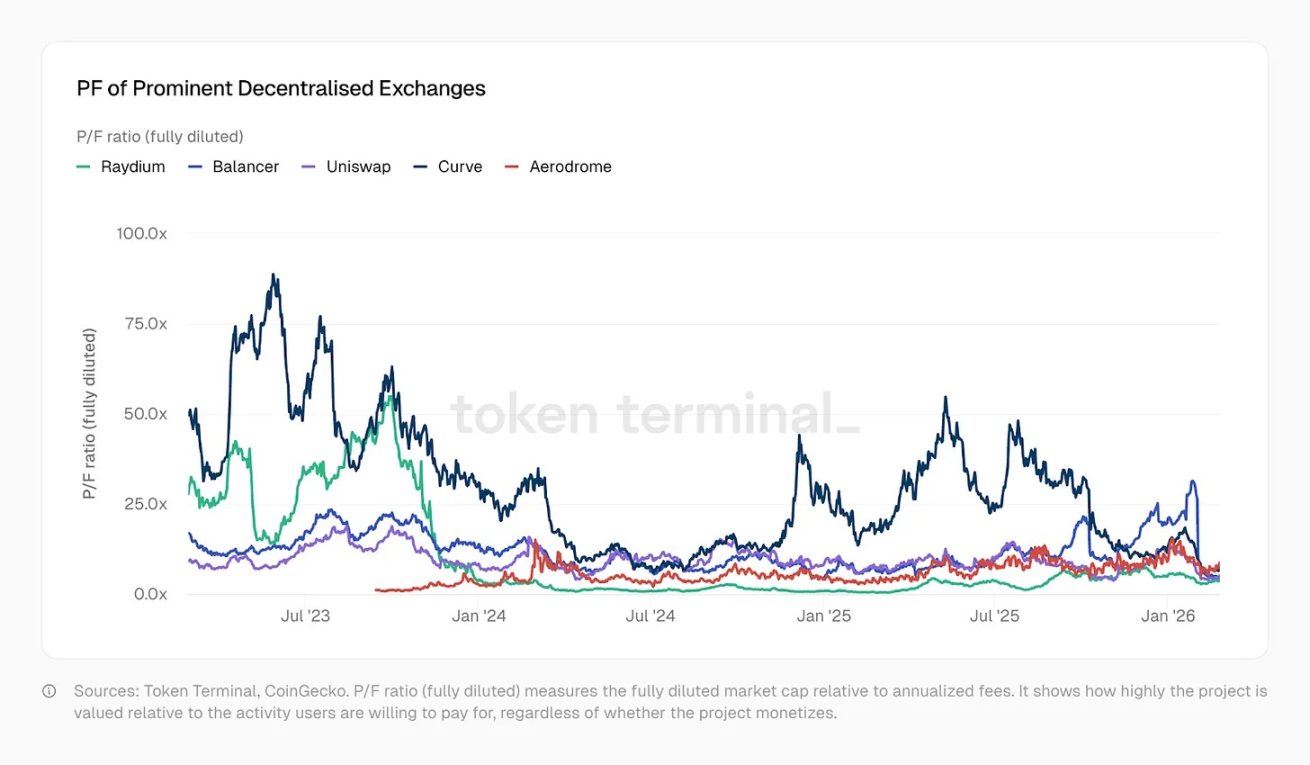
In other words, the market values them lower than the future year’s potential fee generation.
A strange paradox has emerged: the valuations of underlying protocols (DeFi components, public chains) are declining, but applications built on them are earning more money in a shorter time.
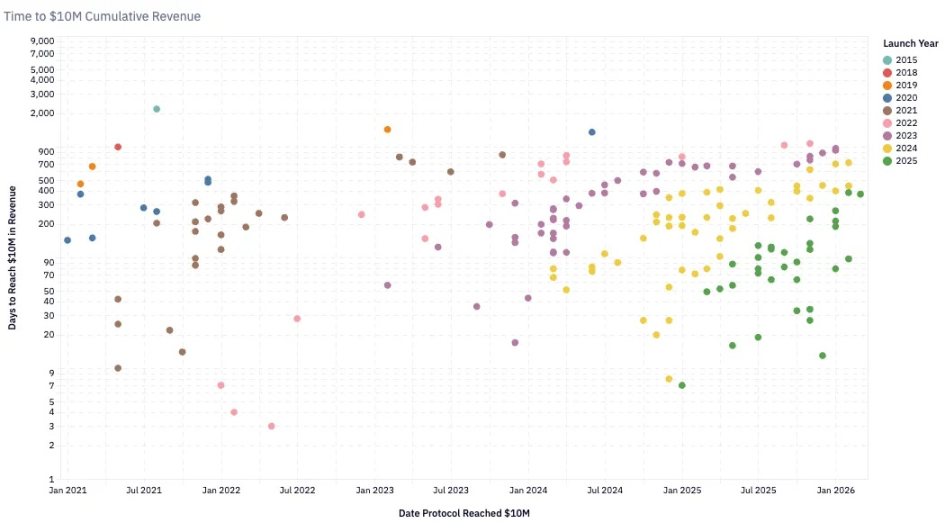
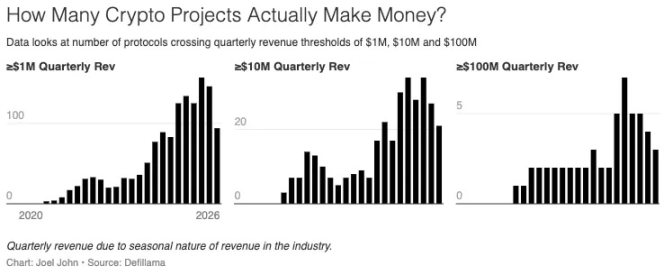
The number of teams earning over $1 million in a single quarter is steadily increasing, now exceeding 100.
In 2020, it took a protocol 24 months to reach an annual revenue of $10 million, which was considered fast. By 2024, it only takes about 6 months. Pump.Fun, launched in early 2024, reached $10 million in revenue in just about two months, setting a record.
This acceleration reflects the maturation of underlying infrastructure (faster and cheaper), and also reflects the expanding funds pursuing yield and entertainment on-chain.
For developers and entrepreneurs, the facts are clear:
- There are nearly 900 protocols making money today;
- Everyone is fighting for median income, with shares getting smaller, but the number of teams making money overall is increasing;
- The monthly income median has dropped to $13,000.
The Three Moats of the Crypto Industry
Crypto-native businesses have three types of moats:
- First-Mover Advantage
The early network effects of Tether and Circle are extremely difficult to replicate. They have navigated multiple cycles, forming a dual oligopoly. Their businesses are non-tokenized and highly financialized. Tether is a centralized entity, with revenue mainly coming from U.S. Treasuries.
- Liquidity Moat
Aave has maintained deep liquidity across cycles in an industry where capital typically seeks profit. Hyperliquid is also trying to replicate this, but it needs time to validate. These protocols return funds to liquidity providers and optimize token governance.
- Distribution Moat
Seasonal applications like meme coin trading platforms rely on turnover and user demand. Web3 games and NFTs fall into this category as well. After AI boosts productivity, small, agile teams can launch consumer-facing products faster. The core competency shifts to the ability to acquire and retain users when the market is hot.
Products built on distribution barriers may be incredibly valuable but are exceptional rather than the norm. The value of traditional startups lies in replicable experiences, like Y Combinator. But crypto iterates too quickly for such experiences to take hold.
This is also why entrepreneurs struggle to replicate success in consumer-facing products.
The cyclical support that once helped projects explode may never return. This is not to say entrepreneurs shouldn’t act. Predictive markets and data service providers for smart economies may have excellent cash flow in the short term.
But it is crucial to understand: this is a high-turnover, short-term game, and not necessarily sustainable. The trap lies in blindly raising funds or clinging to a token that has long since lost its effectiveness after the hype fades.
Questioning Governance: The Soul-Searching of Token Value
In 1999, many tech stocks had price-to-sales ratios of 10-20 times. Akamai once reached 7434 times. By 2004, it fell to 8 times. A large number of companies saw their ratios drop from 30-50 times to below 10 times.
The dot-com bubble burst, resulting in the evaporation of trillions of dollars in speculative value. But many companies survived because their business was real.
Amazon fell 94%, later becoming one of the world’s most valuable companies. Crypto is experiencing the same valuation compression, but even faster.
In 2020, DeFi was still in its experimental phase, with total annual revenue of only $21 million, and the overall market price-to-sales ratio (P/S) was as high as 40400 times.
The market was filled with fantasies of "what the future will hold."
In 2021, the summer of DeFi turned revenue into real numbers, and the P/S plummeted to 338 times. Today, with annualized revenue of $18 billion, the P/S is about 170 times. In five years, it has compressed from 40400 times to 170 times.
But there is a key question:
Visa has a P/S ratio of about 18 times, and shareholders receive dividends, buybacks, and legal protections for their profit and governance rights. Aave has a P/S ratio of about 4 times, but token holders only have governance rights and only recently gained direct economic rights. Hyperliquid has used the rescue fund for buybacks, bringing HYPE holders closest to traditional equity holders. Aave also passed a $50 million annual buyback plan in 2025.
These are meaningful actions, but they are exceptions.
In the entire market, most protocols do not have mechanisms for returning value to token holders. Valuations may seem cheap, but the attached rights are much weaker than in traditional markets. These valuations hold because of the revenue scale and efficiency of this industry, which traditional businesses cannot compete with.
Protocols compressing crypto P/S ratios are not large organizations with thousands of people. They are small teams operating global financial infrastructure with nearly zero marginal costs and no physical footprint.
Breaking down the sectors provides clearer insights:
- Aave: P/S ~4 times
- Hyperliquid: P/S ~7 times
- This is no longer bubble valuation, and is even lower than traditional benchmarks:
- Coinbase: ~9 times
- CME: ~16 times
- Visa: ~15 times
Will Clemente said in our podcast: crypto is the purest form of capitalism. No other industry comes close to Tether’s level of profit per employee — Tether has about 125 employees and annual revenue of about $12.5 billion, resulting in an annual income per employee of $100 million.
For comparison:
- Nvidia: $5.2 million per employee
- Apple: $2.4 million per employee
- Google: $2 million per employee
The efficiency of Tether may be the highest in corporate history. Although the overall 170 times P/S looks crazy, the market is not irrational about truly profitable protocols — pricing is even equal to or below traditional financial infrastructure.

This leads to the next question: what is the use of tokens?
In many categories, tokens are powerful tools for coordinating capital towards a shared vision. Crypto is now entering a stage where a dual oligopoly is solidified.
Traditionally, founders had to rely on debt or equity financing to fund financial products. Hyperliquid, Uniswap, Jupiter, Blur prove: with token incentives, individuals are willing to provide capital for new products.
If tokens come with governance rights, these individuals can also deeply participate in governance.
Tokens may evolve in the future to serve two major functions:
- Coordinating capital and resources from the right crowd
- Granting them the power to govern the protocol
Pure tokens are no longer valuable. Even stocks can be tokenized now. These tools must possess both rights to economic activity income and governance guiding rights. Many Layer1 and Layer2 tokens can achieve neither.
Teams and venture capital hold most tokens, while ordinary holders are scattered. Regular people have no reason to care about newly launched assets. The industry is currently dividing. MetaDAO allows investors to receive full refunds in case of team misrepresentation. No large protocols have adopted this yet.
The core reflection of crypto is: traditionally, tokens grant too few rights to holders. Now protocols are addressing an ancient question: why do people hold these things?
Crossroads: The Next Era of Crypto
Over the past twenty years, capital markets have become increasingly intertwined, largely thanks to technological advancements.
We can trade goods, overseas indices, and digital assets, and in the future, we may even be able to trade computing power (GPU). Blockchain allows these markets to operate globally and around the clock. The shift of Nasdaq and the New York Stock Exchange to 24/7 trading exemplifies how technology changes the spirit of the times.
We live in a highly financialized world.
For founders, this means rethinking: what to create and how to create it. The data is already clear: all blockchain products ultimately earn through just two models:
- Extracting small fees from high-frequency trading
- Extracting high fees from trades requiring verifiability and trust
Core competitiveness is either trading speed or verifiable transparency. Profit-seeking is the purest motive for participants in capital markets. The market will ultimately move towards extreme efficiency. We see multiple sectors where 70% of the shares are held by two leading players as evidence.
For founders: the capital that once flowed to your tokens will now shift towards assets with higher volatility and higher capital returns. Long-term capital still exists, and is even willing to pay a premium, but only for real business value.
Investors in Google and Amazon need not panic and flee, because the business itself is valuable. In an era where the value of software itself is questioned, blockchain-native applications must find new ways to create value.
We can reconstruct tokens; we can even allow startup equity to circulate on the chain. But this is not just a token issue; it is also a business model question.
The vast majority of long-tail blockchain applications, such as Web3 social, identity, and games, have not scaled nor formed effective differentiation from traditional products. It is not that these experiments lack value, but we have failed to commercialize effectively.
The era of crypto infrastructure is over. In the future, it will merge deeply with the Internet.
No one talks about "online business" anymore; you just exist on the Internet. No one is called "mobile application developers" anymore; you are just developers.
The era of blockchain enthusiasts has ended. We are just ledger maximizers, pondering the best uses of these ledgers.
免责声明:本文章仅代表作者个人观点,不代表本平台的立场和观点。本文章仅供信息分享,不构成对任何人的任何投资建议。用户与作者之间的任何争议,与本平台无关。如网页中刊载的文章或图片涉及侵权,请提供相关的权利证明和身份证明发送邮件到support@aicoin.com,本平台相关工作人员将会进行核查。


