Author: Nancy, PANews
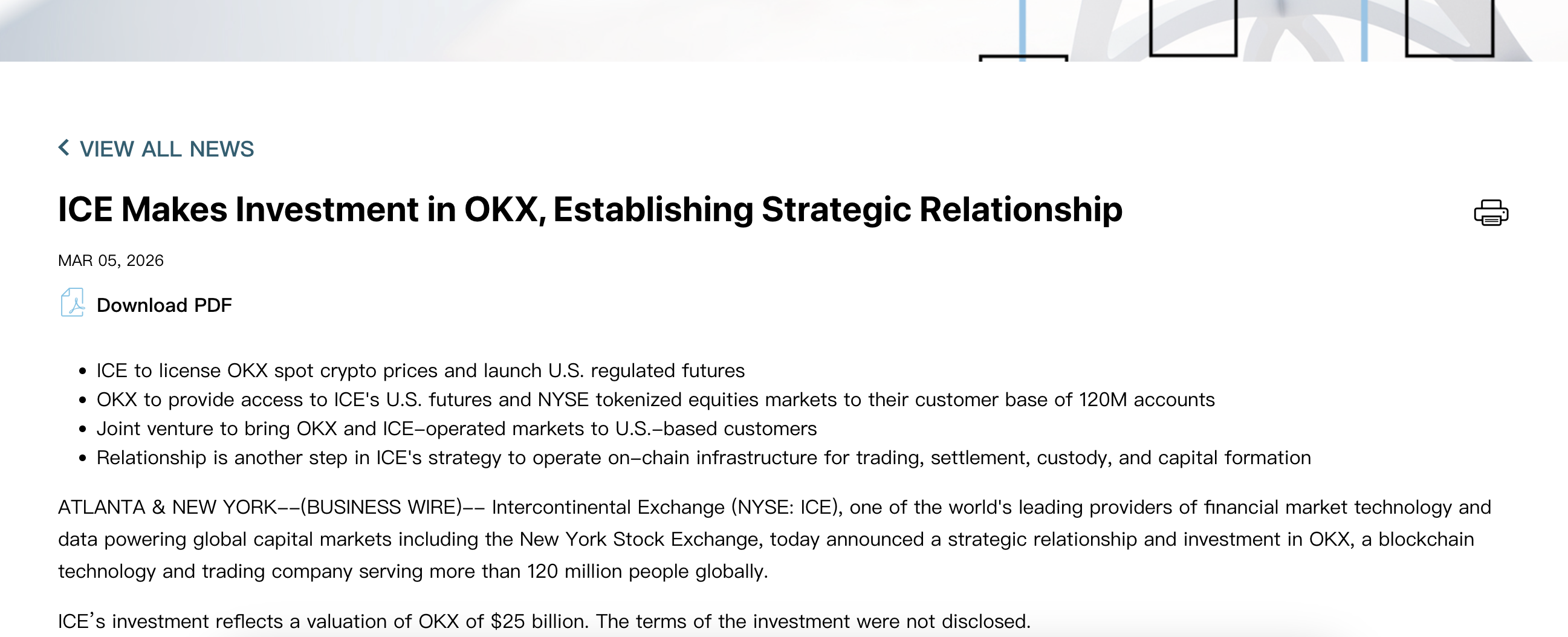
Last night, OKX unexpectedly released a major announcement, securing an investment from ICE, the parent company of the New York Stock Exchange, at a valuation of $25 billion. The significance of this transaction goes beyond the valuation itself.
This is not a typical capital game led by venture capitalists, but rather a core player in traditional finance stepping onto the field. Even more surprisingly, the century-old giant ICE, which controls the New York Stock Exchange, did not choose a local heir from its own backyard but extended an olive branch to an exchange founded by Chinese individuals with deep-rooted crypto-native genes.
It is worth mentioning that ICE founder Jeffrey Sprecher is one of the important supporters of U.S. President Trump. During Trump's campaign, he donated millions of dollars to several political action committees (PACs). His wife, former Senator Kelly Loeffler, currently serves as the head of the Small Business Administration (SBA) and is also regarded as an important member of Trump's camp. In the highly intertwined regulatory and political environment of the U.S. crypto industry, such a network of relationships is often considered to carry additional symbolic significance.
120 Million Users and Ten Years of Experience, ICE Aims for an RWA Breakthrough
In the crypto field, ICE was one of the earliest traditional financial giants to take action, but it did not yield the expected results.
In 2018, as the crypto market began to enter the public eye, ICE attempted to step down itself and launched the high-profile crypto derivatives platform Bakkt. The project was personally overseen by ICE founder Jeffrey Sprecher's wife, then-CEO Kelly Loeffler. At that time, ICE aimed to provide institutional investors with a compliant and secure crypto trading channel, but ultimately this layout was "noisy but little rain".
The turning point appeared after 2025. As institutional funds gradually flowed into the crypto market and the regulatory environment became increasingly clear, ICE began to take strategic steps back into the crypto world. This time, ICE changed its approach; it no longer attempted to build from scratch but quickly entered key areas through partnerships or investments.
For example, ICE quickly entered the on-chain prediction market by investing in Polymarket and collaborated with Circle and Chainlink to promote the underlying construction of RWA.
Notably, RWA is seen by ICE as an important direction for the next generation of capital markets. As one of the largest exchange groups in the world, ICE operates the New York Stock Exchange (NYSE). However, this exchange, which has a history of over 200 years, is facing new competitive pressure in recent years. Whether in trading volume or attracting tech companies to list, Nasdaq is gradually gaining an advantage.
More crucially, in September last year, Nasdaq submitted a proposal to the SEC seeking approval to trade and settle tokenized versions of Nasdaq-listed stocks and ETPs, viewed as a significant transformation of its business.
In the face of this trend, ICE also began to accelerate its actions.
In January of this year, the New York Stock Exchange announced the development of a blockchain-based tokenized securities platform. According to the plan, the platform supports 7x24 trading of U.S. stocks and achieves T+0 instant settlement. In its design, the tokenized stocks will have the same dividends and governance rights as traditional securities. To facilitate round-the-clock capital circulation, NYSE chose not to implement a stablecoin solution but rather plans to collaborate with banks such as BNY Mellon and Citibank to introduce tokenized deposits.
To accelerate the advancement of its RWA business, ICE has turned its attention to OKX, which has 120 million active users and has been deeply engaged in the crypto field for ten years.
In the U.S. domestic market, exchanges such as Coinbase and Kraken hold compliance advantages, but OKX leads in terms of global retail user activity and scale; at the same time, compared to financial service platforms like Robinhood, OKX has a broader coverage of crypto business, showcasing stronger data performance in areas such as spot trading, derivatives, and on-chain products, along with ten years of product experience.
According to Forbes, Haider Rafique, global partner of corporate affairs at OKX, specifically flew to Atlanta last summer for a four-hour discussion with ICE founder Jeffrey Sprecher, saying, "We have a great chemical reaction in regard to how we view the world, the future of tokenized securities, how derivatives will take the global stage, and how traditional finance and digital assets can merge."
Jeffrey Sprecher also openly pointed out that OKX has immense distribution capabilities, and ICE will leverage this relationship to expand its global retail user base and accelerate plans to provide on-chain infrastructure and tokenized assets for U.S. investors. Moreover, Star possesses experience in creating successful companies.
According to the cooperation agreement between both parties, OKX will authorize real-time crypto asset price data to ICE, which plans to launch crypto futures products based on this data; meanwhile, ICE will also open up tokenization channels for NYSE-listed assets to OKX, allowing OKX users to directly trade NYSE tokenized stocks and related derivatives on the platform. This feature is expected to go live in the second half of 2026. Additionally, both parties will also promote clearing and risk management solutions, multi-chain custody, and wallet architecture, as well as structured connections needed for institutional confidence to participate in the digital asset market.
To align with this strategy, OKX is also planning to strengthen its presence in the U.S., with Rafique disclosing that OKX is considering relocating up to 2,000 employees to the U.S., though no specific timetable has been revealed.
Why is ICE Investing in Exchanges Again After Ten Years of Investing in Coinbase?
Public information shows that OKX has completed four rounds of financing to date. The scale of the three rounds of financing before 2017 ranged from millions to tens of millions of dollars, but no specific valuation was disclosed at that time. However, previous reports from PANews mentioned that in 2019, when OKX's predecessor OKCoin's parent company, OKC Holdings Corporation, went public via a backdoor listing in the Hong Kong stock market, the valuation at that time, when some investors exited, was approximately $200 million.
Several years later, OKX's valuation has significantly increased to $25 billion, driven by both its business expansion and the transition of crypto assets into the mainstream.
In this round of financing, neither OKX nor ICE officially disclosed the specific fundraising amount. However, according to Bloomberg, citing informed sources, ICE invested approximately $200 million in OKX. From the scale of funding, this considerable investment represents the determination for institutional business transformation and the trend toward industry maturation.
In fact, this is not ICE's first investment in a crypto exchange. Back in 2015, ICE proactively invested in Coinbase, acquiring 1.4% of its shares, and after Coinbase went public in 2021, chose to cash out fully, which can be regarded as a successful case of crypto investment.
Now, after ten years, ICE has chosen to invest in OKX. In addition to aligning with its own plans in the crypto business, the market generally believes that ICE also sees the potential for returns.
Among crypto exchanges that have already gone public in the U.S., Coinbase has listed, with a current market value of about $54 billion. Although OKX is close to Coinbase in global trading volume and user scale, its market valuation is far lower than that of Coinbase. If OKX successfully enters the U.S. capital market in the future, there is still room for further appreciation in its valuation. Among crypto institutions planning to go public in the U.S., such as Kraken, Upbit, Gmini, etc., there may be differences with ICE in terms of business fit, distribution capabilities, and strategic positioning.
OKX has already released signals for an IPO in the U.S., and given the current capital market's increasing focus on the RWA narrative, if OKX can become an important distribution channel for NYSE tokenized assets, its valuation logic may also be repriced accordingly. In other words, if OKX goes public or its valuation increases in the future, ICE will not only gain operational synergies but may also achieve substantial investment returns.
For OKX, bringing in ICE has even more practical significance. OKX is attempting to re-enter the U.S. market and even agreed to pay nearly $500 million in settlement fees to resolve litigation. This move is seen as an important step for OKX to re-establish its footprint in the U.S.
In this context, the stake from traditional financial institutions like ICE carries greater credibility. As the parent company of the NYSE, ICE not only has profound influence and a mature compliance system in the U.S. financial system, but this investment in OKX and gaining a board seat will help reduce the regulatory uncertainties that OKX may face in its future development in the U.S.
OKX CEO Star also admitted that this cooperation marks a new chapter for OKX in entering the U.S. market. In many respects, OKX views its business in the U.S. as a blank slate, an opportunity to carefully construct, engage in constructive interactions with regulatory authorities, and contribute to creating market infrastructure that meets the standards of the most mature capital markets globally.
For ICE and OKX, this cooperation may also become an important move for both in the next round of new financial competition.
免责声明:本文章仅代表作者个人观点,不代表本平台的立场和观点。本文章仅供信息分享,不构成对任何人的任何投资建议。用户与作者之间的任何争议,与本平台无关。如网页中刊载的文章或图片涉及侵权,请提供相关的权利证明和身份证明发送邮件到support@aicoin.com,本平台相关工作人员将会进行核查。


