The "Weekly Editorial Selection" is a "functional" column of Odaily Planet Daily. Based on its weekly coverage of a large amount of real-time information, the Planet Daily also publishes many high-quality in-depth analysis articles, but they may be hidden in the information flow and trending news, going unnoticed by you.
Therefore, our editorial team will select some high-quality articles worth spending time reading and saving every Saturday from the content published over the past 7 days, bringing new inspirations to you in the crypto world from perspectives such as data analysis, industry judgment, and viewpoint output.
Now, let’s read together:

Investment and Entrepreneurship
Will the oil impact triggered by the Iran situation become the fuse that disrupts the interest rate cut timetable Wall Street has long awaited? This depends on how long the Strait of Hormuz will be effectively blocked.
If resolved within a few days, the inflation impact is highly likely to be just a temporary spike in energy prices—painful but controllable. However, if the disruption continues for weeks, it may coincide with summer gasoline seasonality, stubborn core inflation, and price pressures caused by tariffs, forming a "pressure combination" that forces the Federal Reserve to maintain a long-term tight policy throughout 2026.
When the Strait of Hormuz is Blocked, What is the True Safe-Haven Asset?
Iran's closure of the Strait of Hormuz will raise global oil prices and compel American allies to pressure the U.S. to restrain military actions, disrupting the internal political stability of the U.S. during the election period.
At the same time, the cost of war is also very unsustainable; the global economic turmoil caused by the blockade will undermine Western countries' financial support for Israel's long-term military actions.
If we are facing World War III—gold still symbolizes safe-haven; silver acts as an amplifier of uncertainty; oil is a core bargaining chip that will tear apart the central bank's balance measures between "anti-inflation" and "growth maintenance".
If the traditional financial system partially fails, then the role of crypto assets will undergo a qualitative change. In an environment with heightened capital controls and restricted cross-border clearing, the ability to transfer value on-chain will be revalued. The distribution of mining farms, power, and computational power will become geopolitical variables. The reserve structure of stablecoins will be scrutinized, and the judicial jurisdiction of trading platforms will become risk points.
The underlying logic of asset pricing will undergo fundamental shifts. The first to be revalued will be the priority of physical assets.
The technology sector will also see significant appreciation: artificial intelligence and semiconductors, which are growth stories in peacetime, become the core of productivity during wartime. Computing power determines command efficiency, chips determine weapon system performance, and satellite communications determine information sovereignty. Assets like data centers, power infrastructure, and low-orbit satellite networks will be rapidly incorporated into national strategic frameworks.
Bear Market Survival Guide: Teach You to Identify True "Cash Flow" Tokens
Ignas has used AI to filter out 12 categories and 132 investable tokens.
After repeatedly pondering what to do in the crypto space, examining old and new tokens, and researching new narratives, he believes that the optimal risk-reward choice in the crypto world is: directly buy Bitcoin (BTC); use "play money" to continuously try out new crypto protocols while continually learning to use AI tools.
2026 Death List: Games Are Dead, DeFi Is Dead, Tools Are Dead, Who Will be Next?
In the first 90 days of the year, more than 10 projects collectively went into "euthanasia". There was no run-off or hullabaloo, only a quiet exit after an announcement. The lack of self-sustaining ability is the underlying reason for all failures. Multi-chain expansion is a trap that has been repeatedly validated. Security is a human issue, not just a code issue. Funds are rapidly concentrating towards the heads with real demand.
Snapshot of Holdings of 100 Crypto KOLs: The 10 Stocks They Are Quietly Accumulating
- The flow of funds from crypto to stocks is real and accelerating
- AI, metals, energy/power are consensus overweight tracks
- Memory/semiconductors are high-certainty sub-themes (multiple interviewees have detailed arguments)
- Robots/humanoids are becoming a strong narrative—many KOLs have built positions
- Space and defense are gaining real allocations, not just on the watchlist
- IBKR is the preferred broker for crypto natives entering the stock market
- @Citrini7 is the most followed stock KOL among crypto traders
- Rare earths and uranium are popular inverse/macroeconomic bets
- European and Israeli defense stocks are emerging as standalone themes
Prediction Markets
A Century-long Journey of an Egg from Wall Street to Polymarket
The traditional assets that can be traded on Polymarket are far more than we imagine: from crude oil CL, gold GC, silver SI and other commodities to various foreign exchange prices and housing data, they can all be found on Polymarket.
24/7 continuous trading is one of the biggest advantages of trading such bets on Polymarket, and this advantage is very obvious when traditional financial markets are closed, as evidenced by the escalation of the U.S.-Iran conflict last weekend.
Polymarket has already been officially recognized as a polling agency and information exchange center, while Hyperliquid has also been seen as a new type of fully-owned product trading platform.
Price discovery rights have always been one of the core powers in financial infrastructure.
Also recommended: 《How to Systematically Track High Winning Rate Addresses on Polymarket?》《Pricing the Death of Iranian Leader, Where is the Ethical Boundary of Prediction Markets?》.
Policy
Kraken Obtains Federal Reserve Master Account, Fulfilling Long-Term Wish of the Crypto Industry
On March 4, Kraken announced that its bank, Kraken Financial, registered in Wyoming, has obtained the Federal Reserve master account qualification. This means it can complete USD settlements directly through the Federal Reserve system, no longer needing to go through partner banks, and symbolizes its crossing of a regulatory hurdle that the crypto industry has faced for many years.
The focus of the next phase is no longer on approval, but on actual operational effectiveness. If operations run smoothly and meet regulatory requirements, it will strongly support the idea of "allowing a small category of regulated, payment-focused institutions to access the Federal Reserve more directly." If it does not go well, it will reinforce the position that "central bank entry should be strictly tied to traditional banks".
Different Judgments for the Same Case: Why Uniswap Can be Innocent, but Tornado Cash Cannot?
Uniswap does not know about scam tokens’ situation; even if it does, it did not provide substantial assistance, and it also does not meet any definitions of fraudulent behavior in state law. Regarding unjust enrichment, Uniswap has not obtained direct benefits, while speculating that such scam projects expand the user base leading to indirect benefits is too strong.
Facing the same judge, Tornado Cash's Roman Storm has a different conclusion. The jury has found that Roman Storm “conspired to operate an unlicensed money transmitting business,” but has not yet been formally sentenced.
The author understands this as: decentralization is allowed, but privacy is not.
Airdrop Opportunities and Interaction Guide
After OpenMind Issues Tokens, A Quick Overview of Robot Sector Projects Yet to Launch Tokens
PrismaX, Konnex, BitRobot Network, Axis Robotics.
Also recommended: 《Popular Interaction Collection | Perle Labs New Questionnaire Tasks; Perceptron Network Earn Points by Hanging (March 4)》.
Bitcoin
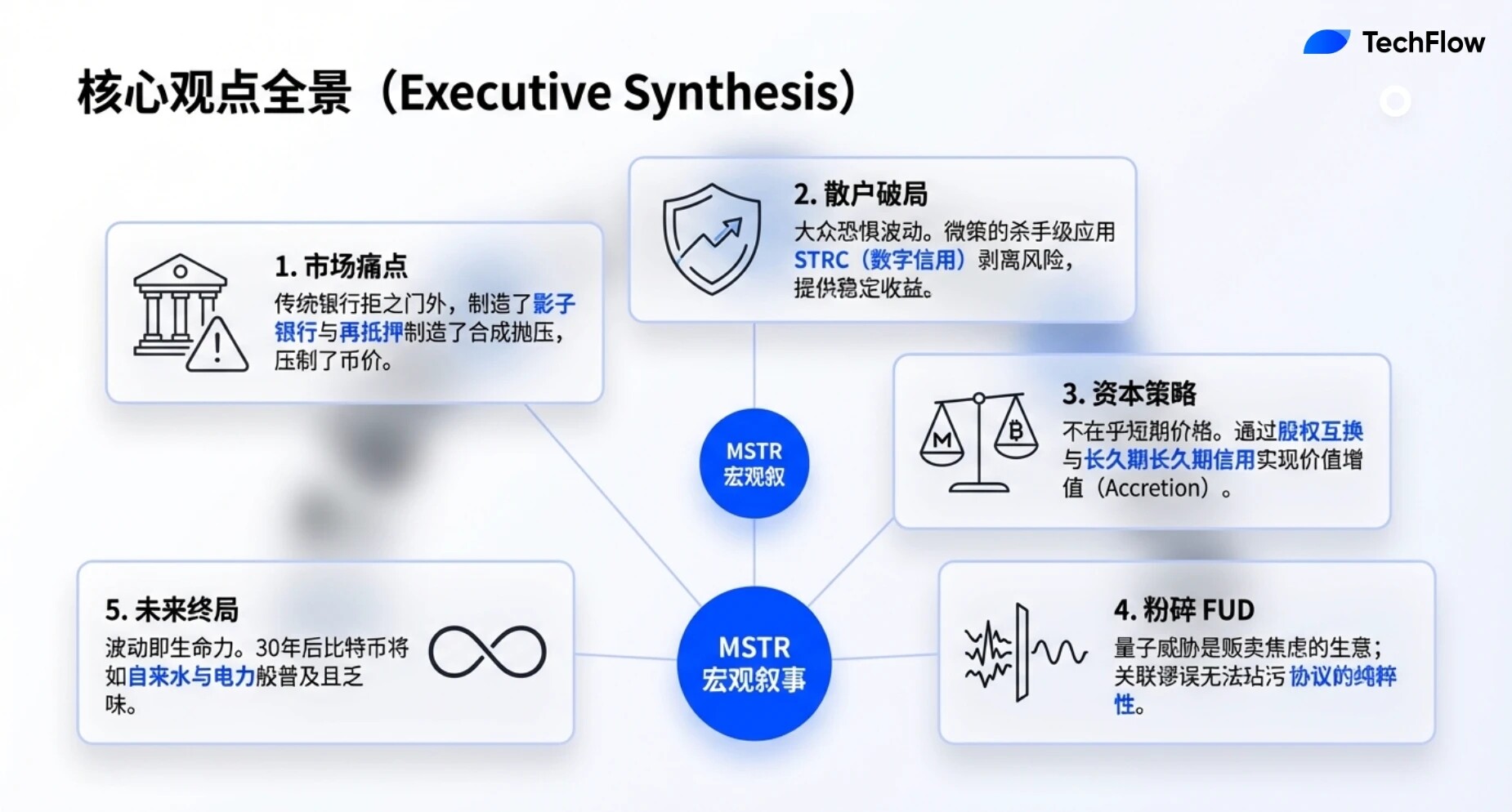
The $2 Trillion Predicament: Michael Saylor Dissects the "Invisible Selling Pressure" of Bitcoin
Ethereum and Scaling
Vitalik's Rare Self-Criticism: Ethereum Missed the Truly Important Battlefield
Ethereum has been almost absent from various social issues in recent years, and Vitalik proposed a new framework—"Sanctuary Tech"—free and open-source technology that enables people to live, work, communicate, manage risks, accumulate wealth, and collaborate around common goals; all with resilience to external pressures as the optimization goal.
Ethereum's goal should be to decentralize, creating digital stable islands in chaotic times, making interdependence unable to be weaponized.
From an overall architectural perspective, Vitalik provided a phased expansion plan aimed at continually expanding Ethereum's network capacity in the coming years. To scale Ethereum over the next five years, three types of resources need to be expanded: execution resources, data resources, and state resources.
Vitalik's idea is to make creating new states more expensive while making ordinary transactions cheaper. Long-term expansion aims to strengthen the main network itself, reducing dependency on Layer 2. This includes a phased rollout of Blobs + PeerDAS and ZK-EVM.
As for state expansion, Vitalik currently has no perfect solution but hopes to combine "strong state un-statefulness" with "state expiration," incorporating "temporary storage," "periodic storage," and "limited storage".
What "Killer Moves" Does the Ethereum Glamsterdam Upgrade Proposed by Vitalik Hold?
If Fusaka is the "data layer upgrade," then Glamsterdam is the "execution layer upgrade.” Fusaka mainly addresses "how to transmit data," while Glamsterdam aims to solve "who will produce blocks."
Wall Street Shortening ETH: Vitalik Knows and is Running Ahead, While Tom Lee Remains Delusional
Wall Street short-selling firm Culper Research suddenly announced it is shorting ETH and related securities like BMNR.
Culper Research's logic is that Vitalik and other developers miscalculated Ethereum's demand elasticity before the Fusaka upgrade, leading to the upgrade disrupting ETH's token economic model.
Culper Research also mentioned that Vitalik is well aware of this and is already taking actions to get ahead, while the deluded Tom Lee will head towards a dead end.
Also recommended: 《When Base Takes Everything, What’s Left for Optimism?》.
CeFi & DeFi
Hyperliquid's new improvement proposal suggests introducing a continuous liquidation auction mechanism at the protocol level, allowing new token projects to complete the entire capital raising and liquidity launch process on-chain, without relying on centralized exchanges or third-party platforms.
The author drew on Uniswap's continuous liquidation auction model and redesigned it for Hyperliquid's order book environment.
Web3 & AI
The Stronger AI Becomes, the More Valuable McDonald's Is
HALO (heavy assets, low elimination risk) — go buy those companies that AI can't eliminate no matter how it evolves. HALO represents a reversal in the valuation logic of the capital market under AI anxiety.
The American market focuses on what AI can take away, while the Chinese market focuses on what AI can help with.
What will truly be killed by AI are those companies that never should have existed—products with no barriers, growth relying solely on financing, survival dependent on information asymmetry.
Behind OpenAI's $110 Billion Funding is the Game Between Amazon and Microsoft
OpenAI announced completing the latest funding of $110 billion with a pre-money valuation of $730 billion.
Stateless API represents the present, while Stateful Runtime Environment represents the future. As long as OpenAI's Stateless API is called, Azure will charge in the background—regardless of who the customer is or where the channel is, the final traffic will return to Azure. This presents very strong cash flow certainty, but the issue lies in the trend of diminishing profit margins for Stateless APIs: calling volume may continue to grow, but actual profits may not remain stable in the long term. On the other hand, Amazon is obtaining the underlying hosting rights for the AI Agent era with $50 billion in actual cash and $100 billion in expansion agreements. Once Agents become the core carrier of enterprise productivity, the truly long-term consumed resources—compute power, storage, scheduling systems, workflow orchestration, and cross-tool collaboration—will be deposited in the AWS operational environment.
For OpenAI, this is a typical decentralized betting strategy—avoiding deep binding with any single cloud service provider, ensuring future growth is not entirely dependent on one side, using future business as leverage to negotiate better terms.
When AI Agents Become Powerful, Stablecoins = Dollar API
The currency belonging to AI is on-chain stablecoins. Crypto solves problems regarding AI Agents' identity, account, payment, and control.
USDC may become the best currency for AI Agents.
Paradigm's New Arithmetic: When Crypto Can't Hold $12.7 Billion, AI Becomes the Answer
The cryptocurrency investment firm Paradigm is raising a new fund that could reach up to $1.5 billion, expanding its investment direction to artificial intelligence, robotics, and other cutting-edge technologies.
Paradigm's entry into AI does not imply that it is competing for the same batch of projects as a16z or Sequoia, but rather betting on the intersection that others have not yet seen clearly.
When the Founder of Openclaw Advises Young People to Stay Away from Crypto
Talent, capital, and attention are fully migrating from Crypto to AI.
Mass Migration of Miners: Some Already Hold $12.8 Billion in AI Orders
Mining companies are shifting towards AI infrastructure.
OpenClaw "Brings Goods" to Venice, What Other Targets Are There in Privacy AI Sector?
VVV, NEAR, SAHARA, PHA.
Weekly Hot Topics Review
In the past week, the U.S. and Israel have launched a war against Iran, affecting the entire Middle East (Comprehensive Information Dispatch); New York Stock Exchange's $25 Billion Investment in OKX, OKX plans to relocate over 2,000 employees to the U.S. to advance its tokenized stock trading plan; Nasdaq Enters the Prediction Market, intending to launch 100 index binary options; Coinbase officially launches stock trading feature;
In addition, on the policy and macro market side, Federal Reserve Kashkari: The Fed is watching, and if inflation cools, it may cut rates one or two more times; Federal Reserve Bowman: the liquidity regulatory framework should be examined for effectiveness and reform the discount window mechanism; Secret U.S.-Iran Contacts Signal a Chance for Peace Talks, causing the dollar to fall from its highs; Waller disagrees with the Fed's current inflation theory, and soaring oil prices may not prevent rate cuts; FATF recommends stablecoin issuers embed freezing functions and blacklist mechanisms in smart contracts; Uniswap's victory proclaims decentralized platforms need not bear responsibility for scam projects; Hong Kong's Financial Secretary: expanding qualifying investment types for funds and family-control tools to cover digital assets outside Hong Kong; 21 Finance: Hong Kong will provide guidance to clarify that the ledger for bondholder registrations may be backed up by distributed ledgers; HSBC CEO Responds to Hong Kong Stablecoin License Application: hoping to play a responsible role; Sam Altman: OpenAI to Collaborate with the U.S. Department of Defense, deploying models on a confidential network, which will amend the agreement with the defense department to restrict domestic surveillance usage; 10x Research: mining companies' transformation to AI infrastructure may reshape the next cycle and the structure of the crypto stock market; on March 3, South Korean stock market crashed triggering a trading halt;
In terms of opinions and voices, Arthur Hayes stated that if the U.S. remains involved in the Iran conflict for the long term, it might push up Bitcoin prices; Forbes noted that Trump's "War is Coming" warning could elevate the Fed's expectations for monetary easing, benefiting Bitcoin; the founder of Bridgewater indicated that Bitcoin is not suitable as a long-term store of value; Bitcoin Treasury company EmperyDigital stated that it will not immediately liquidate all Bitcoin assets at this stage; Vitalik elaborated on the execution layer roadmap, involving changes to state trees and virtual machines; viewpoint: Ethereum's recent pullback looks more like a "value reset," the fundamentals remain solid after the liquidation wave; Trump Media & Technology Group is considering splitting off to list TruthSocial to prioritize developing crypto business; Binance's Asia-Pacific head stated plans to obtain 5 regulatory licenses in Asia this year; Limitless official publicly stated: old users participating in platform transactions enjoy double points bonus, we care more about the community than Opinion;
For institutions, large companies, and major projects, Morgan Stanley designated Coinbase and Bank of New York Mellon as its custodians for Bitcoin ETF; an alliance of 12 European banks plans to launch euro-pegged stablecoins in the second half of 2026; two board members of American Bitcoin significantly acquired company stock after the financial report release; X platform updated paid cooperation policy: cryptocurrencies, investment services, etc. do not meet promotional conditions (negative impact on crypto KOLs); X platform added timeline theme selection feature; Solana launched AI Agent trust layer Agent Registry; Uniswap initiated final voting on multi-chain fee switch, proposing that part of the fees be allocated to UNI holders;
In terms of data, Bloomberg analysts: Bitcoin ETF attracted another $500 million in a single day, up 12% since the Middle East conflict began; under the turmoil in the Middle East, BTC is strengthening against the trend, with institutional funds returning as the main reason for stability; CoinShares: amidst a 23% pullback in Bitcoin, institutional investors still hold their positions steadily; Bitwise: Bitcoin investors must hold for at least 3 years to avoid losses, short-term trading has nearly a 50% probability of loss; Polymarket platform the U.S.-Iran conflict-related event contracts "attracted" $600 million... Yes, it has been a week of witnessing history.
Attached is the series portal to "Weekly Editorial Selection".
See you next time~
免责声明:本文章仅代表作者个人观点,不代表本平台的立场和观点。本文章仅供信息分享,不构成对任何人的任何投资建议。用户与作者之间的任何争议,与本平台无关。如网页中刊载的文章或图片涉及侵权,请提供相关的权利证明和身份证明发送邮件到support@aicoin.com,本平台相关工作人员将会进行核查。


