Written by: Cointelegraph
Compiled by: AididiaoJP, Foresight News
A year ago, U.S. President Trump signed an executive order establishing a U.S. strategic cryptocurrency reserve. A year later, the value of the reserve has shrunk by billions of dollars.
At the beginning of his administration, Trump set up a special task force to study how the government could better implement and regulate cryptocurrencies, including Bitcoin and cryptocurrency reserve programs.
In the following year, the Trump administration launched several macroeconomic and policy adjustments. Among them, the friendly regulatory policies implemented in Washington have been beneficial for cryptocurrencies, but punitive tariffs and escalating geopolitical tensions have had negative impacts.
Currently, the number of tokens in the U.S. cryptocurrency reserve has remained basically unchanged since its establishment.
Trump's cryptocurrency reserves remain unchanged
On March 6, Trump established the "Strategic Bitcoin Reserve" and the "U.S. Digital Asset Reserve" through executive order. The Bitcoin reserve only contains Bitcoin, while the digital asset reserve includes various altcoins. Before the executive order was issued, Trump had indicated that the reserves would include XRP, Solana, and Cardano.
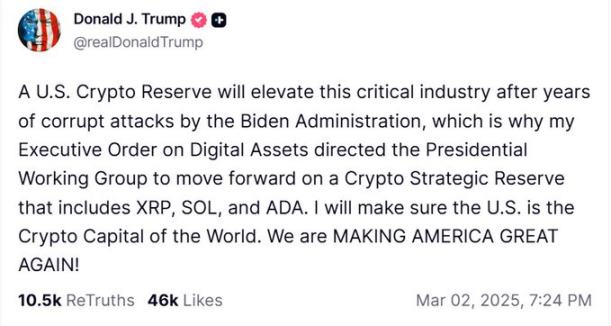
Source: Donald Trump
These two reserves "will not acquire additional assets through anything other than forfeiture procedures."
This executive order essentially consolidated seized assets that were previously scattered across multiple federal regulatory and law enforcement agencies. The executive order states that concentrating ownership, control, and management of these assets within the federal government will ensure appropriate oversight, accurate tracking, and a uniform approach to managing the government's cryptocurrency holdings.
The government has not disclosed specific details about the Bitcoin reserve and the digital asset reserve, but blockchain analytics firm Arkham Research has identified several blockchain wallets associated with the U.S. government.
As of the time of publication, the total value of cryptocurrencies held by the U.S. government is approximately 22.39 billion dollars, with Bitcoin alone accounting for about 22 billion dollars. Other major holdings include the stablecoin USDC, Ethereum, wrapped Bitcoin (WBTC), and BNB.
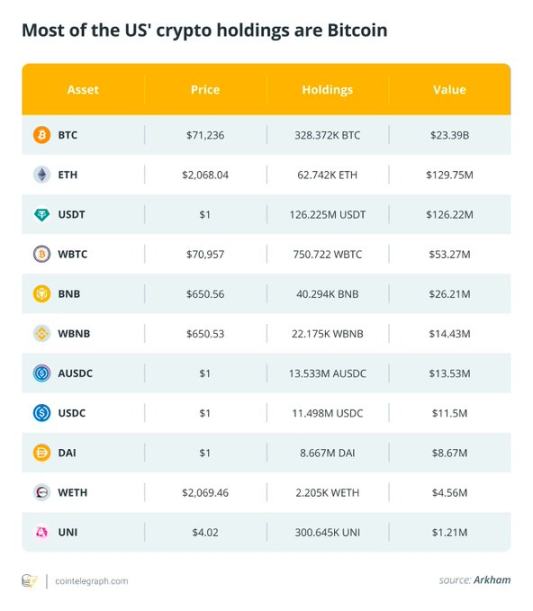
(Data collected on March 4)
It is currently unclear how many of these assets belong to the official reserves and whether these assets have been transferred or how they have been transferred. However, the dollar value of the reserves has significantly decreased. Arkham data shows that when Trump signed the executive order, the total value of the cryptocurrency assets held by the U.S. exceeded 30 billion dollars. As of the time of publication, this figure has dropped to 22 billion dollars, a decline of 26%.
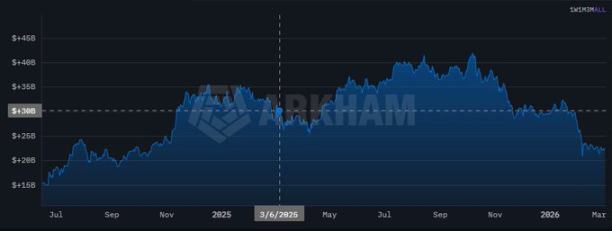
Since March 2025, the value of the U.S. cryptocurrency portfolio has significantly decreased. Source: Arkham
The White House does not seem to be shaken by this. Deputy Press Secretary Kush DeSae spoke about the recent price drop, stating: "In a free market, the government does not set prices, market fluctuations do not change the Trump administration's determination to ensure that the U.S. maintains its dominant position in the cryptocurrency and other frontier technology sectors."
Bitcoin holdings unchanged, no purchase plans
Despite steadfast supporters of Bitcoin hoping that the U.S. government would start buying Bitcoin, the amount of Bitcoin held by the government has not changed. Since the signing of the executive order, the U.S. government has continued to hold approximately 328,272 Bitcoins.
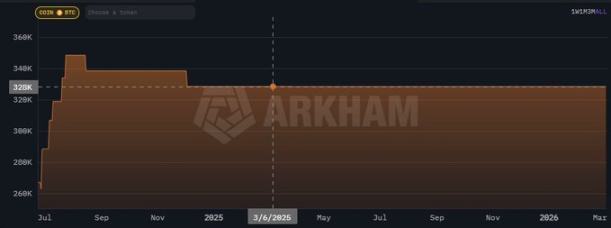
The amount of Bitcoin held by the U.S. has remained unchanged since the establishment of the reserve. Source: Arkham
Ethereum is the second largest cryptocurrency asset held by the U.S. government, and its amount has decreased since the signing of the executive order, which may indicate a swap or transfer. However, after April 2025, Ethereum holdings have generally remained stable.
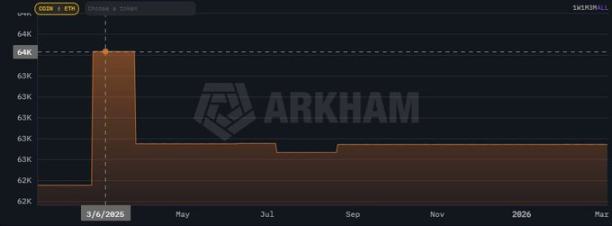
Changes in Ethereum holdings. Source: Arkham
Tether's USDt is the largest stablecoin held by the U.S. government, with a significant increase of over 200 million coins in May 2025, followed by a drop back to levels before March 2026.
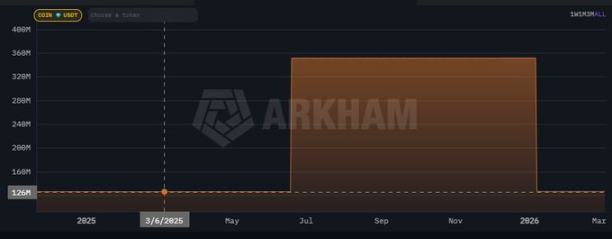
Changes in USDT holdings. Source: Arkham
These trading patterns are not very clear. As mentioned above, the government has not publicly disclosed specific trading volumes.
The new cryptocurrency reserve strategy does not entirely rule out the possibility of the government purchasing Bitcoin but requires that any purchases be made in a manner that "does not affect the budget." David Sachs, the Artificial Intelligence and Cryptocurrency Affairs Commissioner, stated last year: "No increase in deficit, no increase in debt, and no taxation of the American people."
"Taxpayers will not spend a penny. However, if the Treasury secretaries can find ways to accumulate more Bitcoin without increasing the taxpayer burden, they can do so."
A year has passed, and it remains unclear whether the government has devised such a strategy, or how it would be implemented.
Jason Yanowitz, co-founder of the cryptocurrency company Blockworks, told the BBC last year that a cryptocurrency reserve containing various assets could negatively impact the market. "If there’s no clear framework, randomly selecting assets can distort the market and lead to a loss of public trust." He stated: "Ensuring transparency through independent audits and public reporting is crucial for promoting innovation and avoiding favoritism."
Following the success of Strategy, a software company transformed into a Bitcoin investment tool, the idea of establishing Bitcoin reserves has gained attention at both the state and corporate level since last year. The notion of seeing Bitcoin as "digital gold" has made holding this asset appealing for government budgets.
According to data from the tracking website BitcoinTreasuries.net, currently, ten countries, including the U.S., China, Ukraine, El Salvador, the U.K., and North Korea, hold Bitcoin.
At the corporate level, analysts expect consolidation in the industry as the bear market continues. Wojciech Kazimierczak, Chief Strategy Officer of cryptocurrency infrastructure and treasury company BTCS, previously told Cointelegraph that companies with Bitcoin treasuries valued below their net asset value may be acquired by operating businesses.
The concept of a Bitcoin reserve remains new and has yet to undergo a complete test through the crypto winter.
免责声明:本文章仅代表作者个人观点,不代表本平台的立场和观点。本文章仅供信息分享,不构成对任何人的任何投资建议。用户与作者之间的任何争议,与本平台无关。如网页中刊载的文章或图片涉及侵权,请提供相关的权利证明和身份证明发送邮件到support@aicoin.com,本平台相关工作人员将会进行核查。


