Written by: River
When it comes to the virtual asset market in Hong Kong, who is the first person you think of?
Most likely it is OSL and HashKey, as some of the earliest exchanges in Hong Kong to obtain licenses, they have long been regarded as the two most representative flags in Hong Kong's crypto financial landscape.
However, in the public eye, the visibility of the two is quite different. OSL has always been low-key; even though its subsidiary OSL HK is the first listed licensed exchange, the company rarely appears in the center of public opinion. On the other hand, HashKey consistently remains in the spotlight, frequently appearing at various industry events and often capturing market focus with discussions around their ecosystem token HSK.
Interestingly, the two institutions announced the launch of their coins only one day apart:
- On February 25, HashKey Exchange launched the ecosystem token HSK;
- On February 26, OSL HK launched the enterprise-grade compliant stablecoin USDGO;
At first glance, these appear to be ordinary token launches, but looking at them in a broader strategic context, it seems like a divergence between two paths: one deeply cultivating the Web3 native trading ecosystem, while the other begins to bet on stablecoin financial infrastructure.
This also reflects the deep changes occurring in Hong Kong's crypto asset industry and serves as an excellent snapshot of the evolution of Hong Kong's crypto financial landscape.
1. The "Temperature Difference" in Coin Launches: Ecosystem Token vs Financial Tool
First, let's discuss the HSK that HashKey has launched.
As is widely known, HSK is an ecosystem token under the HashKey Group, and in the official narrative, it is used across all of HashKey's business scenarios, fulfilling multiple functions such as ecosystem incentives, community governance, and gas fee payments on the self-developed blockchain HashKey Chain.
In other words, HSK is a typical "platform coin."
This is a strategy that has already matured significantly within the crypto industry. From this perspective, HashKey's strategic path is quite clear: within the compliance framework of Hong Kong, it connects exchange trading, on-chain ecosystems, and community incentives through HSK, aiming to build a closed loop around trading and traffic and attempting to replicate the most classic growth path seen in Crypto:
Exchange (traffic entry) → self-developed blockchain (underlying infrastructure) → HSK (value capture) → Web3 ecosystem (closed loop).
The core of this logic lies in binding the platform coin to users, amplifying the network effect with users, activating the ecosystem through the network effect, which in turn boosts overall valuation, ultimately constructing an ecosystem network centered on crypto asset trading. Therefore, its target audience is quite clear—more focused on retail traders, Web3 native players, and those willing to bet on the future of the HashKey ecosystem.
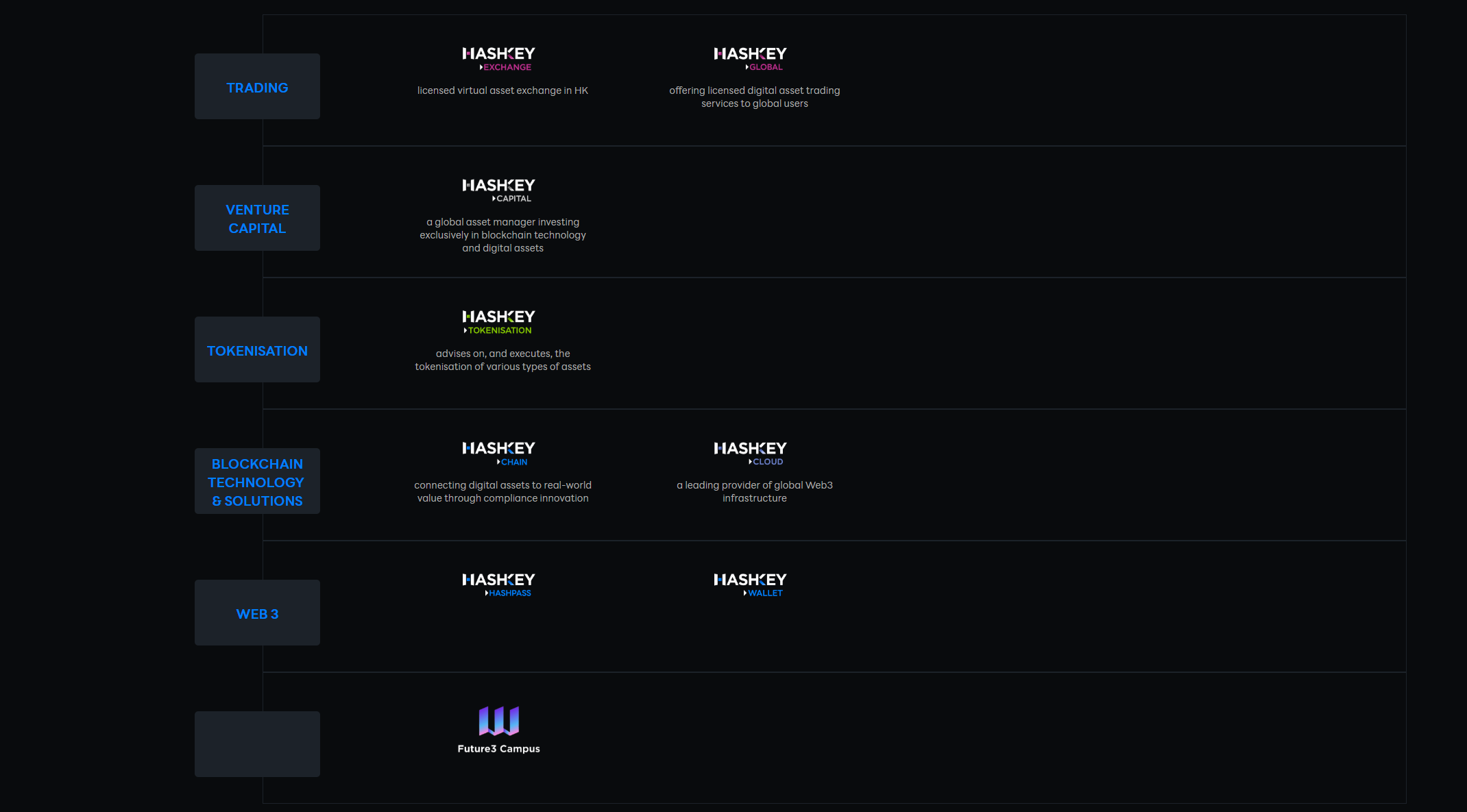
Source: HashKey Official Website
However, the challenge is that as a listed company (3887.HK), HashKey not only holds HSK as a platform coin but also has publicly issued shares, which means it must face a unique reality of "two skins": 3887.HK represents shareholder interests and financial returns, while HSK carries the mission of ecosystem growth and community incentives. How to clearly define the boundaries of these two dynamics and achieve long-term synergy is always a question that similar models need to address.
In fact, HashKey has already intentionally separated the listed entity from the ecosystem token structurally. For example, the prospectus clearly states that the rise and fall of HSK token prices are legally and structurally independent of the share price of the listed company. However, this does not mean the tension disappears: the capital markets and Web3 ecosystems differ inherently in terms of rhythm, objectives, and evaluation systems and still require clearer narratives and boundaries for explanation.
From the market performance perspective, HSK has fallen from its historical high of $2.50 to a low range of $0.15 since its launch. This trend itself may also reflect the market's cautious attitude towards this "two skins" model.
Now let's discuss OSL's launch of USDGO.
A frequently overlooked detail is that OSL has not chosen to issue a platform coin; instead, it launched this new stablecoin from the beginning of this year, which strategically can almost be viewed as OSL Group’s well-esteemed “quasi-son.”
USDGO is pegged 1:1 to the U.S. dollar, issued by Anchorage Digital Bank, a crypto bank regulated by the U.S. federal government, which undergoes stringent third-party audits and is brand-operated and distributed by globally licensed OSL. Such compliance endorsement and product form also distinctly differentiate it from traditional "crypto circle assets," placing it objectively closer to an on-chain digital financial tool.
OSL’s public positioning of USDGO is also quite clear—“enterprise-grade compliant stablecoin,” with its primary audience being not ordinary crypto speculative traders, but companies and institutional clients with cross-border payment and capital settlement needs.
In terms of trading forms, USDGO has now launched RFQ flash exchange services and professional trading on the OSL Global platform, progressively smoothing out the entry and exit paths for stablecoin and circulation, and also providing trading liquidity via OTC services from OSL HK.
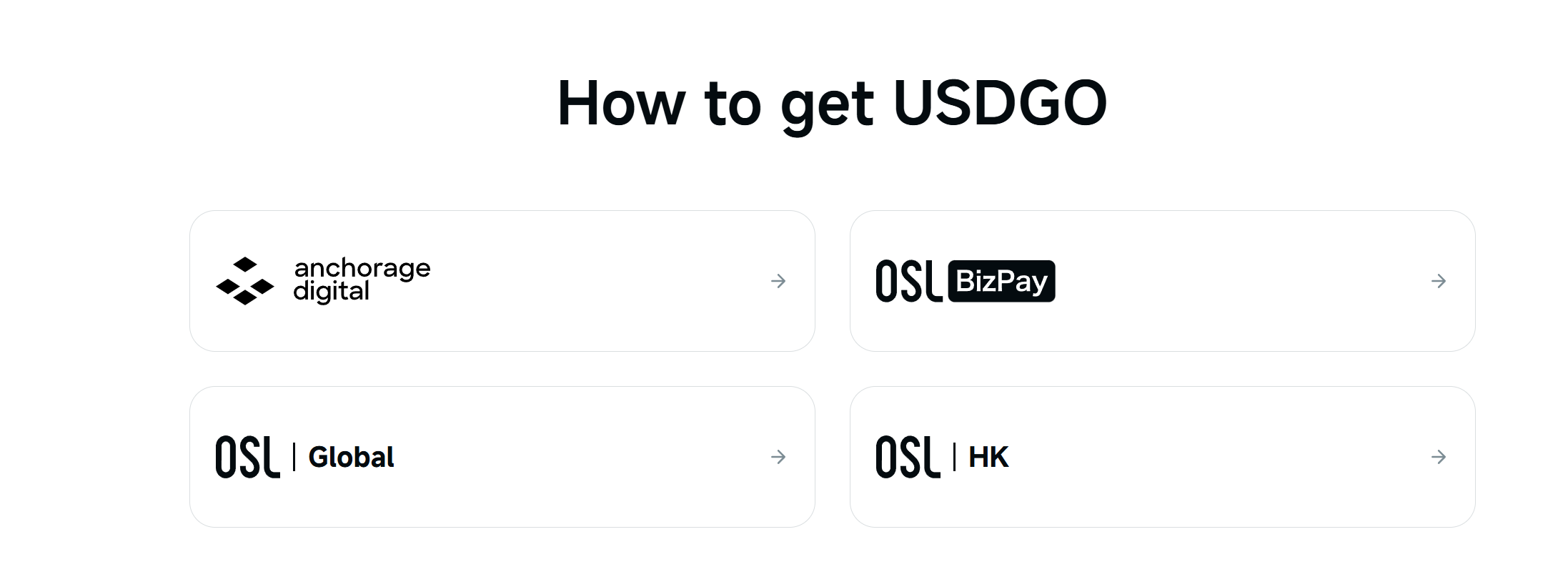
Source: USDGO Official Website
An even more interesting signal is that at the same time as the launch of USDGO, OSL also initiated the stablecoin ecosystem alliance "GO Alliance," announcing an initial investment of $20 million in ecosystem incentives. But this fund is not a traditional retail airdrop; rather, it is aimed at enterprise and institutional partners.
The logic is more akin to a typical B2B SaaS customer acquisition model, attracting the first batch of industry users by lowering the early adopting costs, thus gradually building authentic business application scenarios, which fundamentally differs from the platform coin incentive logic represented by HSK.
Ultimately, the new launches of HSK and USDGO present a very stark contrast: one is a platform coin, the other is a stablecoin; one serves to grow its Web3 ecosystem, while the other attempts to become a financial tool for cross-border capital flow for enterprises.
The two most representative licensed institutions in Hong Kong, and the two listed companies behind them, OSL Group (863.HK) and HashKey Holdings (3887.HK), are betting on two completely different futures.
2. The Moment of Divergence Between Two Paths and Two Bets
The two coin launches may not be sufficient to draw conclusions, but looking back to 2025 shows that this divergence did not occur suddenly.
HashKey has consistently focused on the Web3 narrative, betting on the prosperity of the native ecosystem and accelerating the completion of its "global exchange matrix + self-developed blockchain + platform coin system" closed loop.
HSK had already been launched on multiple platforms such as HashKey Global, HTX, KuCoin, and Gate.io prior to its arrival at HashKey Exchange, and in January 2026, it further landed on Kraken, opening up trading pairs with the U.S. dollar and the euro, continuously expanding the token's circulation map.
Meanwhile, the construction of HashKey Chain is ongoing, with its entire layout pointing toward maintaining a set of Web3 native growth logic within a compliant framework: building ecosystems, creating networks, and forming incentives and value capture through platform coins, aiming to become a compliant crypto traffic entry point from Hong Kong to the global stage.
In contrast, OSL Group underwent a noticeable strategic restructuring over the past year, transitioning from a digital asset trading institution to a stablecoin payment and settlement infrastructure platform:
- In April 2025, officially launched stablecoin payment business;
- In July 2025, completed a $300 million financing, providing funds for payment business expansion;
- In July 2025, launched an enterprise-grade crypto payment solution BizPay;
- In August 2025, disclosed mid-term results, reporting that payment business contributed about 30% of revenue just two months after launch;
- In November 2025, disclosed that it had laid out over 50 licenses in more than 10 key markets globally;
- In January 2026, completed the acquisition of global Web3 payment service provider Banxa;
- In January 2026, completed a new round of $200 million equity financing;
- In February 2026, launched the enterprise-grade stablecoin USDGO;
In this context, the launch of USDGO becomes particularly crucial; it is not just a stablecoin but also the core tool in OSL Group's entire payment network, aimed at solving real-world capital flow issues with stablecoins and following the path of "TradiFi + Digital Finance."
When a business uses USDGO for cross-border settlements, the overall process roughly looks like this: fiat currency entry → on-chain stablecoin settlement → account management and fund aggregation → treasury optimization → fiat currency exit. Coupled with the enterprise payment functions of OSL's own BizPay and a globally laid license network, the entire link can be completed without relying on traditional SWIFT systems, while compliant, regulated, and auditable throughout.
Thus, we see an interesting picture: one continuously building a "exchange + blockchain + platform coin" Web3 ecological matrix, and the other accelerating its transformation into a "stablecoin + payment network + compliant license" global financial infrastructure.
Neither path has an inherent superiority; they simply bet on different directions, revealing the two institutions' differing understandings of their roles:
- What HashKey builds is a Web3 native ecological network revolving around trading, public chains, and platform coins, where the core logic is "traffic × ecosystem": with an ecosystem comes traffic, with traffic comes valuation, and with valuation comes back to nourish the ecosystem, attempting to replicate the most classic growth myth in the crypto sphere within the compliance framework of Hong Kong;
- What OSL attempts is to treat stablecoins as a financial infrastructure tool embedded in the payment and settlement systems serving the real economy, where the core is "license × network": with compliant licenses comes institutional trust, with a payment network comes real demand, and with real demand comes sustained revenue, attempting to find a real place for "compliant digital assets";
3. Where Will Hong Kong's Crypto Financial Experiment Go?
Zooming out a bit, the divergence between HashKey and OSL can also be seen as a microcosm of a larger experiment taking place in Hong Kong's crypto asset market.
The regulatory approach of Hong Kong has never been a simple "either/or."
Since the virtual asset policy declaration was issued in 2022, Hong Kong has unequivocally promoted the development of the Web3 industry while also attempting to gradually embed crypto assets into the traditional financial system through a compliant regulatory framework. Therefore, the emergence of two different paths within the same market is not contradictory; rather, it could become a structural advantage in Hong Kong's crypto asset ecology—a "compliance horse race" of sorts:
One side innovates in Web3, while the other builds crypto financial infrastructure; they are not necessarily in competition, but may rather represent different levels of market division of labor.
With stablecoin regulation gradually being implemented, the significance of this experiment is being further amplified, and to some extent, stablecoins are becoming a key variable in determining the success or failure of the experiment.
It is important to note that from the initiation of regulatory consultations in 2022, the introduction of a regulatory sandbox in 2024, to the high vote approval of the "Stablecoin Regulation Draft" in May 2025, followed by the official enactment of the regulations in August of the same year, Hong Kong's stablecoin regulatory framework has undergone years of refinement and has now nearly taken shape. As the licensing system is about to be implemented, the stablecoin market will formally enter a phase of compliance.
From a more macro industry trend perspective, stablecoins are increasingly becoming the core asset of on-chain financial systems. The reasons are not complex: they retain the technical advantages of global circulation, real-time settlement, and programmability of blockchain while also possessing the stability attributes of traditional finance—fiat currency pricing, auditability, and regulatory compliance, and can even embed more financial rules within compliant frameworks.
This is also why more and more traditional financial institutions are starting to pay serious attention to stablecoins. At least for large, medium, and small enterprises globally, the true value of stablecoins lies not in speculation, but in more efficient cross-border payments and capital management.
Perhaps it is within this context that OSL places USDGO in such a central position.
In essence, understanding OSL's strategy hinges on understanding what USDGO really is, as it is not a stablecoin aimed at the trading market in the traditional sense, but more like a system of on-chain accounts and funds that bridges TradFi with Web3:
Enterprises can still invoice in fiat currency, issue dollar invoices, and provide standard audit reports; they just switch "cross-border capital flow" from SWIFT to a more efficient and convenient on-chain settlement network. In this process, businesses do not need to understand Web3 culture or hold any volatile assets to enjoy a payment channel that is faster, cheaper, and still compliant.
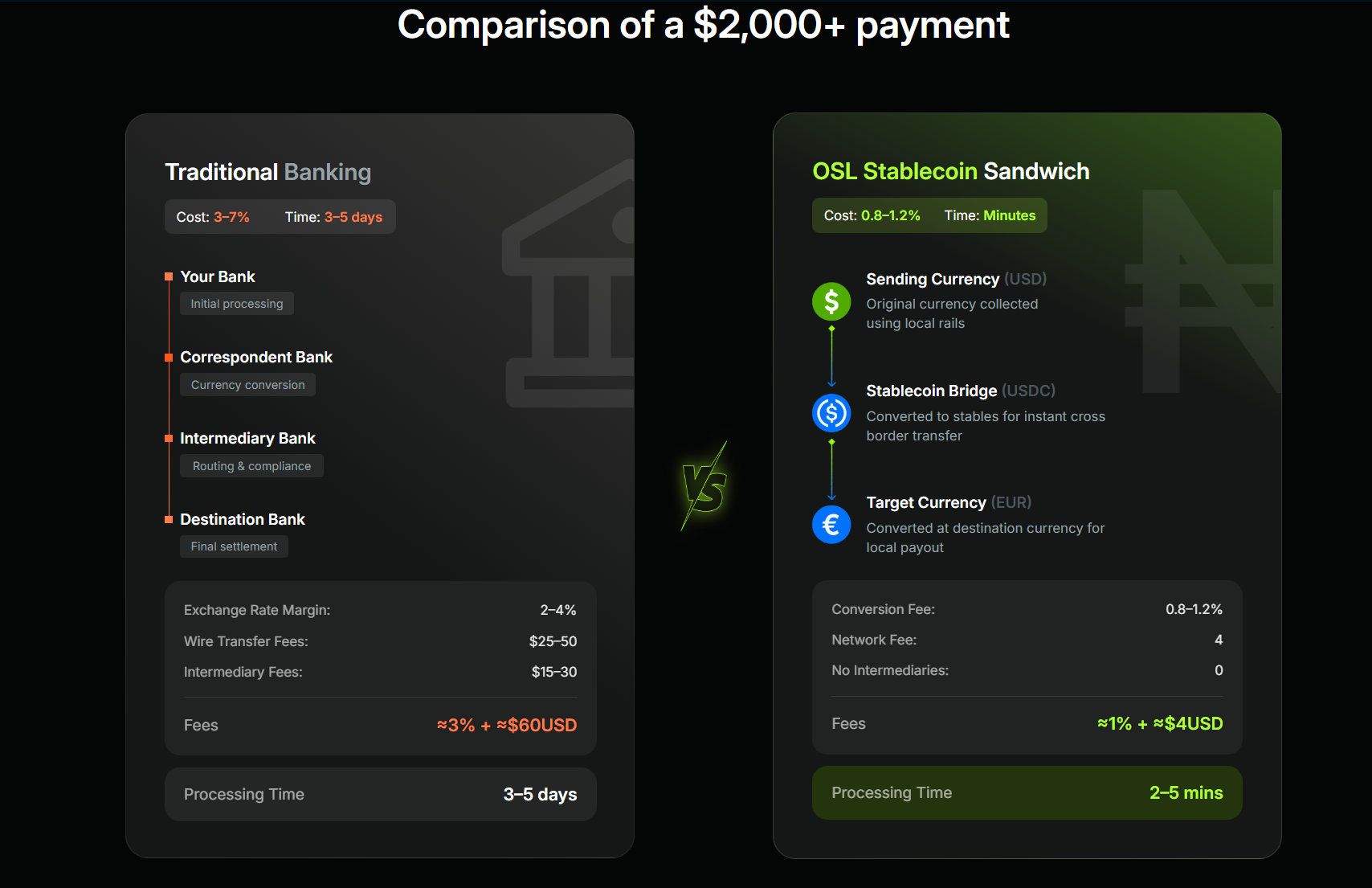
Source: OSL
In summary, whether it is HashKey's committed Web3 ecology or OSL's bet on stablecoin financial networks, both paths essentially attempt to answer an ultimate question: Where is the second half of the compliant crypto asset industry? What can compliant crypto assets truly be used for?
Looking back at the first decade of the crypto industry, the core narrative has always revolved around "trading." However, with the development of stablecoins, RWA, and on-chain finance, more institutions are beginning to realize that real opportunities may not lie in new exchanges or new tokens, but rather in building the crypto financial infrastructure itself.
Thus, when HashKey and OSL follow two different paths, what they represent are effectively two futures that the entire industry is exploring.
Final Thoughts
It has been over three years since the virtual asset policy declaration was released in Hong Kong, and during this period, market cycles have changed, regulatory systems have become more refined, and the initial two licensed institutions now stand at different crossroads.
Whoever travels farther down their path will ultimately return to two very basic questions: What real pain points have been addressed? Where is the network effect?
The answer requires time to unfold, but at least one thing has become clear:
The two most representative licensed institutions in Hong Kong are no longer on the same road.
免责声明:本文章仅代表作者个人观点,不代表本平台的立场和观点。本文章仅供信息分享,不构成对任何人的任何投资建议。用户与作者之间的任何争议,与本平台无关。如网页中刊载的文章或图片涉及侵权,请提供相关的权利证明和身份证明发送邮件到support@aicoin.com,本平台相关工作人员将会进行核查。


