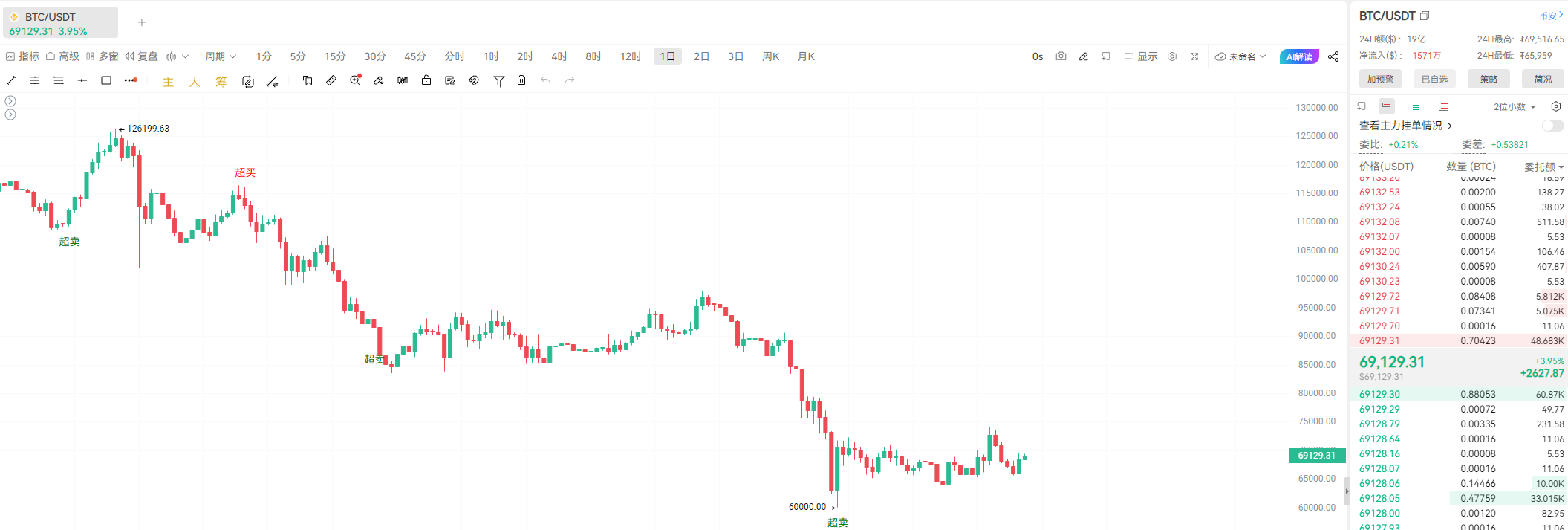
In the past week, Bitcoin, after experiencing a five-month consecutive decline on a monthly basis, briefly paused above $72,000, only to soon fall below the $66,000 mark. The market did not witness a one-sided frenzy or collapse but instead fell into an unprecedented state of "disagreement."
Some are staring at the candlestick chart, calling it a "bull trap," predicting a second dip to the $40,000 range; while others hold on to on-chain data, firmly believing this is the last "golden pit" in the bull cycle. In this fierce battle over direction, emotional shouting gradually faltered, while cold quantitative indicators and technical charts became the only "judges" for both bulls and bears.
1. Market "Crack": From Extreme Fear to Bull-Bear Standoff
● Just days ago, the market was shrouded in record pessimism. Bitcoin had undergone the longest consecutive monthly decline in history, and countless people speculated that the bear market had arrived. However, as prices rapidly surged above $72,000 earlier this week, sentiment on social media instantly switched from "extreme fear" to a fierce debate over whether it was a "rebound or a reversal."
● This divergence is vividly reflected in the prediction market. Data from the decentralized prediction platform Polymarket shows that despite the market rebound, a significant number of traders are betting that Bitcoin will drop again to a low this year. Among these, as much as 75% of bets believe BTC will dip to $55,000, and a considerable portion thinks it is even possible to fall below $45,000.
● In stark contrast, however, the spot Bitcoin ETF has suddenly recorded a net inflow of nearly $700 million this week after months of capital outflows, as if institutional funds are quietly "bottom fishing."
● This "temperature difference" between retail pessimism and institutional entry forms the core contradiction of the current market. Ordinary investors worry that this is a "bull trap" or a "dead cat bounce," and after chasing the rise, they may face even sharper declines; while institutions holding massive funds seem to be using this divergence to adjust their positions structurally.
2. The "Key Figures" of the Technicians: RSI and Funding Rates' Shouts
When the market direction is uncertain, traders begin to turn to those technical indicators that have historically predicted turning points accurately multiple times.
● The first to issue a strong signal is the weekly relative strength index of Bitcoin. During the decline at the end of February, this indicator once fell to 26.84, entering a historically rare "deeply oversold" zone. This value is not only the lowest point of this cycle but also the third lowest level in Bitcoin's trading history.
● Data analysis shows that the previous two times the RSI hit such a low point corresponded to significant bottom regions in the market. For technicians, this feels like the market is whispering quietly: "The selling pressure may have exhausted."
● Another key evidence comes from the underlying data of the derivatives market—perpetual contract funding rates. Recently, the 30-day average funding rate for Bitcoin perpetual contracts turned negative for the tenth time since 2018. This means that short positions in the market dominate absolutely and need to pay fees to long positions.
● Historically, extremely consistent pessimism often provides a good investment opportunity for contrarian strategies. A report by K33 indicates that after similar negative funding rate periods, the average return for Bitcoin in the following 30 days can reach 13%, and in 180 days even as high as 101%.
● In addition to these macro indicators, specific price patterns are also speaking. Analysts are closely monitoring the 200-week exponential moving average, a long-term lifeline. Although the price once fell below this trend line, the defense of the bulls did not completely collapse. Some viewpoints suggest that the current price structure is reminiscent of the market in 2023—only after repeated contests over the 200-week average did the market initiate the subsequent upward space.
3. The "Judgment" of Cycle Theory: Does It Take 200 Days to Hit Bottom?
Apart from immediate technical indicators, discussions about Bitcoin's four-year cyclical macro cycles have resurfaced. However, the viewpoints this time are somewhat different.
● Jan van Eck, CEO of the well-known asset management company VanEck, recently expressed his view that Bitcoin may be approaching the bottom of this cycle. However, he also pointed out that the traditional "four-year cycle theory" may be failing. With the launch of spot ETFs and the deep participation of institutional funds, the dominant forces in the market have shifted from merely halving narratives to the allocation behaviors of macro liquidity and compliant funds.
●This viewpoint suggests that the previously typical pattern of immediate surges following halvings may be a thing of the past, replaced by a more gradual and prolonged "structural repricing." Although prices may have bottomed, based on historical data models, a true trend recovery may require a lengthy bottoming process.
●Some analysts estimate that the complete repair of market sentiment and the initiation of a new leading wave may require about 200 days of volatile bottom formation, with the timeline pointing exactly to the fourth quarter of 2026.
●This means that even though the most pessimistic times may be over, it does not mean that profits can be made immediately. The market may enter a wide-ranging volatility period of "mutual damage" for bulls and bears, causing impatient leveraged funds to repeatedly be stopped out.
4. A Divided Future: Three Paths and One Consensus
Based on the current technical and macro environment, market analysts have outlined three possible scenarios for the upcoming months, almost covering all the imaginations from both bulls and bears:
1. The Despair Hypothesis (Pessimistic Scenario): If the Federal Reserve delays interest rate cuts due to rising oil prices, and ETF inflows reverse again, Bitcoin may effectively break below the $68,000 support and test the $63,000 or even $60,000 mark. At that time, discussions about "$40,000" will once again become rampant.
2. The Pragmatist's Wait (Neutral Scenario): This is currently the most probable trend. Bitcoin will oscillate repeatedly within a wide range between $60,000 and $75,000, gradually digesting the locked-in positions above through time for space. This type of market will repeatedly frustrate traders chasing after rises and falls.
3. The Optimist's Vision (Optimistic Scenario): If ETF funds continue to flow in massively and regulatory breakthroughs are achieved (such as the CLARITY Act), Bitcoin will effectively break through the $75,000 resistance and challenge $84,000 or even previous highs.
Despite the strong arguments from both bulls and bears, there is a rare consensus on one point: the current price level is not suitable for panic selling. Whether bears predict a drop to $45,000 or bulls aim for new highs, they all acknowledge that extreme technical indicators indicate the selling pressure has entered a phase of exhaustion.
In this noisy divergence, perhaps as a veteran trader said: "This is not a moment of panic, but a test of discipline and patience." Whether it is the historical low of the weekly RSI or the significant ETF inflow, they point to one fact: the market is resetting, not collapsing. When the last participant in the bull-bear battle takes their stance, the true direction choice may quietly come.
Join our community, let’s discuss and become stronger together!
Official Telegram community: https://t.me/aicoincn
AiCoin Chinese Twitter: https://x.com/AiCoinzh
OKX Benefits Group: https://aicoin.com/link/chat?cid=l61eM4owQ
Binance Benefits Group: https://aicoin.com/link/chat?cid=ynr7d1P6Z
免责声明:本文章仅代表作者个人观点,不代表本平台的立场和观点。本文章仅供信息分享,不构成对任何人的任何投资建议。用户与作者之间的任何争议,与本平台无关。如网页中刊载的文章或图片涉及侵权,请提供相关的权利证明和身份证明发送邮件到support@aicoin.com,本平台相关工作人员将会进行核查。