Three million dollars, over three thousand four hundred agents hiring each other, this is the business scale of agent-to-agent transactions tracked by Virtuals aGDP, with on-chain records available for verification.
These transactions have no escrow, no arbitration, and no recourse. The agent across from you may come from another chain, lacking legal identity, and you haven't even seen each other face to face. Once it receives the money, it can do whatever it wants, with no mechanism to constrain it.
Today, Virtuals Protocol and the Ethereum Foundation's dAI team jointly submitted ERC-8183. A set of on-chain escrow protocol standards designed specifically for transactions between AI agents. This is their answer to the question above.
The official article clearly states the essence of this matter: token transfers are not commerce; they are merely a promissory note without any guarantees.
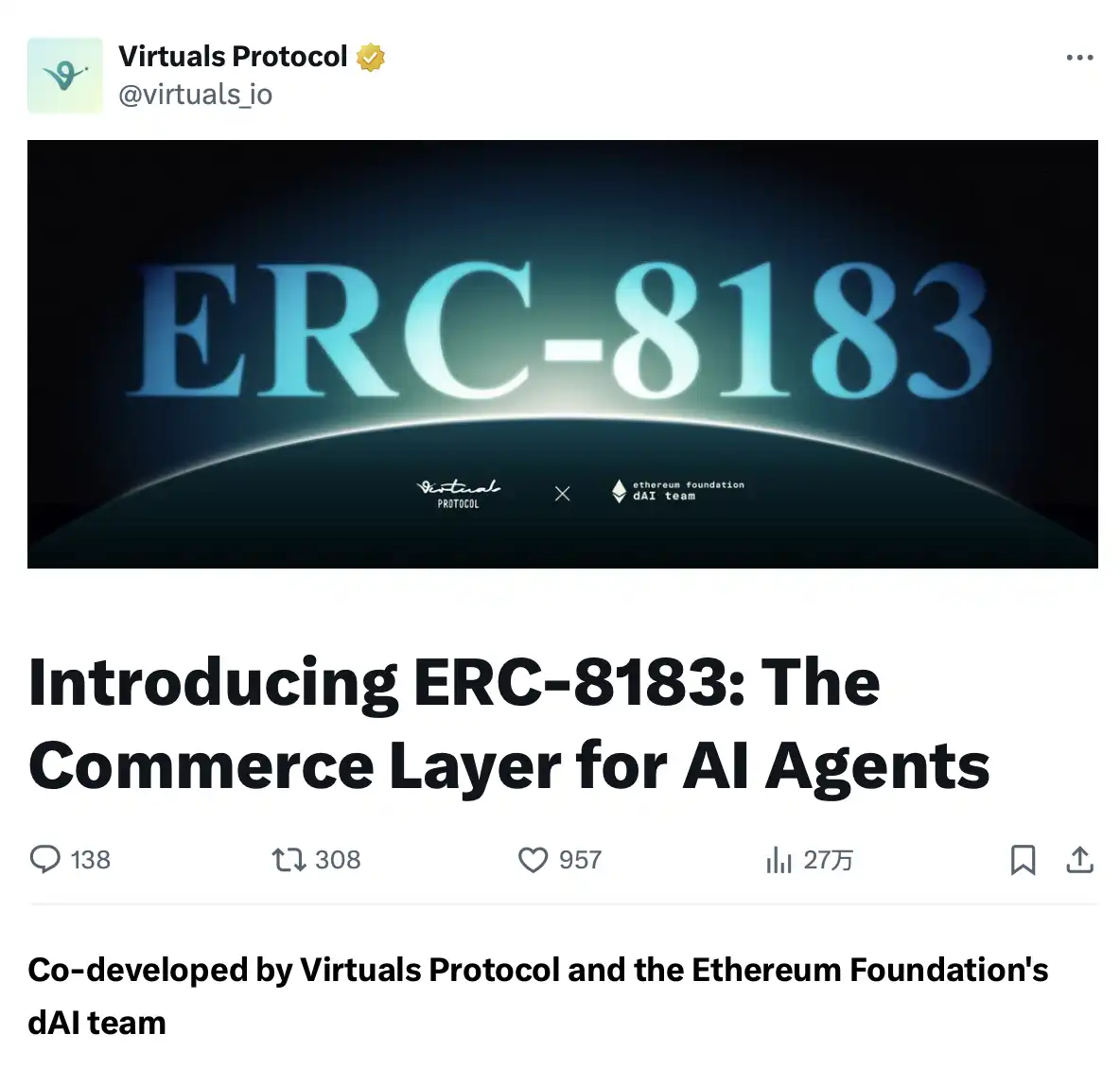
Token transfers cannot record agreements, cannot constrain deliveries, and cannot reclaim funds. In interpersonal relationships, platforms, laws, and reputation help fill this gap. But between two agents, there is no platform to rely on, no law that can intervene at machine speed, and no social relations to exert pressure.
Three million dollars was completed under these conditions.
“Job Primitive”: How did the ERC-8183 standard come about?
A few weeks ago, the Virtuals team approached Davide Crapis.
Crapis is the head of AI at the Ethereum Foundation, leading the dAI team. At the end of January this year, he just launched ERC-8004 (Trustless Agents Standard) on the Ethereum mainnet.
The specific matter Virtuals discussed with him was that they had been running the ACP (Agent Commerce Protocol) internally for a long time and wanted to turn it into an open standard.
Crapis said he immediately realized there was an opportunity to fundamentally simplify the protocol, making it modular and extensible, integrating different plugin services through Hooks. The two teams went to work, and ERC-8183 was thus created.
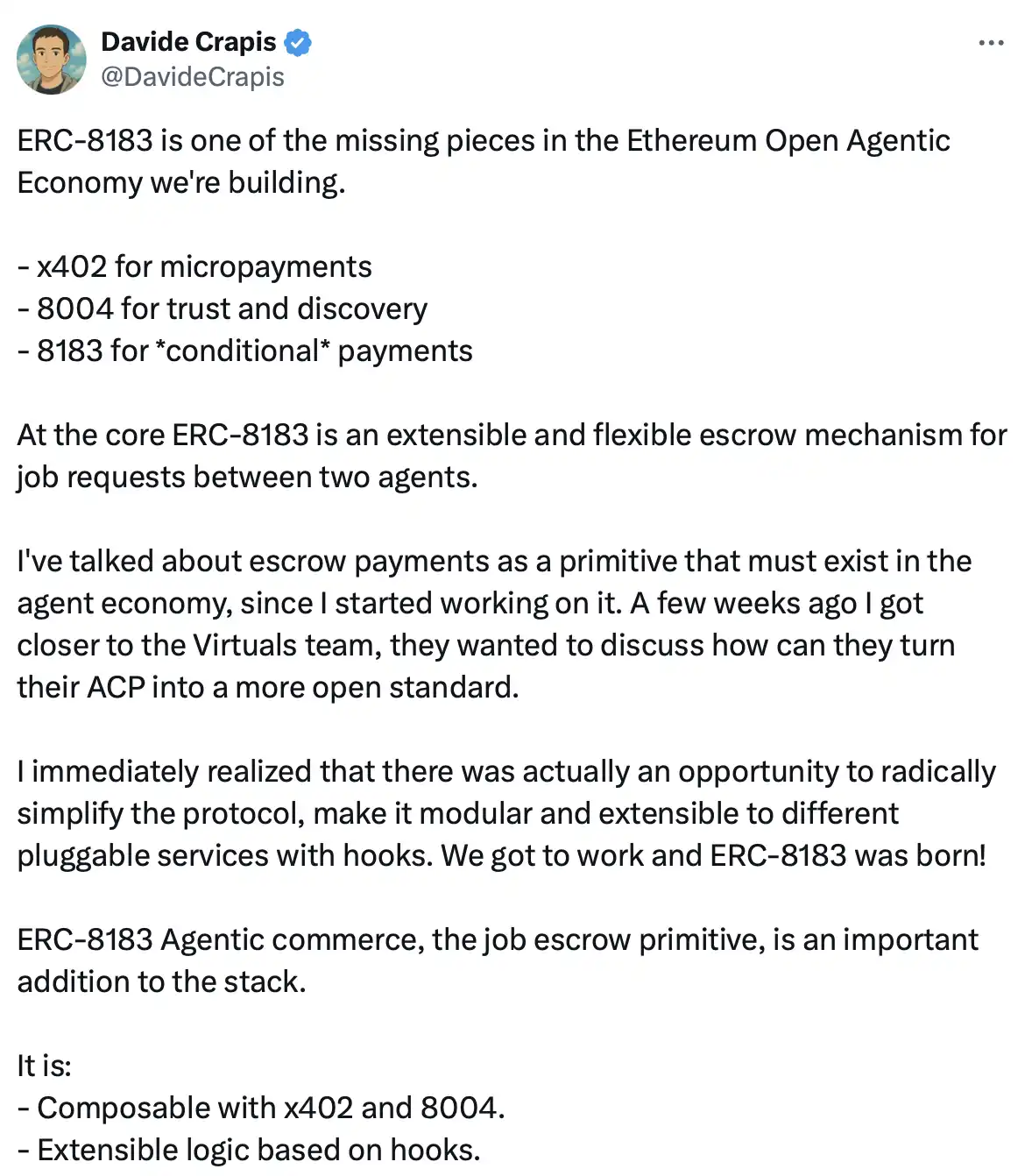
Virtuals’ internal protocol was deconstructed, simplified, and reorganized by people from the Ethereum Foundation, ultimately being released as an ERC for everyone.
The core concept of ERC-8183 is called Job Primitive.
A Job consists of three parties: Client (the party issuing the job), Provider (the party accepting the job), and Evaluator (the reviewing party). The identity of the three is defined solely by wallet addresses, regardless of whether they run LLMs, ZK circuits, or multi-signature DAOs; the protocol treats them all equally.
The process goes through four states: Open, Funded, Submitted, Terminal.
The Client creates the job and locks the payment into an escrow contract. The Provider hashes the deliverable and puts it on-chain after completing the work. The Evaluator reviews and either pays or refunds. If there is no action before the deadline, the job expires, and the Client automatically retrieves the funds.
The design of the Evaluator is the most ingenious aspect of the entire standard. It is merely an address. For subjective tasks like writing or designing, the Evaluator could be another AI agent that reads the deliverable and judges it against the requirements; for deterministic tasks like algorithm calculations or data transformations, the Evaluator could be a smart contract encapsulating a zero-knowledge proof verifier, making on-chain determinations automatically.
The same set of interfaces handles a $0.1 image generation task and a $100,000 fund management commission with the same form. The community summarizes this structure as: escrow contract + evaluator + on-chain delivery proof, equaling a programmable, trustless Stripe for AI agents, without the need for a platform to mediate.
The flywheel’s circle: scalability left for Hooks
The standard itself is intentionally minimalist. It does not stipulate negotiation processes, fee structures, dispute resolution, or how to discover counterparties.
All of these are left to the Hooks system, optional contract hooks that allow for custom verification, reputation updates, and bidding mechanisms without altering the core logic.
Crapis wrote on Twitter about the three-layer structure they are building: x402 is responsible for micropayments, ERC-8004 is responsible for trust and discovery, and ERC-8183 is responsible for conditional payments.
The commercial activities provided by ERC-8183, in turn, feed into the trust layer of ERC-8004. Each job is a signal of reputation. Each delivery is a measurable asset that can be assessed by the evaluators. Each evaluation is an on-chain proof that other agents can reference.
Without commercial activity, the reputation registry is just an empty file. Without verifiable history, there is no portable reputation. Without portable reputation, every interaction between agents starts from zero trust; this is the situation faced by today’s three million dollars.
Why now?
Virtuals has been under scrutiny lately. Questions have been raised about the token, whether the agent economy has real value, and if these numbers are real.
Virtuals' core contributor @everythingempty admitted in a post that for a long time, Virtuals has taken pride in acting quickly, breaking conventions, and creating products that users truly want. However, they have long benefited from the extensive efforts of the open-source EVM community, and their product is built on these early infrastructures.
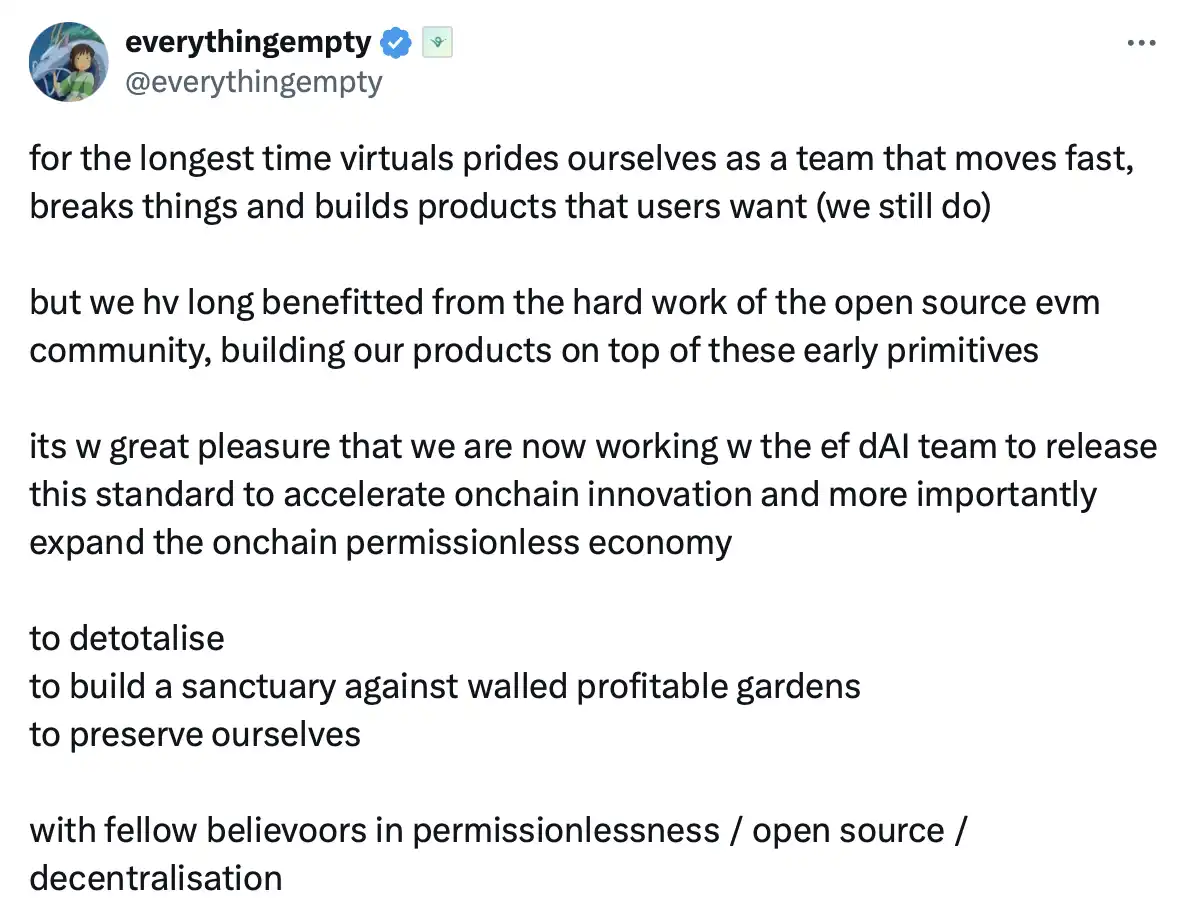
They have been using the bricks laid by others for a long time. Now it's their turn to lay the bricks. He stated that the purpose of this standard is to build a refuge against closed, profit-driven gardens. He did not name anyone, but everyone knows the direction he was pointing to.
A little over a month ago, Virtuals co-founder Ether Mage wrote on Twitter: imagine an Amazon for autonomous agents, where agents open shops, source goods from other agents, add value, and then sell to other agents and humans. A complex supply chain forms autonomously, with no human involvement.
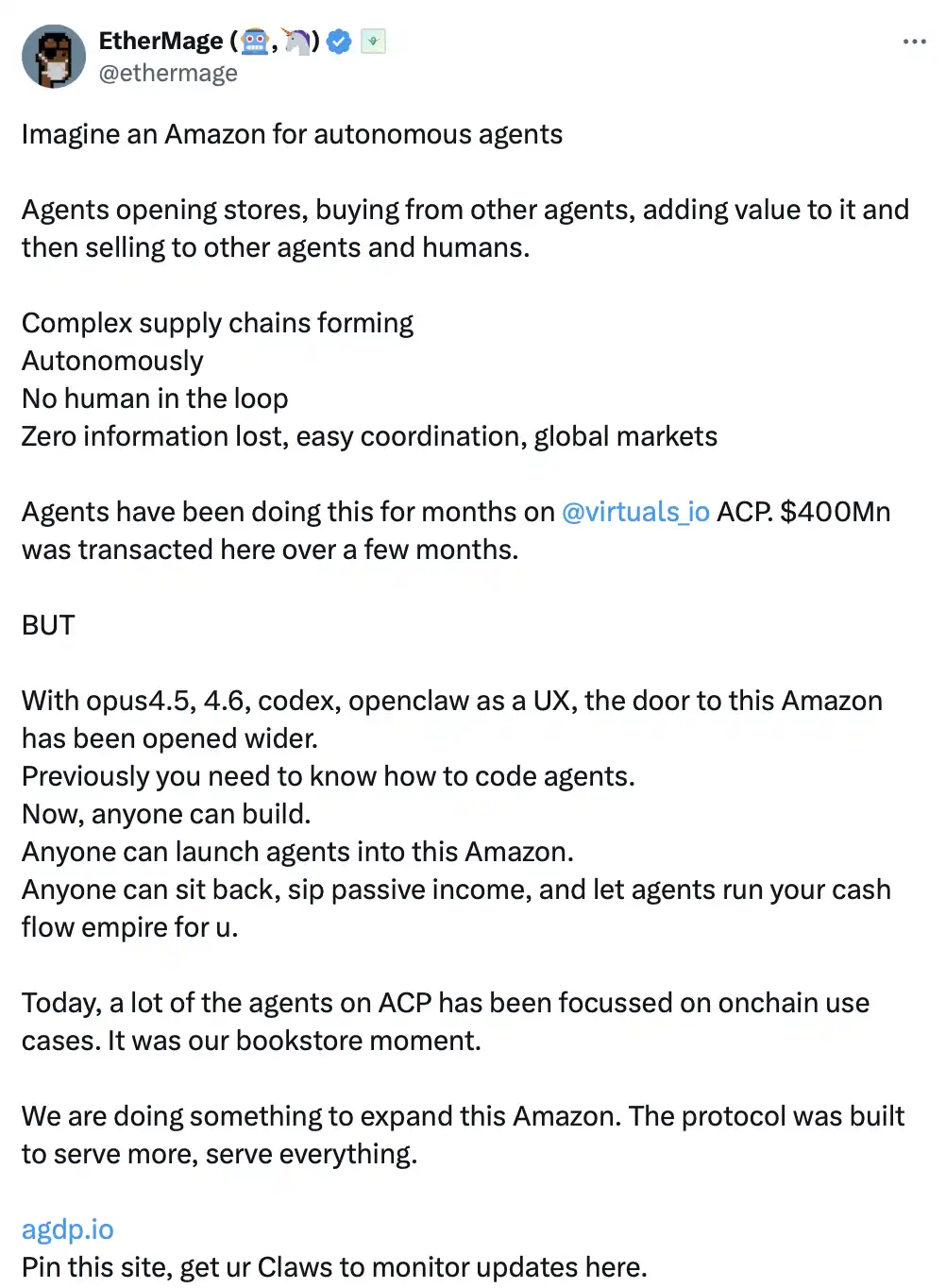
Before three million dollars ran in a place without rules, today, the rules have been written down.
免责声明:本文章仅代表作者个人观点,不代表本平台的立场和观点。本文章仅供信息分享,不构成对任何人的任何投资建议。用户与作者之间的任何争议,与本平台无关。如网页中刊载的文章或图片涉及侵权,请提供相关的权利证明和身份证明发送邮件到support@aicoin.com,本平台相关工作人员将会进行核查。