Written by: Frank, PANews
In recent times, the hottest topic in the tech and startup circles has not been the release of a new model by a major company but rather the nationwide craze of "raising shrimp."
On one hand, the "raising shrimp" trend has spurred business growth in related industries, with large model companies and cloud service providers raking in profits. On the other hand, the actual benefits that Openclaw brings to its users remain a mystery. Although social media is filled with mythical stories about it, a closer look reveals that most are fabricated stories aimed at attracting views.
Can raising shrimp really make money? If so, who is actually pocketing that money?
PANews has compiled data from the TrustMRR data platform, publicly available cases on social media, project official websites, and multi-source cross-validated reports. To differentiate between "verified real income" and "myths told online," a large number of rumors based solely on one-sided statements or lacking evidence have been excluded.
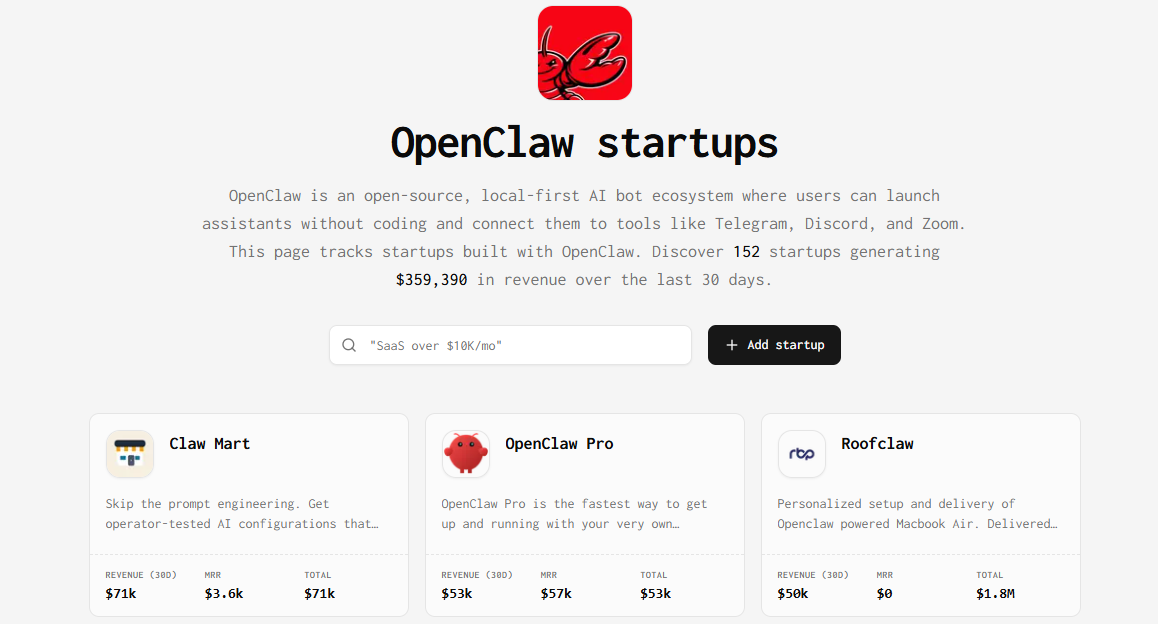
The OpenClaw category page on the overseas startup data platform TrustMRR shows that there are a total of 153 recorded projects in this ecosystem, which have collectively generated approximately $358,600 in revenue over the past 30 days. Further extracting the top 30 samples, their combined revenue accounts for 97.3% of total income. If we dissect these projects and their underlying profit logic by "industrial value chain," a painful truth emerges: the ones making money first are not those making products with shrimp, but those helping others raise shrimp, teaching others how to raise shrimp, and those capitalizing on the hype to issue MEME coins.
However, this segment clearly does not provide the genuine answer we seek. How are those truly using Openclaw making money? In response, PANews has summarized five gold mining logics of OpenClaw.
First: Selling "shovels" and acting as agents: Capitalizing on "cognitive gaps" for quick cash flow
Whether overseas or domestically, the products with the highest discussion volume and most eye-catching revenue data related to OpenClaw are often not specific applications but rather packaged tools and one-click hosting services.
OpenClaw resembles a layer of infrastructure rather than a ready-to-use consumer product, creating a high barrier for non-technical users. Once complexity exists, services will grow.
In the approximately $350,000 sample revenue over 30 days in TrustMRR, the "hosting deployment" and "one-click cloud hosting" categories alone contributed about $120,100, accounting for 34.5% of sample revenue.
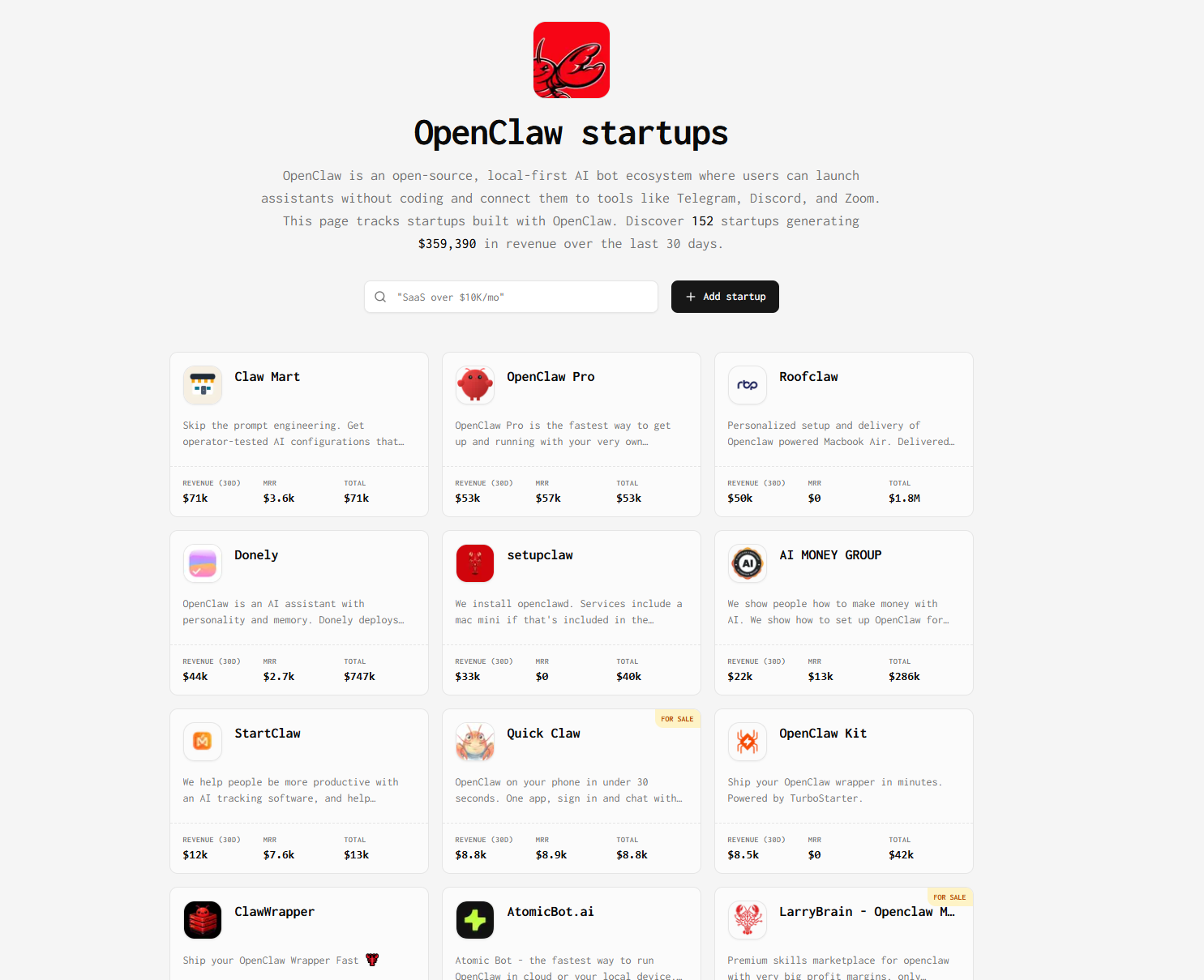
A typical example is QuickClaw, which packaged its underlying capabilities into a mobile app, priced at $3.99/week or $49.99/year, generating approximately $8,782 in revenue over the past 30 days.
On the Chinese internet, this logic has manifested in a more straightforward manner: "Proxy shrimp installation" on Xianyu.
According to media reports, recent proxy deployment services for OpenClaw on Xianyu and Xiaohongshu have seen explosive growth. Remote installations often cost between 100-300 yuan, while on-site services range from 400-1,000 yuan. At one point, the daily trading volume of related goods and services grew by 150% month-over-month.
The essence of this logic is making money from "information and cognitive gaps." Users are willing to pay to save 30 minutes of hassle, but this is a "window period" business— as official one-click deployment tools mature, the pure proxy service's benefits will quickly fade.
Second: Packaging AI expert personas: When the "story" itself becomes the most valuable product
If we take a further step up, another more valuable element in the OpenClaw ecosystem emerges: not just deploying for you but training your Agent well. In the top 30 samples of TrustMRR, projects related to templates, skill packs, and configurations contributed 26.4% of the revenue.
One of the most credible and complete evidence chain business case at this level is FelixCraft.
In early 2026, overseas creator Nat Eliason launched an experiment. He named his OpenClaw robot "Felix," invested $1,000 in startup capital, and let it build its own business. Within a week, Felix generated about $3,500 in revenue through Stripe. Additionally, the crypto community also issued related MEME tokens on-chain for this Agent and forwarded 60% of daily transaction fees to it, enabling it to earn up to $100,000 in crypto tokens within a week.
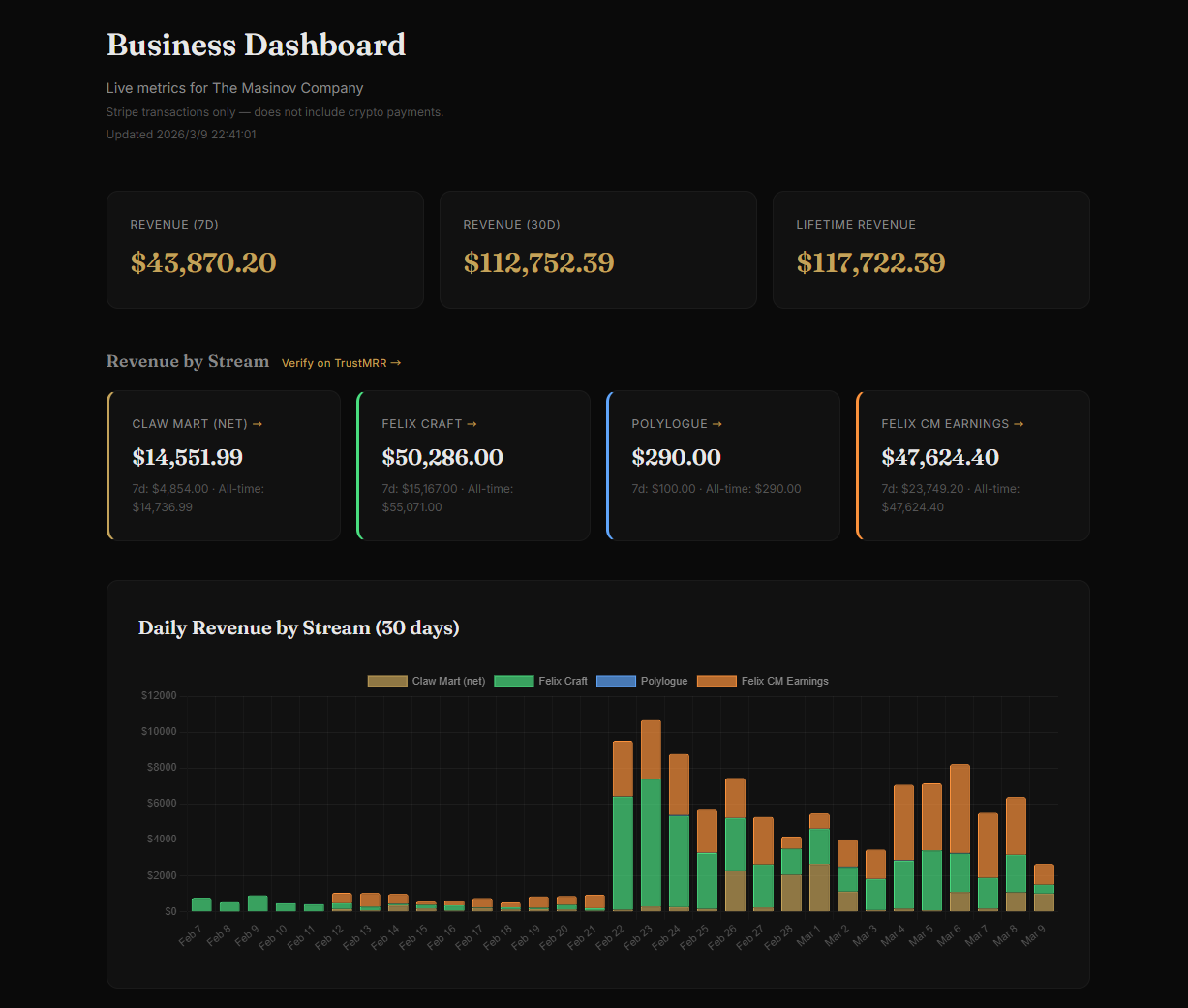
As one of the most analyzed cases in the research, Felix's case features several characteristics. Firstly, Nat Eliason granted this AI sufficient permissions, allowing the Agent to autonomously post tweets, retweet comments, and interact within the community. Additionally, before the product went live, Nat Eliason reported investing a significant amount of time building the framework for this Agent, including memory modules, security settings, workflow design, and more.
His ability to achieve profitability was candidly described by Nat Eliason in a podcast interview as an accident. Essentially, Felix's main source of revenue still comes from packaging the processes and results of training itself as a product for sale. As for the revenue from MEME coins, it benefited more from the topics created by this story and the traffic it attracted.
It is worth mentioning that TrustMRR's highest-revenue project in the OpenClaw category, Claw Mart (an Agent Skill marketplace), was indeed created by this Agent Felix, and its cumulative earnings have reached $71,300. Another important reason for this project's high earnings is that the story itself of Felix being able to autonomously create projects and automate work is the strongest endorsement for this product.
Felix’s success reveals a high-level path for commercializing OpenClaw: endowing Agents with continuous identities. When OpenClaw is packaged into a specific name (Felix), a sellable guide, a reusable skill set, plus the perfect narrative of "AI starting a business," it transforms into a new type of personal brand with explosive visibility. However, the core barrier of this gameplay lies not in AI but in Nat Eliason's powerful Agent training capability and brand marketing approach behind it.
Third: Selling the myth of efficiency: Earning through "storytelling" while using AI
Among all the profitable paths, the one widely agreed upon might be: using OpenClaw to replace human labor, with the money saved being counted as profit.
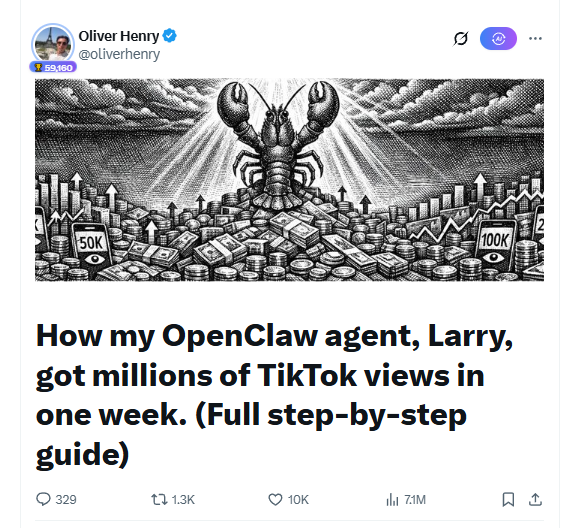
In the content operation sector, this has already become a reality. Developer Oliver Henry named his Agent "Larry," who takes full charge of his TikTok account. Larry automatically invokes large models to generate images, write captions, and upload drafts, while Henry only needs to spend 60 seconds each day selecting background music and clicking publish.
Oliver Henry reported that this Agent Larry helped his videos reach over 500,000 views in just five days, bringing him an income of $588 (this refers to the revenue from the two applications recommended in his videos). Additionally, Larry also created $4,000 in revenue through issuing MEME coins. Interestingly, the tweet telling this story has now garnered 7.1 million views, echoing the earlier mention of Felix, indicating that the story itself appears to have more commercial value than the Agent.
Domestically, Fu Sheng, the founder of Cheetah Mobile, formed a team called "Thirty Thousand" with eight Agents, achieving a leap in his public account's output from a few articles per year to daily updates, and setting a record of over 1 million views on a post, which captured public attention. Notably, this million-view post still tells the story of how the Agent works.
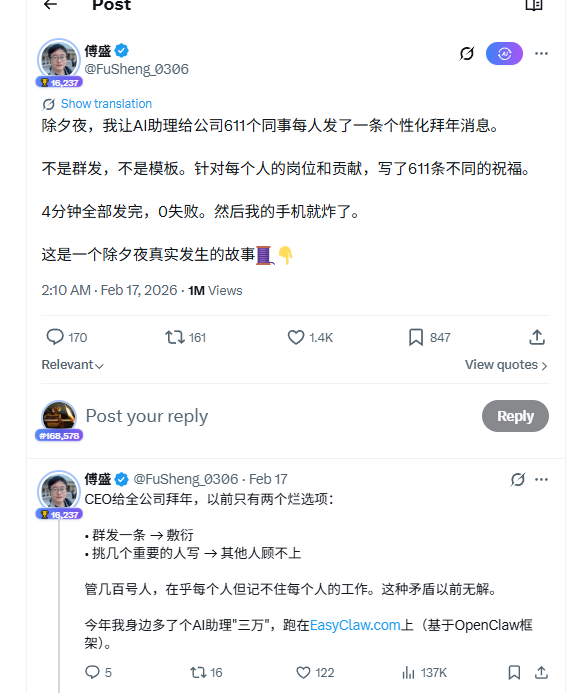
This indicates that, in content production, whether the content quality produced by the Agent can become a hit is still unverified. The hits that have already occurred are primarily stories about the Agent's ability to earn money or enhance work efficiency. Telling stories about "little shrimp" is currently the biggest talking point in the field of content creation.
Fourth: Industry deep customization: Breaking free from tool competition to earn "service premiums"
If proxy installation earns money based on "barriers," then extending this to package "little shrimp" as a personalized product is another matter entirely.
RoofClaw is a typical representative of such projects. According to TrustMRR, its revenue over the past 30 days has been about $49,800, with a cumulative return of $1.8 million. It is positioned as "personalized customization and delivery of MacBook Air equipped with the Openclaw system," meaning its business idea is not simply to help you pre-install a "little shrimp" but to encapsulate that little shrimp within a MacBook, along with customized services to help you train that "shrimp" into an Agent that meets your needs.
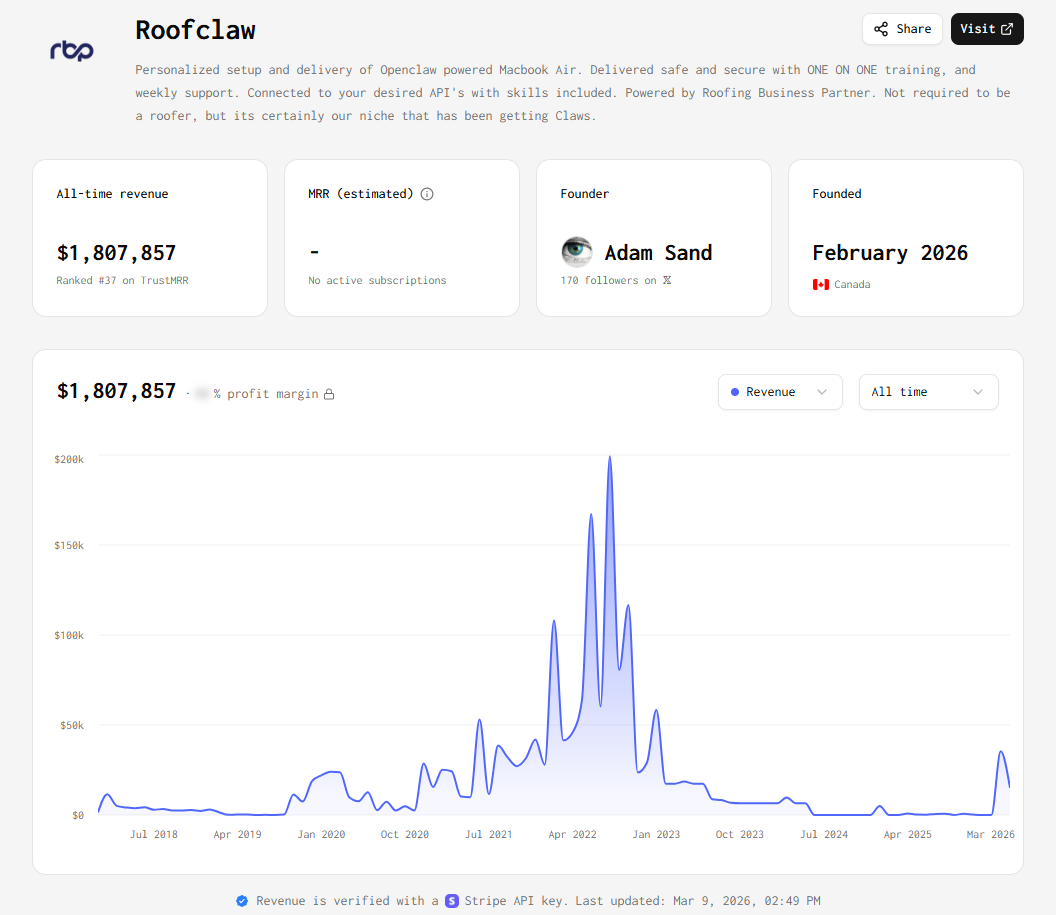
This kind of service might strike at the real commercial demand for "little shrimp" in the future. Users' true needs may not be just a "usable" "little shrimp" installed, but rather a fully trained "little shrimp" customized based on their own requirements. Behind this demand is the selling of in-depth services targeted at the Agent.
To put it plainly, we can foresee a future where many companies will rely on Agents, but how to train or "educate" these Agents will inevitably become a significant necessity.
Fifth: On-chain transaction legends: The most tempting poisoned apple and traffic bait
On social media, the strongest communicative effect regarding OpenClaw is always the myth of sudden wealth.
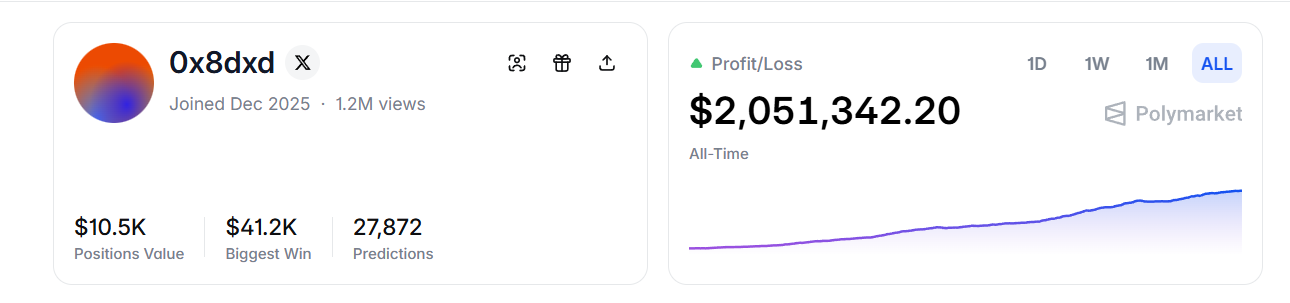
Currently, the only verifiable case via on-chain data is the account 0x8dxd on the prediction market Polymarket, which operates as a high-frequency trading robot. Numerous posts on social media speculate that its underlying system relies on OpenClaw to execute high-frequency trading. However, from PANews's analysis, the actual controller behind this high-frequency address has never made such statements, and those so-called "OpenClaw helped me design an automated trading program that earns $100,000 a month" stories are largely clickbait, primarily aimed at attracting users to adopt their follower bots.
The reason for mentioning this case is to serve as a reminder, consistent with PANews's previous findings, that Agents and high-frequency trading bots are completely different; people are often misled and enchanted by the mystery surrounding both.
Final Thoughts: Those who teach you how to make money are the guaranteed winners
Upon reviewing the whole ecosystem, we discovered a phenomenon more thought-provoking than any single case: sharing "how much money I made with OpenClaw" on social media itself is a highly stable business.

When a post claiming "I earn 50,000 a month with OpenClaw" goes viral, the traffic becomes bait. The author naturally directs viewers to premium communities, consulting services, or corresponding paid product links. "Showing off income" sits at the top of the customer acquisition funnel, while "money-making myths" serve as the strongest marketing material. This creates a perfect self-confirming cycle: selling money-making cases — gaining traffic — transforming traffic into revenue — sharing wealth-building secrets in a mentoring capacity — leveraging even greater returns.
Essentially, it has spawned a new business chain: at the bottom are proxy installations and infrastructure, in the middle are skill packages and workflow replacements, and at the top are industry solutions and consulting services. If you understand business, marketing, and possess traffic, OpenClaw can drastically reduce your costs and amplify productivity.
Many are sharing that they have optimized workflows with OpenClaw, achieving many convenient functions, but it is far from a wealth-making password. The "herd effect" triggered by this is the most essential content in this traffic story; when you desperately push through the crowd to the front row, you may find that there is nothing there, and you are the one who has been awaited.
(PS: This article was created without using "little shrimp")
免责声明:本文章仅代表作者个人观点,不代表本平台的立场和观点。本文章仅供信息分享,不构成对任何人的任何投资建议。用户与作者之间的任何争议,与本平台无关。如网页中刊载的文章或图片涉及侵权,请提供相关的权利证明和身份证明发送邮件到support@aicoin.com,本平台相关工作人员将会进行核查。


