Original Author: Castle Labs
Original Compilation: AididiaoJP, Foresight News
69 trillion dollars—this is the estimated market value of the U.S. stock market, which drives the total market value of global stock markets to 130 trillion dollars.
Opportunities to participate in the stock market are increasingly coming into the view of on-chain native participants, despite their initial lack of interest. The reasons are varied, but the general consensus is that cryptocurrencies were once thought to provide faster returns. However, more and more investors are beginning to choose diversified investments. The Wall Street Journal emphasizes this trend, noting that funds are shifting from Bitcoin to gold or the "Magnificent Seven" Tech stocks (MAG7).
Until recently, the claims in the cryptocurrency space still reflected a dedicated loyalty to digital assets, accepting the cyclical pattern of mysterious crashes every four years—almost reminiscent of astrology. Most crypto assets have not recovered since peaking in the second quarter of 2025, while the stock market continues to reach new highs, prompting investors to start questioning: is loyalty to blockchain merely an obsession disguised as a belief.
The true purpose of tokenization is neither "financial inclusivity" nor "democratization of access," but rather to provide traders with tools to short Tesla (TSLA) to the bottom, borrow Nvidia (NVDA) stock as collateral without KYC, trade pre-IPO stocks, or earn yield in the Kamino vault.
This article analyzes three different paths of on-chain tokenization:
- OndoFinance launched Global Markets in September, elevating tokenization on the Ethereum network to institutional-grade standards.
- xStocksFi, a subsidiary of Backed Finance (now owned by Kraken), debuted in June, targeting the retail market with multi-chain composability.
- HyperliquidX activated HIP-3 in October, enabling permissionless perpetual contract trading on any asset, including commodities and stocks.
This article will delve into the internal operational mechanisms of each protocol, focusing on how they achieve asset "tokenization" on-chain.
We will provide a general analysis of the legal frameworks behind each protocol and their implications for investors.
Finally, we will explore where the broader tokenization trend is headed and what it means for the cryptocurrency ecosystem that we are familiar with.
Ondo: On-Chain BlackRock
Founded in 2021 by Nathan Allman and Justin Schmidt, who have backgrounds at Goldman Sachs, Ondo has focused for years on building tokenized treasury bond products (retail USDY and institutional OUSG). Before launching Global Markets in September 2025, it held assets exceeding 2 billion dollars. Currently, the total locked value (TVL) of all Ondo products (including Treasury bills) has reached 2.47 billion dollars.
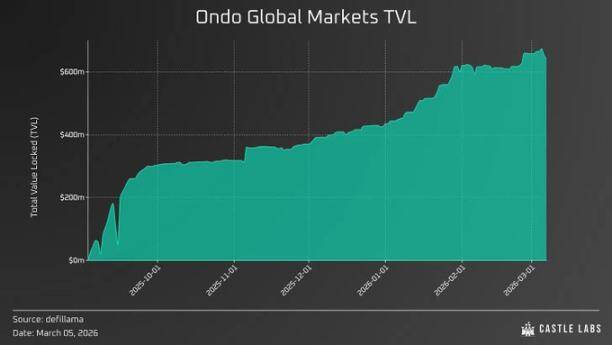
Ondo's tokenization model falls under what the industry refers to as indirect tokenization. The way it operates is that an offshore special purpose vehicle (SPV) purchases and holds the underlying stock on behalf of the token holders and then issues structured notes on-chain. These notes convey economic risk but do not confer legal ownership. Token holders have a creditor claim against the entity issuing Ondo, secured by the underlying stocks held in a segregated account at a U.S. registered broker-dealer.
The Ondo token is essentially a debt instrument secured by stocks rather than the stocks themselves. For instance, token holders do not enjoy voting rights possessed by the underlying stockholders.
Its main features are as follows:
- Uses institutional-grade tokenization standards, has an SPV with bankruptcy isolation, provides daily proof of reserves, employs U.S. registered custodians, and supports instant minting during market trading hours.
- If Apple (AAPL) stock has a trading price of 180 dollars on NASDAQ, a user can instantly mint AAPLon using 180 dollars worth of stablecoins and redeem at any time. Arbitrageurs maintain close anchoring of the on-chain price by balancing the price of tokenized stocks between decentralized exchanges (DEX) and Global Markets. The arbitrage loop is key to maintaining price stability. Ondo achieves atomic settlement: stablecoins enter, tokens are generated, completing the process in one step. If AAPLon trades at a price higher than 180 dollars on DEX, market makers will mint new tokens on Global Markets and sell them in the market to stabilize the premium; conversely, if the price is below 180 dollars, they will buy tokens on-chain and redeem them at face value, pocketing the difference.
Ondo tokens are fully backed by U.S. stocks and ETFs held at one or more regulated U.S. broker-dealers. Holders do not directly own the stocks but gain economic exposure through tokens, and dividends are automatically distributed.
There are no fees for minting or redeeming, and Ondo profits from the spread.
The platform initially launched over 100 assets on Ethereum, later expanded to BNB Chain and Solana, and recently announced Ondo Chain. Ondo Chain introduces a specific proof-of-stake (PoS) mechanism for staking real-world assets (RWA).
The current product catalog covers a wide range: including large-cap stocks (Apple AAPL, Tesla TSLA, Nvidia NVDA, Google GOOGL), exchange-traded funds (ETFs, such as SPY, QQQ), and commodities.
However, its geographic restrictions are very strict: U.S. citizens or residents are prohibited from participating. Ondo tokenized stocks are only available to accredited investors and KYC is mandatory.
Each protocol's tokenization process has its unique characteristics, warranting attention.
The self-clearing broker dealer Alpaca, based in the U.S., currently holds over 94% of tokenized U.S. stocks and ETFs by value, including Ondo's products. Alpaca's instant tokenization network provides physical minting and redemption channels. This means the underlying stocks are transferred directly between broker accounts instead of being liquidated and repurchased, thus eliminating slippage and maintaining stable token prices. Ondo has recently submitted a registration statement to the U.S. Securities and Exchange Commission (SEC); once effective, Global Markets will become the first transferable tokenized stock issuer subject to SEC reporting requirements. The SEC concluded a two-year investigation in November 2025 without recommending charges against Ondo. Subsequently, Ondo acquired SEC-registered broker-dealer Oasis Pro Markets to accelerate its expansion in the U.S. market.
Ondo believes that, compared to ideological purity, institutions value clear regulations and operational efficiency more.
xStocks: A Handy Tool for Retail Users
xStocks has found an ideal balance between cryptocurrency and traditional finance: it is easier to access than Ondo, more compliant than HIP-3, and open to all users.
xStocks launched in June 2025, offering over 60 tokenized stocks and ETFs. Each is backed 1:1 by securities held by Swiss or U.S. custodians under the supervision of Swiss regulators. Its tokens follow SPL or ERC-20 standards and can be freely transferred across different blockchains.
Its timely success prompted Kraken to acquire Backed in 2025. Currently, xStocks holds publicly traded equities valued at 250 million dollars, with Tesla stocks comprising more than a quarter of that.
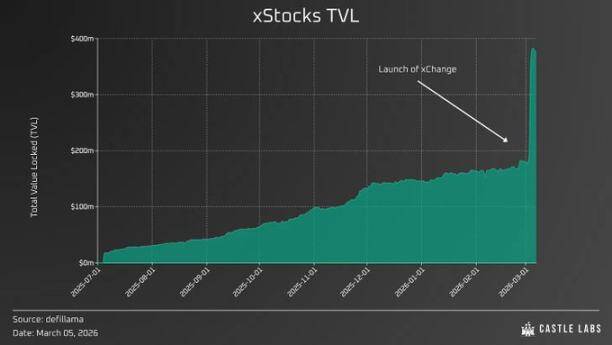
In this model, token holders do not own the stocks themselves but have a creditor claim against the issuer. Each xStock is supported 1:1 by the underlying stocks. Dividends are automatically reinvested in a model similar to Ondo: when the underlying stock pays dividends, holders’ wallets receive additional xStock tokens equal to the dividend amount.
Its tokenization mechanism compresses traditional structured finance models onto the blockchain. Legally speaking, each xStock is a tracking certificate categorized as an unregistered debt instrument. It is issued by a Jersey-registered SPV—Backed Assets Limited, which is a wholly-owned subsidiary of Swiss Backed Finance AG. The financial value of the token tracks the specific underlying stock or ETF but does not confer ownership or voting rights. Token holders are creditors of the issuer, not shareholders of the underlying company. This is similar to the indirect tokenization model adopted by Ondo, but the specific legal structures and post-issuance operational mechanisms differ.
The issuance process is as follows:
- Authorized participants (APs) submit minting requests through Alpaca's API, specifying the stock code, quantity, target blockchain, and receiving wallet address.
- As a U.S.-based self-clearing broker dealer, Alpaca verifies the request and transfers the corresponding stocks from the AP's broker account to the issuer's account.
- Once Backed confirms the receipt of the underlying securities, it mints corresponding xStock tokens on-chain and sends them to the AP's wallet.
The redemption process is the reverse: the AP destroys the tokens, and once Alpaca verifies the destruction, the corresponding stocks are transferred back to the AP's broker account. This physical transfer mechanism keeps the token price closely tied to the underlying stocks.
On March 5, xStocks launched xChange—a swap engine designed to directly pull capital market liquidity into DeFi during trading hours while maintaining on-chain liquidity pools over the weekend for price discovery.
The system consists of three parts:
- On-chain liquidity, supporting price discovery outside of trading hours.
- xChange itself, responsible for connecting DeFi and traditional finance during trading hours.
- xPort, for bringing assets on-chain.
xChange is supported by Chainlink oracles, is live on Solana's aggregator, and is set to launch on Ethereum's CoW Swap and 1inch. Integration with PancakeSwap, LiFi, DFlow, and Kamino Swap is also underway.
From a vertical angle, off-chain liquidity is being pulled into the blockchain through arbitrage, tightening the spreads in on-chain trading pools; from a horizontal perspective, it opens up access to a wide range of xStocks products without the need for prior liquidity injection for each stock code.
Its regulatory framework covers three jurisdictions:
- The issuing entity is located in Jersey and is regulated by the Jersey Financial Services Commission under the Borrowing Control Order.
- The prospectus has been approved by the Financial Market Authority (FMA) of Liechtenstein, allowing the tokens to circulate freely across EU countries.
- The tokenization operations are executed by Swiss Backed Finance AG.
The underlying collateral is stored in segregated accounts at regulated custodial banks in Switzerland and the U.S. (including InCore Bank and Maerki Baumann), governed by third-party account control agreements. Should token holders' rights be compromised, the collateral agents have the right to seize these collateral accounts.
The distribution channels are extensive, with stocks available on centralized exchanges such as Kraken, Bybit, and Gate. Kraken offers instant settlement, fractional share investments (with a minimum of 1 dollar), and competitive rates (0.1% maker fee, -0.02% rebate for takers).
Unlike Ondo, xStocks’ philosophy is to serve users where retail participants are. There are no specific KYC or whitelist restrictions, allowing anyone to purchase stocks and freely transfer them between self-custody wallets.
On February 25, xStocks’ trading volume reached 25 billion dollars.
Kraken has designated Alpaca as its preferred source and custodian partner for 1:1 underlying stocks. Alpaca's instant tokenization network provides real-time minting and redemption services for institutions. In early February 2026, Deutsche Börse's 360X platform began offering xStocks to its clients! This exchange is regulated by the German Federal Financial Supervisory Authority (BaFin) and the European Securities and Markets Authority (ESMA), representing the gold standard in Europe.
The core idea of xStocks is that retail users value self-custody and multi-chain access capabilities more than institutional custody. Naturally, they yearn for tools that provide them the same capabilities as institutions. Stock tokenization is the first step in narrowing the information asymmetry gap: now, anyone can immediately make buy or sell decisions before the market opens after listening to earnings calls.
Hyperliquid: Everything is Tradable
Hyperliquid promotes a vastly different model, simplifying the concept of tokenization into its most basic form: traders gain price exposure through going long or short on derivative contracts—nothing more, with no economic ownership of any underlying asset involved.
HIP-3 was activated in October 2025, allowing any user staking 500,000 HYPE to launch their own perpetual contract exchange on HyperCore. Deployers can set their own oracles, define leverage multiples, manage risks, and earn 50% of trading fees.
The operational mechanics here are fundamentally different. In the Ondo and xStocks models, real stocks are held in custodial accounts, and tokens are structured claims on these stocks; when holders destroy the tokens, the corresponding stocks are sold. The asset custody chain is as follows:
NASDAQ → Broker → Special Purpose Vehicle (SPV) → Blockchain
In contrast, the above chain does not exist in Hyperliquid’s model. The HIP-3 market operates as an independent isolated margin market and is not directly listed on Hyperliquid’s main interface; instead, it is entirely built and decided by third-party creators regarding which markets to provide and distribute. Oracles are a key variable: each deployer chooses their own price information sources and defines the handling rules for when the U.S. market is closed, but perpetual contracts still need to be traded 24 hours a day. During market closure periods, the exchange relies on internally generated pricing processed through an exponentially weighted moving average (EMA), protocol-defined price limits, and specific trust layers based on asset liquidity depth.
This is not tokenized stocks like Ondo Global Market. No stocks, no dividends, no redemption mechanisms, and no SPV—only contracts that track prices through oracles and settle in stablecoins or HYPE.
For instance, the XYZ100 deployed by trade.xyz tracks the value of the "market capitalization-weighted index of 100 large non-financial companies listed on U.S. exchanges." It has achieved a daily trading volume of 72 million dollars and 55 million dollars in open contracts within two weeks, ranking among the top ten on Hyperliquid; currently, its monthly trading volume has reached several billion dollars.
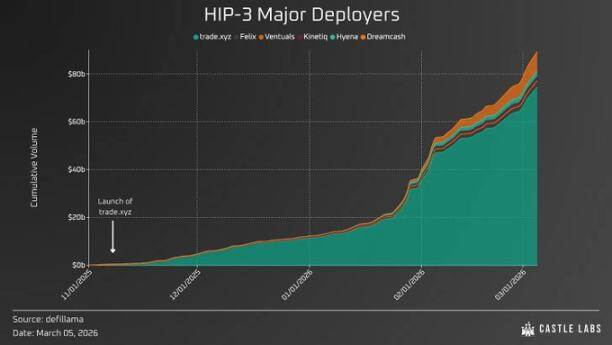
Hyperliquid's advantage lies in its decentralized market creation mechanism. Any builder meeting the 500,000 HYPE staking requirement can freely deploy three markets; for more markets, acquisition must go through a Dutch auction.
This has led to an explosion of various niche markets:
- trade.xyz (offering XYZ100, NVDA, TSLA, AAPL, GOOGL, etc.)
- Ventuals (providing perpetual contracts for SpaceX in the Pre-IPO stage)
- Felix (using USDH as collateral, with a 20% lower fee for takers)
- Kinetiq, a liquid staking protocol with monthly trading volumes over a billion dollars
Through HIP-3, Hyperliquid is becoming the AWS (Amazon Web Services) of the perpetual contract space: it no longer competes with each niche market but provides underlying infrastructure, allowing builders to compete against each other.
Just as AWS rents computing, storage, and networking resources to users, who can freely build applications on top of it, Hyperliquid achieves the same model with financial infrastructure:
- HyperCore provides order books, margin engines, and settlement layers.
- Deployers decide what assets to list, which oracles to use, what leverage to allow, and how to manage risk.
- The protocol itself does not care whether the market is tracking Tesla, Pre-IPO SpaceX, gold, or a basket of GPU manufacturers. It can charge a 50% share of fees regardless. This fundamentally differs from the business models of Ondo or xStocks, which must separately design structures, arrange custody, and build legal frameworks for each tokenized asset. Hyperliquid completely delegates these functions to builders, adopting a completely laissez-faire approach to tokenization.
The current market conditions are extremely favorable for perpetual contract DEXs, with no signs of slowing trading volume in 2026. Cryptocurrency speculators prioritize leverage and accessibility over ownership. However, as previously mentioned, this is partly due to cultural shifts yet to occur, as accessibility has historically been poor before the rise of tokenization in recent years.
However, the risks are far higher than those of tokenized stocks. In periods of high volatility or during market closure times, oracle failures, massive liquidations, or market makers withdrawing to avoid losses could lead to complete loss of principal. Unlike tokenized stocks, once a position is liquidated, the funds are permanently gone.
Institutional trading desks require auditable counterparties and clear regulatory provisions regarding derivative classifications, neither of which HIP-3 provides. For funds with compliance requirements, trading stock perpetual contracts on Hyperliquid would immediately raise questions from auditors and risk committees, especially regarding adherence to ISDA standards. Hyperliquid's current user base remains primarily retail, as it is open to the public. However, there are signs that this situation is changing. Ripple has integrated Hyperliquid into its institutional wholesale brokerage platform Prime, providing customers with access to perpetual contracts—this is yet another testament to the evolution of the times. Over the weekend of the Iran attack, the gold, silver, and oil markets on Hyperliquid remained available, making it increasingly a key reference for on-chain asset prices during non-trading hours.
Tokenizing Everything

Hyperliquid demonstrates that decentralized protocols can and will compete with traditional exchanges.
Other platforms are also following suit. Binance relaunched its tokenized stock business on February 24, 2026, partnering with Ondo to list 10 tokenized U.S. stocks and ETFs on Binance Alpha. This is the first time since July 2021, when issues regarding its compliance raised by the UK FCA and German BaFin led to a series of subsequent events, that Binance has offered such services again.
The current exclusion of the U.S. market is another point of controversy. Once the SEC approves domestic tokenized securities (given the momentum following the passage of the GENIUS Act, this is almost certain), the on-chain RWA sector is poised for explosive growth. Regardless of how sluggish the cryptocurrency market is, the overall value of stocks (listed or not) is on an upward trend.
The real competition lies in: when the U.S. officially approves it, who will control the infrastructure.
There is no direct competition between Hyperliquid and xStocks and Ondo, as they serve fundamentally different purposes. Ondo and xStocks provide economic exposure to stocks, their tokens are backed by real stocks, dividends are automatically reinvested, and there are redemption mechanisms tied to the underlying assets. Their core value lies in "access": holding, collateral lending, and utilizing portfolios of assets that could previously only be traded on traditional platforms like Schwab or Interactive Brokers. In contrast, Hyperliquid’s HIP-3 provides leverage and speculative tools: it is a synthetic contract that tracks prices without ownership of any underlying asset, has no custodial chain, and grants no rights to creditors. In some sense, this may be the ultimate manifestation of financial freedom—anyone with a wallet and funds can instantly access virtually any asset.
For retail users, this is not a binary choice, as each option brings different outcomes. A trader may hold xTSLA in a self-custody wallet as a mid-term position while simultaneously shorting TSLA-USDC on Hyperliquid to hedge against potential bad earnings risks, just as many traders do arbitrage between Polymarket, Pre-market, OTC point platforms, etc.
One is a long-term portfolio allocation, while the other is a short-term trading operation. The confusion arises because both are accessed through cryptocurrency wallets, both are priced in stablecoins, and both are broadly categorized under the concept of "tokenized stocks." But this comparison is one-sided: xStocks and Ondo face issuer and custodian risks (the SPV must maintain solvency, the collateral must remain segregated), while Hyperliquid faces oracle and liquidation risks (price information must be accurate, margin must be sufficient, or positions will disappear permanently). Thus, despite being part of a broad category, these various protocols are not directly comparable.
Hyperliquid’s advantages over the first two lie in speed and flexibility. The permissionless nature of HIP-3 means the market itself is the product—any asset with access to oracle price information can have a corresponding perpetual contracts market launched within hours without going through months of legal structuring like tokenized stock issuance.
These are three protocols that are virtually impossible to directly compare, each focusing on very specific areas to meet different user needs: competition among them is an illusion.
Ultimately, this is a discussion about choice, autonomy, and the spirit of innovation.
免责声明:本文章仅代表作者个人观点,不代表本平台的立场和观点。本文章仅供信息分享,不构成对任何人的任何投资建议。用户与作者之间的任何争议,与本平台无关。如网页中刊载的文章或图片涉及侵权,请提供相关的权利证明和身份证明发送邮件到support@aicoin.com,本平台相关工作人员将会进行核查。


