Abstract: From Petrodollars to the Meme Era, why did a single tweet cause global oil prices to plummet?
In 1974, then Secretary of State Henry Kissinger flew to Riyadh and struck a deal with Saudi Arabia that would change the world order: Saudi Arabia would sell oil only for dollars; and these dollars would flow back to purchase U.S. Treasury bonds.
At that time, Nixon had just severed the link between the dollar and gold, domestic inflation was out of control, dollar reserves were depleted, gold was flowing out in large quantities, and the Bretton Woods system collapsed. At that moment, many believed that the golden age of the dollar had come to an end.
However, the deal struck by Kissinger and Saudi Arabia established what would later be known as the "Petrodollar" system. It was this system that sustained the dollar's existence for another half-century after the gold standard collapsed.
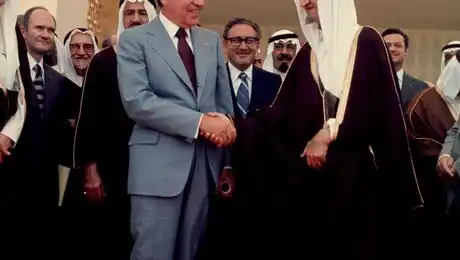
Because of this, whenever someone threatens to block oil routes, it is not just an energy issue for the United States, but a shock to the very foundation of the entire dollar system. This is why the narrow waterway of the Strait of Hormuz, which is as constricted as a throat, has been regarded by the United States for the past fifty years as a critical point that must be held, even to the extent of using military force if necessary.
This historical context helps us to understand today's situation well, fifty years later.
Early this morning, most people in China were still asleep. However, in the global crude oil futures market, a violent fluctuation lasting less than an hour had already evaporated hundreds of billions of dollars in market value.
The cause was a social media post.
U.S. Energy Secretary Chris Wright posted on the X platform: "The U.S. Navy has successfully escorted an oil tanker through the Strait of Hormuz to ensure that oil continues to flow into the global market."
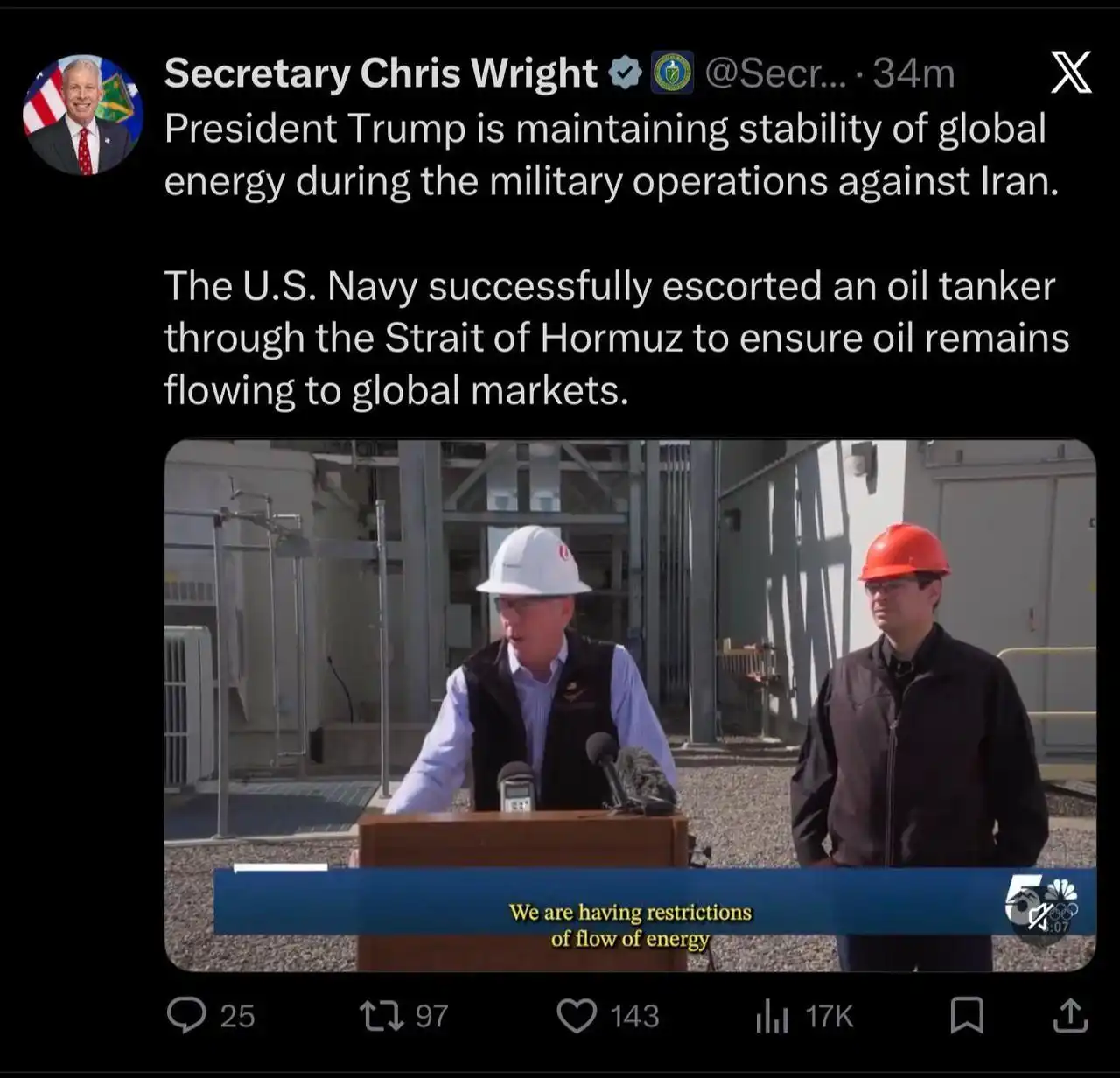
After this tweet was released, WTI crude oil prices plunged within minutes, dropping as much as 17%, and at one point fell below $80 per barrel. In the previous weeks, due to the tense situation in the Middle East, Brent crude had just surged from $70 to $120.
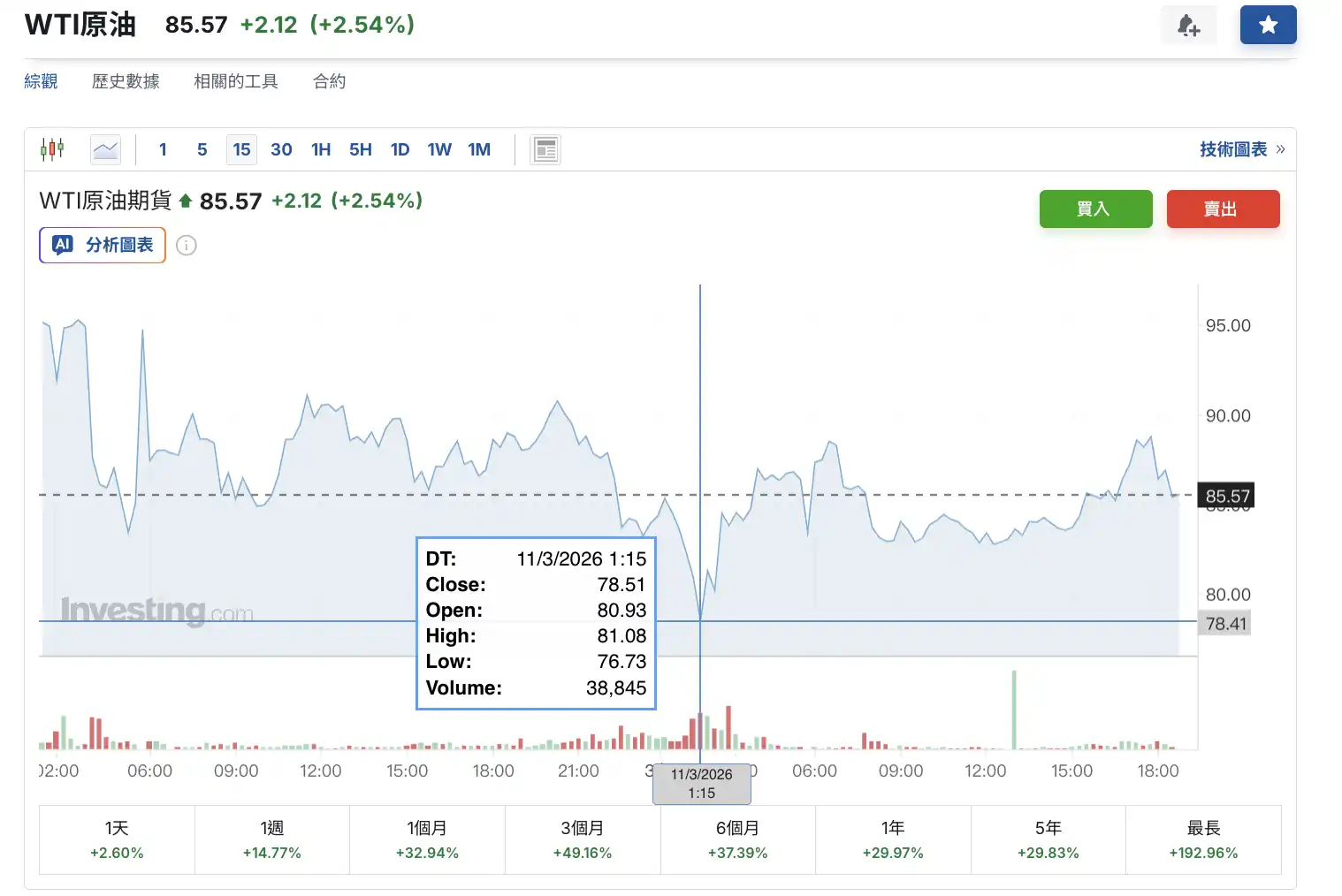
For traders betting on continued price increases, this moment was a nightmare.
However, the situation quickly reversed.
Less than an hour later, White House Press Secretary Karoline Leavitt urgently clarified at a press conference: the U.S. Navy is not currently escorting any oil tankers. Subsequently, Energy Secretary Chris Wright quietly deleted the post without any explanation. Oil prices then rebounded but could not return to their initial positions.
A post, from publication to deletion, took less than sixty minutes. Yet, the traces it left in the global financial market extend far beyond this one hour.
Since the end of February, when the U.S.-Iran conflict escalated, the game surrounding oil has intensified. Especially after Iran announced the blockade of the Strait of Hormuz, this narrow waterway, which carries about one-fifth of global oil transportation, suddenly closed, causing a huge shock to the global energy market. As the situation escalated, international oil prices surged from $70 to $120 per barrel within days, putting the energy market in a highly tense state.
Almost all traders were waiting for the same signal: when the Strait of Hormuz would reopen. In this collective anxiety, any slight movement could trigger severe price fluctuations. The rapid drop caused by the Energy Secretary's post was a concentrated embodiment of this sentiment.
So, why did oil prices drop 17% in just a few minutes? Because humans struggle to react that quickly, but algorithms can. A significant portion of trading volume in today's financial markets comes from high-frequency trading algorithms and AI trading systems. They scan the entire internet in real time, including social media accounts of government officials, capturing keywords and automatically placing orders.
That post contained three keywords: Navy, Escorted, Hormuz. The algorithms recognized these words and quickly drew a conclusion based on the contextual semantics: blockade lifted, supply restored, weakening the logic of rising oil prices.
As a result, the program immediately sold off.
All of this happened in about 0.003 seconds.
Algorithms do not make calls to confirm whether the oil tanker actually passed through the strait; they only recognize text and strive for speed. An unverified post, in this mechanism of "collective unconsciousness," was instantaneously exchanged for hundreds of billions of dollars in market value evaporation.
It takes hours for a real oil tanker to traverse the Strait of Hormuz, requires actual military escort, and bears costs and risks. However, a post about "escorting" can lead to dramatic price fluctuations in this commodity in just 0.003 seconds.
In other words, crude oil, once dominated by supply and demand fundamentals, inventory data, and production agreements, has now, to some extent, become little different from a meme.
During the last U.S. election, Trump and Musk keenly sensed that this is an information age, so one created Truth Social while the other bought Twitter.
As the information age has developed to today, the social media accounts of government officials have become one of the most sensitive information sources in the market. This also means that power itself has begun to possess certain meme-like attributes: extremely fast dissemination, highly concentrated emotions, and it can be easily misread and amplified.
Traditional policy information transmission is slow and rigorous. White House statements, State Department bulletins, and Pentagon press conferences naturally involve verification, proofreading, and multiple confirmations. But when officials directly post policy-related information on X, these processes are bypassed.
What we can foresee is that as we further delve into the AI Agent era, the speed of capturing information and executing trades will surge exponentially, causing sharp rises and falls to occur in milliseconds.
From a more macro perspective, this incident may indicate a more significant change: we are entering an era of "full-on asset memeification." Almost any financial asset could, at any moment, be driven by emotions, narratives, and social media.
Kissinger prolonged the life of the dollar with oil for fifty years. But he probably never imagined that one day oil itself would also become a meme.
No asset has a truly unbreakable fundamental moat. All moats are essentially built on some kind of consensus. And in the dual acceleration of social media and algorithmic trading, this consensus is more fragile and dangerous than ever before.
In a sense, this might also be a victory for the meme.
免责声明:本文章仅代表作者个人观点,不代表本平台的立场和观点。本文章仅供信息分享,不构成对任何人的任何投资建议。用户与作者之间的任何争议,与本平台无关。如网页中刊载的文章或图片涉及侵权,请提供相关的权利证明和身份证明发送邮件到support@aicoin.com,本平台相关工作人员将会进行核查。


