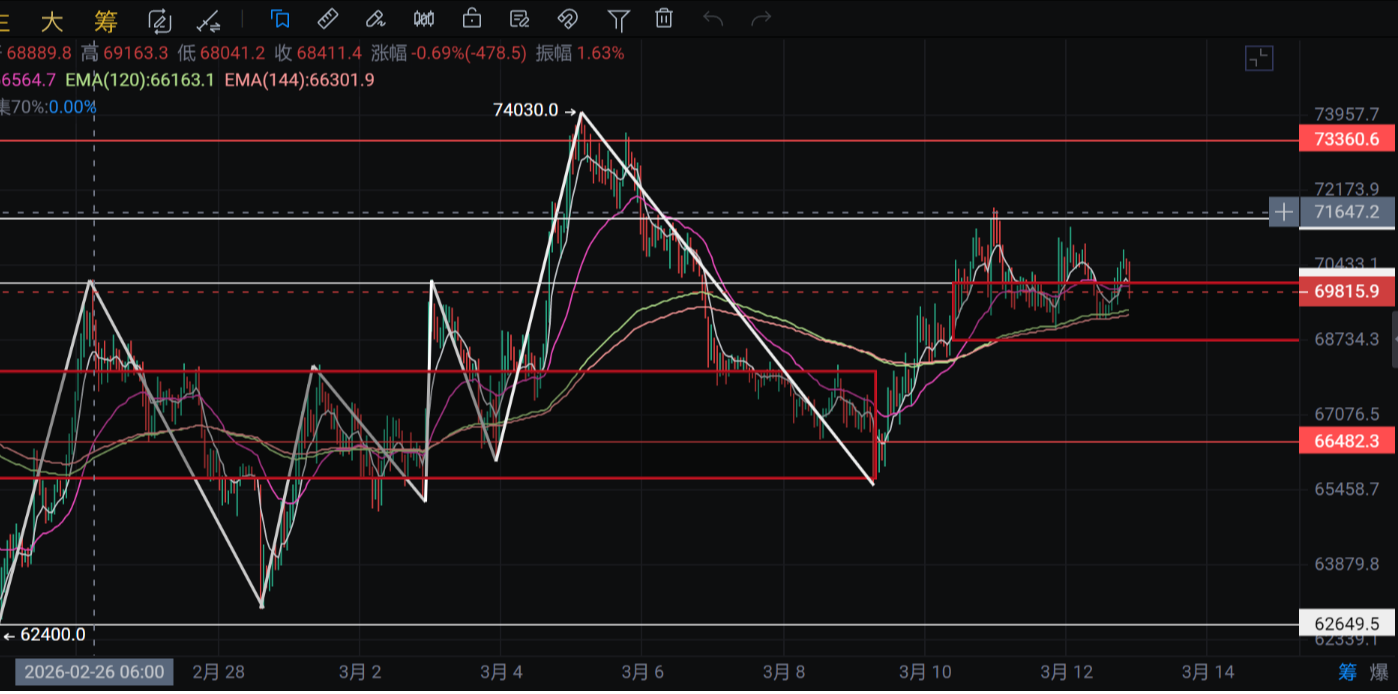
This week in East Eight Zone time, global macro uncertainty and risk sentiment have significantly intensified, with the market repeatedly pricing in geopolitical frictions, energy shocks, and fluctuating interest rate expectations. In an atmosphere where traditional safe-havens and risk assets are simultaneously under pressure, the weakening of gold and the pressure on U.S. tech stocks contrast sharply with Bitcoin's upward trend. According to a single source statistic, Bitcoin recorded an approximate 7% increase in this round of volatility, while gold declined about 2% and the Nasdaq 100 Index dropped approximately 0.5%. This divergence from traditional assets raises a sharp question: Is Bitcoin being reinterpreted by the market as a new macro hedge asset, reinforcing its narratives of "digital gold" and "resistance to macro shocks"?
Gold Weakens, Nasdaq Pressured, Bitcoin's Counter-Trend
● Performance comparison is clear: According to data from a single source, during this round of macro turmoil, Bitcoin's approximate 7% cumulative increase sharply contrasts with gold's approximate 2% decline and the Nasdaq 100's approximate 0.5% pullback. The traditional safe-haven represented by gold and the tech stock index representing growth expectations are both under pressure, while Bitcoin shows a completely different price curve, providing practical material for discussions on "new macro hedging tools."
● Funds shifting logic: From the perspective of fund behavior, one end sees a clear cooling of risk appetite towards tech stocks, while on the other end, gold has failed to fully serve its safe-haven role due to the intertwining of inflation and interest rate expectations, prompting some funds to accelerate their movement between various assets. In this misalignment, Bitcoin is seen by some investors as a high-elasticity risk asset, while another group views it as a store of value resistant to inflation and censorship, with the dual positioning amplifying its price elasticity.
● Data scope limitations: It needs to be emphasized that the aforementioned 7% increase in Bitcoin, 2% pullback in gold, and 0.5% drop in the Nasdaq 100 all come from a single statistical source, the sample period is relatively limited and has not differentiated between different trading periods and pricing bases. Therefore, these data are more useful for illustrating trends and structural differences rather than arriving at strict statistical conclusions; readers should remain cautious regarding statistical scopes and time windows when interpreting these figures.
Funds Voting with Their Feet: From Retail Narratives to "Quasi-Institutional" Exploration
● Industry discourse reinforcement: In this round of macro fluctuations, industry opinion leaders such as Arthur Hayes have publicly emphasized multiple times that Bitcoin has shown stronger performance in the context of geopolitical and energy shocks compared to gold and U.S. tech stocks. Such highly attentive public statements reinforce the market narrative of "Bitcoin can resist macro shocks," providing a new story framework for retail and high-risk appetite investors, and further amplifying this recognition in social media and derivatives markets.
● Quasi-institutional allocation samples: Unlike the early days dominated by retail investors, we can now observe the exploratory layouts of some "quasi-institutional" entities. For example, Stack BTC Plc, in which former UK Chancellor Kwasi Kwarteng is involved, recently chose to increase its Bitcoin holdings, and the U.S. listed company Exodus Movement holds a substantial amount of Bitcoin and some Ethereum in its long-term balance sheet. These cases indicate that Bitcoin is gradually transitioning from a pure trading target to a strategic asset and treasury allocation tool in the views of some enterprises.
● The emergence of marginal discourse power: Although these entities still remain marginal compared to traditional hedge funds, insurance companies, and large pension funds, their absolute holding volumes and allocation proportions are limited, but their discourse power on the narrative level is rising. In media reports, regulatory discussions, and secondary market sentiments, they are often seen as "pioneer samples," and their attitude changes provide a certain directional significance for whether larger-scale institutions consider Bitcoin as a macro allocation option in the future.
National-Level Players Entering the Scene: Bhutan Using Bitcoin to Tell "National Strategy"
● Bhutan's "Extreme City" experiment: At the sovereign level, the Bhutanese government has taken a highly symbolic path—leading state-directed Bitcoin mining as the underlying cash flow and infrastructure, promoting a Special Administrative Zone project named "Extreme City." By binding computing power, green energy, and regional development, Bhutan seeks to transform Bitcoin from a mere financial speculation target into a means of attracting foreign investment, developing the digital economy, and reshaping the national brand.
● Sovereign participation amplifying legitimacy: When a sovereign nation participates in mining and holding Bitcoin in an official capacity, the signal conveyed is not only an acknowledgment of the asset's technology and economic model but also objectively amplifies the narrative of its "legitimacy" and "resistance to censorship." Sovereign endorsement means that some cross-border capital can bypass certain traditional financial intermediaries and geopolitical constraints within the Bitcoin network, resonating with the demands for asset security and fund flow in the current macro risk environment.
● From marginal to symbolic: Compared to the evolutionary path of traditional safe-haven assets, gold often completes the recognition of "national asset" through central bank reserves and sovereign fund allocations. Currently, Bitcoin has yet to reach such a broad extent, but cases like Bhutan have already pushed it from purely civilian and institutional assets to a symbolic coordinate at the national level. It is no longer just a line item on individual investors' balance sheets but has begun to appear in the context of national development narratives and diplomatic soft power.
Macro Hedging Narratives Gaining Popularity, But Evidence Remains Thin
● Popular claims awaiting validation: Currently in the market, the claim that "Bitcoin is being redefined as a new generation of macro hedge asset, even a safe-haven asset" is rapidly gaining traction, frequently appearing in social media and research reports. However, this is closer to an emerging market narrative rather than a fact that has been tested by long historical data and multiple rounds of crises. It influences pricing at the emotional and expectation levels but still needs to be clearly labeled as a "view awaiting validation."
● Lack of systematic accumulation evidence: In traditional markets, determining whether an asset has macro hedging attributes usually requires observing institutional systematic allocation behavior during periods of soaring volatility or extreme events. Currently, publicly available information is insufficient to prove that large institutions significantly increase their Bitcoin holdings during such times. More specifically, the assertion of "institutions uniformly buying BTC when volatility indicators soar" lacks reliable statistical and disclosure support; related conclusions should be approached with caution to avoid misinterpreting individual cases or short-term price differences as structural rules.
● Structural constraints still exist: Bitcoin's total market capitalization, available floating chips, and market depth remain limited compared to the global traditional asset pool, with liquidity highly concentrated in a few trading platforms and addresses. In terms of time samples, it has experienced a limited number of macro extreme event cycles, with each round having significantly different backgrounds and regulatory environments. In such a structure, prematurely concluding that Bitcoin "has already established stable safe-haven attributes" is too early; a more reasonable statement is that Bitcoin is being experimented with as a potential macro hedging tool by some market participants, and its attributes are still dynamically shaping.
Resilience of Microstructure: Who Supports the Price Curve
● Market structure's supporting power: Bitcoin's ability to maintain an upward trend during this round of macro fluctuations cannot be separated from the support of the micro trading structure. The depth and matching efficiency of mainstream exchanges allow large orders to be executed with relatively controllable slippage; the linkage between perpetual contracts and spot trading facilitates rapid price return to the mainstream range under the influence of hedging and arbitrage forces; changes in coin holding concentration also invisibly affect the elasticity of selling and buying pressures.
● Long-term holders and market-making buffers: Without introducing specific trading volume and leverage ratio figures, it can be observed that long-term holders tend to reduce their willingness to sell during high volatility phases, while professional market-making funds provide continuous liquidity through bilateral quotes and cross-product hedging. This dynamic interplay of one quiet and one active forces ensures that macro-level emotional shocks do not directly evolve into unilateral liquidity crises, and after local pullbacks, conditions remain for subsequent buying pressure absorption, creating a perception of "not falling through and bouncing back quickly."
● Differences with gold and the Nasdaq: Compared to gold and the Nasdaq, which have clear trading hours and are more strongly influenced by emotions during concentrated trading periods, Bitcoin's continuous trading 7×24 hours ensures liquidity rotates across different global time zones, with a more diversified leverage structure. This means that under the same macro news shock, Bitcoin prices can quickly repricing through more frequent trading and more flexible leverage adjustments. For external observers, this high-frequency self-correction is intuitively perceived as "resilience" and speed of response in pricing.
The Safe-Haven Label Has Yet to Be Stamped, the Price Has Already Provided the Answer
In this round of macro turmoil, Bitcoin's approximate 7% increase has significantly outperformed gold, which recorded an approximate 2% decline, and the Nasdaq 100 Index, which fell about 0.5%, presenting a factual data scenario. Behind this is the swinging of funds between traditional assets, a repricing above Bitcoin, and the narrative push from industry figures such as Arthur Hayes alongside the exploratory layouts of entities like Stack BTC Plc and Exodus. The price curve and market discourse have formed a rare resonance at this moment.
Meanwhile, the gradual involvement from national and institutional levels—from Bhutan's state-led mining driving the "Extreme City" Special Administrative Zone to some enterprises and "quasi-institutions" incorporating Bitcoin into their treasury—continues to inject new imaginative dimensions into the "macro hedging" narrative. However, the lack of systematic and transparent allocation data, as well as the absence of long-term samples across multiple rounds of extreme events, puts the statement that "Bitcoin has become a new generation macro hedging asset" still on the edge of evidence.
In the future, whether Bitcoin can truly wear the "macro hedging" hat will depend on two key dimensions: first, whether it can continue to show excess performance relative to traditional assets during more complex and even extreme macro events; second, the real allocation ratios, behavioral patterns, and disclosure transparency of institutional and sovereign capital can provide reproducible and quantifiable support for such performance. Until then, Bitcoin may be seen as an ongoing macro experiment rather than a settled safe-haven answer.
Join our community, let's discuss and grow stronger together!
Official Telegram community: https://t.me/aicoincn
AiCoin Chinese Twitter: https://x.com/AiCoinzh
OKX Benefits Group: https://aicoin.com/link/chat?cid=l61eM4owQ
Binance Benefits Group: https://aicoin.com/link/chat?cid=ynrd1P6Z
免责声明:本文章仅代表作者个人观点,不代表本平台的立场和观点。本文章仅供信息分享,不构成对任何人的任何投资建议。用户与作者之间的任何争议,与本平台无关。如网页中刊载的文章或图片涉及侵权,请提供相关的权利证明和身份证明发送邮件到support@aicoin.com,本平台相关工作人员将会进行核查。