Written by: Yokiiiya
If in the future the AI industry has only a few model companies, then the vast majority of entrepreneurial opportunities will likely emerge at the wrapper layer.
Recently, while training my own OpenClaw (lobster), I increasingly feel that "wrapping" is truly a good business.
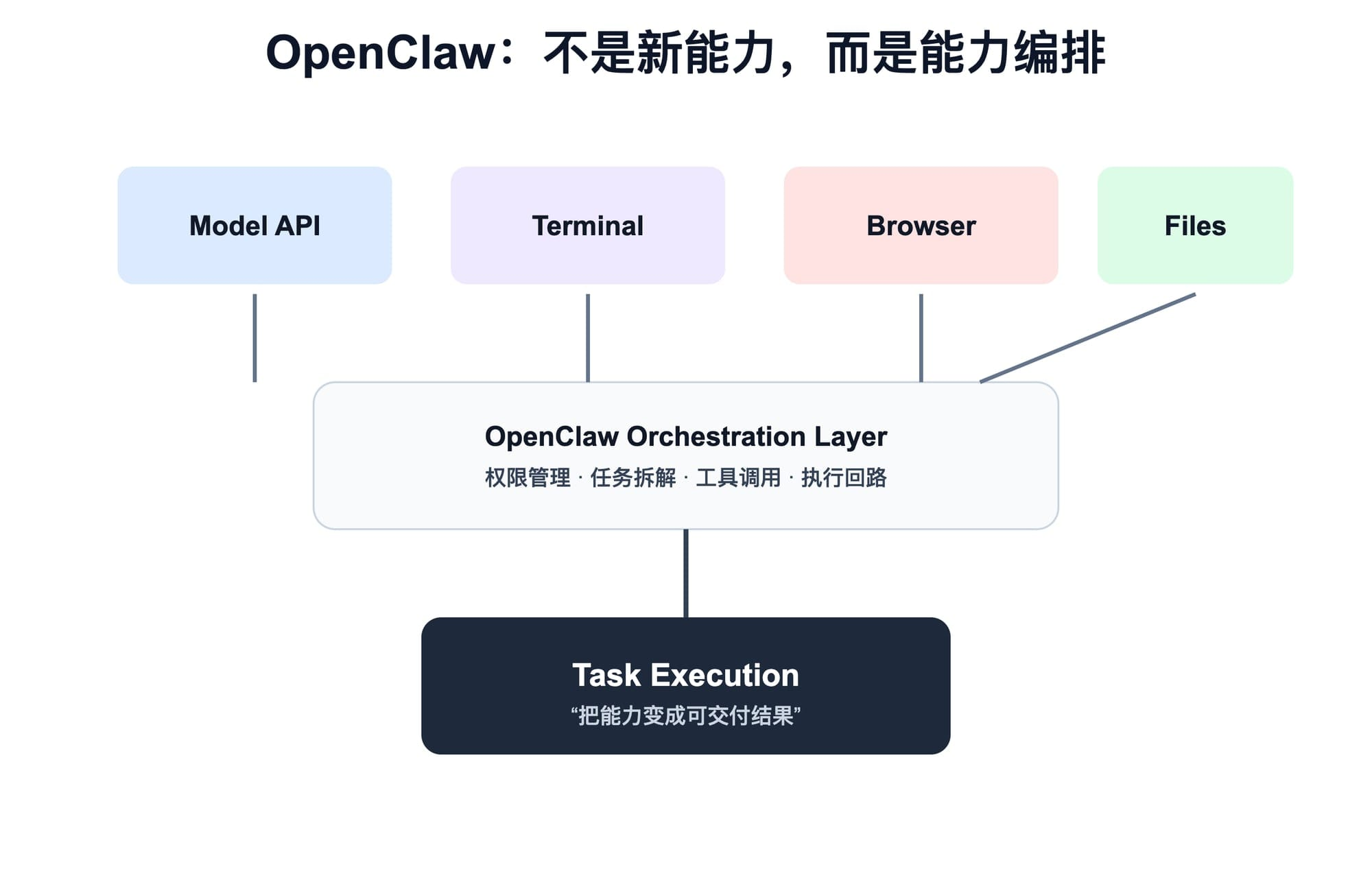
From a technical structure perspective, OpenClaw is essentially a wrapper of Claude Code. It doesn't train a new model and has no new algorithm breakthroughs. The underlying capabilities are still provided by Anthropic's Claude and other foundational large models. What OpenClaw does is quite clear: it rearranges model capabilities, terminal tools, browser operations, and local file systems together, allowing AI to perform tasks on a computer. Writing code, running commands, modifying files, automating tasks.
These capabilities already exist. It's just that most people find it difficult to piece them together into a stable operating system. When I realized this, a question began to become increasingly interesting: why can wrappers be so popular?
To be frank, in the past, I actually underestimated wrapper businesses. Because on the surface, they look a lot like "wrapping": others provide the capabilities, and you just add another layer. But recently, I increasingly feel that maybe in the commercial world, most of the time, the competition is not about the capabilities themselves. Rather, it is about something else: who can turn those capabilities into products faster. There has always been a reality in the tech world: the distribution of capabilities is uneven. Some have the capabilities but don't know how to use them. Others need capabilities but find them difficult to access. As technology becomes more complex and information redundant, this asymmetry will only become more pronounced. Thus, a type of product emerges, specifically doing one thing: turning complex capabilities into products that ordinary people can directly use.
From this perspective, wrappers are not simply "wrapping." What they are doing is something that has always been very valuable in the commercial world: reducing the friction cost of capability transfer. When this is taken to the extreme, a wrapper is no longer just a tool but can become a genuine business.
The explosive popularity of OpenClaw may serve as a reminder that in the AI era, capabilities are becoming concentrated in the hands of a few model companies.
However, business opportunities are likely spreading to another layer. Capabilities belong to models; business belongs to wrappers.
What is a Wrapper
In the tech industry, a wrapper is a very common product form. Simply put, it refers to a product that does not create foundational capabilities but reorganizes existing capabilities into a more user-friendly system.
In other words, the value of a wrapper lies not in "invention" but in three things: reducing complexity, shortening paths, and increasing realization efficiency.
If we look back at internet history, many successful companies have actually been doing similar things.
For instance, Stripe did not invent payment systems. Banking clearing, credit card networks, and payment settlement systems have long existed. What Stripe does is encapsulate these complex systems into simple APIs. Developers can complete payment functions with just a few lines of code.
Similarly, Shopify did not create e-commerce. Order management, inventory systems, payments, and logistics already existed. What Shopify does is integrate these capabilities into a complete SaaS platform, allowing any merchant to quickly open an online store.
Moreover, Vercel did not invent cloud computing. Servers, CDN, and storage systems already existed. Vercel transforms complex deployment processes into a minimalist experience: a single git push deploys a website automatically.
These companies share a commonality: they did not create new capabilities; rather, they made complex capabilities easy to use. This is the core value of wrappers.
The AI industry is beginning to exhibit the same structure. Underlying capabilities are becoming increasingly concentrated in a few model companies, such as OpenAI and Anthropic. These companies provide the capability layer: reasoning abilities, code generation, text generation, multimodal comprehension, but for most users, merely having model capabilities is not enough. What users truly need is a system that can complete tasks.
And this is precisely why wrappers arise. Products like OpenClaw fundamentally do one thing: embed model capabilities into specific workflows. Terminals, browsers, file systems, coding execution environments… these capabilities already exist, but ordinary users find it challenging to combine them into a stable and usable process.
OpenClaw encapsulates these capabilities into a task-executing system. This is why in the AI era, there will be an increasing number of wrappers. Because as foundational capabilities grow stronger, new problems arise: how to turn these capabilities into products.
Why OpenClaw Became Popular So Suddenly
If it were only about the concept of AI agent, OpenClaw is not the first. In the past year, many similar projects have emerged: auto-writing code, auto-operating browsers, auto-executing tasks. In the tech circle, these things are not uncommon. But why did OpenClaw break through? Because it hit three things at once.
First, it made AI truly "move" for the first time
Most AI product experiences in the past were static. Users input a sentence, and AI returns a piece of text. Even if the model's capabilities are strong, it ultimately remains conversational interaction. But OpenClaw is different; it feels less like "it will answer" and more like "it will do things." Writing code, running commands, editing files, opening web pages, executing tasks. Once these actions really happen, the perception of AI changes.
It is no longer just a chatbot but resembles a working agent. This is a very crucial change because for most users, the visual impact of executing tasks far outweighs the intellectual impact of text generation.
You may not forward a screenshot of a response, but you might be shocked by a recording of "AI automatically opening a terminal, automatically changing code, automatically running a project." This forms the first layer of its virality.
Second, it compressed complex technology into a product experience
If you attempt to set up an AI agent environment yourself, you'll find the process incredibly complex. You need to configure model APIs, install runtime environments, configure tool calls, and manage system permissions. For ordinary users, this is not just "a bit troublesome" but something they would fundamentally avoid doing.
The most critical thing OpenClaw did is transforming these complex steps from being a "technical setup problem" into a "product integration problem." This is the archetypal value of wrappers: it's not about making capabilities stronger but about making the invocation of capabilities simpler.
Many tech products fail to take off not because their capabilities are insufficient, but because the usage paths are too long. What OpenClaw got right was turning a set of processes that originally belonged only to technical players into something broader users could handle.
Third, it is naturally suited for dissemination
Many people underestimate this point. Whether a product can become popular depends not only on its value but also on its demonstrability. OpenClaw is incredibly suitable for demos. AI auto-writing code, auto-executing commands, auto-debugging, auto-completing tasks. The entire process itself is content. It's not like many SaaS products, which require lengthy explanations for users to understand their value. Its value can be directly seen.
Thus the growth flywheel emerges:
AI moves → Strong visual impact → More recording shares → More people want to try → The topic's momentum continues to amplify.
Therefore, the explosion of OpenClaw is fundamentally not because it suddenly made AI smarter. But because it was the first to translate "capabilities" into a product experience that the public can understand, demonstrate, and imitate.
Why Will There Be a Large Number of Wrappers in the AI Era
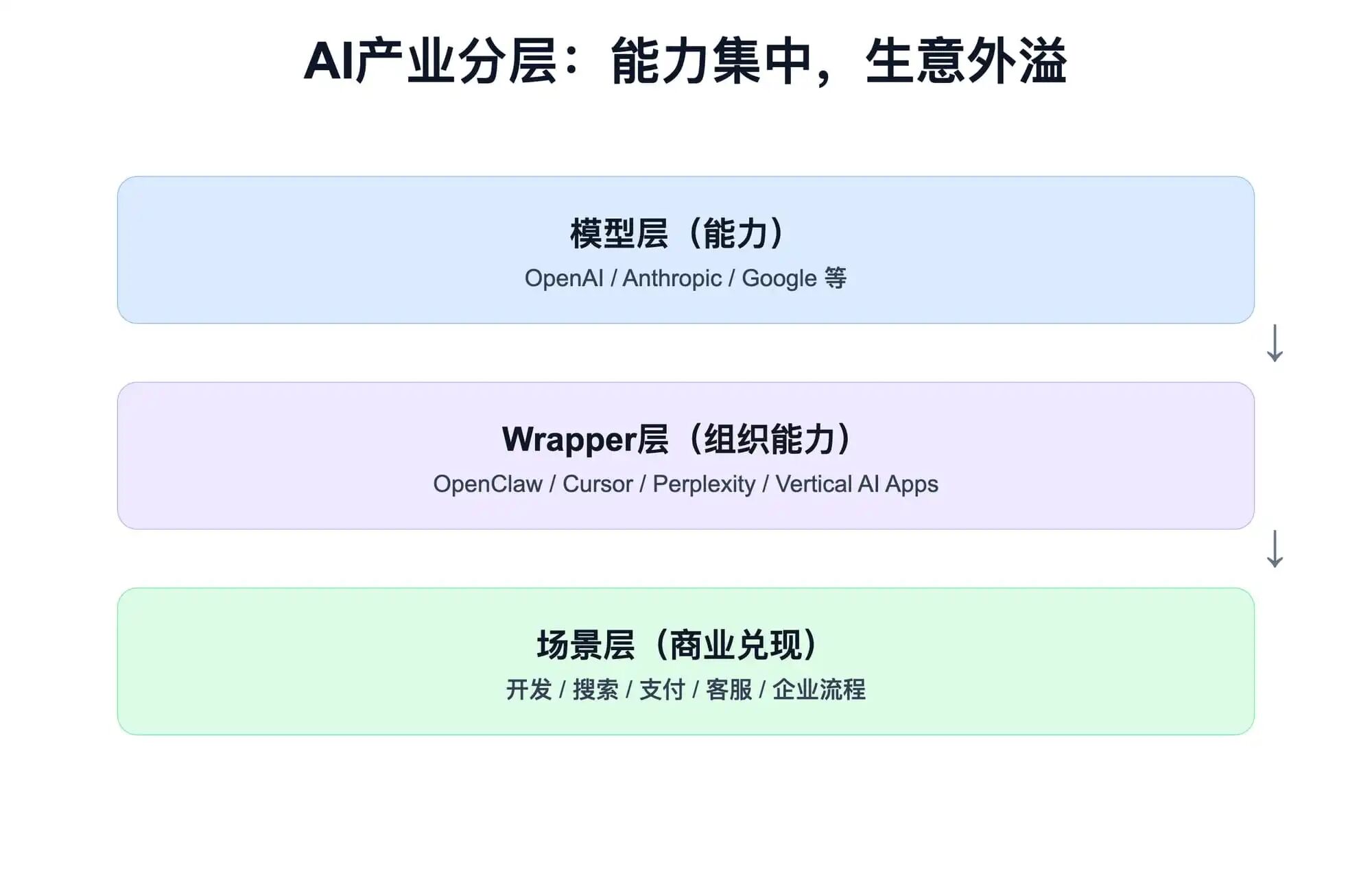
The explosive popularity of OpenClaw is actually just a signal. If we dissect the AI industry, a very clear layered structure is forming.
At the bottom layer is the model layer. Companies at this layer are responsible for training and maintaining foundational models, such as OpenAI and Anthropic. They solve the question of where capabilities come from. The stronger the models, the stronger the reasoning capabilities and generation abilities, enabling a higher overall capability limit for the industry. But the problem is, as foundational capabilities grow stronger, another question emerges: how will these capabilities be truly used.
The vast majority of users will not directly call model APIs or build complex toolchains themselves. What they need is a product that can complete tasks. Thus, naturally, a new layer of structure appears above the model layer: the wrapper layer. This layer organizes foundational capabilities into systems that can be used directly. For example:
AI writes code → becomes AI IDE, such as Cursor embedding code generation, editing, and understanding capabilities directly into the development environment.
AI searches → becomes AI search engines, such as Perplexity AI, reconstructing the search experience from "keyword retrieval" to "directly providing answers."
AI office → becomes AI workspace, such as Notion AI integrating writing, summarization, and knowledge organization capabilities into daily workflows.
AI agent → becomes software for automatically executing tasks, such as OpenClaw or Manus allowing AI to call tools, execute commands, and perform complex tasks.
From an industrial structure perspective, this is actually a recurring pattern in the tech industry. Foundational technologies become increasingly concentrated. But the product forms at the application layer become more diverse. The cloud computing era is similar. There are not many companies that provide foundational capabilities, such as Amazon Web Services and Google Cloud. But above these infrastructures, a large number of SaaS companies have emerged. AI will likely follow a similar structure: there won't be many model companies, but a large batch of wrapper companies will appear.
Because models address the capability problem, whereas wrappers address the scenario problem. Capabilities can consolidate, but scenarios will always be dispersed. Each specific scenario may give birth to new product opportunities.
But not all Wrappers are Good Businesses
As model capabilities become stronger, the number of wrappers will surely increase rapidly. Because as long as a model provides an API, any team can package these capabilities into a product. This is also why a large number of tools appeared in the AI industry in the past year: chat clients, prompt tools, AI aggregation platforms, various agent frameworks. But from a business structure perspective, most wrappers will quickly disappear.
The reason is simple: if a product is merely API + UI, it has almost no real barriers. Model companies can do it themselves, platform companies can replicate it, and users can easily switch. The lifecycle of such wrappers is usually very short. Truly valuable wrappers often possess three characteristics.

First, embed into core workflows.
When a product becomes a part of the user's daily work, it is no longer just a tool. For example, Cursor is not just a simple AI code-writing tool but deeply embeds AI into the development process. Developers do not need to leave the IDE to call AI; AI becomes part of the development environment.
Second, master irreplaceable contextual data.
Many AI products merely call models but do not own the user's context. Truly valuable wrappers often understand the user's work environment, such as code repositories, corporate documents, or business data. These contexts gradually form the product's moat.
Third, redefine the interaction method.
The most successful wrappers often change how users interact with software. For example: IDE → AI IDE, search → AI search, office software → AI workspace. When the interaction method changes, users gradually form new usage habits. Once these habits are established, the transition costs will follow. This is why some wrappers ultimately evolve from tools to new product entry points.
If you look at these three points together, you'll find:
• Low-value wrappers: solve "can it be used."
• High-value wrappers: solve "can it be continuously used, is it indispensable, and irreplaceable."
Another Signal from OpenClaw
The explosive popularity of OpenClaw has also brought about a very interesting phenomenon: many people have started purchasing Mac minis to deploy local models and build their own AI agents.
From a productivity standpoint, this is somewhat counterintuitive. Because in many cases, directly using cloud models is actually more convenient and stable. Yet still, a large number of users are willing to spend time setting up local environments. This reflects another change in AI: AI is not just a tool; it is also becoming a type of technology consumer product.
One very important reason why OpenClaw became popular is here. It can not only showcase capabilities but also be personally deployed. AI auto-writing code, auto-executing commands, and auto-completing tasks are content in themselves, and also material for dissemination.
When a technology can be both "seen" and "owned," it easily transitions from a tool to a new technological culture. Many people deploy OpenClaw not just for efficiency but to experience a new form of technology. Meanwhile, local agents also present a very intuitive feeling: AI belongs to you.
When AI can run on your computer, execute tasks, and manage files, it is no longer just a remote service but much more like a tool that truly enters the personal computing environment. The significance of this may be more worthy of attention than OpenClaw itself. Because it shows that AI is moving from "online service" to "personal system," and surrounding this change, new product forms and new business opportunities are just beginning, which could also redefine the future of software forms.
Capabilities belong to models; business belongs to Wrappers
The explosive popularity of OpenClaw is essentially not a technical breakthrough. It is more like a signal: AI is moving from the model competition stage to the product organization stage.
Model companies define the upper limit of capabilities, while wrapper companies determine the speed of capability realization. In the future, a large number of wrappers will emerge, but only a few will make it to the end—it is essential that they embed capabilities into workflows, solidify products as habits, and then upgrade those habits into entry points.
Capabilities belong to models; business belongs to wrappers. And what truly decides how big a company can grow is who can complete this chain more quickly.

免责声明:本文章仅代表作者个人观点,不代表本平台的立场和观点。本文章仅供信息分享,不构成对任何人的任何投资建议。用户与作者之间的任何争议,与本平台无关。如网页中刊载的文章或图片涉及侵权,请提供相关的权利证明和身份证明发送邮件到support@aicoin.com,本平台相关工作人员将会进行核查。