In the world of cryptocurrencies, losses of tens of millions of dollars usually indicate contract hacks, manipulated oracles, or attacks on protocols, but such amounts rarely occur in individual and ordinary DEX trading behavior. On March 13, a user lost 50.43 million dollars in just 12 seconds without any attack, based solely on a single on-chain transaction.
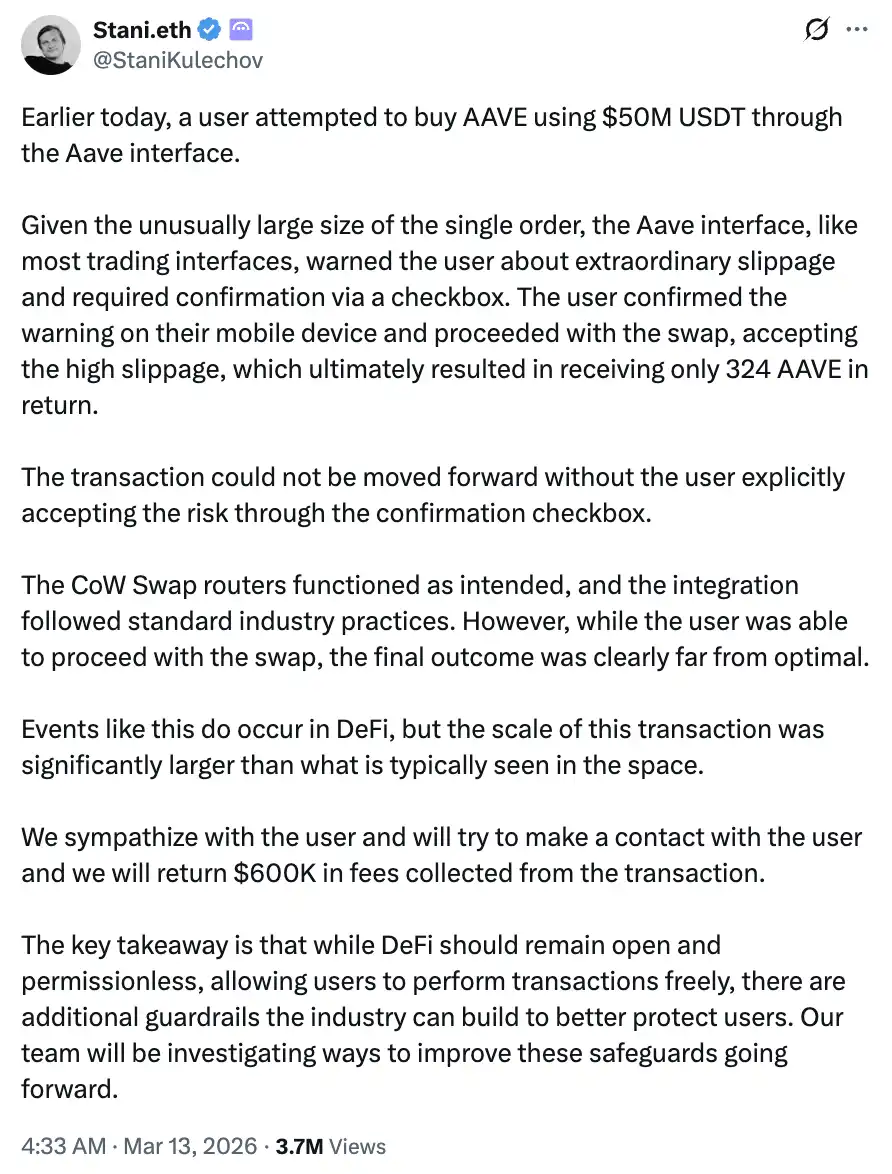
The details are not complex. The user attempted to exchange 50.43 million dollars worth of USDT for AAVE tokens through the Aave front-end interface. The Aave interface displayed a warning of a 99% price impact and required the user to check a confirmation box to proceed. The user checked the confirmation on his phone, and the transaction was executed. In the end, he only received 324 AAVE, worth about 36,100 dollars.
This equates to 154,000 dollars per AAVE, while the market price was only 111 dollars.
Aave founder Stani Kulechov later tweeted expressing sympathy, promising to refund about 600,000 dollars in frontend fees charged during the trade, and claimed to "investigate how to improve these protection measures." However, the loss of 50 million dollars was already a fait accompli, and on-chain irreversible.
This article will not repeat the headlines you have already seen; what we want to trace is where this 50 million dollars went? Who consumed it in 12 seconds? And why would someone do this with 50 million dollars?
Three Routes, Gradually Evaporating
This transaction was initiated through the "Collateral Swap" function on Aave's front end, executed by a solver from the CoW Protocol. On-chain data shows that the entire transaction was split into three steps.
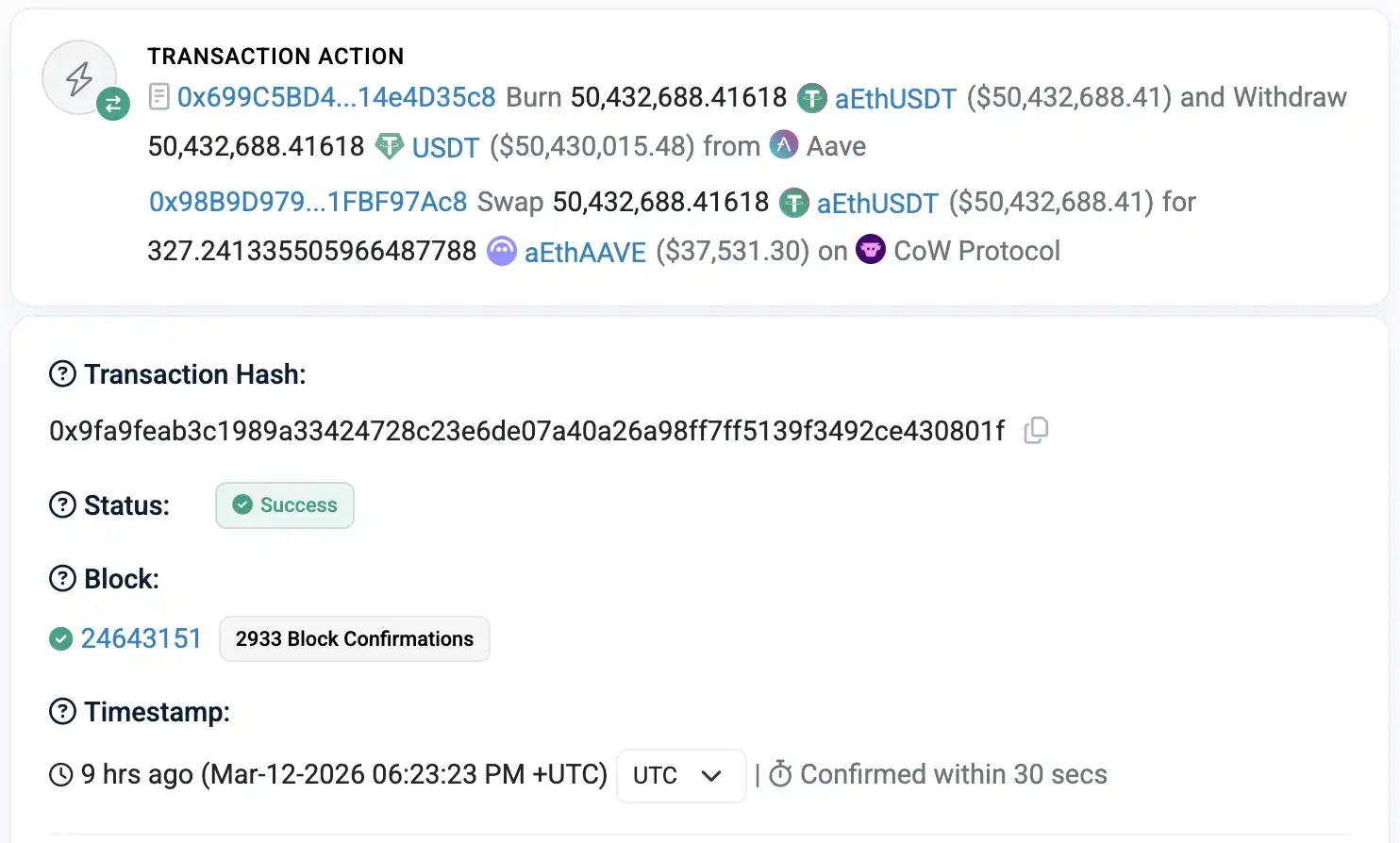
In the first step, the aEthUSDT (yield-bearing USDT certificate) held by the user on Aave V3 was redeemed for 50.43 million USDT. This step was an internal redemption operation of the protocol, and the funds were fully credited without any loss.
In the second step, 50.43 million USDT was pushed into the USDT/WETH trading pool on Uniswap V3. Based on the market price at the time, this money should have been converted to approximately 24,600 WETH. However, due to the order size far exceeding the depth of pool liquidity, only 17,958 WETH were actually exchanged, worth about 37.07 million dollars. Just this step alone incurred a loss of about 13.36 million dollars. These losses were not fees "deducted" but were the direct result of price impact. When you dump too much USDT into the pool, the WETH in the pool becomes increasingly "expensive," and you lose more as you buy into the slippage. This price difference was passively absorbed by liquidity providers (LPs) in the pool.
The third step was the core of the disaster. The solver from CoW Protocol pushed all 17,958 WETH (worth 37.07 million dollars) into a SushiSwap AAVE/WETH trading pool. How shallow is this pool? The total liquidity was only about 73,000 dollars.
Dumping 37 million dollars into a 73,000 dollar pool is like trying to pour the entire Pacific Ocean into a swimming pool. The pricing curve of AMM (automated market maker) nearly vertically rises under such extreme proportions, and the AAVE tokens in the pool were "purchased" at an astronomical price of 154,000 dollars each, while the market price was only 111 dollars.
In the end, 17,958 WETH exchanged for 331 AAVE, worth about 36,700 dollars. The loss for this step was about 37.03 million dollars, with a price impact rate of 99.9%. These 331 AAVE were returned to Aave V3, minted as aEthAAVE and delivered to the user.
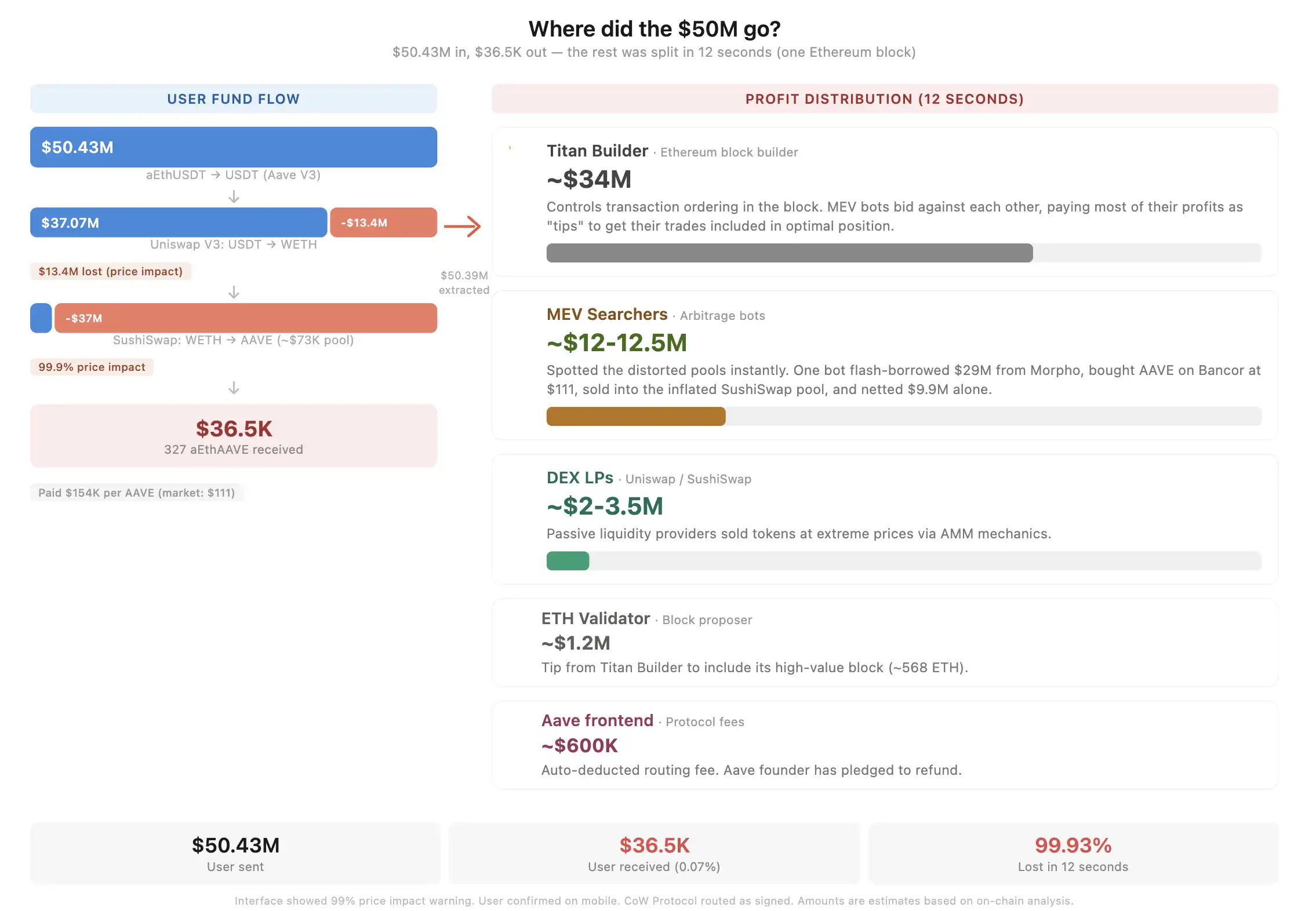
The entire transaction path can be simply summarized as three hops of gradual evaporation. The first hop redeemed from Aave V3, converting 50.43 million aEthUSDT into 50.43 million USDT without loss. The second hop through Uniswap V3 converted 50.43 million USDT into 17,958 WETH (worth about 37.07 million dollars), with a loss of about 13.36 million. The third hop through SushiSwap converted 17,958 WETH into 331 AAVE (worth about 36,700 dollars), with a loss of about 37.03 million. The total loss was 50.39 million dollars. The user ultimately retained 36,100 dollars, accounting for 0.07% of the initial funds.
Aave engineer Martin Grabina later clarified a widely misunderstood concept on Twitter. He said the core of the issue was not "slippage" but rather "price impact." The quote field on CoW Explorer showed that, before deducting fees and slippage, the original quote of this transaction was already "50 million USDT cannot get 140 AAVE." It was a poorly structured trade from the beginning. The 1.21% slippage tolerance set by the user was completely meaningless in the face of such a magnitude of price impact.
Who Divided 50 Million in 12 Seconds?
In the dark forest of DeFi, every on-chain transaction is exposed to everyone, and well-equipped "hunters" are always ready to extract value from any price imbalance that can be exploited. This transaction perfectly illustrates the complete food chain of the Ethereum MEV (maximum extractable value) ecosystem.
The largest piece of meat was consumed by the Ethereum block builder Titan Builder, approximately 34 million dollars. On-chain analyst @emmettgallic tracked and discovered that Titan extracted this enormous ETH from the block where the transaction was located and immediately transferred all proceeds to Coinbase after the block was confirmed.
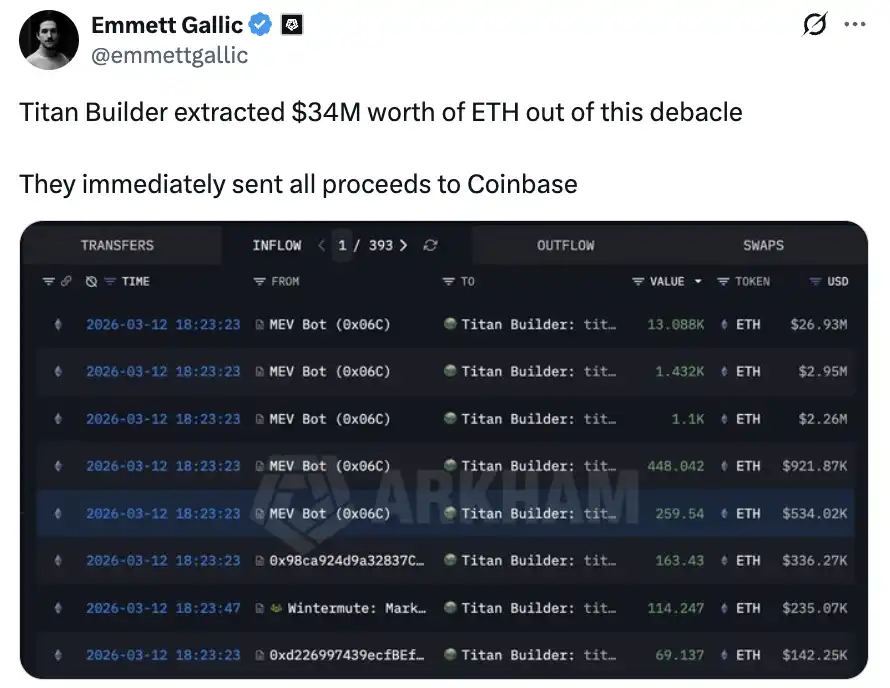
To understand the source of this money, one must first understand the current Ethereum block building mechanism. Since Ethereum transitioned to proof of stake (PoS) and introduced the MEV-Boost system, block production has been divided into two roles. Block builders are responsible for assembling transactions within a block and determining the transaction order, while block proposers (the validating nodes) are responsible for signing and adding the block to the chain. Builders compete through bidding; the block that yields the highest profit is more likely to be selected by the validating nodes.
Titan Builder is currently one of the largest block builders on Ethereum, along with Beaverbuild, which collectively constructs about 90% of Ethereum's blocks. In this transaction, Titan's "god perspective" allowed it to perfectly arrange the order of all transactions within the block, maximizing the value extracted from the price distortion. MEV bots, in order to obtain an optimal trading position, were forced to offer the majority of their arbitrage gains as "bribes" to Titan.
The second largest winner was the MEV Searchers, or arbitrage bots, totaling about 12 to 12.5 million dollars. These are automated arbitrage programs lurking on the Ethereum chain 24 hours a day, monitoring every pending transaction and instantly striking when they discover an exploitable price distortion.
On-chain analyst @CryptoKaleo tracked down the most classic MEV arbitrage operation in this event. One MEV bot completed a risk-free arbitrage of 9.9 million dollars with zero capital within the same block (12 seconds).
The logic of this operation was as follows. The bot first initiated a flash loan from the lending protocol Morpho, instantly borrowing approximately 29 million dollars of WETH, without needing any collateral, as long as it was repaid within the same transaction. It then bought AAVE tokens at normal market prices (about 111 dollars each) using the borrowed WETH on Bancor. Next, since the user's massive trade had already pushed the AAVE price in the SushiSwap pool up to about 154,000 dollars each, the bot sold the AAVE purchased at the market price into this distorted pool at a significantly high price, thus obtaining far more WETH than its costs. Finally, it repaid the principal of Morpho's flash loan and netted 9.9 million dollars. The entire operation was completed within a single transaction, with zero capital investment and zero risk.
This is the harsh reality of the DeFi "dark forest." The user's disastrous trade created a significant price distortion, while the bots completed a full arbitrage cycle of low-price buying and high-price selling within the same 12-second block. In addition to this largest arbitrage, other MEV Searchers also performed similar arbitrage operations in the Uniswap V3 jump.
The third layer of beneficiaries was DEX liquidity providers, about 2 to 3.5 million dollars. LPs in the Uniswap V3 and SushiSwap pools, as passive participants, sold tokens to users at extreme prices through the AMM mechanism. They did not need to take any active actions; the algorithm automatically priced according to the curve of "the more you buy, the more expensive it gets." The user's large orders allowed the LPs to sell their WETH and AAVE at prices far exceeding market rates.
The fourth layer consisted of Ethereum validating nodes, around 1.2 million dollars (approximately 568 ETH). This money was a fixed bidding amount paid by Titan Builder to ensure that its carefully constructed "high-profit block" would be chosen by the validating nodes in the current round. For validating nodes, this was just normal block proposal revenue but significantly more generous than ordinary blocks.
The final layer was the Aave front end itself, about 600,000 dollars. Regardless of how disastrous the trading results are, the routing integration of the Aave front end will automatically charge frontend fees proportionately. Stani Kulechov has openly promised to try to refund this amount.
Adding up these figures, the user’s loss of about 50.39 million dollars was systematically divided among five layers of the MEV ecology within a single Ethereum block (12 seconds). The biggest winner was not the bots that discovered the arbitrage opportunity but the block builder Titan Builder, which monopolized about 34 million dollars, accounting for 67% of the total losses suffered by the user, by extracting value directly from the transaction ordering and collecting "bribes" from the bots.
This illustrates the "dark forest food chain" of Ethereum. Users create price distortions, MEV bots discover and exploit the distortions, the bots pay most of their profits as tribute to the block builders, who pay out block fees to validating nodes. Layers of deduction, clear division of labor, all completed within 12 seconds.
The Mystery of Motivation
As of the time of publication, the identity of the owner of this wallet (0x98B9D979...1FBF97Ac8) remains unknown. However, on-chain traces and community analysis have left several clues.
@CryptoKaleo pointed out that this is a brand new wallet address that received a total of 50.43 million dollars worth of USDT from Binance 20 days before the transaction occurred. No other deposits were made until the execution of this disastrous trade.
Moreover, this was not an ordinary "buy coin" operation. DeFi analyst YAM pointed out on Twitter that this transaction used Aave's collateral swap feature, with inputs and outputs being aEthUSDT and aEthAAVE, which are the deposit certificates on Aave, rather than ordinary USDT and AAVE. This suggests that the user might have intended to directly convert his USDT deposit position into an AAVE deposit position within the Aave protocol instead of simply purchasing AAVE tokens on the market.
This raises the biggest question of the entire incident. The funds came from Binance, where the trading depth of AAVE far exceeds any on-chain DEX. Buying AAVE in batches on Binance with a scale of 50 million dollars would likely incur a slippage of no more than 1% to 2%. Choosing to withdraw from Binance and operate on-chain through the Aave front end is almost the least efficient and most costly method.
The community has proposed several speculations regarding this. Some believe it may be tax planning. The user may be located in a jurisdiction where trading on centralized exchanges is taxed, but operations on-chain DeFi are tax-exempt or less closely monitored. By withdrawing from Binance and then operating on-chain, they may be trying to avoid generating taxable transaction records on centralized exchanges.
Other community members speculate that this could be some sort of automated trading script or bot malfunctioning, automatically confirming an abnormal transaction without human review. However, this does not explain why the script would check the risk confirmation box. So this is more likely to be a "fat finger" incident. The Aave interface indeed displayed a warning of a 99% price impact, but the user confirmed it on his phone. The small screen operation on the mobile device, habitual neglect of pop-up warnings, and insufficient understanding of DeFi mechanisms could all be contributing factors to this disaster.
Looking back, every link in this transaction had ways to avoid disaster.
The most basic one is to split the order. 50 million dollars should not be sent out as a single transaction. Professional traders would use a TWAP (time-weighted average price) strategy to split large orders into dozens or even hundreds of smaller transactions, dispersing execution over different times and liquidity sources. Even without using TWAP, simply breaking it into 50 transactions of 1 million dollars would reduce the loss by an order of magnitude.
Secondly, using limit orders is essential. The CoW Swap integrated into the Aave interface supports limit order functionality. If the user had set a reasonable limit price instead of a market order, the transaction would be automatically canceled if the ideal price was not met, rather than executing at a disastrous price. Martin Grabina specifically mentioned this point afterward.
Then there is the importance of carefully reading warnings. The interface displayed a 99% price impact warning. This is not a routine "Are you sure you want to continue?" pop-up. 99% means you will lose 99% of your funds. Ignoring this number in any transaction amount is fatal.
Another often-overlooked point is understanding the scale of on-chain liquidity. The liquidity of AAVE/WETH on SushiSwap is only 73,000 dollars, which means that even transactions of a few thousand dollars would generate significant price impact, let alone 37 million dollars. Checking the liquidity depth of the target pool before executing any large DEX trade is the most basic operation.
Finally, if there is a necessity to execute large trades on-chain, smart routing functions of aggregators like 1inch and Paraswap should be used, which can split orders across multiple liquidity sources to significantly reduce price impact, instead of relying on a single route to push all funds into a shallow pool.
Decentralization grants everyone complete freedom, including the freedom to make irreversible mistakes. In this world without customer service numbers or transaction cancel buttons, every click on-chain is a final decision.
And at the moment you click "confirm," the hunters in the dark forest are already prepared with their flash loans in the same block.
免责声明:本文章仅代表作者个人观点,不代表本平台的立场和观点。本文章仅供信息分享,不构成对任何人的任何投资建议。用户与作者之间的任何争议,与本平台无关。如网页中刊载的文章或图片涉及侵权,请提供相关的权利证明和身份证明发送邮件到support@aicoin.com,本平台相关工作人员将会进行核查。


