Original | Odaily Planet Daily (@OdailyChina)
Author | Golem (@web 3_golem)
When major domestic companies rushed to launch "One-click Install OpenClaw," controversy followed.
On March 12, OpenClaw founder Peter Steinberger publicly questioned Tencent's creation of Skillhub on X, claiming that the official speed decreased, making it difficult to quickly fetch data, and stated, "They copied, but did not support this project in any way."
In response to the controversy, Tencent quickly expressed its understanding of Peter Steinberger's concerns, stating that SkillHub is a localized Skills platform built by Tencent based on the OpenClaw ecosystem. As a local mirror site, it not only always credits ClawHub as the data source but also processed 180GB of traffic for users during the first week of launch (870,000 downloads), pulling only 1GB from the official source in non-concurrent requests. At the same time, Tencent expressed its willingness to be a sponsor.
Logically, Tencent's response should have clarified the most likely issue to spark public backlash—whether they were crazy consuming resources from the source—but Peter was not convinced after reading it, stating that this is not the point; he could make SkillHub the official fifth mirror site with synchronized download statistics, but Tencent should have proactively communicated with him beforehand.
Although the matter seemed to come to an end here, if one only understands it as "the OpenClaw founder emotionally firing shots" or "major companies misunderstood while doing localization," then it truly overlooks the issue.
The problem is not the mirror, but the "domineering" nature of large companies
If we only look at the technical actions, this matter is actually not unexpected.
In China's developer ecosystem, mirroring open-source projects is a routine operation. npm, PyPI, Docker Hub, and other international open-source infrastructures all have many local mirrors in China. It is precisely for this reason that Tencent denies that it is copying by creating Skillhub, instead arguing that it is a localized Skills platform, explaining that it is not exploiting the official source but is engaged in distribution, acceleration, and adaptation, helping OpenClaw to establish itself in China.
In a sense, Tencent's actions indeed hit the most pragmatic needs of "shrimp farmers" in China. OpenClaw is so popular in China that it distorts the experience, but not everyone is willing or able to access the original community stably, let alone that many experiences of installing, discovering, and retrieving Skills are still very primitive.
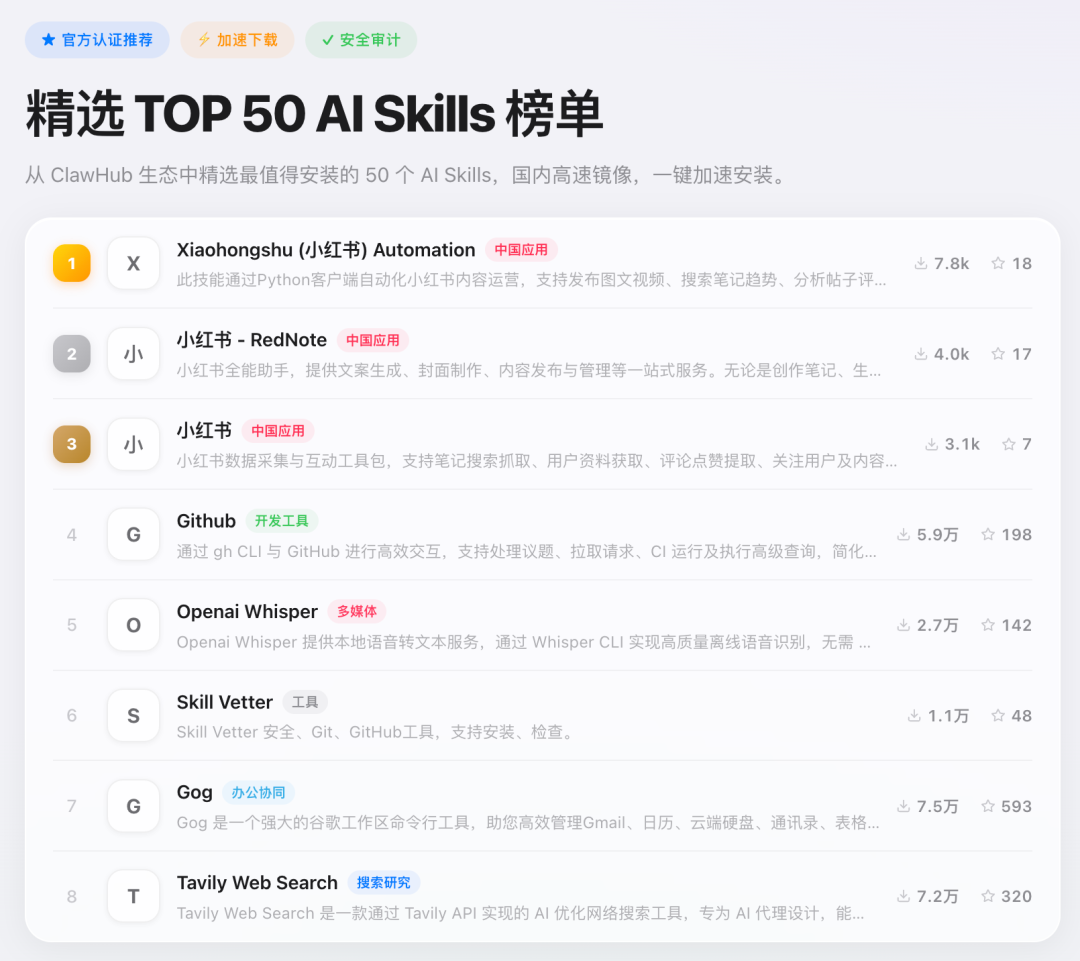
Skillhub
But is the mirror station inherently innocent? The answer is not necessarily.
Because what open-source licenses permit, what community ethics accept, and what business realities ultimately happen are often three different accounts.
At the protocol level, as long as one follows the license and indicates the source, many mirroring and redistribution actions are valid; at the community ethics level, Tencent's SkillHub marks OpenClaw's official source identity and actively reduces the bandwidth costs of the source site, seemingly also taking on some responsibility.
But Tencent forgot that OpenClaw is not a small open-source project that requires significant resources from a large company; it is the most popular project on GitHub, receiving the most stars. Tencent's non-communicative behavior then becomes "domineering." Because it is no longer just a pure mirroring issue but quickly involves three more sensitive questions: Who represents the official ecosystem, who takes away the user entry, and who defines the criteria for downloads, distribution, and statistics.
This is the real discomfort for Peter, as he stated that Tencent's behavior would directly affect download statistics. Peter does not oppose Tencent localizing OpenClaw in China; rather, he believes that it is better to communicate in advance rather than for Tencent to set up the platform, take users over, and then explain under public pressure that it is actually there to help.
Furthermore, from a business reality perspective, once platforms like SkillHub reach scale, the official status and statistical rights originally held by the OpenClaw community can easily become marginalized. Today it is a localized Skills platform; tomorrow it might be a "default Skills distribution market." Later, it could be "who decides which Skills are seen, installed, and commercialized."
This is the real danger signal behind this controversy, and it represents a scene that the Chinese Internet is most familiar with over the past decade: land-grabbing movements.
Large companies are not "farming lobsters," they are using lobsters to seize AI territory
In recent times, "farming lobsters" has become the hottest meme in the Chinese AI circle, and OpenClaw has been quickly elevated to an almost emotional industry symbol. Everyone is saying that lobsters represent a new imagination in the Agent era and the future of personal AI assistants, which sounds inspiring.
But large companies look at lobsters not from an idealistic perspective, but see entry points, traffic, distribution rights, and the next generation of operating system shells.
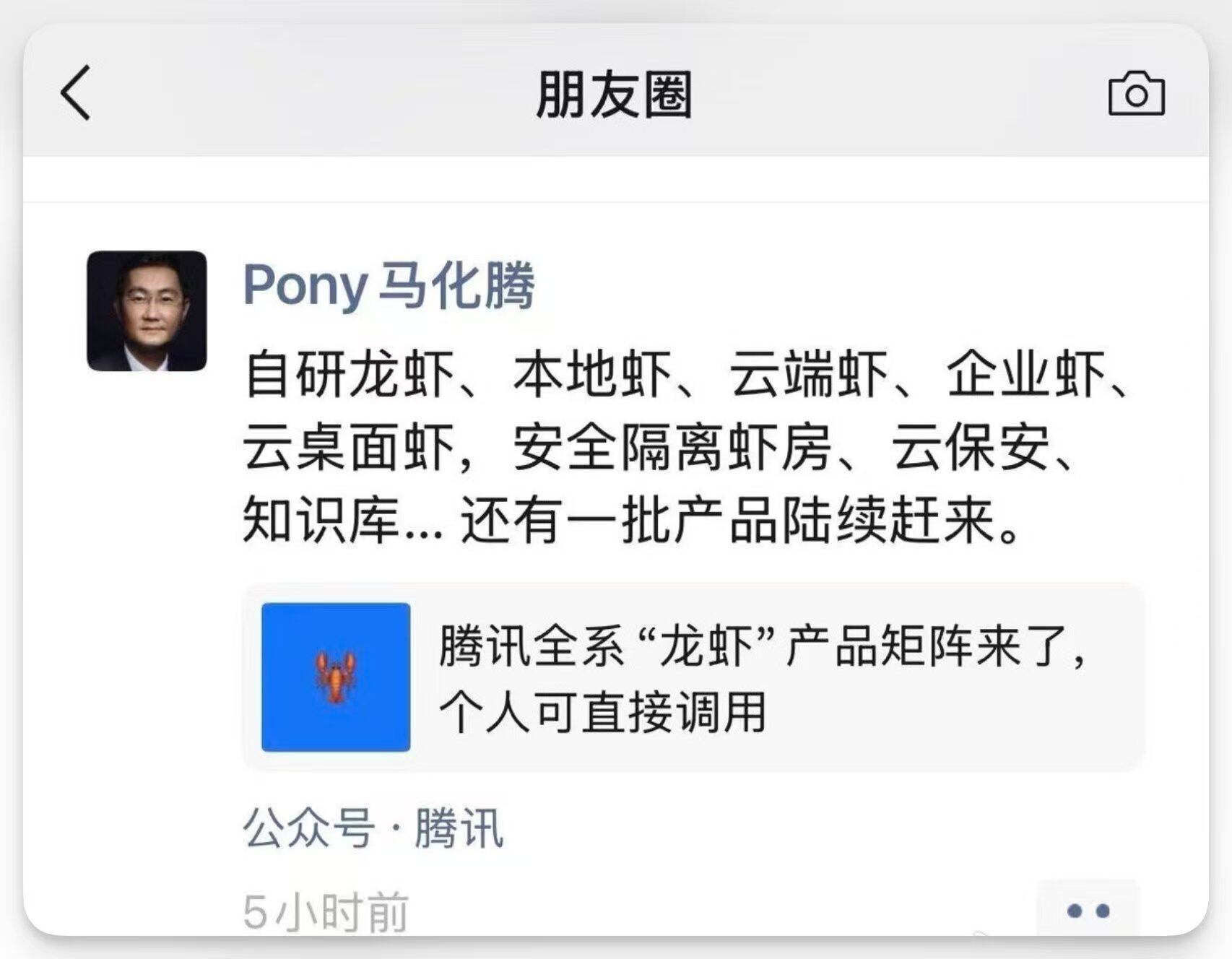
On the early morning of March 11, Ma Huateng promoted Tencent's entire "lobster" product line on WeChat Moments, stating that Tencent's "Lobster Family Pack" customized a "small lobster" for ordinary users, developers, and enterprise-level users, allowing users to install with no thresholds via one-click. SkillHub was also launched at this time, featuring 13,000 localized Skills for one-click invocation, directly usable in scenarios like Xiaohongshu operation and Baidu search.
Of course, it is not just Tencent that is "moving swiftly." Once the timeline is expanded, it becomes clear that domestic major companies are almost collectively addressing the "lobster farming" problem for users, moving in synchrony as if a switch had been pressed, but currently, Tencent is doing it the most comprehensively.
On the surface, everyone seems to have good intentions, but this hides a set of business path dependencies that Chinese internet companies are most familiar with. Faced with a new ecosystem that has already been validated by the market and elevated by public opinion, the first action is not to make money or establish a business model but to first seize the entry, first create the platform, first bring the users over.
What Tencent wants is not only to make it easier for Chinese users to "farm lobsters" but also for the first reaction when Chinese users truly start to "get things done with Agents" to happen within Tencent's product shell.
This is what makes the action of SkillHub intriguing; it appears to be a mirror site, but it may actually be the starting point of a larger closed loop. Today, users see localized search and downloads of Skills; tomorrow, it may be a default integration into a certain cloud, a certain account, or a certain corporate workspace. Later, developers will gradually discover that although they are still developing within the OpenClaw ecosystem, the ones truly deciding exposure, recommendations, reviews, and commercialization paths have already turned into platforms.
This script has been played too many times in the Chinese internet. From ride-hailing to food delivery, from short video platforms to cloud markets, almost every time behind "ecological prosperity" lies the same structural ending—platforms first attract users with free and open offers, then establish walls, and utilize traffic and advertising to transform the ecosystem back into their subsidiary layer.
Large companies know that today, old entry points like search, social, content, and e-commerce have reached their limits, and that Agents may be the next new entry worth betting on. Therefore, rather than waiting for OpenClaw to grow wildly, they might as well take it over while it is still in its explosive early stage, package it first, and cultivate users to develop the habit of "using lobsters" within their own systems.
As a result, everyone is far too familiar with what will happen after major companies rush to help users solve the OpenClaw installation issues. And Peter, who does not understand the Chinese internet, naturally cannot comprehend why Tencent did not communicate with him beforehand or sync data with him.
OpenClaw originally represented another kind of AI future: locally run, individually controlled, community expanded, and openly connected. Its most imaginative aspect was allowing Agents to truly become the user's own execution layer. But once this ecosystem is repackaged by large companies with "localized mirrors," "domestic adaptations," "unified distribution," and "security reviews," its essence changes. In the product logic of large companies, if they control the entry, if they control distribution, then ultimately payment and commercialization should also ideally belong to them.
To put it even more bluntly, large companies are not "embracing lobsters," but are "borrowing lobsters to seize territory in the AI era."
And this is the most unsettling aspect behind this small controversy. Walls are never erected all at once; they always grow slowly under the guise of "greater convenience" and "greater stability." By the time developers, users, and traffic are all packed into the same shell, so-called openness and independence may ultimately just be a component within the ecosystem of the large companies.
OpenClaw currently faces the most paradoxical fate in the country: The lobsters have yet to grow, and the large companies have already begun to surround the net.
免责声明:本文章仅代表作者个人观点,不代表本平台的立场和观点。本文章仅供信息分享,不构成对任何人的任何投资建议。用户与作者之间的任何争议,与本平台无关。如网页中刊载的文章或图片涉及侵权,请提供相关的权利证明和身份证明发送邮件到support@aicoin.com,本平台相关工作人员将会进行核查。


