Oil Shock Rattles Global Markets as Stocks Slide
U.S. stocks closed lower Friday, extending a difficult stretch for equities as rising oil prices and geopolitical tension between the U.S., Israel, and Iran injected fresh uncertainty into the global economy.
The S&P 500 fell 40.43 points, or 0.61%, to close at 6,632.19, marking its third consecutive weekly decline and a new low for 2026. The Nasdaq Composite dropped 206.62 points to 22,105.36, while the Dow Jones Industrial Average slipped 119.38 points to 46,558.47. The NYSE Composite also declined 67.76 points to 22,050.94, reflecting broad weakness across the market.
Nine of the S&P 500’s 11 sectors finished in the red, with consumer staples and real estate among the weakest performers as investors reassessed the economic outlook.
The immediate catalyst was the oil market.
Brent crude has climbed back above $100 per barrel, while West Texas Intermediate (WTI) traded in the $95–$98 range, as attacks on commercial shipping and reports of mines near the Strait of Hormuz disrupted one of the world’s most critical energy corridors. The narrow waterway handles roughly one-fifth of global oil flows, making any sustained disruption a major concern for global supply.
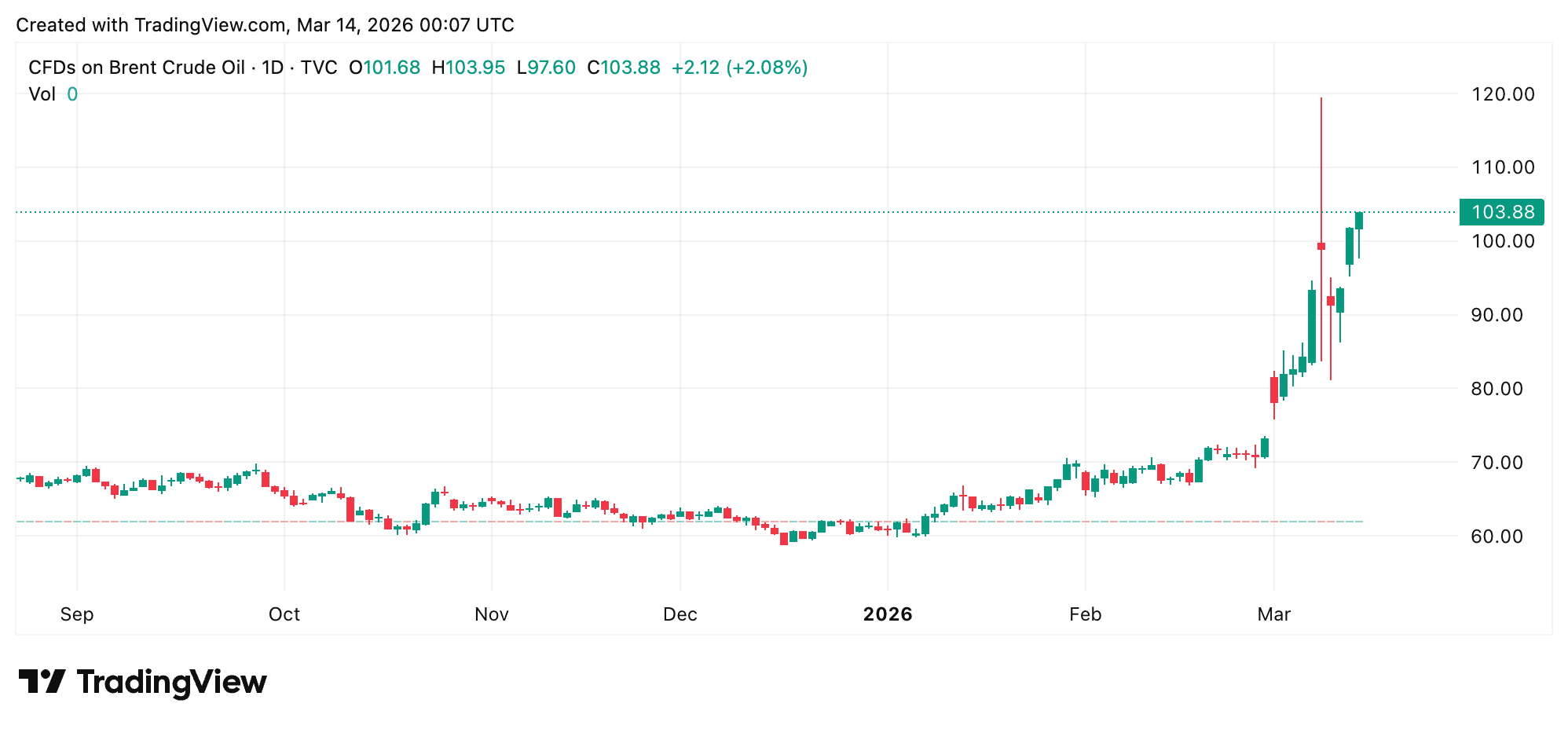
Brent crude (UKOIL) has surged above $100 once again.
Markets are increasingly worried that higher energy prices could rekindle inflation just as central banks were hoping to ease policy later this year.
That scenario—slower growth paired with stubborn inflation—is the textbook definition of stagflation, and it tends to be particularly uncomfortable for equity investors.
The pressure was not limited to U.S. markets.
Oil Disruption Sends Waves Through Global Equities as Gold Slips but Still Holds Above $5K
Global equities also retreated as the oil shock reverberated through energy-importing economies. Japan’s Nikkei 225 fell about 1.6%, weighed down by a weakening yen and the country’s heavy reliance on imported energy. In Europe, Germany’s DAX dropped 1.4%, the Stoxx 600 declined 0.7%, and the FTSE 100 slipped roughly 0.6%.
Export-heavy sectors and energy-sensitive industries led the declines as investors recalibrated expectations for global growth.
Against that backdrop, precious metals continued to attract defensive flows but cooled off ahead of the weekend.
Gold briefly pushed above the $5,100-per-ounce level earlier in the week before pulling back Friday to close near $5,043, down roughly $51 on the session but still holding well above the threshold.
Citigroup analysts had projected in January that gold would still hold $5,000 per ounce by March 2026, citing rising geopolitical risk, supply constraints, and uncertainty surrounding central bank independence.
That forecast has now effectively been met.
Silver also retreated modestly on Friday, trading near $80.89 per ounce, down about $3.36 on the day after an extended rally that has pushed the metal more than $50 higher year over year. Industrial demand remains a key driver for silver, which straddles the line between monetary hedge and industrial commodity.
Other precious metals showed mixed performance. Platinum traded near $2,044 per ounce, while palladium hovered around $1,582, both reflecting volatility tied to the automotive sector and broader industrial demand.
The common thread across these markets is simply oil.
If oil prices remain elevated, higher transportation and production costs could ripple across the global economy. That would raise the likelihood that inflation remains sticky, potentially delaying interest-rate cuts that investors had been anticipating later this year.
Markets are already beginning to adjust to that possibility.
Rising energy prices have strengthened the U.S. dollar and pushed Treasury yields higher, tightening financial conditions even without additional action from the Federal Reserve. For equities, that combination tends to weigh on valuations.
A quieter subplot in the week’s trading was the relative stability of digital assets.
While global equities slid, bitcoin traded near $70,900 and was modestly higher over the past week, with the broader crypto market capitalization hovering around $2.42 trillion. The move did little to change overall sentiment, which remains cautious, but it highlighted how some investors are increasingly viewing digital assets alongside traditional macro hedges.
All Eyes on the Strait of Hormuz
Analysts say the trajectory of the conflict affecting the Strait of Hormuz will likely dictate market direction in the coming weeks. If shipping flows resume normally, energy prices could ease quickly and provide relief for risk assets.
If disruptions persist, however, investors may have to grapple with a far less comfortable environment—one defined by expensive energy, stubborn inflation, and slower global growth.
For now, markets appear to be bracing for the latter.
FAQ 🔎
- Why are global stock markets falling right now?
Rising oil prices tied to disruptions in the Strait of Hormuz are increasing inflation concerns and slowing growth expectations. - Why is gold holding above $5K while stocks fall?
Gold often attracts demand during geopolitical crises and inflation fears because it is widely viewed as a store of value. - How high is oil trading right now?
Brent crude has climbed above $100 per barrel, with West Texas Intermediate trading roughly between $95 and $98. - How are cryptocurrencies reacting to the market turmoil?
Digital assets have remained relatively stable, with bitcoin trading near $70,900 while global equity markets declined.
免责声明:本文章仅代表作者个人观点,不代表本平台的立场和观点。本文章仅供信息分享,不构成对任何人的任何投资建议。用户与作者之间的任何争议,与本平台无关。如网页中刊载的文章或图片涉及侵权,请提供相关的权利证明和身份证明发送邮件到support@aicoin.com,本平台相关工作人员将会进行核查。


