Written by: KarenZ, Foresight News
On the evening of March 13, the Ethereum Foundation (EF) Board released a mission statement titled "EF Mandate".
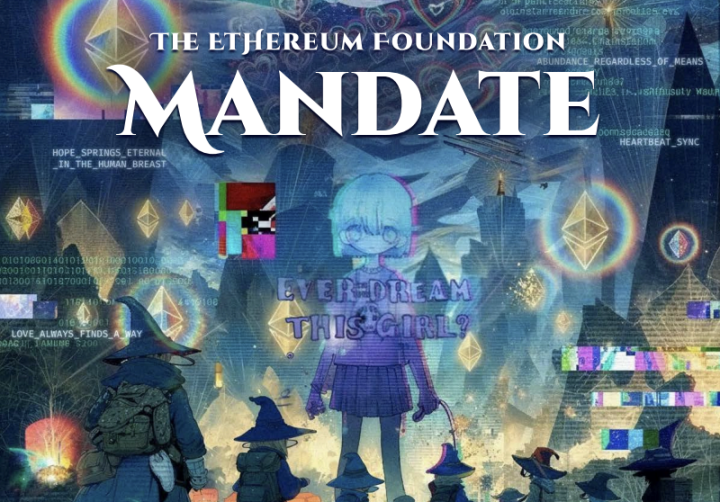
Opening this mission statement, you might wonder if you've walked into the wrong set—an array of stars, elves, wizards, and layouts reminiscent of anime posters. Beneath this flashy exterior lies the current "ideological program" of the Ethereum ecosystem.
TL;DR
- EF's core position: Guardian, not Ruler. EF’s ultimate goal is to ensure that through the "Walkaway Test"—even if the Ethereum Foundation disbands tomorrow, the Ethereum network can continue to operate perfectly.
- The CROPS ironclad rules are the bottom line: Any technological development must meet the criteria of Censorship Resistance, Open Source, Privacy, and Security. None of these four attributes can be lacking, and no development priority can override them.
- EF’s working philosophy: The Foundation does subtraction, so Ethereum can be more resilient. Once the ecosystem is mature enough, the Ethereum Foundation will gradually decentralize authority.
- What we won't do: Not act as a "kingmaker", not as a rating agency, not as a marketing agency pushing trades, and certainly not encourage viewing Ethereum as a "big casino".
- Ultimate vision: Focus on the next 1000 years, providing a "digital sanctuary" free from exploitation by power, capital, AI, or even family.
What problems does Ethereum aim to solve?
EF believes that in the digital age, there are two infrastructure-level necessities: controlling one’s own data, identity, and assets (self-sovereignty), and collaborating with others without being "choked" by anyone (sovereignty-preserving coordination).
Pursuing only the first point means running a local application is enough; pursuing only the second point would suffice with traditional internet. The unique value of Ethereum lies in achieving both simultaneously.
The statement includes a phrase that notes: Ethereum exists to ensure no one can "rug" you—whether it's a government, company, organization, or AI.
Around this goal, EF proposed an acronym: CROPS. This term appears 32 times in the statement.
- Censorship Resistance: No one can prevent you from doing lawful things; external pressures must rely on cryptography to maintain neutrality.
- Open Source & Free: All code and rules are laid bare, with no hidden black boxes.
- Privacy: Your data is yours, not the platform’s. You can decide what information to share with whom.
- Security: Protect both the system and the user from harm caused by technical failures or coercion.
These four attributes are defined in the document as an "indivisible whole", representing the highest priority and a line that cannot be compromised for any reason.
EF's stance is clear: It's better to be slow and get it right from day one. Once abandoned, it’s nearly impossible to reclaim.
What does the Foundation do? What doesn’t it do?
EF is taking the approach of "making itself unnecessary" as the ultimate standard of success.
The document mentions a term called "walkaway test", meaning: If EF disappeared tomorrow, could Ethereum continue to run itself and evolve? EF’s goal is to make that answer "yes".
Thus, EF is practicing a "subtractive development" philosophy: focusing on key things that no one else in the ecosystem can or wants to do—core protocol upgrades, long-term technical research, and public safety guarantees. Once a community can take over a certain area, EF will pass it on, further reducing its relative influence.
At the same time, EF has drawn up a lengthy "not to-do" list, reading like a solemn disclaimer: not a company, not a kingmaker, not a certification body, not a product studio, not a marketing firm, not a boss, not a government agency, not a casino, not an opportunist.
How will EF make choices without standard answers?
Earlier much was said about grand principles: CROPS, self-sovereignty, subtraction philosophy. But how to deal with specific issues? This chapter provides the answer.
It serves as a sort of "decision algorithm" for the Foundation: when confronted with two paths, how to choose without betraying original intentions?
- When choosing technical solutions, select the one "that won't choke you in the future", even if it's slower now. The document gives an example about transaction broadcasting: one solution has good performance but relies on a private relay network (whitelist), while the other is decentralized but progresses slowly. EF’s answer might be the latter because once the former is implemented, "going decentralized later" is unlikely to happen.
- When designing or evaluating proposals, don’t just look at this layer, consider the impact on other layers. Some solutions may seem fine in isolation, even conforming to the CROPS principle, but when viewed in the context of the entire ecosystem, they may create new problems elsewhere. Don’t solve one problem to create ten more.
- User safety is important, but don’t make decisions for users. Provide tools for users' self-defense, absolutely refrain from "parental" restrictions, and do not allow anyone to deprive users of their autonomous choice under the guise of "protecting users". For example, some wallets default to "safety mode," covertly block certain contracts, direct users to specific platforms, or use opaque AI to determine "risky operations" while secretly collecting user behavior—this is opposed by the Foundation. True protection is providing users with verifiable filtering tools and publicly defined black and white lists; whatever the tool, defaults should always prioritize privacy protection, including AI components.
- Need an intermediary? Break down barriers and leave an exit route: If there are areas where intermediaries are currently unavoidable, then lower the entry thresholds to the minimum, allow full market competition, and at the same time ensure users have a "no intermediary" alternative, which must be user-friendly and feasible.
- When choosing which teams to support, focus on actual technical choices, not social cachet. Many projects profess adherence to CROPS, but in actual design harbor closed-source core components, impose whitelist restrictions, and steer users down fixed paths. These should be approached with caution.
Ideals are rich, reality is lean
This declaration is written with great conviction, but the questioning of reality never ceases.
Does this document represent collective consensus or just the ideals of some authors? If EF changes its personnel, will it still count? Who will supervise and enforce?
More realistic questions include:
- EF's operating funds heavily rely on its ETH holdings. If ETH's price is sluggish, the budget will be constrained. "Not caring about the price" is merely a spiritual discipline, not a financial reality.
- The CROPS rules are ideal rules, but the world does not operate according to CROPS.
- The majority of users care about: speed, cost, usability.
- EF insists on being "fully CROPS from day one," but will this cause Ethereum to lag behind more "pragmatic" competitors in terms of user experience and commercialization?
- How will EF's "doing" and "not doing" be assessed? How will accountability be enforced? How to judge whether coordination is done well?
The community is divided: punk ideals vs. disconnect from reality
Less than 24 hours after the statement was released, community feedback has already polarized:
Critics:
- Eigen Labs researcher Kydo bluntly stated that EF's current direction has made a 180-degree turn, overturning the previous "pragmatic route" supporting stablecoins, institutional entry, and RWA, marginalizing the currently most marketable applications;
- Forward Ind. Chairman complained: "They want to build whatever they want, not what you want"—accusing EF of constructing solely according to idealism, ignoring community and market demand;
- Hazeflow founder Pavel Paramonov referred to it as "another pile of ideological nonsense," failing to clarify Ethereum's specific future direction.
Supporters:
- Namefi founder Zainan Victor Zhou believes this is a constraint on the EF organization rather than a restriction on the entire ecosystem;
- Columbia Business School professor Omid Malekan pointed out that CROPS is exactly what allows Ethereum to lead in the financial realm—it provides genuine "access + verifiability + property protection".
In the face of controversy, Vitalik personally clarified: this declaration "is not surprising to many" and reflects the direction EF has been contemplating for the past few months. EF will act solely as the guardian of Ethereum, leaving the rest to the broader ecosystem—this marks the starting point of a new chapter.
At the end of the declaration, it concludes with an Italian phrase: "E quindi uscimmo a riveder le stelle"—from Dante's "Divine Comedy, Inferno," literally meaning "And so we emerged to see the stars again."
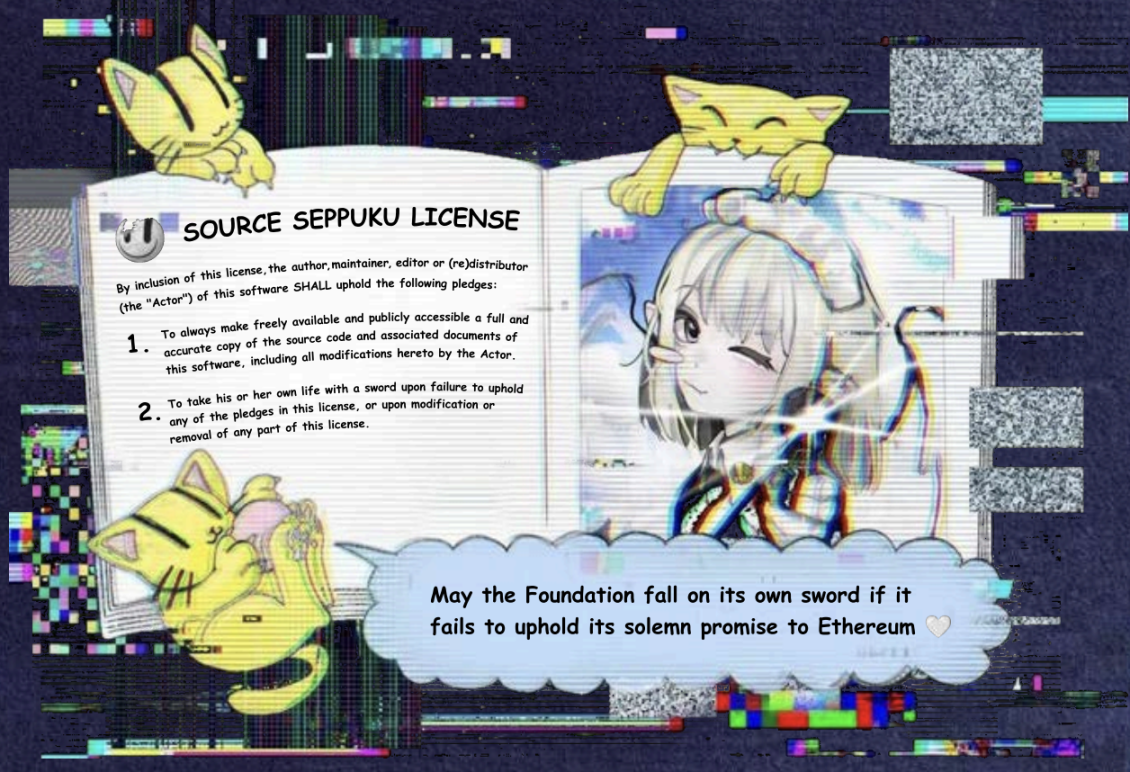
EF also created a meme titled "SOURCE SEPPUKU LICENSE," stating: "If the Foundation fails to honor its solemn commitment to Ethereum, let it bear the consequences and end itself."
EF compares itself to a traveler passing through hell, willing to endure real-world trials and doubts to advance toward the stars of "digital freedom." Of course, time will tell.
免责声明:本文章仅代表作者个人观点,不代表本平台的立场和观点。本文章仅供信息分享,不构成对任何人的任何投资建议。用户与作者之间的任何争议,与本平台无关。如网页中刊载的文章或图片涉及侵权,请提供相关的权利证明和身份证明发送邮件到support@aicoin.com,本平台相关工作人员将会进行核查。


