Author: DWF Ventures
Translated by: Deep Tide TechFlow
Deep Tide Summary: This report from DWF Ventures clarifies one thing with data: the money has not left crypto, it has just changed tracks. In 2025, over 80% of token issuance prices will break even, while crypto IPO financing skyrockets 48 times to $14.6 billion, and M&A reaches a five-year high of $42.5 billion. This is not just a market sentiment issue, but a systematic shift in capital structure, with a batch of IPOs from Kraken, Ledger, Animoca, and others on the way in 2026.
Key Conclusion
The old methods of token issuance have ended. High valuations and declining liquidity have undermined investor confidence, and we see capital flow shifting towards equity.
Tokens and equities have similar upside potential, but their risk structures are vastly different: tokens peak faster (within 30 days) and face greater volatility; while equities maintain a steady upward trend over a longer time dimension.
Equities enjoy a higher valuation premium than tokens: this premium is attributable to institutional entry barriers, potential for index inclusion, and more varied trading strategies supported by equity.
The price-to-sales ratio (P/S) provides a useful benchmark for assessing companies, but the dispersion in valuations reflects the importance of other factors, including regulatory moats, revenue diversification, shareholder value, and sector sentiment.
M&A activity reached a five-year high with accelerated consolidation: acquiring capabilities has proven quicker than building in-house, and regulatory compliance is driving strategic M&A.
Current State of Token Issuance
The crypto industry has reached a turning point. Billions of dollars are flooding in, institutional interest is at its peak, and regulations are becoming friendlier—yet for builders and users, everything feels gloomier than before. The widening gap between the influx of institutional funds and the morale of the crypto-native community is part of a larger problem—the original spirit of decentralization and cypherpunk experiments seems to be gradually dissipating with the influx and immense influence of centralized entities.
Crypto has thrived in a high-risk, casino-like environment, and this environment is slowly being peeled away as token performance sharply declines. This is also driven by extractive events that significantly affect retail investors, leading to liquidity being withdrawn from the market.
According to a report from Memento Research, over 80% of token issuances in 2025 are currently trading below the TGE price. Projects are severely impacted by high volatility and a general lack of token demand—due to the difficulty in proving and maintaining high valuations. Potential for upside is also scarce, with most tokens facing substantial selling pressure since TGE—stemming from early profit-taking, lack of substantial confidence in the product, or poor token economic models (airdrops, CEX listings, etc.). This has undermined the interest of both investors and retail participants, while events like 10/10 further exacerbated the outflow of crypto funds, raising doubts about the core infrastructure of the industry.

Rise of IPOs
Meanwhile, in traditional markets, IPOs are gaining strong traction among crypto companies—a number of notable IPO cases emerged in 2025, with more companies submitting applications for upcoming IPOs. Data shows that crypto IPO financing increased 48 times compared to 2024, exceeding $14.6 billion in 2025. M&A transactions have also experienced similar growth, with leading companies seeking diversified positions, which we will explore further below. Overall, the outstanding performance of these companies showcases a strong demand from the market for exposure to digital assets, and this momentum may accelerate further as we approach 2026.
Flow of Liquidity
Over the past year, we have seen both high-profile IPOs and ICOs raising large amounts of capital. The table below shows the financing amounts and initial valuations of each company.
From this, we observe that the valuations of IPOs and ICOs are relatively close. Certain ICOs, such as Plasma, are specifically priced lower than institutional investor valuations, aiming to provide greater upside and participation opportunities for retail investors. On average, the publicly traded share ratio for IPOs hovers between 12% to 20%, while the publicly circulating ratio for ICOs is between 7% to 12%. World Liberty Finance stands out as an obvious exception, offering over 35% of the total supply for sale.
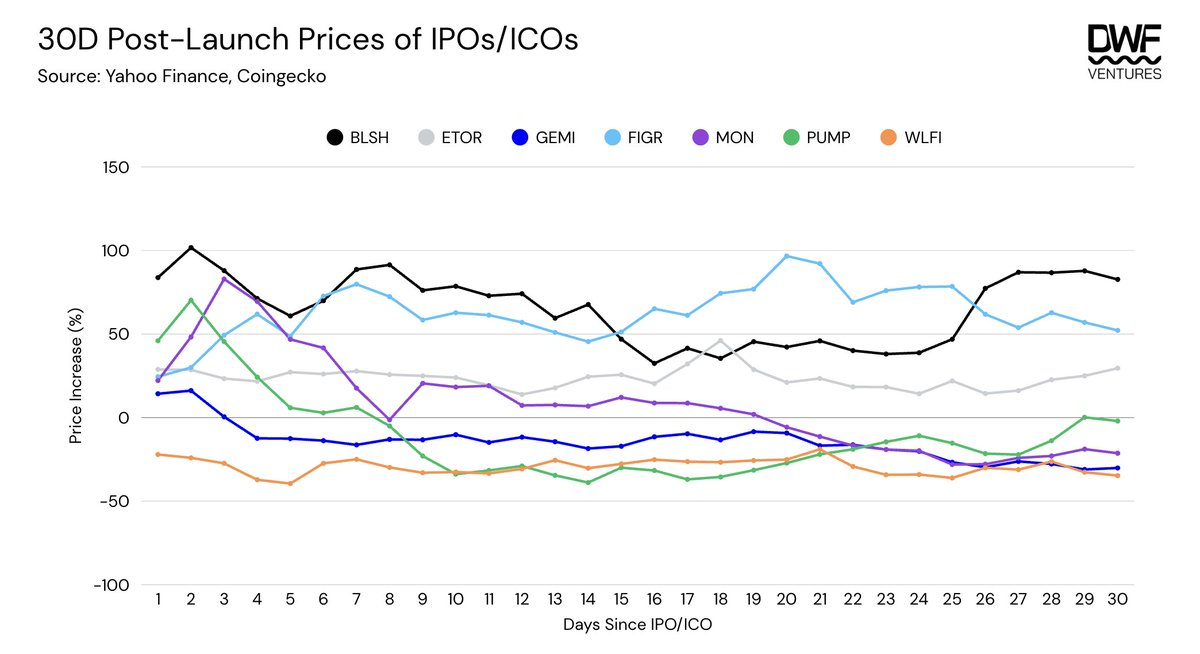
Analyzing the performance of ICOs and IPOs, tokens are associated with greater short-term volatility and shorter peak times (within 30 days). On the other hand, equities often record solid gains over longer time dimensions. Notably, despite this, both are similar in terms of upside potential.
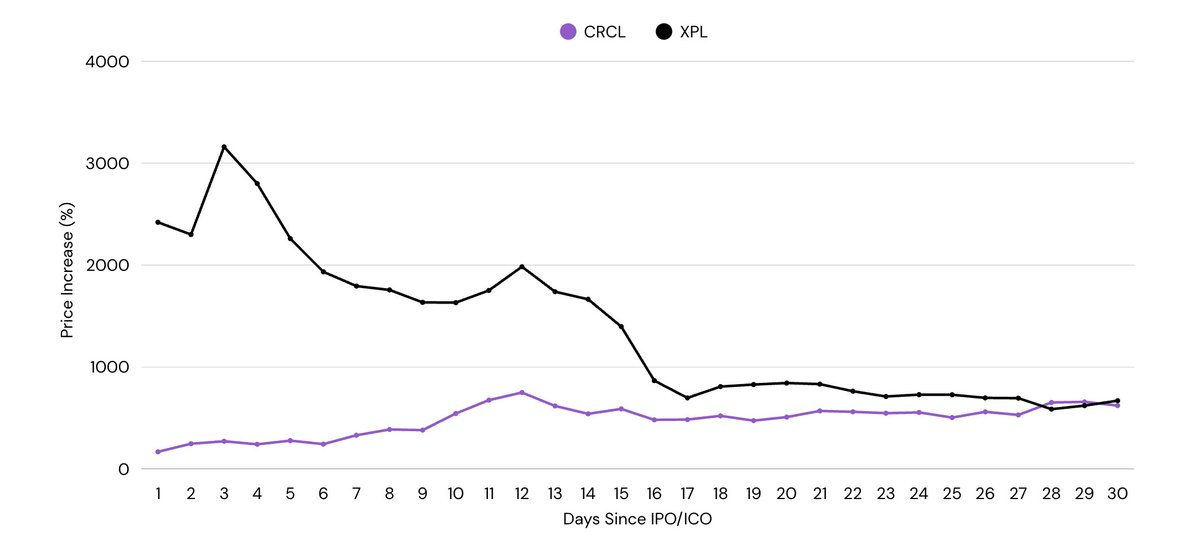
CRCL and XPL are exceptions, experiencing significant surges right from the start, providing investors with 10 to 25 times upside potential. However, their performance also follows the aforementioned trend—XPL retraced 65% from its peak within two weeks, while CRCL steadily climbed during the same period.
Revenue: Assessing Equity Premiums
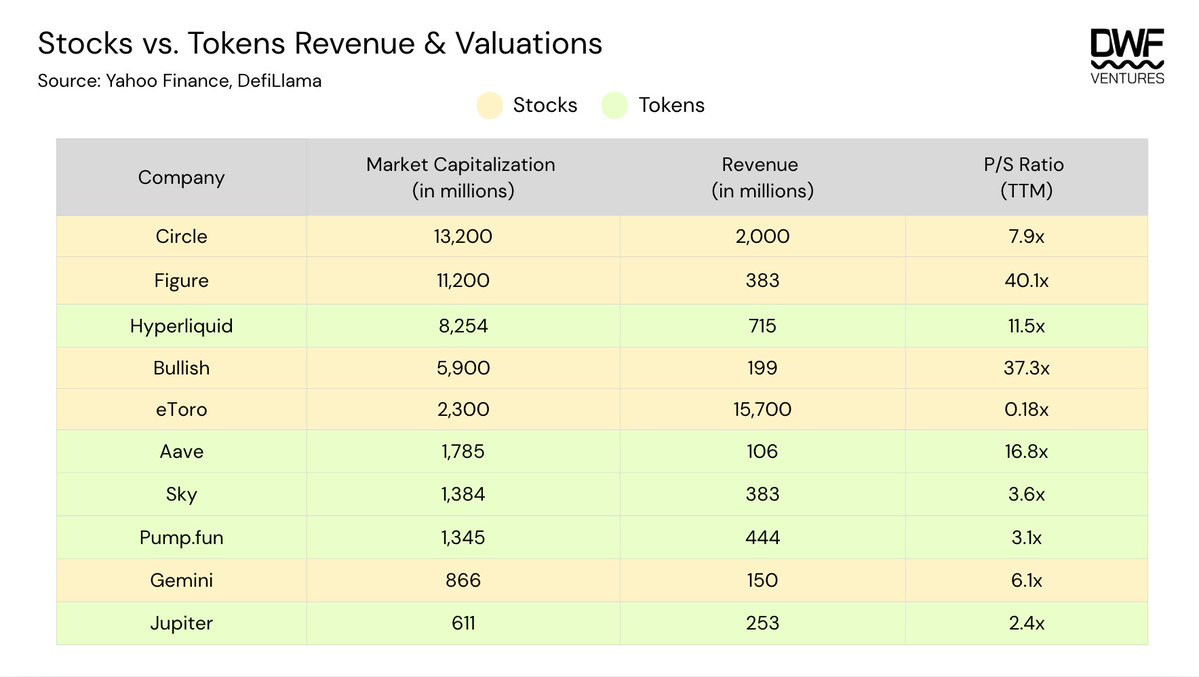
Diving into the revenue figures, stocks overall enjoy a higher premium than tokens, with P/S ratios ranging from 7 to 40 times and 2 to 16 times, respectively. This can be attributed to various factors enhancing liquidity:
Institutional Entry: Despite growing positive sentiment towards holding digital assets on balance sheets, it remains limited to funds authorized only for holding securities (especially pensions or endowment funds). Choosing IPOs allows companies to tap into this institutional pool of capital.
Index Inclusion: The growth tailwinds in the public market are significantly stronger than on-chain. In May 2025, Coinbase became the first crypto company to join the S&P 500 index, which may have contributed to the buying pressure formed by index tracking funds/ETFs accumulating positions.
Alternative Strategies: Compared to on-chain tokens, equities can operate with a wider variety of institutional strategies, including options and leverage, while on-chain tokens often lack liquidity and counterparty.
Overall, the P/S ratio reflects a company's valuation based on revenue from the past 12 months, helping to determine whether a company is undervalued or overvalued compared to its competitors. However, factors beyond the numbers that could reflect investor sentiment have not been included. Some factors to consider when evaluating stocks/tokens include:
Moat and Diversification: This is crucial in the fast-evolving digital asset industry. The market pays a premium for licenses and regulatory compliance, while a diversified business layout can strengthen the core business's value proposition beyond pure revenue numbers.
For example, Figure launched its own RWA lending pool, open to both retail and institutional investors, and became the first to receive SEC approval for a yield-bearing stablecoin ($YLDS). Bullish is a regulated exchange that also owns other businesses such as CoinDesk, enhancing its value beyond pure trading services. These factors may contribute to a higher premium.
In contrast, eToro's P/S is strikingly low and superficially appears "undervalued," but a deeper analysis reveals that its revenue growth has risen in tandem with costs, which is not an optimal situation. Additionally, the company focuses solely on providing trading services, lacks differentiation, and has low margins. This indicates that establishing a defensible moat and diversified business layout is also a key consideration for investors.
Shareholder Value: Returning capital to investors through buybacks is common in both stocks and tokens, particularly for high-revenue companies.
For instance, Hyperliquid has one of the most aggressive buyback programs, using 97% of its revenue for repurchases. Since inception, the aid fund has repurchased over 40.5 million HYPE tokens, accounting for more than 4% of the total supply. Such aggressive buybacks do influence prices, as long as revenue remains stable and the sector still has growth potential, it can boost investor confidence. This leads to a higher P/S ratio, but does not necessarily mean that the token is "overvalued," as strong support from the team itself genuinely exists.
Sector Sentiment: High-growth sectors determined by institutional or regulatory dynamics naturally enjoy a premium, as investors seek relevant exposure.
For example, Circle's share price soared rapidly after its June 2025 IPO, with the P/S ratio peaking at around 27 times. This may be attributed to the passage of the GENIUS Act—a framework aimed at legalizing stablecoin adoption and issuance, introduced soon after Circle's IPO, positioning Circle as one of the primary beneficiaries in the stablecoin infrastructure domain.
M&A: Major Integration
According to the report, crypto M&A activity reached a five-year high in 2025—driven by a wave of Traditional Finance institutions entering the space and a friendlier regulatory sentiment. Following a series of crypto-friendly policies introduced by the Trump administration, a surge in Digital Asset Treasury (DAT) made holding digital assets on balance sheets much less controversial. Companies are also shifting their focus to acquisitions, as this is a more efficient way to obtain specific licenses and enhance compliance. Overall, the introduction of a proper regulatory framework has laid the groundwork for accelerating M&A.
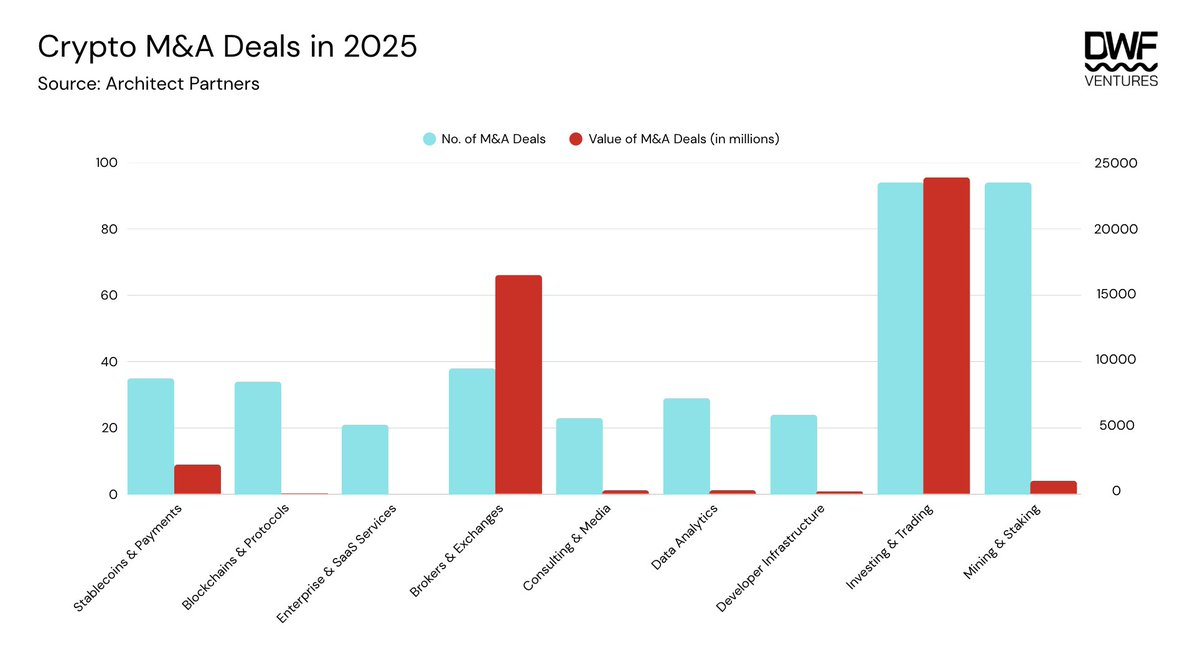
Looking back over the past year, we have seen a significant increase in transaction volume across various categories. The following three categories have become institutional priorities:
Investment and Trading: Covering trading settlement, tokenization, derivatives, lending, and DAT infrastructure;
Brokers and Exchanges: Regulated platforms centered on digital assets;
Stablecoins and Payments: Covering inflow and outflow channels, infrastructure, and applications.
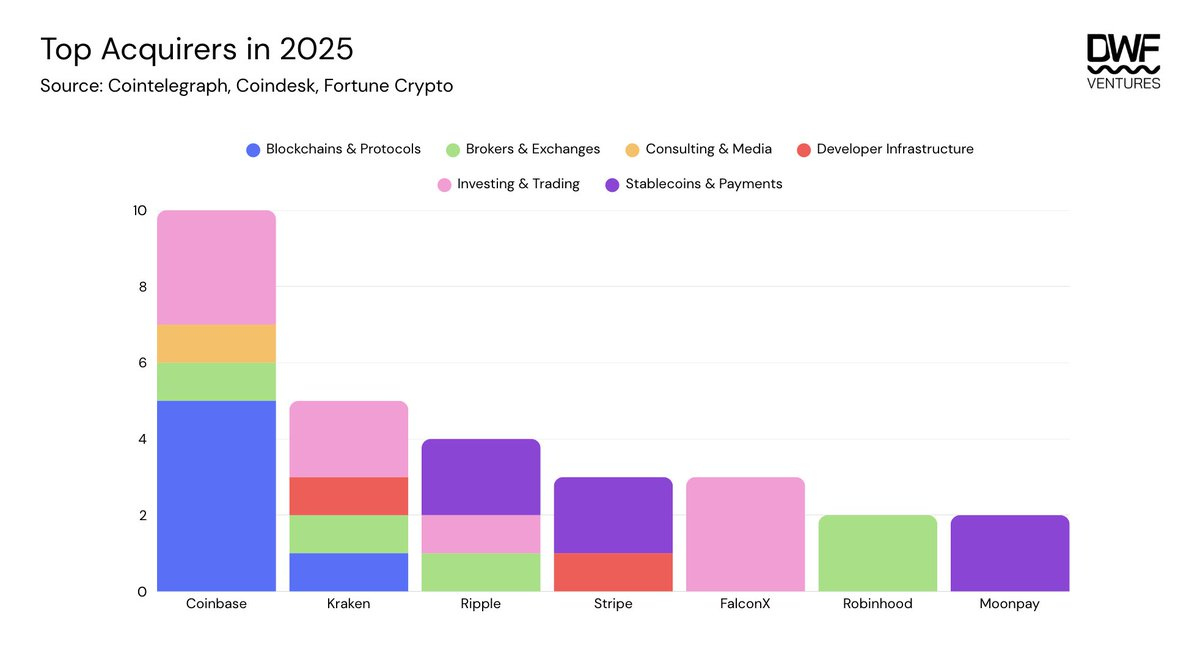
These three categories collectively accounted for over 96% of transaction value in 2025, totaling over $42.5 billion.
Leading acquirers include Coinbase, Kraken, and Ripple, all of which are involved in multiple categories. Among them, Coinbase’s layout is particularly prominent, demonstrating its ambition to become a "one-stop super application," with a core focus on bringing on-chain solutions to the masses through acquiring both traditional and innovative DApps. This is driven by intensifying competition among exchanges and the desire to capture an all-encompassing traffic entry point.
Companies like FalconX and Moonpay are going deep within their categories, building comprehensive service capabilities through complementary acquisitions.
The Next Steps for Token Issuance
Despite the current market environment and sentiment, we believe 2026 will continue to bring significant tailwinds for the digital asset space. We expect more companies to go public, which is a net positive for the overall industry—it provides greater accessibility to a larger pool of capital and investors, effectively expanding the pie.
Upcoming IPO candidates include:
Kraken: Submitted the S-1 registration statement to the SEC in November 2025, with strong expectations for an IPO in early 2026;
Consensys: Reportedly collaborating with Goldman Sachs and JPMorgan for a mid-2026 public listing;
Ledger: Targeting a $4 billion valuation and working with Goldman Sachs, Jefferies, and Barclays to advance an IPO;
Animoca: Plans to go public on Nasdaq in 2026 through a reverse merger with Currenc Group Inc.;
Bithumb: Aiming for a $1 billion valuation to list on Korea's KOSDAQ in 2026, underwritten by Samsung Securities.
The path forward is not a choice between TradFi validation and crypto-native innovation—but a fusion of both. For builders and investors, this means prioritizing fundamentals and building useful products that can generate real, sustainable income. A shift towards a long-term mindset could trigger some turbulence, but those who adapt will be able to seize the next wave of value creation.
The token is dead, long live crypto.
免责声明:本文章仅代表作者个人观点,不代表本平台的立场和观点。本文章仅供信息分享,不构成对任何人的任何投资建议。用户与作者之间的任何争议,与本平台无关。如网页中刊载的文章或图片涉及侵权,请提供相关的权利证明和身份证明发送邮件到support@aicoin.com,本平台相关工作人员将会进行核查。


