Source of content: YouTube blogger Futu Niuniu (2026 Futu Niuniu product launch conference)
Content organized by: Peter_Techub News
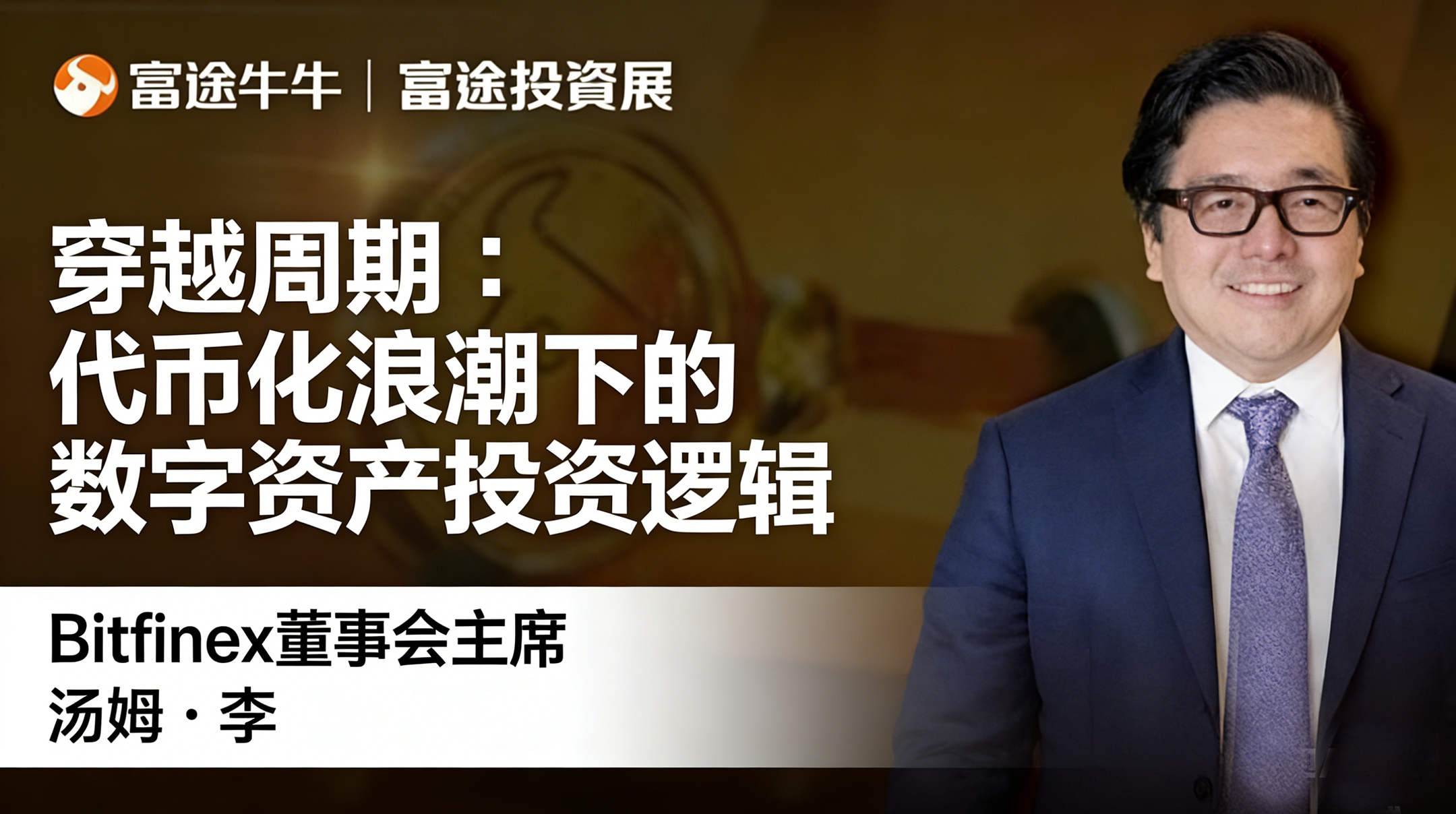
Opportunities Amid Crisis: High Oil Prices, Geopolitical Wars, and the "New Bottom" of the Cryptocurrency Market
Tom Lee opened by discussing geopolitical conflicts and oil prices rather than cryptocurrency prices. Current market forecasts suggest a nearly 90% chance that crude oil will remain above $100 in the coming months, indicating that the global economy will face long-term pressures from high costs and slowed growth, particularly for countries heavily reliant on Middle Eastern energy, such as China, India, South Korea, Japan, and Europe.
In an environment where traditional assets are under pressure, funds often reprice "scarce growth." The United States, as a major energy producer, has shown some resilience amidst high oil prices, and the high proportion of growth stocks in the US stock market makes it a natural candidate as a "safe haven" for global capital. Tom Lee emphasized that a frequently overlooked fact is that since the last round of conflict, US software stocks and tech leaders (referred to as "MAG 7") have significantly outperformed the market, and highly correlated cryptocurrency assets have already begun "rushing to rebound" in anticipation of this round of shocks.
In other words, in his view, the geopolitical crises and high oil prices are not the end for cryptocurrency assets, but rather the starting point of a new cycle.
The Final Chapter of the "Crypto Winter": From Gold Mismatch to Ethereum V-Shaped Reversal
Tom Lee spent a considerable amount of time explaining why he believes this round of the crypto winter is coming to an end, specifically naming Ethereum (ETH) as the core beneficiary of the next cycle.
- First, he pointed to the structural problems of traditional "safe haven king" gold: the total market value of gold has reached about $41 trillion, and its daily price fluctuations can correspond to value changes of up to $5 trillion, several times that of Bitcoin. This scale means that, for a diversified asset portfolio, gold itself has become a new source of volatility rather than a stable anchor.
- Secondly, looking at the historical performance of inflation hedges, gold has underperformed inflation for nearly half of the past 55 years, whereas Bitcoin, since its inception in 2009, has only underperformed inflation in about 3% of the months. In the long term, the "beta" of digital assets against currency devaluation is replacing the cognitive inertia of the gold standard era.
On this basis, he put forward a more controversial and engaging judgment: the recent selling pressure on Ethereum has technically replicated the large drops in the US stock market in 1987 and 2011. Research conducted by the Bitmine team and renowned market timing expert Tom DeMark shows that the current ETH market is 93% correlated with the 1987 S&P movement and exceeds 80% with 2011; accordingly, it is highly likely that Ethereum completed a "time bottom" around early March.
On the other hand, from the on-chain "Realized Price" perspective, the current discount of ETH price relative to the on-chain holding cost has returned to the range observed around the end of 2025 before the reversal. Historical data indicates that whenever Ethereum experiences a 20%-40% deep discount to its on-chain average cost, it often signals the starting point of a mid-to-long term rebound.
More notably, all eight previous deep retracements of over 50% for Ethereum have ended with a V-shaped reversal. Tom Lee believes that if this pattern reoccurs in 2026, returning Ethereum to $5,000 or even higher is not out of reach, but rather a matter of time and rhythm.
Wall Street on Chain: Three Long-Term Driving Forces of Tokenization, AI, and Creator Economy
Beyond the cycle judgment, Tom Lee is more concerned with "why this bull market will be completely different from the past." His core argument is that Wall Street, AI, and the creator economy are three forces that are collectively pushing Ethereum towards the role of "financial infrastructure."
Wall Street: Rewriting the Financial System on Chain
In his conversations with large financial institutions, a consensus is forming: the future financial ledger will gradually migrate from decentralized, closed internal systems to open, shared blockchain ledgers. There are at least four reasons for this:
- A shared ledger can significantly reduce efficiency losses and reconciliation costs brought by multiple accounting systems.
- Asset tokenization not only means 24/7 trading, but also greatly enhances the "liquidity radius" of collateral, allowing the same unit of asset to complete collateralization, re-collateralization, and settlement much quicker in the global financial system.
- Once "currency = software" becomes a reality, elements such as financial products, reputation, and intellectual property will naturally be digitized and put on chain, achieving more complex programmable financial relationships.
- In terms of public blockchain selection, Ethereum remains the most familiar and mature choice for institutions and developer ecosystems.
In Tom Lee's narrative, tokenization is not a conceptual hype, but a migration project that Wall Street is implementing, with Ethereum being the core public infrastructure in it.
AI Agents: The Next Batch of "Users" Are Not Humans, But Machines
The second long-term driving force comes from AI and the so-called "Agentic Systems." When large models transition from local conversational tools to intelligent agents that can truly "go out and do things" for you, they will need three things: identity, state, and settlement.
- Identity: Agents need a verifiable, traceable identity system that does not rely on a single central institution, which is where decentralized identity (DID) comes into play.
- State: When multiple agents collaborate to execute complex tasks, a "neutral state machine" trusted by all participants is crucial, and the blockchain naturally meets this requirement.
- Settlement: The value exchange and task settlement between agents require a near-real-time, programmable, frictionless payment network across borders, which is precisely the scenario that public chains and stablecoins excel in.
Coinbase founder Brian Armstrong and industry leaders such as CZ have publicly stated that the next billion-level blockchain "users" may come from AI systems themselves. In Tom Lee's view, Ethereum is already preparing technically for this trend: including account abstraction (smart accounts), conditional accounts, and programmable relationships designed for machine collaboration, all of which make it a strong candidate for the "AI-native financial layer."
Creator Economy: Proving "I Am Me" in the Age of Deepfakes
The third driving force comes from the creator economy. With the proliferation of AI-generated content and deepfake technology, the boundary between genuine human creation and machine-synthesized content is being rapidly blurred. For top creators, how to prove "this is indeed my own creation" will determine the upper limit of their commercial value.
Tom Lee mentioned that leading content creators like MrBeast have begun exploring ways to apply on-chain identity and networks like Worldcoin that "prove you are human" to provide verifiable "human signatures" for content and IP. In the long run, this means content distribution, copyright accounting, fan economies, and creator financial services could potentially be restructured on public chains like Ethereum, allowing creators to no longer just be "traffic suppliers" for platforms, but direct participants and equity sharers in the on-chain economy.
Bitmine: The Asset Allocation Paradigm Betting on the "Ethereum Era"
As the chairman of Bitmine Immersion Technologies (BMNR.US), Tom Lee did not shy away from a core fact in this talk: Bitmine itself is a "native financial instrument" betting on the Ethereum era.
By the end of 2025, Bitmine will have become one of the world's largest Ethereum corporate treasuries, holding millions of ETH, with total crypto assets and cash exceeding $10 billion, and achieving substantial on-chain yields through staking. In all Ethereum-centric digital asset treasuries, Bitmine significantly leads in both asset size and secondary market trading liquidity, with some metrics even several times or even a dozen times that of similar companies.
Tom Lee's logic is:
- From a downside protection perspective, Bitmine strictly controls leverage, does not rely on convertible bonds or high-interest liabilities, and hedges against the common "death spiral" associated with high volatility in crypto.
- From an upside elasticity perspective, by continuously increasing the "amount of Ethereum per share" and actively timing buying strategies, it aims to amplify the growth of shareholders’ equity during ETH bull cycles.
In his envisioned conclusion, once the price of Ethereum approaches long-term targets of $12,000, $22,000, or even higher, the Bitmine structure of holding ETH heavily, along with staking yields and "monthly coin generation capabilities," will convert Ethereum's beta into an equity form of "excess amplifier."
For ordinary retail investors, what Tom Lee wants to convey is not a "go all in" sentiment, but rather a newly designed asset allocation blueprint: beyond traditional stocks, bonds, and gold, gradually and systematically introducing quality digital asset exposure, especially in the lower range of Ethereum, through long-term holding and reinvestment of yields, to hedge against inflation and share in the structural dividends of tokenization and AI financialization.
Conclusion: 2026, More Than Just a Price Turning Point, but the Starting Point of Rule Rewriting
From macro wars and oil prices to gold mismatches and inflation, and to Ethereum's historical retracements and on-chain data, Tom Lee provided a compact talk revealing his view of 2026:
- In the short term, this is the end of the crypto "winter," with ETH expected to complete a V-shaped bottom amidst bad news.
- In the medium term, the three forces of Wall Street, AI, and the creator economy will push Ethereum towards becoming a new generation of financial infrastructure.
- In the long term, "digital asset vaults" like Bitmine may become the key carriers of this paradigm shift in the next generation of family asset allocation.
In a noisy market, the signal he provided is clear: what truly deserves attention is not the next candlestick, but what the next generation of the financial system will look like.
免责声明:本文章仅代表作者个人观点,不代表本平台的立场和观点。本文章仅供信息分享,不构成对任何人的任何投资建议。用户与作者之间的任何争议,与本平台无关。如网页中刊载的文章或图片涉及侵权,请提供相关的权利证明和身份证明发送邮件到support@aicoin.com,本平台相关工作人员将会进行核查。


