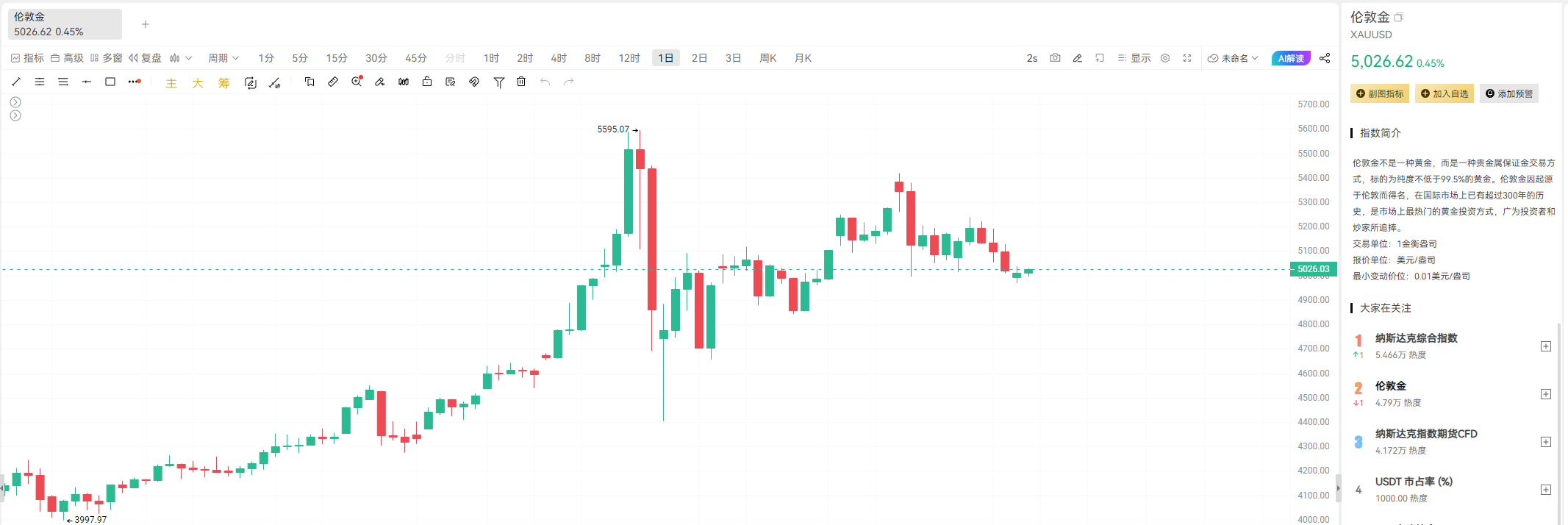
The flames of war have burned for two weeks, yet gold has fallen.
As the Strait of Hormuz is blocked, the U.S. military strikes Iranian oil facilities, and oil prices soar by 40%, traditional safe-haven asset gold has not only failed to surge but has also dropped approximately 6% compared to before the war, momentarily falling below $5000/ounce. This “failure of safe haven” has left the market in collective confusion.
However, JPMorgan Chase provided a counterintuitive answer in its commodity report released on March 13: the sale of gold at the onset of the crisis is precisely a repetition of history, rather than the end of the logic of safe haven. Even more surprising is that this Wall Street giant still insists on a bold bet of gold prices reaching $6300 within the year.
1. “Inflation Bomb” Overcomes “Safe Haven Powder”: Why Did Gold Fall Amid Gunfire?
1. The Butterfly Effect of Oil Prices
● On March 16, spot gold briefly fell below $5000, hitting a low of $4967.44/ounce. On the surface, this is a “flash crash” of gold, but behind it is a clear transmission chain: the semi-blockade of the Strait of Hormuz — soaring oil prices — rising inflation expectations — dwindling expectations for Fed interest rate cuts — a strengthening dollar — pressure on gold.
● Since the conflict erupted at the end of February, Brent crude oil has surged more than 40%, momentarily surpassing $100/barrel. The price of gasoline in the U.S. has soared nearly 25% in two weeks, reaching the highest level since October 2023. RJO Futures senior strategist Bob Haberkorn stated frankly: “The rise in oil prices pushes up inflation, and the central bank's willingness to cut rates is not as strong as it was six months ago, which is clearly bearish for gold prices.”
2. The Shift in the Interest Rate Market
● The CME FedWatch tool shows that market expectations for rate cuts in 2026 have been reduced from two times to once, with the probability of a third cut dropping to 50%. Meanwhile, the dollar index is stable above the 100 mark, and U.S. Treasury yields continue to rise.
● Gu Fengda, chief analyst of Guosen Futures, pointed out that the current market trading focus has shifted from “geopolitical risk” to “the game of inflation and monetary policy”, as safe-haven buying has been completely offset by the “inflation-tightening” logic.
2. JPMorgan Chase's “Anti-Human” Interpretation: The Decline Itself is a Buying Signal
1. “Wrong Killing” Under Liquidity Crunch
● JPMorgan Chase proposed a core viewpoint in its report: When the VIX panic index is high, gold is often sold off "in a lump".
● The bank compiled data since 2006: when the VIX is above 30 and continues to rise, the average weekly return of gold turns negative, which is the only state presenting this feature among all VIX intervals, during which the probability of gold price increase is only 45%.
● The logic behind this is: when market pressure arises, investors face margin calls and rebalancing of portfolios, being forced to sell liquid assets for cash—gold, precisely due to its liquidity, becomes the first to be sold. The significant outflow from global gold ETFs last week is a testament to this phenomenon.
2. Historical Pattern: Regaining Ground in 4 Days
JPMorgan Chase analyzed 25 events since 2006 when the VIX first broke through 30 and found a clear pattern:
● First 2 trading days: the selling pressure is most intense, and the gold price averages a drop of about 0.5%
● From the 3rd trading day: a continuous rebound begins
● On the 4th trading day: on average, all losses are recovered and the price surpasses the levels before the breakout
● On the 10th trading day: average increase from low to peak exceeds 2%
“The risk premium of geopolitical conflict is often very short-lived, more reflected as ‘buy the expectation, sell the fact,’” pointed out JPMorgan Chase, which is exactly why gold prices failed to maintain upward momentum after the outbreak of the Iran conflict.
3. Exceptions to Be Cautious Of
The bank also warns of tail risks: during the global financial crisis in 2008, the European debt crisis in 2011, and the COVID-19 pandemic in 2020, the VIX remained elevated for a long time, extending or even interrupting the rebound process of gold prices. In other words, if the conflict evolves into a systemic economic crisis, the patterns may fail.
3. How Do Domestic Institutions View It? The Logic is Aligning
1. Stagflation Trading May Replace Inflation Trading
Zhang Chining, an analyst at Guotai Junan Futures, stated that traders have largely ruled out the possibility of a rate cut in September and are only expecting one cut in December. However, several analysts mentioned a key turning point: if oil prices continue to rise and begin to erode economic growth momentum, the market may shift from “inflation trading” to “stagflation trading.”
Gu Fengda of Guosen Futures pointed out that under stagflation conditions, economic growth slows while inflation rises, and gold's anti-inflation attributes will once again become the core pricing logic, potentially leading to a rebound opportunity.
2. Subtle Changes in Liquidity
It is noteworthy that despite the decline in gold prices, some funds have started to enter at lower prices. As of March 12, SPDR Gold ETF holdings increased by 2.53 tons from the previous week, reaching 1075.85 tons, and CFTC non-commercial net long positions in gold increased by 968 contracts. This indicates that institutional investors have not exited but are positioning during the pullback.
4. Mid to Long-Term Logic: Where is the Confidence in $6300?
1. Historical Experience of Inflation Hedging
JPMorgan Chase analyzed five periods since 2000 when the U.S. CPI rose rapidly by more than 2.5 percentage points and found that: except for the pandemic period of 2020-2022, in the other four periods, gold recorded double-digit increases and outperformed the commodity index.
If the current oil price shock evolves into a stagflation environment, the hedging value of gold will be more prominent.
2. The Fed's “Dilemma” and Shift in Expectations
The bank cited its economists' analysis, stating that if oil prices continue to rise to $120/barrel or higher, the risks of economic downturn will non-linearly amplify, significantly burdening the job market. Although overall inflation will be high at that time, the transmission to core inflation will be relatively limited, the Fed is expected to switch to easing due to employment objectives.
Once the path to rate cuts accelerates, it will have a significant amplifying effect on gold.
3. Central Bank’s Long-Term Allocation
As of the end of February 2026, the People's Bank of China has increased its gold holdings for the 16th consecutive month, with gold reserves rising to 74.22 million ounces. Data from the World Gold Council shows that although global central bank gold purchases slowed in January, geopolitical uncertainty persists and substantive changes in long-term supporting factors such as the restructuring of the international monetary order have not occurred.
Qin Rui, senior deputy director at Dongfang Jincheng, believes that gold remains the core asset for hedging global systemic risks.
5. Market Outlook: The Significance of the $5000 Threshold
1. Short-Term Focus of Games
This week, the Federal Reserve's March interest rate decision will be a key variable. The market generally expects no changes, but the focus will be on how Powell expresses his views—if he signals a reduction in the number of rate cuts for the year, gold prices may come under further pressure.
Technically, the analysis from IG Group indicates that gold prices are likely to fluctuate between $4803.68 and $5234.68 this week. The gain or loss around the $5000 threshold will serve as a barometer for short-term sentiment.
2. Allocation Strategy
Senior market strategist James Stanley stated: “If spot gold prices remain above $5000, it indicates that the market's acceptance of gold prices is increasing, and as long as this trend continues, bullish investors will have the opportunity to push gold prices higher again.”
JPMorgan Chase’s latest price forecast provides a clear path:
● First quarter of 2026 average price: $5100/ounce
● Second quarter: $5530/ounce
● Third quarter: $5900/ounce
● Fourth quarter: $6300/ounce
Taking into account the views of multiple institutions, gold is still facing pressure from the “inflation-tightening” logic in the short term, and the fluctuations may not be over. However, for long-term investors, every pullback near $5000 may be as JPMorgan Chase states—a repetition of that “tactical buying opportunity” in historical patterns.
Join our community to discuss and become stronger together!
Official Telegram community: https://t.me/aicoincn
AiCoin Chinese Twitter: https://x.com/AiCoinzh
OKX Welfare Group: https://aicoin.com/link/chat?cid=l61eM4owQ
Binance Welfare Group: https://aicoin.com/link/chat?cid=ynr7d1P6Z
免责声明:本文章仅代表作者个人观点,不代表本平台的立场和观点。本文章仅供信息分享,不构成对任何人的任何投资建议。用户与作者之间的任何争议,与本平台无关。如网页中刊载的文章或图片涉及侵权,请提供相关的权利证明和身份证明发送邮件到support@aicoin.com,本平台相关工作人员将会进行核查。


