Written by: outprog
In the past era of the mobile internet, our digital lives were fragmented across countless icons (apps). To complete a simple asset cross-platform operation, we had to hop back and forth between different apps, enduring various UI logics and cumbersome operational processes.
However, as AI Agents represented by OpenClaw (Lobster) come to the forefront, this "app-centric" logic is rapidly coming to an end.
1. Intent Layer: Semantics as Operation, UI Becomes the "Backup"
In the past, we operated based on "paths"; now, we express "intent".
In the era of traditional GUI (Graphical User Interface), completing a task required a high "learning cost". You had to know where the buttons were and how many levels deep the menus went. But in the age of Agents, interaction has turned into LUI (Language User Interface).
Case Comparison: From "Clicking" to "Intent"
Uniswap (DEX): represents permissionless decentralized trading, but its complicated wallet connections, chain switching, and slippage settings often leave users frustrated.
OKX (CEX): represents efficient centralized services, but the asset transfer process between CEX and on-chain DEX is extremely fragmented.
The "torture" of traditional UI/UX:
1. Open the OKX app, click "Withdraw", enter the address, and wait for confirmation.
2. Open the wallet plugin and connect to the Uniswap official website.
3. Manually select the network and search for the token contract.
4. Set the slippage, click Swap, and confirm the signature in the wallet.
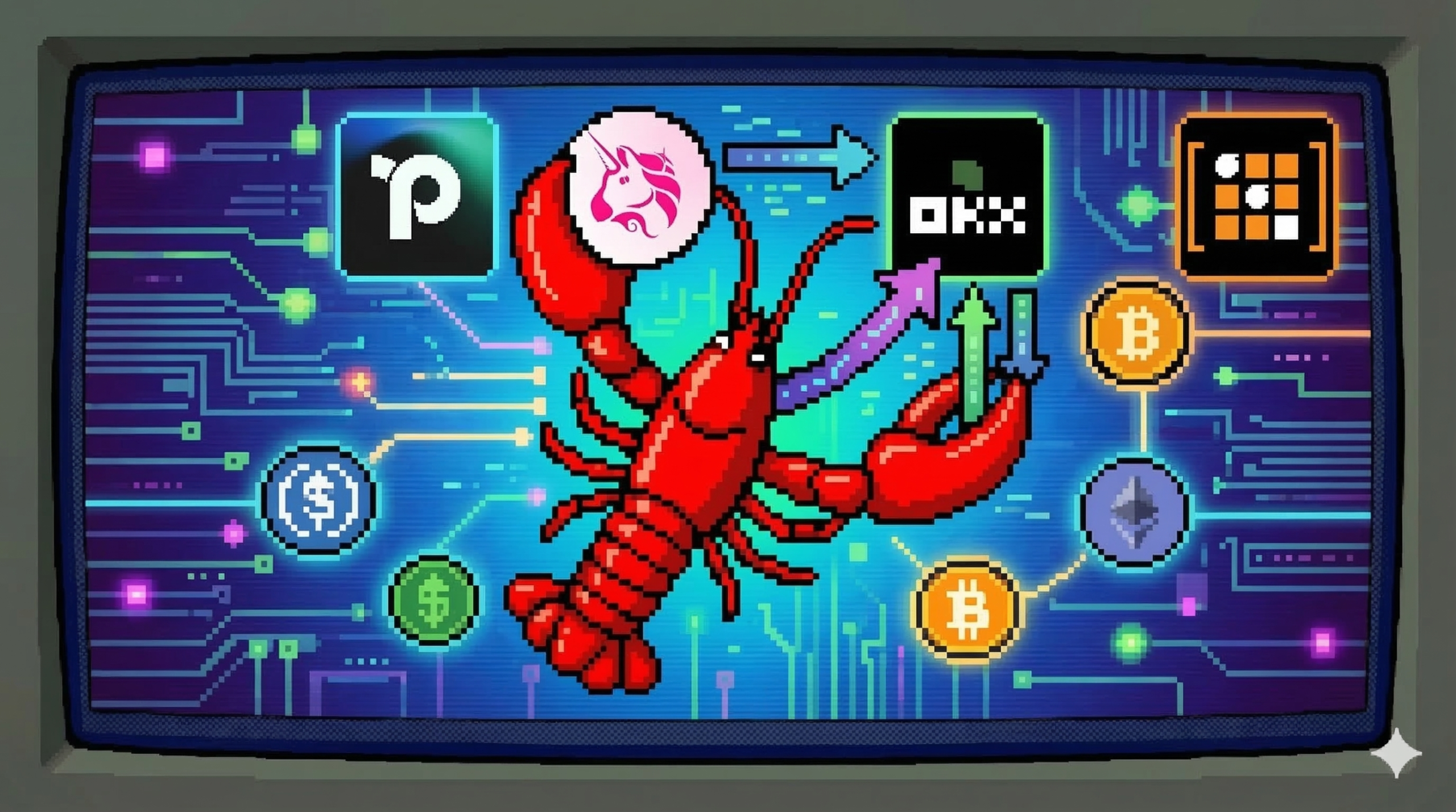
AI Agent's semantic interaction:
Human: "Help me exchange 1 ETH in OKX for the cheapest USDC on Uniswap, the lower the fee, the better."
Machine (Agent): "Okay. I have detected that the lowest fee for withdrawing ETH from OKX to X Layer is currently, and Uniswap has the best liquidity on that layer.
I am executing the cross-chain withdrawal and automatic exchange for you...
The exchange is complete, 1 ETH has been converted to 2026 USDC, saving you about $12 in Gas fees."
This is the divine disruption of "semantic transformation into intent." When conversation is the service, the meticulously designed UI of apps will lose their meaning because the Agent is the one reading the interface for you.
2. Workflow Layer: Skill Packaging and Automatic Evolution
If intent is the "starting point" and operation is the "endpoint", then the core value of the Agent lies in how to automatically construct the "bridge" in between.
Diving into the logic layer, an Agent is not just a chatbot, but an executor with a Skill library. For the cases mentioned above, the Agent automatically decomposed the following algorithm flow:
Asset Awareness: Check the balance of the OKX account through API calls.
Path Search: Compare the withdrawal fees of OKX with the quotes on different chains from Uniswap.
Dynamic Execution: Automatically handle withdrawal verification, on-chain signing, and other Skill operations.
Feedback Loop: Monitor on-chain status in real-time and report results in natural language.
Core Concept: Previously, these steps required engineers to "hardcode" the logic, but future Agents will automatically adjust Skill priorities based on environmental changes (such as when a certain chain becomes congested), achieving logical self-evolution.
3. Architecture Layer: The Arrival of MCP Protocol and an "Agent-Friendly" Society
When software is no longer designed for humans, the underlying protocols of the internet will undergo a major reshuffle.
The mention of the MCP (Model Context Protocol) indicates a brand new form of software:
Software as Plugin: Software no longer needs a fancy front-end but must provide standard interfaces that are easy for Agents to call. OKX's Agent Trade Kit is a pioneer of this trend.
Agent Friendliness: The mainstream traffic of the future will no longer be "human clicks," but "Agent dispatches." If one platform (like Uniswap) offers more functional Agent Skills, it will monopolize all entrances.
4. Industry Shock: Reshaping and Disappearance of Roles
This reshuffle targets not only software but also developers:
Front-end Engineers: Demand will face structural shrinkage. When users no longer need to click buttons, the elegance of the interface becomes irrelevant.
Product Managers (PM): Transition to "Conversation Managers." The core work shifts from "drawing prototype diagrams" to "designing conversation flows" and "optimizing the algorithmic efficiency of Agent task decomposition."
Back-end Development: Focus shifts to how to support more complex VM environments and how to facilitate smoother integration of Agents with underlying protocols.
The Path to a "Self-Driving" Digital World
The end of the app era is, in essence, a return of human control over tools.
We no longer need to be slaves to software, learning the quirks of every product; we just need to give direct instructions through the Agent. From "semantics" to "intent," and then to automated "operations," AI Agents are building a "self-driving system" in the world of software.
In this new world, the best UI is "no UI," and the strongest application is that "Agent that understands your intent the best."
免责声明:本文章仅代表作者个人观点,不代表本平台的立场和观点。本文章仅供信息分享,不构成对任何人的任何投资建议。用户与作者之间的任何争议,与本平台无关。如网页中刊载的文章或图片涉及侵权,请提供相关的权利证明和身份证明发送邮件到support@aicoin.com,本平台相关工作人员将会进行核查。


