The New York-listed company (NYSE: CANG), which shifted from auto finance into bitcoin mining in November 2024, reported its unaudited 2025 results on March 16, showing rapid top-line expansion alongside steep accounting losses. Cango mined 6,594 BTC across its global operations and generated $675.5 million in mining revenue, accounting for the vast majority of total income.
Despite the headline loss, Cango reported adjusted EBITDA of $24.5 million for the year, indicating positive operating performance when excluding non-cash and one-time items. The company said its net loss was primarily driven by a $338.3 million impairment on mining machines and $96.5 million in fair value losses tied to bitcoin-collateralized receivables.
Fourth-quarter results reflected similar pressures, with revenue of $179.5 million and a net loss of $285 million, compared with net income in the same period a year earlier. The company cited bitcoin price movements at year-end and transformation-related costs as key contributors to the quarterly decline.
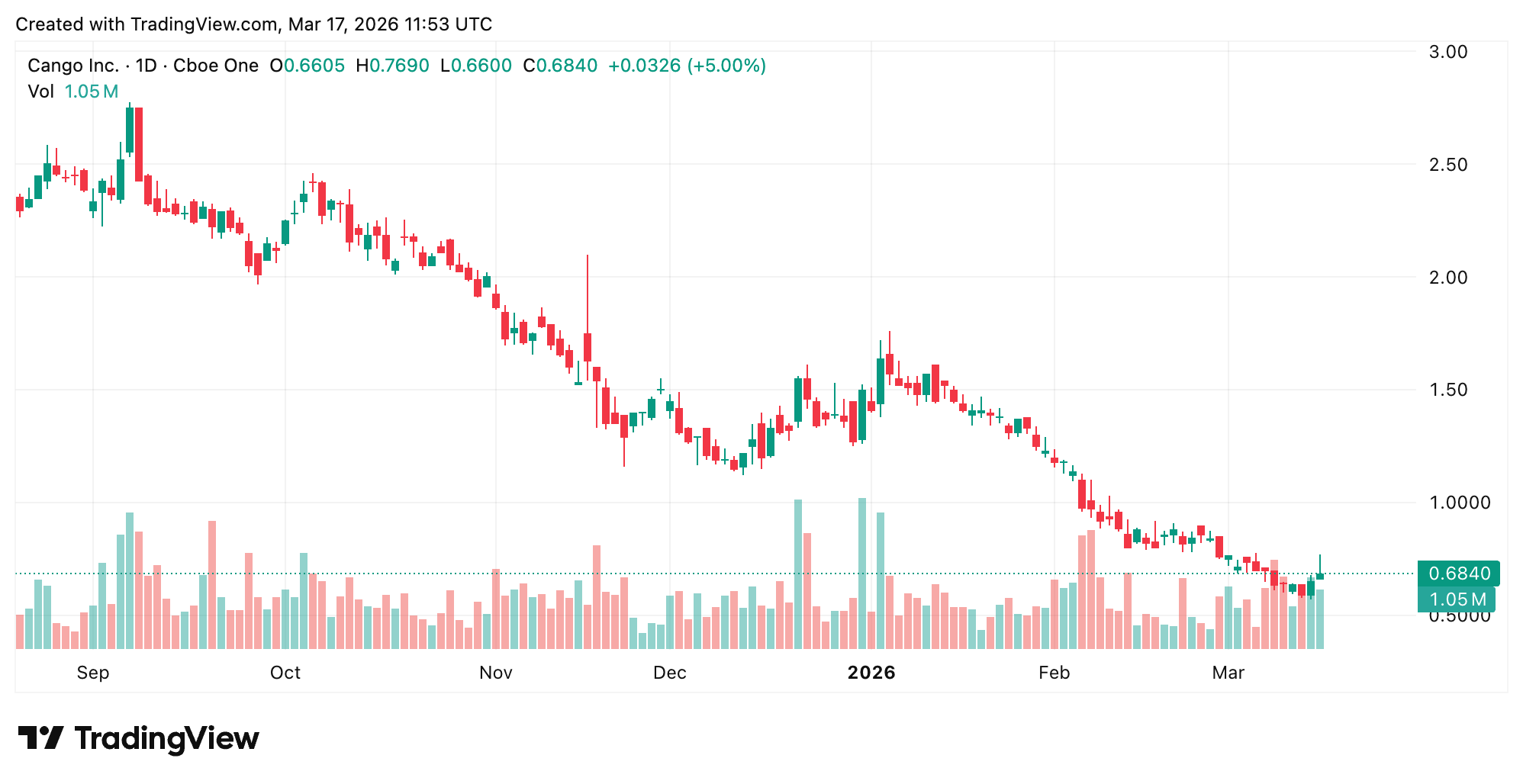
Cango stock via tradingview.com
Cango scaled its mining operations aggressively in 2025, producing an average of 18.07 BTC per day and operating across more than 40 sites spanning North America, the Middle East, South America, and East Africa. By February 2026, its deployed hashrate reached 50 EH/s, with continued monthly production, including roughly 496 BTC mined in January.
To address leverage, the company moved quickly in early 2026 to strengthen its balance sheet. It sold 550 BTC in January and 4,616 BTC in February, using proceeds to repay bitcoin-backed debt and improve liquidity. A February sale of more than 4,400 BTC generated about $305 million, settled in USDT, reflecting a treasury strategy focused on capital efficiency rather than long-term accumulation.
Cango is also repositioning beyond mining, advancing a shift into artificial intelligence (AI) infrastructure through its U.S. subsidiary, Ecohash. The company is retrofitting its Georgia-based mining site with modular AI inference systems, with pilot deployments already underway. The initiative targets demand for distributed, lower-cost computing using existing energy-connected infrastructure.
Leadership framed the transition as a continuation of its broader transformation strategy. CEO Paul Yu said the company entered 2026 focused on balance sheet optimization and expansion into AI-driven computing services, while CFO Michael Zhang emphasized that the net loss stemmed largely from non-recurring and market-driven accounting factors rather than core operations.
Investor backing has continued during the transition. In February, Cango secured a $10.5 million equity investment from Enduring Wealth Capital and $65 million in equity commitments from its leadership team, while also repurchasing shares under an existing buyback program.
Shares have recently traded near $0.68, down about 43% over the past three months, reflecting investor response to reported losses and broader mining sector pressures. The company’s results highlight both the capital intensity of large-scale mining and a growing trend among miners reallocating resources toward AI-related infrastructure.
- Why did Cango report a large net loss in 2025?
The loss was mainly due to non-cash impairments on mining equipment and fair value adjustments linked to bitcoin prices. - How much bitcoin did Cango mine in 2025?
Cango mined 6,594 BTC during the year, averaging about 18 BTC per day. - Why did Cango sell bitcoin in early 2026?
The company sold bitcoin to repay debt, reduce leverage and improve balance sheet flexibility. - What is Cango’s AI strategy?
Cango is converting mining infrastructure into AI inference systems through its EcoHash unit to target distributed computing demand.
免责声明:本文章仅代表作者个人观点,不代表本平台的立场和观点。本文章仅供信息分享,不构成对任何人的任何投资建议。用户与作者之间的任何争议,与本平台无关。如网页中刊载的文章或图片涉及侵权,请提供相关的权利证明和身份证明发送邮件到support@aicoin.com,本平台相关工作人员将会进行核查。


