Written by: Tanay Ved
Translated by: Shan Oppa, Golden Finance
Key Points
A user initiated a $50 million USDT exchange transaction through the Aave interface, routed across multiple DeFi platforms, and completed within a single block, ultimately receiving only about $36,000 worth of AAVE tokens.
The transaction was ultimately routed to the SushiSwap WETH/AAVE trading pool, which had only about $75,000 in liquidity, causing extreme price impact while enabling surrounding MEV bots to generate millions in profits.
This event reveals how large orders, insufficient on-chain liquidity, and routing mechanism failures can lead to poor trade execution outcomes, highlighting the urgency of establishing more comprehensive risk protection mechanisms and designing smarter trading routing systems within permissionless blockchain markets.
A $50 Million Loss in an Exchange Transaction
One of the core characteristics of blockchain and decentralized finance is its openness and permissionless nature. These attributes bring new efficiencies and participation methods to the market, but they can also occasionally lead to issues such as protocol exploits, oracle pricing errors, or operational mistakes.
On March 12th, a user executed a $50.4 million exchange transaction, ultimately losing 99.9% of the initial value. The user used the Aave interface on the Ethereum mainnet to exchange $50.4 million USDT, receiving only $36,000 worth of AAVE tokens in return. In a permissionless blockchain system, a large transaction encountering a liquidity-depleted market creates a typical case of on-chain transaction execution risk.
This article will deeply analyze the mechanics of the exchange transaction, the direction of funds, and the insights this event offers for executing large transactions under limited on-chain liquidity.
The Flow of Funds and Mechanics Behind the Transaction
The user's intention was simply to exchange $50 million USDT for AAVE tokens, but the final transaction process was complex. The entire operation involved a series of protocols and asset conversions, from lending protocol interfaces to trading aggregators, decentralized exchanges, and participants involved in maximizing extractable value arbitrage.
The transaction was initially initiated as a collateral swap through the Aave interface, with the user holding a aEthUSDT position at the time. aToken is Aave platform's interest-earning deposit receipt, and aEthUSDT represents the user's USDT deposited on Aave V3. To complete the collateral conversion, the Aave interface routed the order to CoW Protocol—this is a third-party decentralized trading aggregator that finds optimal trading execution paths across various liquidity platforms through solution providers (market makers, algorithmic bots, etc.).
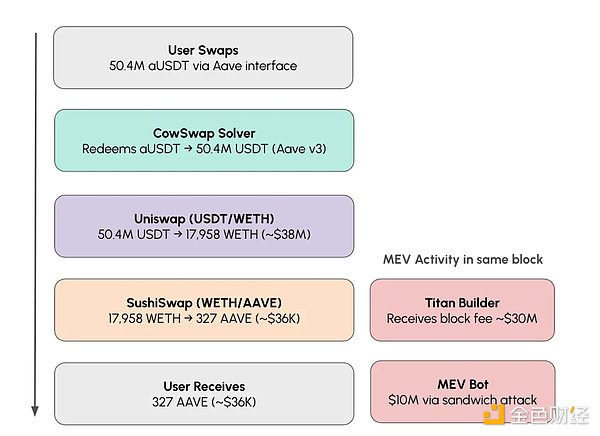
In the same block, the user's aUSDT funds circulated through Aave, CoW, Uniswap, and SushiSwap, with the final direction of funds being arbitraged by MEV-related entities: Coin Metrics ATLAS platform, Talos Research
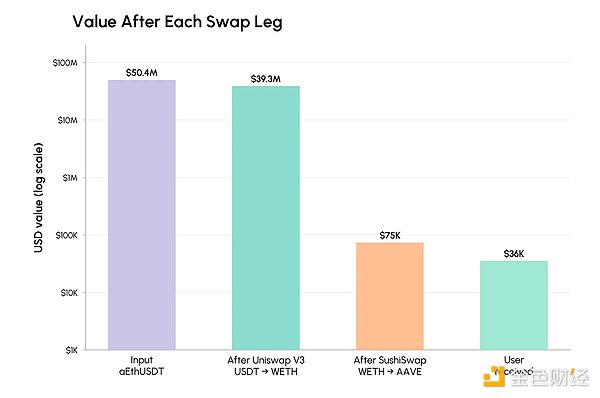
In this transaction, the winning solver first exchanged the redeemed USDT for WETH on the decentralized exchange Uniswap V3, and then transferred these WETH into the low liquidity SushiSwap AAVE/WETH trading pool; this is the core link leading to the significant value loss in the transaction. By tracing through the Coin Metrics ATLAS platform, we can link the transaction's flow through its various stages in block 24643151, clearly observing the nodes of value loss.
Decentralized Exchange Trading Routing
aUSDT burned, USDT redeemed: The user's 50.43 million aEthUSDT was transferred to CoW protocol's GPV2 settlement contract, which completed the token redemption through Aave V3, releasing $50.43 million USDT from the reserve pool while burning the aToken.
USDT exchanged for WETH on Uniswap V3: The CoW settlement contract transferred $50.43 million USDT into Uniswap V3's USDT/WETH trading pool, finally exchanging it for 17,957.81 WETH, worth approximately $38.2 million.
WETH exchanged for AAVE tokens on SushiSwap: 17,957.81 WETH (approximately $38.2 million) was transferred into SushiSwap's WETH/AAVE trading pool, which at the time had only about $73,000 in liquidity. Faced with such a large exchange transaction, the severely liquidity-depleted trading pool only provided the user with 331 AAVE tokens, worth approximately $36,000. The vast majority of the value from this transaction was lost in this stage.
This block also triggered a large number of maximum extractable value arbitrage behaviors. Maximum extractable value refers to the profit earned by bots through monitoring pending transactions and using large or predictable orders to carry out arbitrage. In this event, bots profited from "sandwich attacks," executing reverse operations before and after the user's transaction to exploit the pricing discrepancy from the SushiSwap trading pool.
Related Maximum Extractable Value Arbitrage Operations
Front-running trade: A MEV arbitrage bot (wallet address: 0x06cf...5ef) borrowed 14,175 WETH through a flash loan from the lending protocol Morpho, exchanging for 128.57 AAVE tokens through the decentralized exchange Bancor. This operation raised the price of AAVE tokens before the user's transaction entered the SushiSwap trading pool.
Back-running trade: After the user’s order was completed at the elevated price level, the bot immediately sold 128.57 AAVE tokens for 17,912 WETH, worth approximately $40.9 million. After reimbursing the Morpho flash loan (14,175 WETH), the remaining profits were split: about 13,087 WETH ($29.9 million) paid as block sorting fees to Titan Builders, while approximately 4,824 WETH ($10 million) were retained by the arbitrage bot.
From borrowing funds via a flash loan, front-running trades, back-running trades to loan reimbursement, the entire arbitrage operation was completed in a single transaction in the same block in an atomic manner with the user's exchange transaction.
Where Did the Funds Flow?
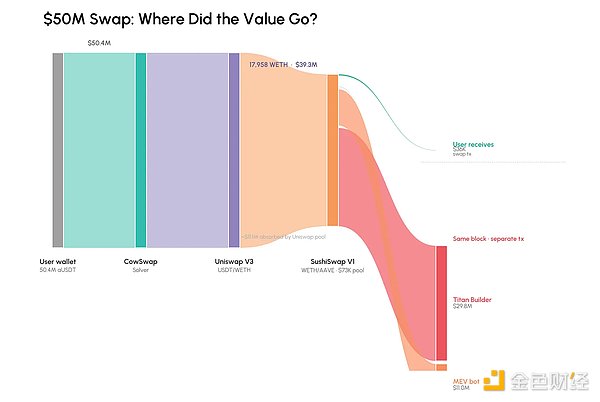
The transaction's value did not vanish into thin air; it was redistributed among other participants in the block. As shown in the image above, approximately $27 million of the total transaction value flowed into Titan Builders as block sorting fees, around $10 million was earned by the MEV arbitrage bot executing the sandwich attack, while the value of the AAVE token position ultimately held by the user was only around $36,000.
Large Transactions Encountering Liquidity Depletion
The approximately $39 million value loss in this transaction can be traced back to the SushiSwap's WETH/AAVE trading pool—this is the automated market maker (AMM) liquidity pool under the SushiSwap decentralized exchange. At the time of the transaction, the total liquidity reserve of this pool was only about $75,000, yet it had to accommodate a large transaction valued at $37 million, resulting in a nearly 500-fold scale mismatch between the two. For a trading pool with such scarce liquidity, this scale mismatch resulted in severe price impact. As the proportion of reserve assets in the trading pool sharply changed, price data indicate that the price of AAVE tokens in this pool soared from about $118 ($0.054 WETH / per AAVE) to approximately $306,000 (139.9 WETH / per AAVE).
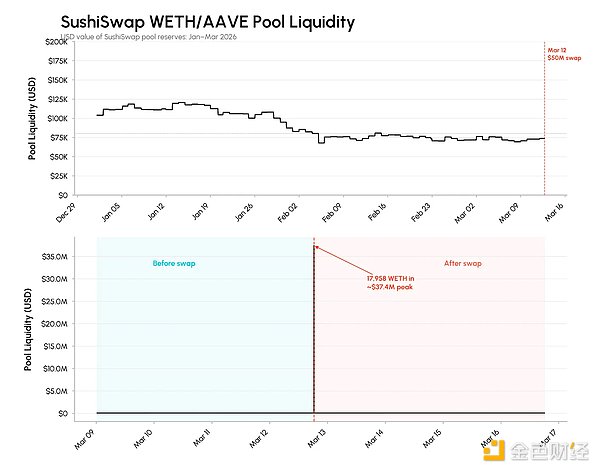
This incident also raised many questions: why would such a large transaction be executed in a single instance and routed to a trading pool with such scarce liquidity? Such a transaction should have been intercepted from the outset. Aave’s post-incident investigation report pointed out that the causes of this incident included insufficient market liquidity and that the user had explicitly confirmed acceptance of a 99.9% price impact warning. Meanwhile, the CoW protocol's analysis suggested that this incident resulted from multiple failures in the routing mechanism: its pricing validation system rejected paths with better pricing due to "GAS limit failure," ultimately causing the winning solver to route this large transaction to a trading pool with only $75,000 in liquidity.
Insights from the Incident
In summary, the core issue of this incident was not protocol vulnerabilities or malicious exploitation, but the extreme price impact triggered by the combination of large transactions and insufficient on-chain liquidity. This incident has brought many profound insights for the structure of on-chain markets and the entire cryptocurrency industry:
Scaled Risk Protection Mechanisms
For such large transactions, the risk warning at the user experience level of on-chain systems is far from sufficient. The permissionless nature of decentralized finance means that protocols typically do not prevent users from executing economically adverse transactions, but this incident also illustrates the practical necessity of setting up transaction execution filtering mechanisms, pool-level validations, or transaction size limits in extreme situations. How to set reasonable risk protection boundaries that ensure permissionless market access while safeguarding user asset security remains an urgent question for the industry to address.
Execution Strategies for Large Transactions
Large exchange transactions like this $50 million one should be executed using time-weighted average price (TWAP) or algorithmic trading techniques to be split across different times and trading platforms. This approach can effectively reduce market impact and lessen the risk of being arbitraged by MEV bots. Such trading strategies have matured in traditional financial markets and are becoming increasingly important in on-chain markets as well.
The Core Role of Data
Real-time data on trading pool/market depth, cross-platform liquidity, and slippage are key for pre-trade verification and can help systems exclude incompatible trading platforms (e.g., those with very low liquidity or abnormal markets). Embedding these real-time data into trading routing logic and risk filtering systems can effectively prevent similar incidents under the backdrop of expanding scales of on-chain trading platforms and increasing market fragmentation.
Balancing Maximum Extractable Value and Permissionless Trading
As illustrated by the block involved in this incident, open transaction mempools are prone to trigger MEV arbitrage behaviors such as sandwich attacks. The industry needs to optimize designs based on this reality: by implementing private or protected trading execution channels, compatible MEV arbitrage trading routing systems, and allowing users to choose whether to enable risk protection features, thereby maintaining the liquidity advantages of permissionless access while reducing users' trading risks.
免责声明:本文章仅代表作者个人观点,不代表本平台的立场和观点。本文章仅供信息分享,不构成对任何人的任何投资建议。用户与作者之间的任何争议,与本平台无关。如网页中刊载的文章或图片涉及侵权,请提供相关的权利证明和身份证明发送邮件到support@aicoin.com,本平台相关工作人员将会进行核查。