On March 18, 2026, the sky over the Middle East was torn apart by missile tail flames.
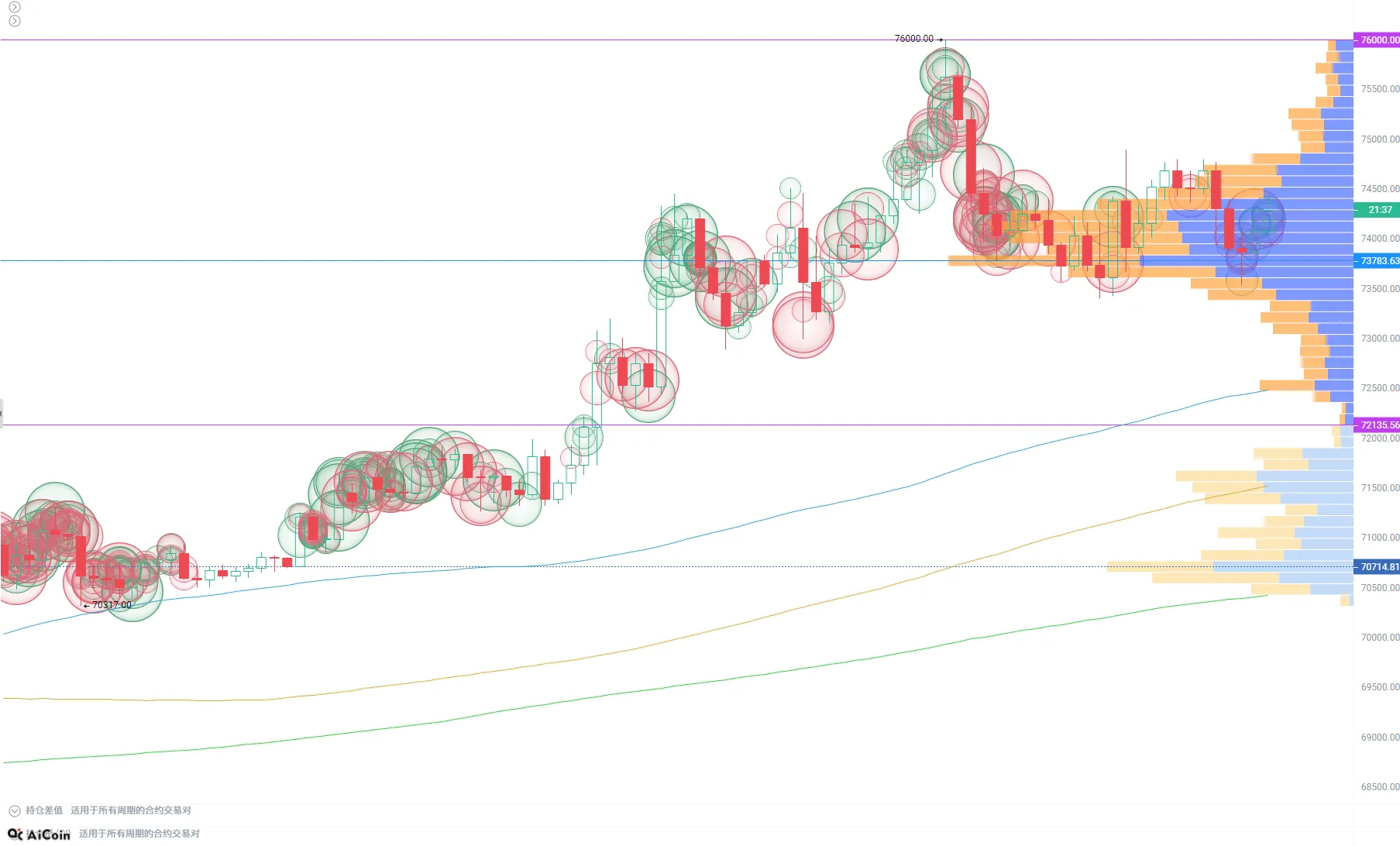
The conflict between the U.S. and Iran entered its 18th day. The situation not only showed no signs of easing, but rather exhibited trends of escalation and prolonged confrontation. Brent crude oil prices surpassed $103 per barrel, reaching a three-year high; Bitcoin fluctuated around $74,000, briefly dropping below $74,000 before resiliently recovering. When the “pulse of oil prices” and the “candlesticks of cryptocurrencies” began to resonate in sync, is it a coincidence or a new consensus of global capital under the shadow of stagflation?
This article will combine the latest battlefield conditions and market data to deeply analyze how geopolitical conflicts affect the cryptocurrency market through the “transmission chain of oil prices,” and rely on the professional tools of the AiCoin platform to outline a strategic map for traders during this special period.

1. The Flames of War Rekindle: From “Blitzkrieg” to “War of Attrition”
As of March 18, U.S. and Israeli military strikes against Iran have lasted for 18 days, and the situation on the battlefield has fundamentally changed.
● The conflict has expanded from initial exchanges between Israel and Iran to the entire Gulf region. The Iranian Revolutionary Guard launched Operation “True Commitment - 4,” targeting not only facilities within Israel but also including U.S. airbases in Qatar, the UAE, and Iraq in its strike range. The USS Ford aircraft carrier lost some combat capability due to a fire, and the U.S. embassy in Iraq was attacked and caught fire.
● According to foreign media reports, Iran has allegedly intensified its attacks on Middle Eastern energy facilities. Although tankers still attempt to navigate the Strait of Hormuz, this “dancing on the edge of a knife” transportation route is extremely fragile. White House economic advisor Hassett soothed the market by saying that “tankers are resuming passage,” but also admitted that Iran's interference capability remains, and Asian countries are beginning to reduce refined oil exports to ensure self-sufficiency, indicating a structural fracture in global energy trade.
● U.S. President Trump stated that military action would not end this week and that the U.S. “no longer needs nor wants help from NATO countries.” The Iranian Supreme Leader rejected peace proposals, insisting that the U.S. and Israel must “be defeated and pay reparations.” The hardline stance from both leaders indicates a bleak prospect for peace, forcing the market to reprice for a “high oil price normal.”
2. Oil Price Transmission: Shadows of Inflation and Rate Shifts
For the financial market, the core impact path of the Middle East situation is not merely a flight to safety, but through the rigorous chain of "oil prices → inflation expectations → central bank policies → risk asset valuations."
● A Bank of America March fund manager survey indicated that geopolitical conflicts have replaced the AI bubble as the primary risk in the market, and commodity overweight has reached a two-year high. The market is transitioning from “soft landing euphoria” to “stagflation defense mode.” As the lifeblood of industry, rising crude oil prices will directly increase transportation and manufacturing costs, forcing central banks to maintain high interest rates for a longer period.
● Nick Timiraos, known as the "new Fed correspondent," pointed out that the escalation of the Middle East situation has strengthened the consensus for the Federal Reserve to remain inactive. This week, the market's focus has shifted from “when to cut interest rates” to “how long to maintain high rates.” Traders expect the Federal Reserve's planned rate cut for the year has drastically shrunk to just 25 basis points. This means that the “liquidity easing expectations” that once drove Bitcoin higher are being consumed by this geopolitical black swan.
3. Bitcoin's “Split Personality”: Digital Gold or Risk Asset?
In the context of soaring oil prices and a declining dollar, Bitcoin's performance is intriguing.
● Resilience and Fragility Coexist: On March 18, Bitcoin rose by 0.38%, remaining around $74,000. This price reflected a rebound from prior lows, exhibiting some resistance to decline. On-chain data provider CryptoQuant noted that the 30-day moving average trading volume delta on Binance and Coinbase has turned positive, indicating that buyer strength is returning.
● Critical $79,962: However, the path to rising prices is not smooth. On-chain data indicates that the average cost basis for holders of U.S. spot Bitcoin ETFs is approximately $79,962. This means that the current price has about a 6.5% gap from that level. Once Bitcoin rebounds to around $80,000, it will face significant selling pressure — this is the area where many “break-even warriors” will look to exit. As of press time, Bitcoin has stabilized above $74,000, but open interest has not significantly increased, indicating that leveraged participation is lacking and the rebound foundation is not solid.
● Tearing of Logic: Theoretically, geopolitical conflicts should evoke Bitcoin's "digital gold" safe-haven attributes; in reality, the interest rate hike expectations triggered by rising oil prices suppress the valuations of risk assets. This sense of tearing defines the high volatility of the current market. Bitcoin is neither purely rust (an industrial commodity) nor purely gold; it is in the chaotic zone between the two.
4. New Variables Emerge: OIL Coin and the Crypto Energy Sector
This conflict is markedly different from previous ones in that the crypto market has seen the emergence of “concept coins” pegged to oil prices, such as OIL Coin. The market is beginning to closely monitor the direct links between crypto assets and commodities.
● Candlestick Comparison Analysis: As suggested by the market, by overlaying the Brent crude oil futures candlestick chart with the OIL Coin/BTC candlestick chart, it can be observed that their correlation is significantly strengthening. When Iran announced intensified attacks on energy facilities, oil prices often spiked and transmitted to relevant crypto assets within half an hour.
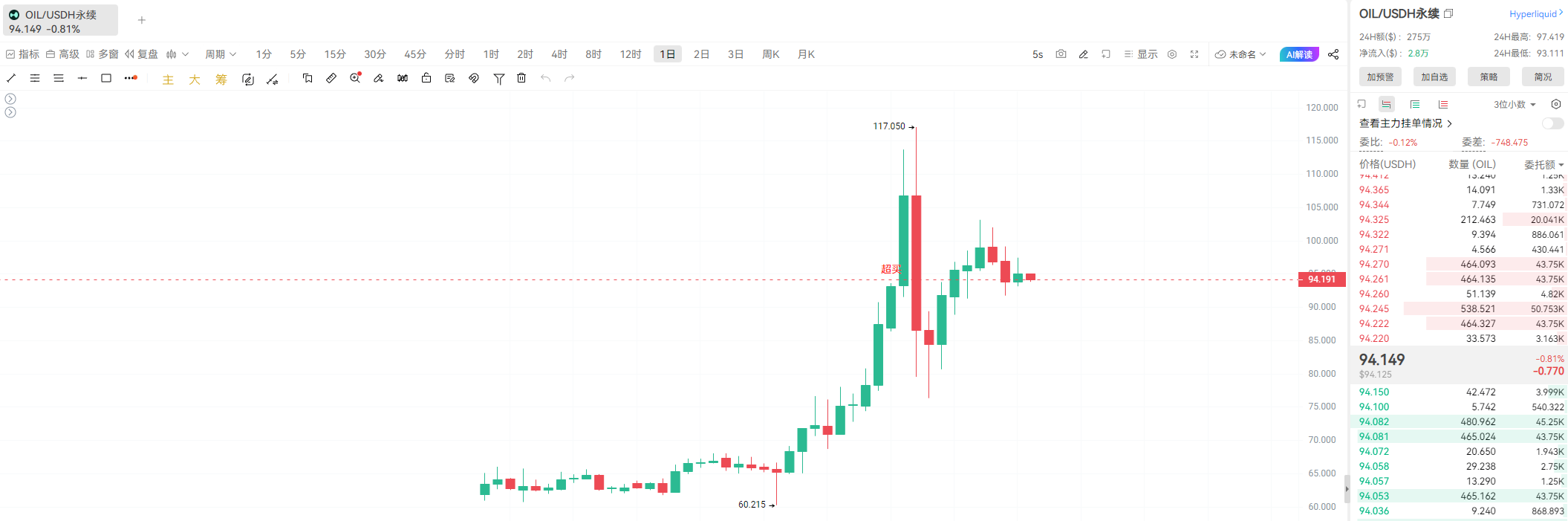
● Self-fulfilling of Themes: In the current prevalence of AI trading, as long as the logical mainline of “Middle East - energy - inflation” is not falsified, capital will seek to find corresponding assets in the crypto market for hedging trades. This results in OIL Coin being activated as a “expectation voting machine” even though it lacks practical application scenarios.
5. Practical Tools: Utilizing AiCoin to Navigate the “War Market”
In the face of extreme market conditions driven by macro events, multi-asset correlations, and severe volatility, traditional single account manual trading methods are clearly inadequate. At this moment, leveraging professional tools such as AiCoin will become the watershed between professional traders and non-professional traders.
1. Panoramic Monitoring: Keeping Track of Market Capital Flows
Using AiCoin’s multi-account panoramic management function, traders can real-time monitor the changes in positions and funding rates across different exchange accounts. When an unexpected spike occurs due to an Iranian battle, they can immediately detect account anomalies through the AiCoin dashboard, without the need to frequently switch apps to log into various platforms, gaining precious minutes for decision-making.
2. Multi-Account Ordering: One-Click Execution of Hedging Strategies
In the current market, simultaneously operating a strategy of “longing oil concept coins” and “shorting Bitcoin hedges” has become mainstream.
● Follow Mode: If the main account captures a breakout signal for OIL Coin, the “follow mode” in AiCoin can be used to set orders on the main account, allowing the remaining 5, 10, or even an unlimited number of following accounts to purchase automatically in proportion (such as 1:1), achieving concentrated positioning and capturing the first wave of momentum.
● Split Account Mode: If anticipating that the market will enter a “high volatility + high interest rate” complex fluctuation, the “split account mode” can be utilized. For example, placing a total order of 1000 USDT and allocating the funds in different ratios (such as 5:3:2) across multiple accounts for different price levels or different cryptocurrencies, thereby both dispersing single-point risk and spreading risk gradients through multiple accounts.
3. News Interaction: Zero Time Lag between Information and Trading
The built-in news system in the AiCoin platform often pushes key messages such as “Iran attack on U.S. military base” or “tankers attacked” in real-time. For professional players, while monitoring news, the multi-account ordering interface is already prepared. While ordinary investors are still searching for the buy button, traders using AiCoin have already completed bulk orders across 10 accounts with a single click.
In this March of 2026, the global financial market is experiencing a profound paradigm shift. The artillery fire of the Middle East has ignited the fuse of oil prices, while the surge in oil prices is reshaping the valuation system of the cryptocurrency world through interest rate expectations.
In this market of “ever-changing moments,” the competition is no longer about whose direction is more accurate, but about whose execution system is faster, steadier, and more comprehensive. Whether using Bitcoin to hedge fiat currency credit or using OIL Coin to speculate on the energy crisis, it all relies on efficient tool support.
The war may end, but the game between “inflation stickiness” and “computational assets” triggered by this conflict has just begun. For smart capital, every movement of the candlestick is an opportunity to capture alpha returns using professional tools like AiCoin.
Join our community, let's discuss and become stronger together!
Official Telegram community: https://t.me/aicoincn
AiCoin Chinese Twitter: https://x.com/AiCoinzh
OKX Benefits Group: https://aicoin.com/link/chat?cid=l61eM4owQ
Binance Benefits Group: https://aicoin.com/link/chat?cid=ynr7d1P6Z
免责声明:本文章仅代表作者个人观点,不代表本平台的立场和观点。本文章仅供信息分享,不构成对任何人的任何投资建议。用户与作者之间的任何争议,与本平台无关。如网页中刊载的文章或图片涉及侵权,请提供相关的权利证明和身份证明发送邮件到support@aicoin.com,本平台相关工作人员将会进行核查。