The world's largest passive component manufacturer, Murata Manufacturing, announced that starting April 1, it will raise prices for AI servers and automotive-grade MLCCs (multi-layer ceramic capacitors) by 15-35%. This marks the first major price adjustment by the Japanese company, which holds a 40% share of the global MLCC market, in three years.
The price increase itself is not surprising. In the past year, the demand for high-end MLCCs in AI servers has doubled, while Murata's capacity utilization has started to rise from its low point in 2024. What really needs to be unpacked is how a ceramic capacitor measuring less than a millimeter can stir the entire AI computing supply chain.
How many capacitors are in an AI server?
When most people discuss the costs of AI servers, they focus on GPUs. However, an easily overlooked fact is that an AI server equipped with the NVIDIA GB300 platform requires about 30,000 MLCCs, which is 30 times that of a smartphone and 5 to 10 times that of a traditional server.
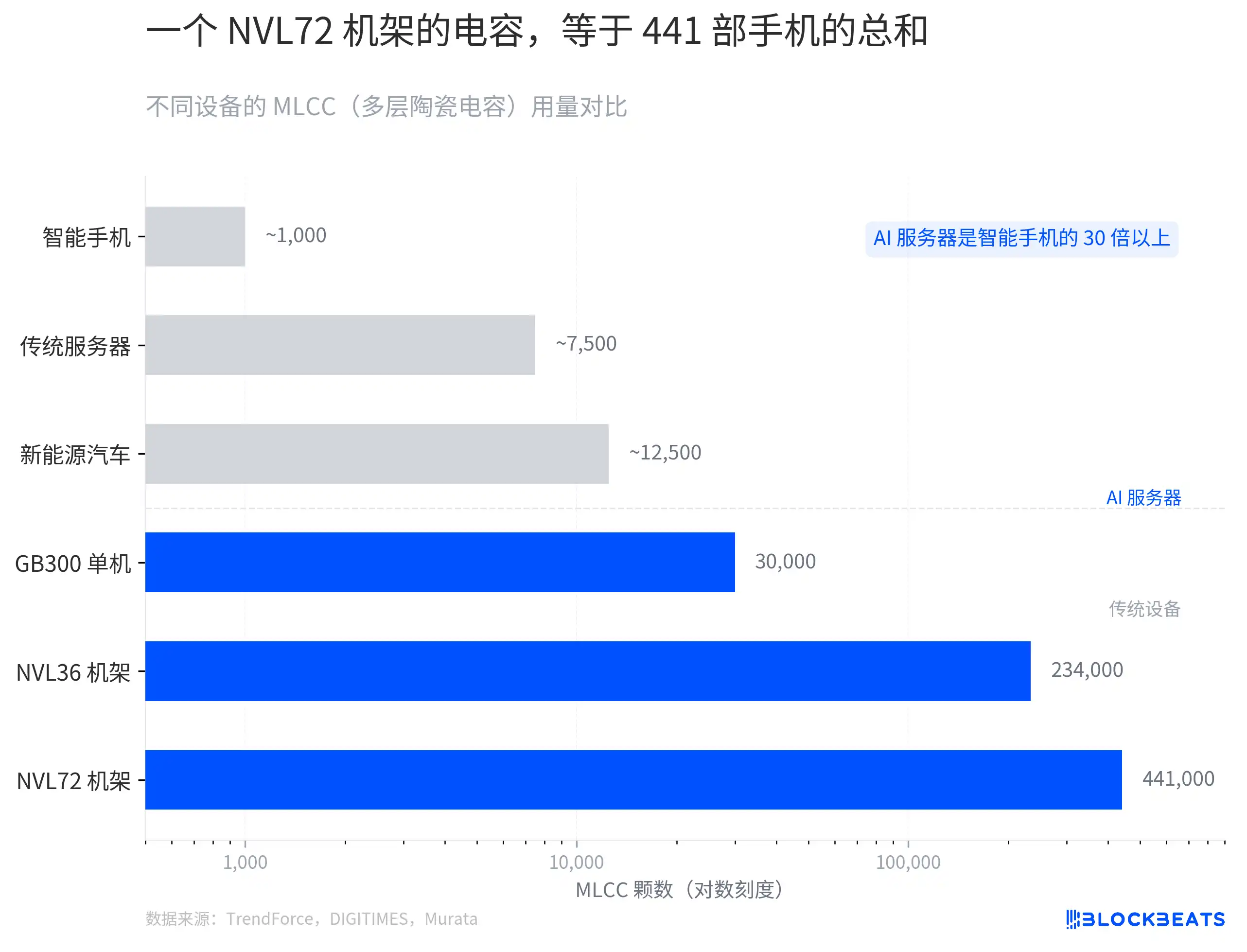
If we look at the entire rack level, the numbers are even more staggering. The NVL36 rack requires about 234,000 capacitors, while the NVL72 rack needs approximately 441,000 capacitors, bringing the cost of MLCCs per rack to between $2,500 and $4,600. MLCCs have become the third largest cost item in the BOM (Bill of Materials) for AI servers, following GPUs and memory.
An absolute value of $4,600 may not seem high compared to a GPU that easily costs tens of thousands of dollars, but the uniqueness of MLCCs lies in their "rigid demand," where "one missing capacitor means the system cannot start." Cloud providers cannot afford to hold up the entire GPU production line due to a few capacitors.
Two companies control 84% of the market
The MLCC market is highly concentrated, but the level of concentration depends on the specific segment being viewed.
According to TrendForce data, globally, Murata ranks first with over 40% market share, followed by Samsung Electro-Mechanics at about 18%, TDK at around 12%, and Japan's Taiyo Yuden and Taiwan's Yageo each with approximately 10%. The top six companies collectively account for 70% of the global market.
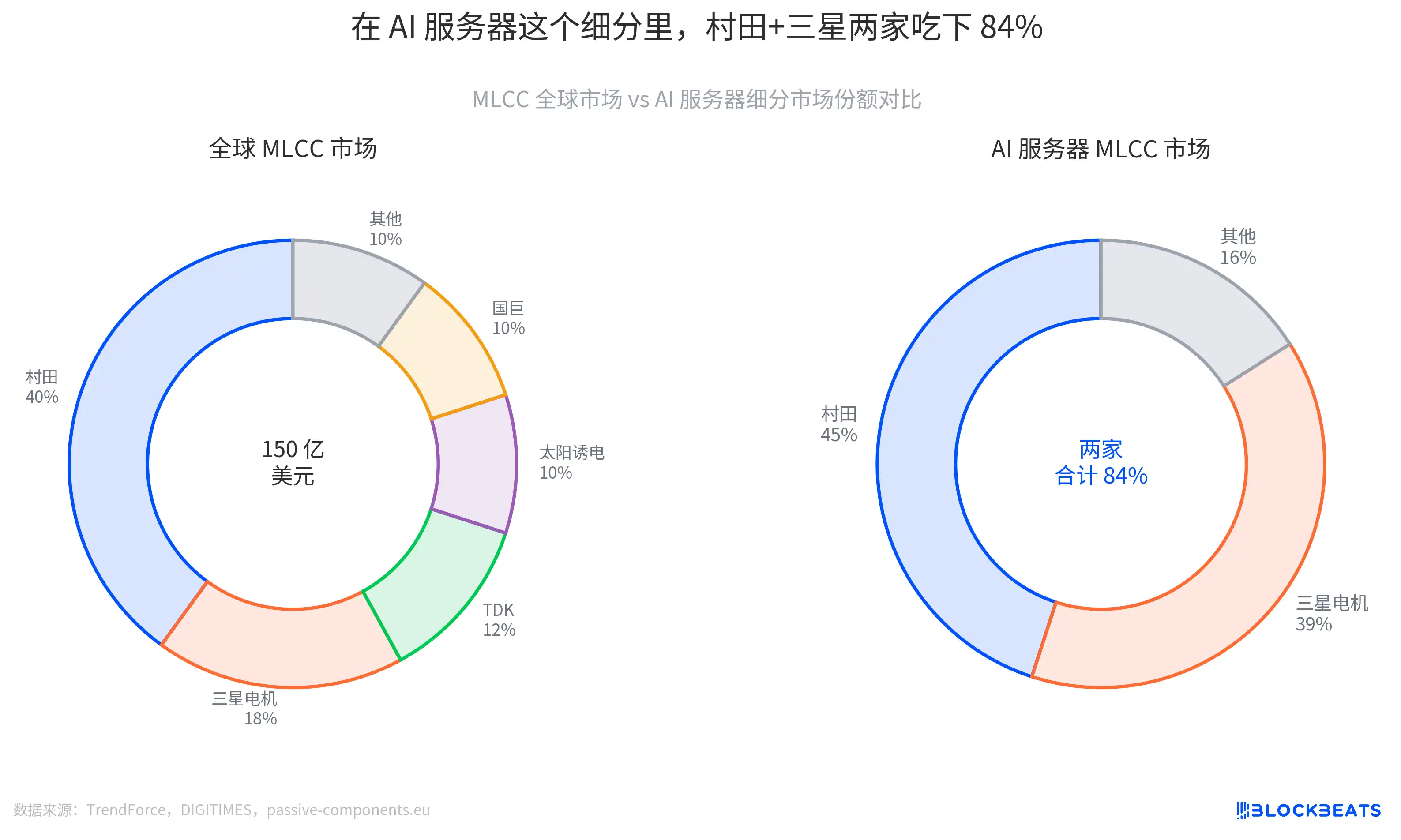
However, the scenario changes dramatically in the AI server submarket. According to the same source, Murata leads with a 45% share, closely followed by Samsung Electro-Mechanics at 39%, with the two companies together controlling 84%. This means that in the global AI server supply chain, the supply of MLCCs is in the hands of two companies, with a concentration level rivaling that of the GPU market.
It is worth noting the competitive variable of Chinese manufacturers. According to passive-components.eu, the global revenue share of Chinese MLCC manufacturers is expected to reach 10% in the second half of 2024, an increase of 4 percentage points since 2019. However, in the high-end specifications required for AI servers, Chinese manufacturers currently have almost no presence.
Price increases at profit margin lows
Murata chose to raise prices at this point for clear financial motivations.
According to Murata's financial report, the company reached a recent peak in FY2022 (ending March 2023), with revenue of 1.81 trillion yen and an operating profit margin of 23.4%. This was followed by a decline in the next two consecutive years. In FY2024 (ending March 2025), the operating profit margin fell to 13.1%, nearly halving. The main reason for the erosion of profits was the intense price wars with Chinese competitors in the mid-to-low-end market.
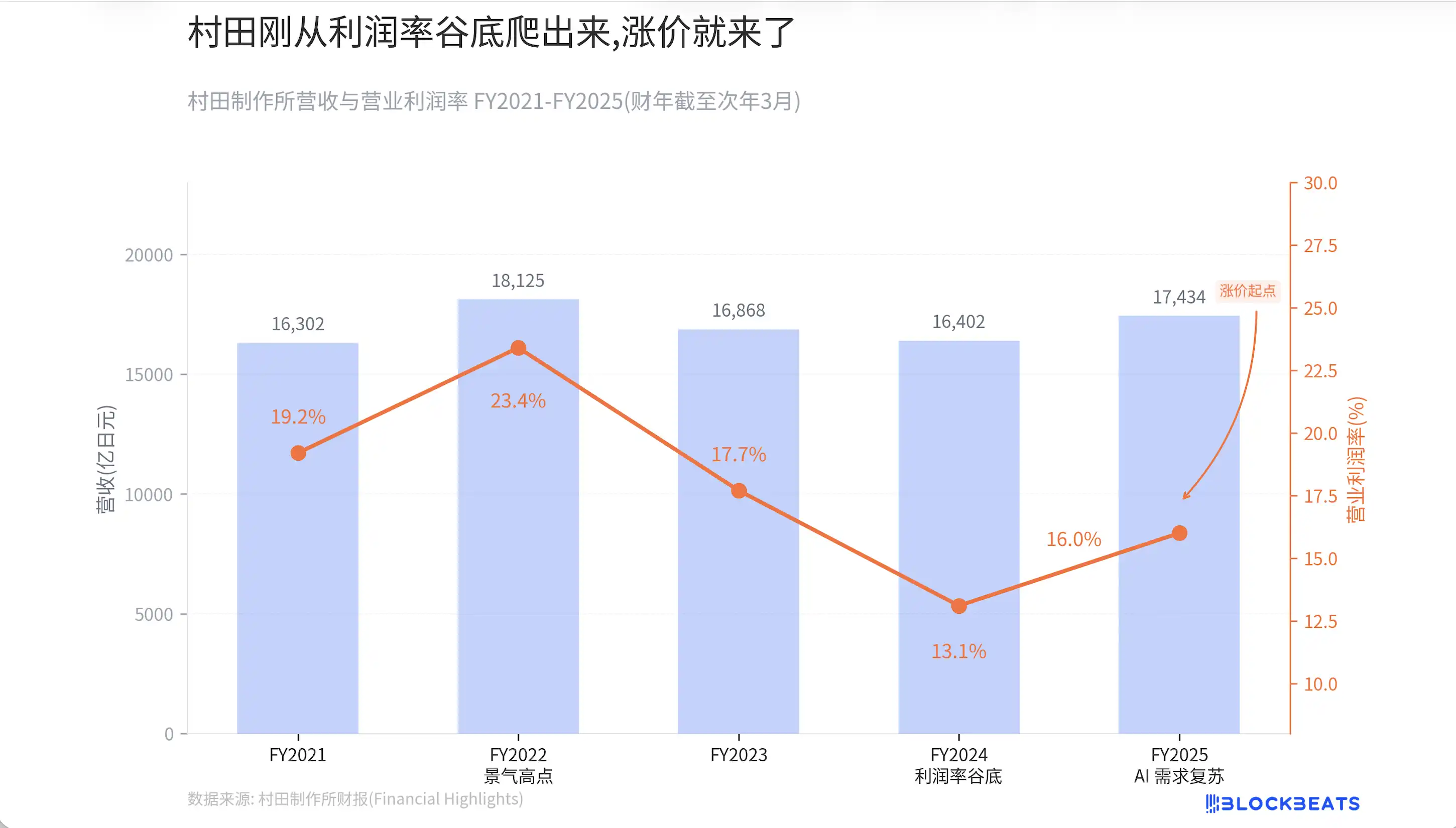
In FY2025 (ending March 2026), a turnaround is expected. Driven by demand for AI servers, the shipment volume of high-end MLCCs is anticipated to increase, with Murata projecting annual revenue to recover to 1.74 trillion yen and the operating profit margin to restore to 16.0%. Murata President Norio Nakajima previously stated during the financial report conference that the demand for MLCCs related to AI servers is expected to double within FY2025.
Announcing a price increase just as profit margins are climbing from their lows indicates that this is not simply a case of "supply not meeting demand." Murata needs to restore the profit margins that have been eroded by the price war, and the rigid demand from AI servers gives it the confidence to raise prices.
The last MLCC price surge lasted two years
This is not the first time the MLCC industry has experienced a price surge cycle. From early 2017 to mid-2018, the MLCC market underwent a "super price surge cycle," during which the prices of standard specification products increased by 5 to 10 times, and delivery times extended from the normal 4 to 8 weeks to over 30 weeks. The driving forces behind that surge were the dual pull from smartphones and automotive electronics, compounded by major Japanese manufacturers shifting production capacity from standard products to high-end, leading to severe shortages in the mid-to-low-end market.
The situation in 2026 is both similar to and different from that of 2017-2018. The similarity lies in that large companies are proactively adjusting their product mix, shifting capacity towards high-margin areas. The difference is that the growth in MLCC demand from AI servers is expected to be more sustainable than that of smartphones at the time. According to TrendForce reports, spot prices for high-end MLCCs used in AI servers have already risen by 15-20%, with an anticipated annual increase of 30-40%. However, consumer-grade MLCCs have remained relatively stable, and there has yet to be a panic-driven price increase across all categories like in 2017.
Whether Samsung Electro-Mechanics, Taiyo Yuden, Yageo, and other competitors follow Murata's price increase will determine the intensity of this cycle. If only Murata raises prices, the impact will be manageable. If the entire industry follows suit, the cost pressure on the AI server supply chain will spread from GPUs to every inconspicuous small component.
An MLCC may be less than a millimeter, but when 441,000 are piled together, they become an unavoidable supply chain node on the NVIDIA NVL72 rack.
免责声明:本文章仅代表作者个人观点,不代表本平台的立场和观点。本文章仅供信息分享,不构成对任何人的任何投资建议。用户与作者之间的任何争议,与本平台无关。如网页中刊载的文章或图片涉及侵权,请提供相关的权利证明和身份证明发送邮件到support@aicoin.com,本平台相关工作人员将会进行核查。