Written by: Mahe, Foresight News
In the early hours of March 19, the Federal Reserve announced its latest interest rate decision, keeping rates unchanged for the second consecutive meeting. The latest interest rates and economic forecasts show that policymakers still expect interest rate cuts this year, with a projected inflation rate of 2.2% by the end of 2027.
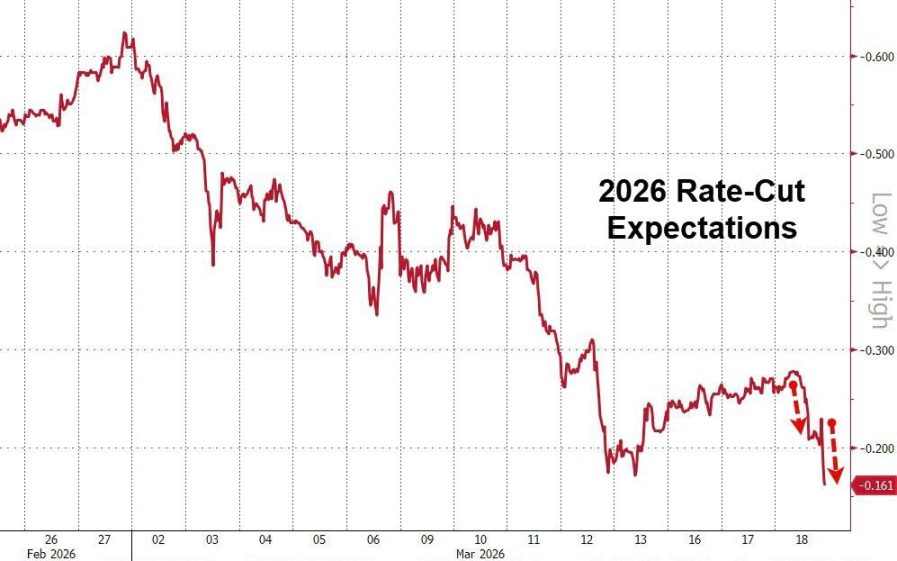
The expected interest rate cut for the year has fallen to 16 basis points.
Since achieving a rare daily increase of 8 consecutive days to $76,000 on March 9, BTC has also continuously adjusted downwards to around $71,000, dipping as low as $70,500. ETH has retraced from around $2,400 to $2,200. Altcoins have generally declined.
In terms of contract liquidation data, according to Coinglass data, in the past 24 hours, the total market has experienced $458 million in liquidations, with long positions accounting for $385 million.
As of the market close, the Dow Jones Industrial Average fell by 768.11 points, a drop of 1.63%, closing at 46,225.15 points, a new low for the year. The Nasdaq Composite Index fell by 1.46%, closing at 22,152.42 points. The S&P 500 Index fell by 1.36%, closing at 6,624.70 points. So far this month, the Dow has dropped more than 5%, which may lead to the worst month since 2022.
Possibility of Interest Rate Hike Back on the Table
The February PPI data far exceeded expectations, increasing inflationary pressures, coupled with the Federal Reserve sending hawkish signals that drastically reduced expectations for interest rate cuts this year, leading oil prices to strengthen, while U.S. stocks and bonds both fell, and the dollar bounced back to the 100 mark.
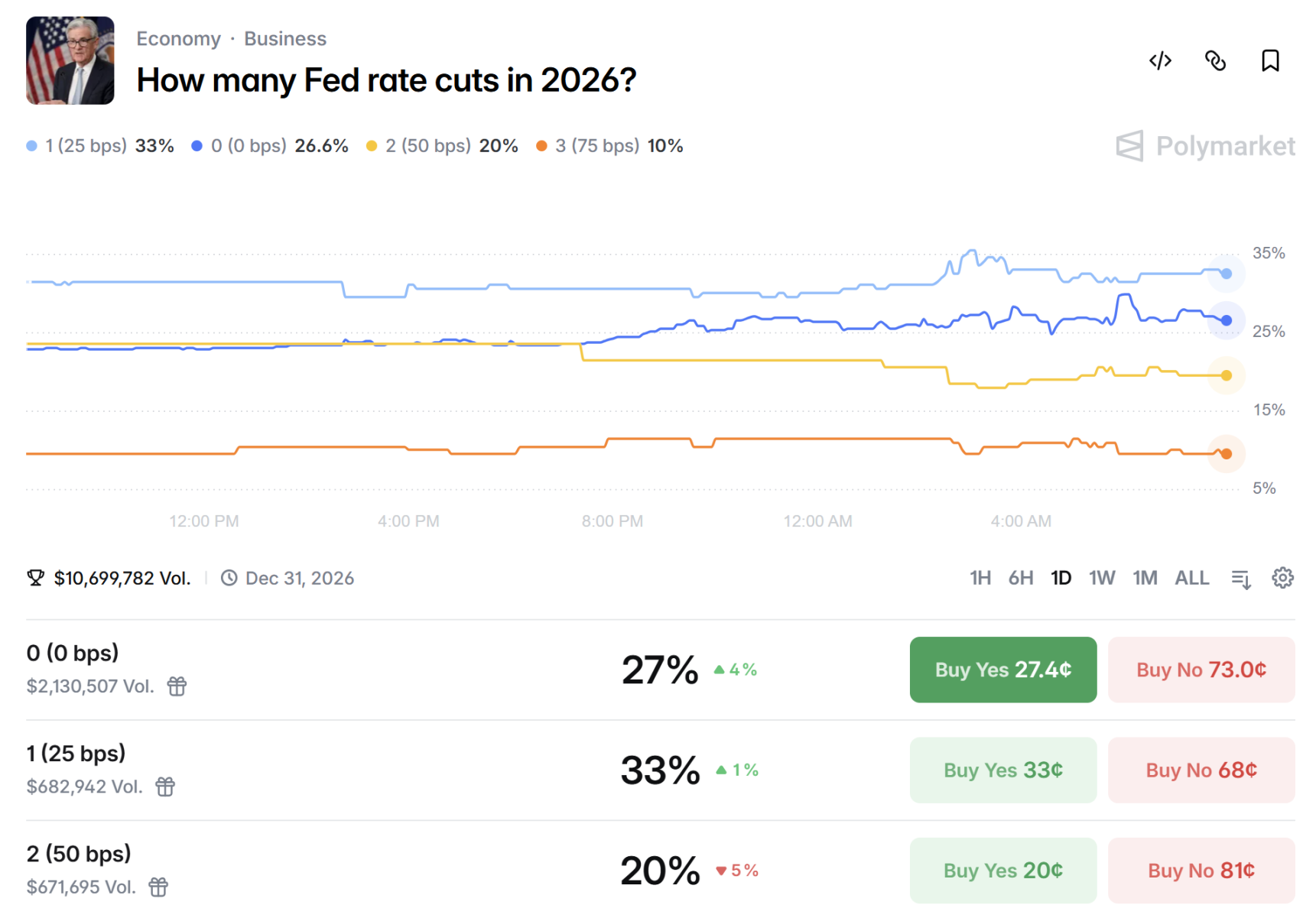
According to the latest data from Polymarket, the market now estimates a 27% probability that the Federal Reserve will keep rates unchanged this year, a slight increase of 4%. The probability of a 25 basis point cut once is at 33%, while the probability of two cuts totaling 50 basis points has fallen to 20%.
Powell clearly stated that he would not consider cutting rates until he sees further improvements in inflation; meanwhile, the committee has already begun discussing whether the next step might be to raise rates, although this remains outside the basic scenario assumed by most officials. Powell pointed out that the current inflation cooling process has noticeably slowed, and short-term inflation expectations have risen again in recent weeks. Price pressures from tariffs are still translating into core inflation, while oil prices driven up by Middle Eastern tensions are also increasing new upside risks, suggesting that commodity inflation may not noticeably decline until at least mid-year.
Powell acknowledged that job growth is at a relatively low level, and the "balance" of the labor market itself carries certain fragility against the backdrop of slowing labor supply. Meanwhile, energy shocks not only push prices higher, but could also negatively impact employment and overall economic activity by suppressing consumption, squeezing corporate costs, and disrupting supply chains.
The war in Iran has led to attacks on multiple energy facilities, and the threat of blockage in the Strait of Hormuz has rapidly intensified concerns over the interruption of oil supplies, with Brent crude briefly surpassing $107. Powell emphasized that it remains difficult to determine how long this round of shocks will last and how significant the impact will be, but its potential shock to the U.S. and global economies should not be underestimated.
Corpay Chief Market Strategist Karl Schamota stated, "The Federal Reserve's decision to keep rates unchanged and the minor adjustments in the policy statement indicate that officials plan to follow long-term monetary policy practices and take a 'wait-and-see' approach to the ongoing global energy price shocks."
Savvy Wealth Chief Investment Officer Anshul Sharma remarked, "I believe we are in a high volatility cycle. If oil prices remain at current high levels... we know this will transmit throughout the economy. Sustained energy shocks will drive inflation higher while growth begins to slow, creating a 'dangerous combination.' This will make it more challenging for the Federal Reserve to balance its dual mandate."
Will Not Leave the Federal Reserve During the Investigation
Powell stated at the meeting that he would not leave the Federal Reserve during the investigation and would continue to perform his duties as "acting chair" if necessary. He mentioned that there are no plans to resign from his position as a governor until the investigation is completed, with the process transparent and conclusions clear; if a successor has not been confirmed by the end of the chair’s term, he will continue in his role as acting chair per legal requirements until a new chair is formally in place, to ensure the Federal Reserve's operations and independence remain free from political interference.
Powell is currently the chairman of the Federal Reserve, with his term set to expire on May 15, 2026. The Trump administration announced back in late January this year the nomination of Kevin Walsh (a former Federal Reserve governor who resigned in 2011 in opposition to quantitative easing policies) to succeed him, which is seen as a choice closer to the White House's preferred hawkish stance on interest rates.
However, the Senate confirmation process has stalled—North Carolina Republican Senator Thom Tillis clearly stated that he would not advance Walsh's nomination for review until the judicial investigation against Powell is thoroughly resolved. This directly ties the transition of leadership at the Federal Reserve to the investigation's outcome.
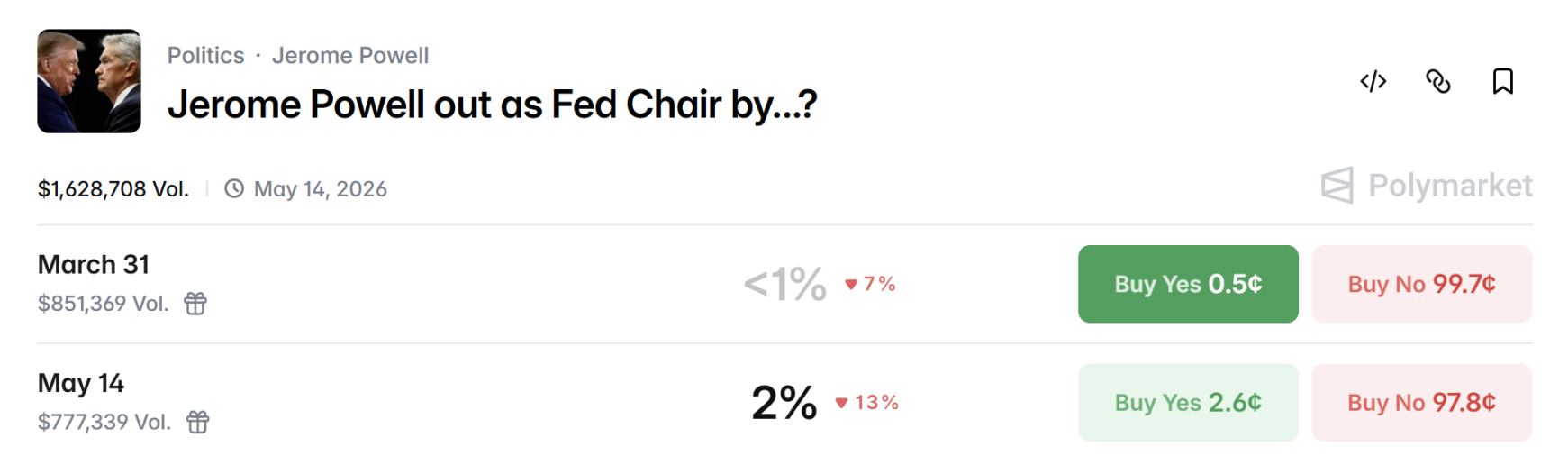
Currently, the latest data from Polymarket shows that the market bets the probability of him leaving in May is only 2%.
Future of the Cryptocurrency Market
With expectations of interest rate cuts by the Federal Reserve decreasing and market liquidity under pressure, what will the future trends in the cryptocurrency market be?
Wintermute published an article indicating that the early bear market selling pressure seems to have passed, but confirmation signals are still needed to officially declare that the market has entered a new phase. The current market structure is more positive than in the past few months. The Coinbase premium reset, ETF capital inflows, and the flow of funds from institutional trading desks all point in the same direction. The $60,000 range seems to have attracted real institutional buy support. This is a very important prerequisite.
Wintermute stated that for BTC, $74,000 and $80,000 are resistance levels that need to be closely monitored. The cyclical analogy is also worth remembering: historically, it typically takes about 400 days to go from peak to trough, and we have not yet been in this bear market for 200 days. Due to structural reasons (including the adoption of stablecoins and RWA, the maturation of institutional infrastructure, and the absence of fundamental destruction), this bear market may be shallower than previous cycles, but this does not mean we can have unrealistic expectations about recovery speed.
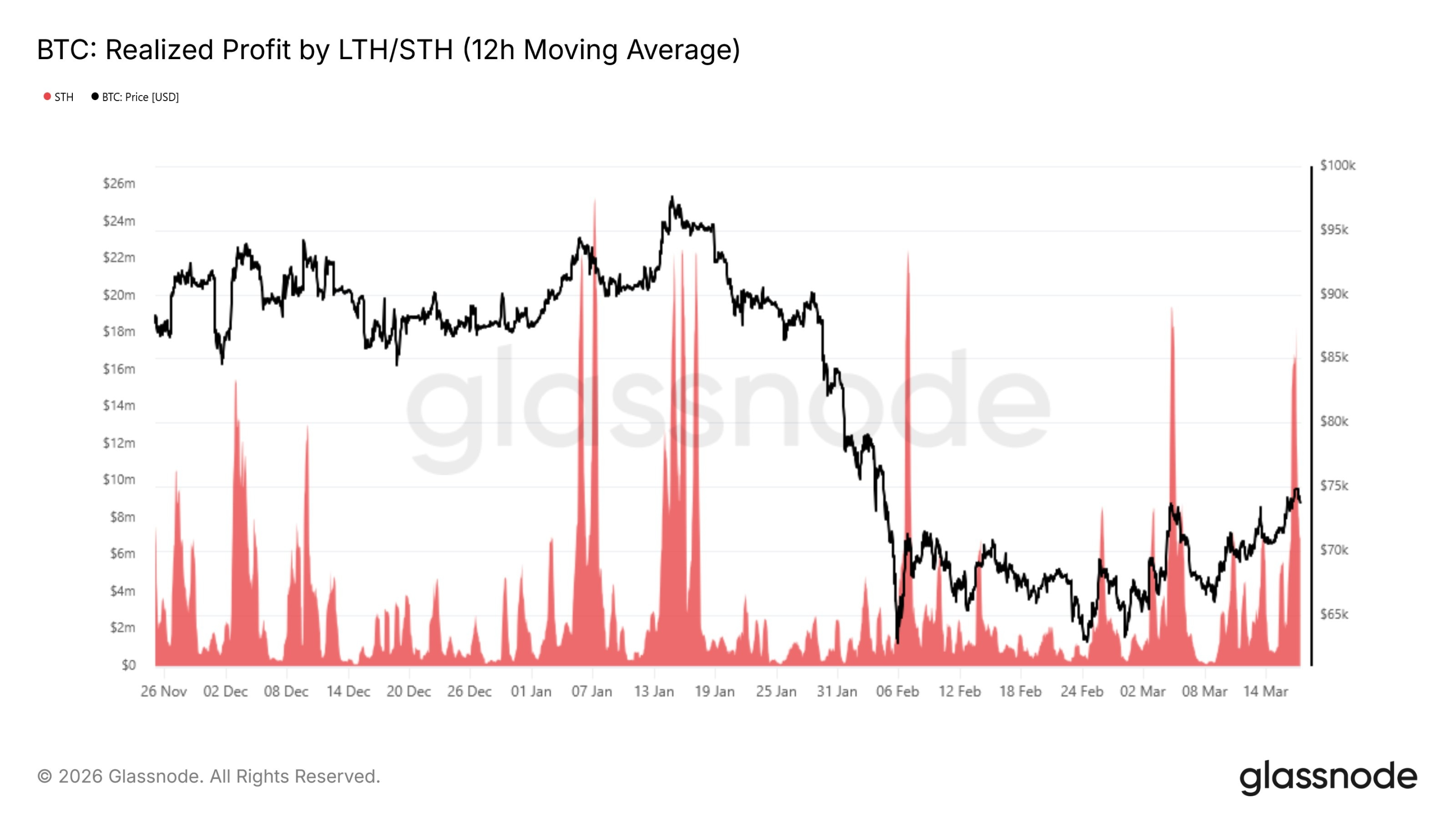
Glassnode tweeted this week that Bitcoin price slightly broke through $74,000, with profits realized by short-term holders surging to $18.4 million per hour. This is consistent with the patterns observed in February: short-term holders have been continuously consuming the momentum of each rebound at the $70,000 threshold, absorbing upward momentum before any real breakout occurs.
免责声明:本文章仅代表作者个人观点,不代表本平台的立场和观点。本文章仅供信息分享,不构成对任何人的任何投资建议。用户与作者之间的任何争议,与本平台无关。如网页中刊载的文章或图片涉及侵权,请提供相关的权利证明和身份证明发送邮件到support@aicoin.com,本平台相关工作人员将会进行核查。


