Gold dropped to a bid of $4,561.70 and ask of $4,563.70 at 9:33 a.m. EST, down $256.00, or 5.31%, with intraday levels ranging between $4,502.70 and $4,867.70, according to market data.
Silver took an even harder hit, sliding 9.97% to a $67.71 bid and $67.96 ask, after trading between $65.45 and $76.81 during the session. The move marks one of the steepest single-day declines for silver in recent months.
Platinum followed suit, dropping 5.78% to $1,906.00 bid and $1,916.00 ask, while palladium fell 3.21% to $1,415.00 bid and $1,455.00 ask. Rhodium, typically more thinly traded, edged down 0.91% but remained elevated in absolute terms.

Image source: X.
The selloff arrived less than 24 hours after the Federal Reserve held its benchmark rate steady at 3.50% to 3.75%, signaling a cautious stance on rate cuts. That posture has strengthened the U.S. dollar and lifted real yields—two forces that tend to weigh on non-yielding assets like gold.
Traders appear to be reacting less to fundamentals and more to liquidity pressures. Analysts describe the move as a classic deleveraging event, where leveraged positions across futures and exchange-traded funds (ETFs) are unwound in rapid succession.
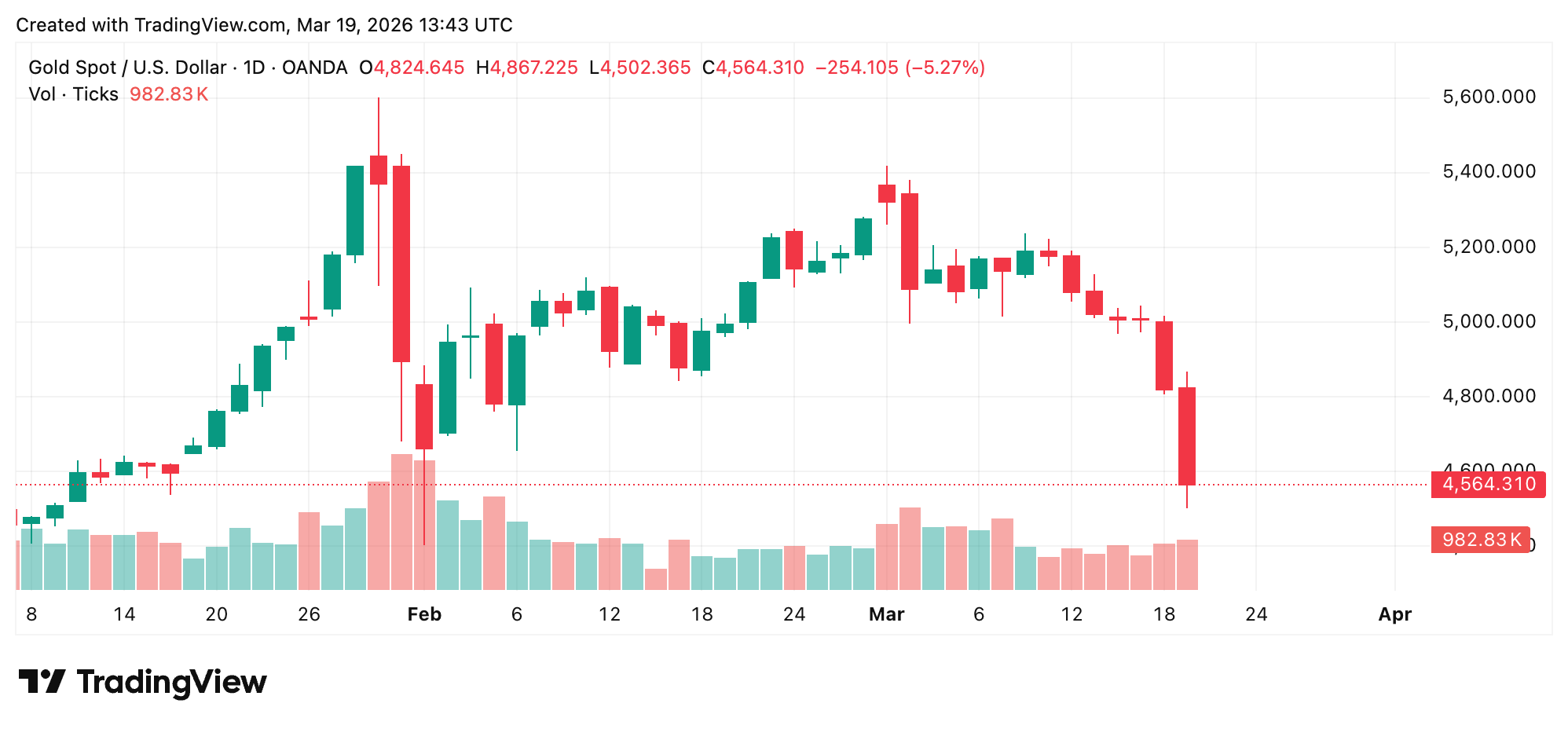
Spot gold prices on March 19, 2026. Image source: tradingview.com.
That dynamic helps explain why metals are falling despite persistent geopolitical tensions. Typically, safe-haven demand would support gold during periods of instability, but in this case, traders are raising cash rather than adding exposure.
Oil price volatility tied to Middle East tensions has added another layer of complexity. While rising crude often boosts inflation expectations—and by extension gold—this time the stronger dollar response has outweighed that effect.
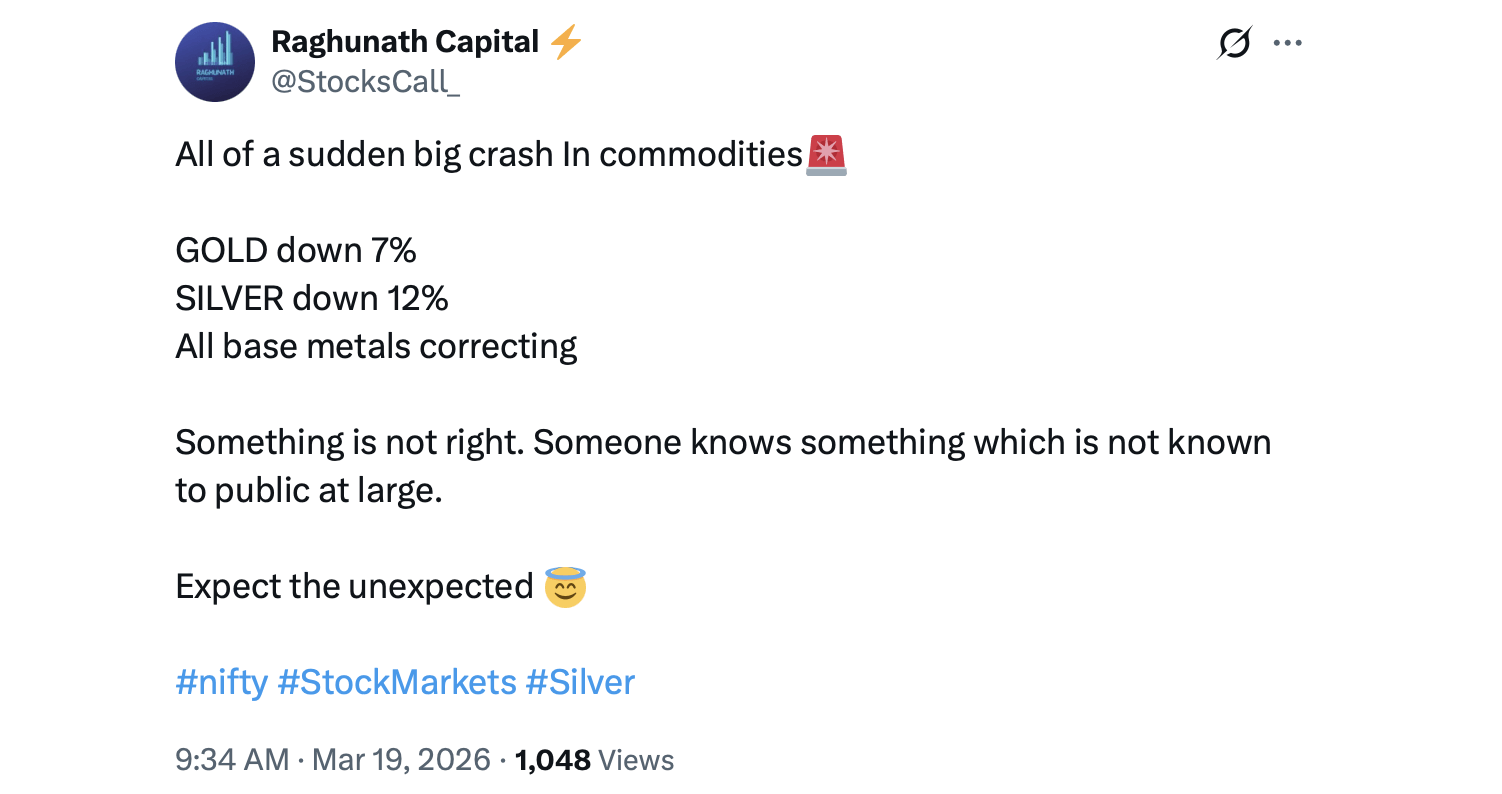
Image source: X.
The result is a counterintuitive moment: gold briefly benefits from risk aversion, then reverses as liquidity becomes the priority. It is less about conviction and more about collateral.
Technical factors are amplifying the decline. Stop-loss triggers, margin calls, and crowded positioning from the recent rally have accelerated selling pressure, turning what might have been a pullback into a sharp correction.
Notably, the weakness appears concentrated in paper markets. Physical demand from central banks, retail buyers and jewelry markets remains intact, with no widespread reports of liquidation in bullion markets.
That divergence between paper and physical markets continues to define the current cycle. While futures pricing reflects short-term stress, underlying demand trends remain supportive over longer time frames.
For now, traders are watching key psychological levels, particularly the $4,500 range for gold. A sustained break below that could invite further selling, while stabilization may attract opportunistic buyers.
- Why did gold fall on March 19, 2026?
Gold declined due to a stronger U.S. dollar, higher real yields and widespread deleveraging in futures markets. - How much did silver drop today?
Silver fell nearly 10%, making it the worst-performing major precious metal during the session. - Are physical gold markets also falling?
Physical demand remains steady, with most selling pressure concentrated in paper markets like futures and ETFs. - What levels are traders watching next for gold?
Market participants are closely monitoring the $4,500 range as a key short-term support level.
免责声明:本文章仅代表作者个人观点,不代表本平台的立场和观点。本文章仅供信息分享,不构成对任何人的任何投资建议。用户与作者之间的任何争议,与本平台无关。如网页中刊载的文章或图片涉及侵权,请提供相关的权利证明和身份证明发送邮件到support@aicoin.com,本平台相关工作人员将会进行核查。


