Introduction
If you have been following AI for the past three years, you will notice a significant change: it is no longer just "usable," but has started to become "irreplaceable." This change did not happen suddenly, but rather went through a clear three-stage evolution.
1. First Stage: AI as a "New Species," but Not Yet Part of Daily Life
Three years ago, the hottest AI products were very concentrated:
- ChatGPT: Chat and Q&A
- Midjourney: Image Generation
- Character.AI: Virtual Character Conversations
What they have in common is: they are all "AI Native Applications", existing essentially to showcase AI capabilities.
User behavior at that time was also very typical:
- Asking Questions
- Generating Images
- Chatting for Entertainment
Essentially, it was about "experiencing AI," rather than "relying on AI." In other words, AI in this stage was more like a showcase of capabilities, rather than a productivity tool.
2. Second Stage: AI Begins to "Embed Itself in All Products"
The real change occurred in the last two years.
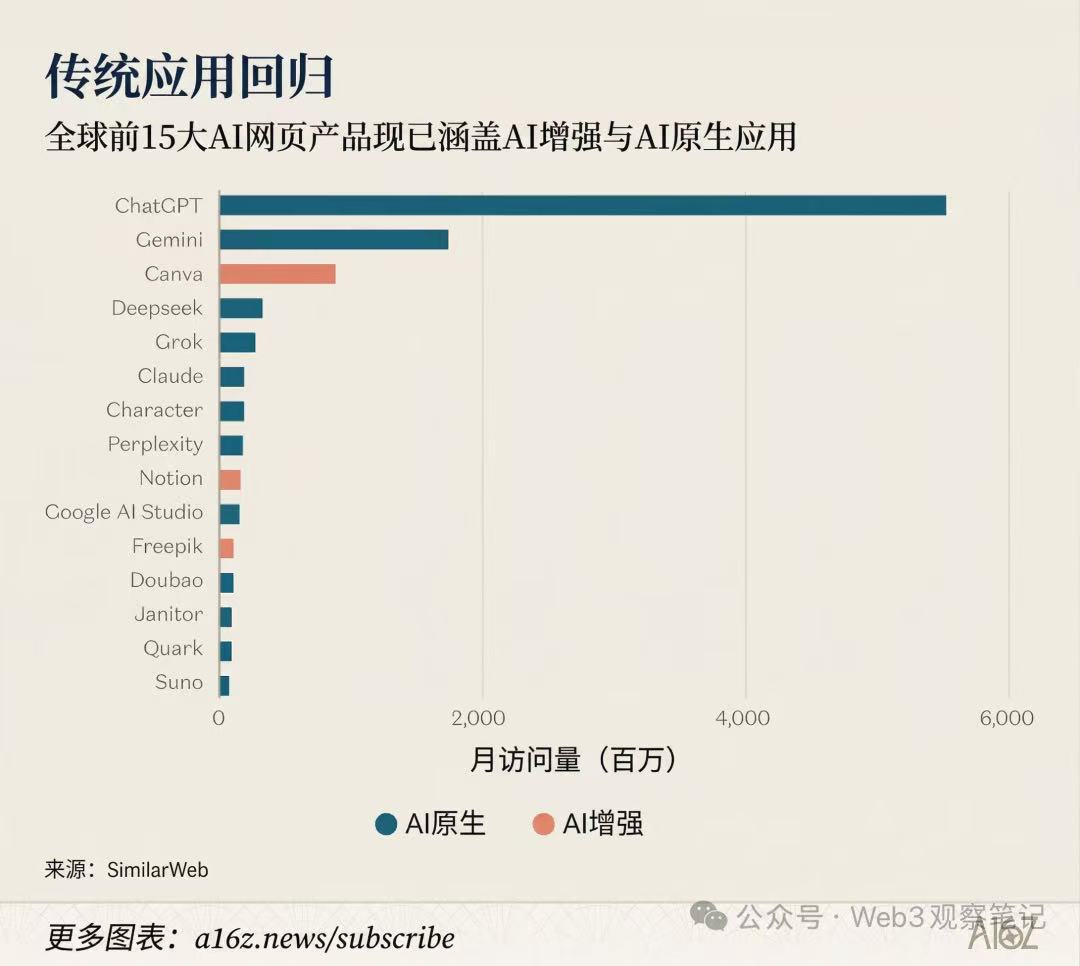
The main characters on the AI application list are no longer "pure AI products," but mature applications that AI has restructured:
- CapCut: 736 million monthly active users, with almost all core functions AI-powered
- Canva: Reconstructing design processes around AI tools
- Notion: AI feature penetration rate from 20% → 50%+
A very key signal has even emerged:
AI has begun to contribute nearly half of the revenue (ARR)
This signifies one thing:
AI is no longer just a feature, but an infrastructure.
Platform Divergence Begins to Appear
As AI becomes a foundational capability, the role of large models has also changed:
From "chatting tools" to "access points."
Two paths are gradually becoming clear:
1) Super Entry Point (Consumer Level)
What ChatGPT is doing includes:
- GPTs + App Store
- "Log in with ChatGPT" Account System
- Integrating with daily life scenarios such as shopping, travel, and health
The goal is clear: to become your starting point for using the internet
2) Professional Work Platform (Productivity Side)
Claude's path is entirely different:
- MCP (Model Context Protocol)
- Deeply integrating development tools and data systems
- Building complex workflows
It is more like: an AI operating system aimed at knowledge workers
An Emerging Structure: Platform Flywheel
As users start to integrate AI into their daily systems:
- Calendars
- Emails
- CRM
- Workflows
The switching cost will rise quickly, and platform stickiness will begin to form.
Thus, the classic flywheel appears:
- The more users, the more developers
- The more developers, the richer the features
- The richer the features, the more users depend on it
This also determines a result: this competition will not result in a single dominant player, but more like two ecosystems coexisting for a long time.
3. Third Stage: AI Begins to "Do Things for You"
The real watershed moment actually occurred in the last year.
AI is no longer just "helping you generate content," but has begun to: execute tasks for you. From "generating content" to "completing tasks"
Early AI (such as Midjourney, DALL·E) addressed:
- Writing content
- Generating images
But now, the new generation of products is focused on:
- Task decomposition
- Automatic execution
- Complete delivery
AI Agents Begin to Appear
- Not just answering questions
- But rather decomposing tasks
- And automatically executing the entire process
For example, a complete process:
- Receiving objectives
- Searching for information
- Analyzing and processing
- Outputting results
- Automatically sending
At this point, AI is no longer just a tool, but: a "software entity that can act"
Another Trend: AI Begins to "Help You Create Products"
Vibe Coding is rising rapidly, with representative products including:
- Cursor
- Replit
- Lovable
What they inherently do is: let AI directly help you "create products". The change this brings is not a simple increase in efficiency, but: from "humans writing code" to "humans defining goals, AI completing the build."
4. When AI Begins to Act, Why Does It Move Towards Web3?
When AI moves from "answering questions" to "executing tasks," a very practical question arises: how does it complete transactions and settlements? In the traditional internet, these rely on platforms and intermediaries to complete, but this system is designed for "humans" and is not suitable for machines to operate independently.
Web3 provides a more suitable underlying structure for AI:
- 7×24 hours of operation: AI can continuously execute and respond
- Machine-native interfaces: Contracts as APIs, can be called directly
- Programmable assets: Fund flows can be automated
The change this brings is that AI not only "does things," but can also automatically complete payments and settlements in the process.
More importantly, blockchain gives transactions the characteristics of immutability and auditability, allowing AI to collaborate without intermediaries. This means the way trust is established on the internet is changing— from "trusting platforms" to "trusting rules."
Because of this, the relationship between AI and Web3 resembles a natural division of labor: AI is responsible for action, and Web3 is responsible for settlement. When AI truly begins to participate in transactions and collaboration, this combination is likely to become the foundation of the next generation of the internet.
免责声明:本文章仅代表作者个人观点,不代表本平台的立场和观点。本文章仅供信息分享,不构成对任何人的任何投资建议。用户与作者之间的任何争议,与本平台无关。如网页中刊载的文章或图片涉及侵权,请提供相关的权利证明和身份证明发送邮件到support@aicoin.com,本平台相关工作人员将会进行核查。


