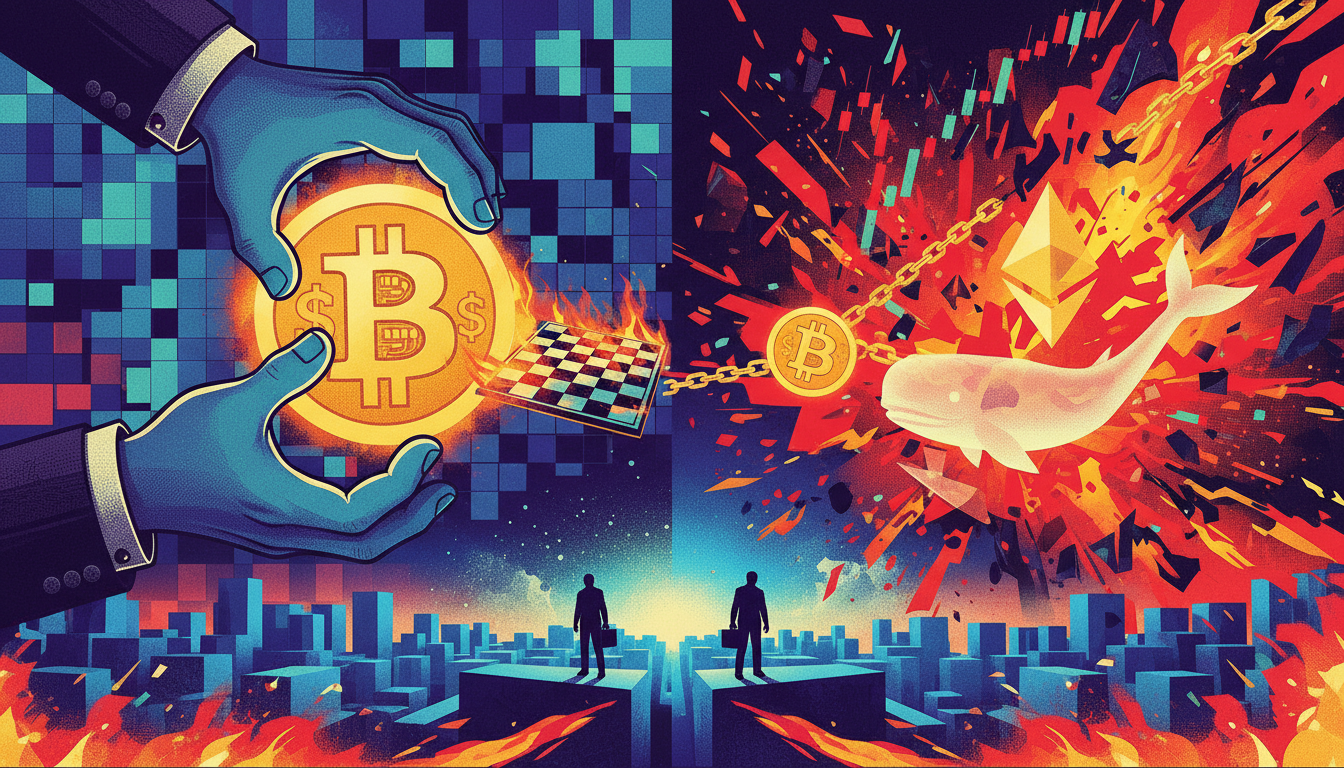
On March 25, 2026, East Eight Zone time, Binance announced the delisting of APTUSD and OPUSD coin-based perpetual contracts. Concurrently, the market's expectation for an interest rate hike by the Federal Reserve in December 2026 has significantly intensified, while the payment and cryptocurrency service platform Wirex chose to integrate Morpho vault services under the same macro environment, opening up an on-chain passive income gateway for corporate accounts. One is the exchange actively retracting high-leverage derivatives, while the other is enterprise-level DeFi moving funds "on-chain". These actions occur in a strong dollar, weak precious metal environment where the Dollar Index DXY is reported at 99.69, up 0.50% for the day, and spot gold has fallen below $4580, down 1.51% for the day. The contraction of crypto derivatives, rising interest rate expectations, tightening liquidity, and the simultaneous decline of "precious metals + crypto assets" point to the same set of macro variables: higher risk-free interest rates, tighter dollar liquidity, and greater risk aversion. The question is no longer just "how will the coin price move," but rather how will exchanges and enterprise-level DeFi reconfigure risk and return in the ongoing interest rate hike game, who will choose to reduce leverage, and who will bet on on-chain interest rate tools.
Binance's Third Contraction of High-Leverage Coin-Based Contracts
Since the fourth quarter of 2025, Binance has already delisted coin-based contract varieties for the third time. In the latest round of adjustments announced on March 25, 2026, APTUSD and OPUSD coin-based perpetual contracts were included in the delisting list, coinciding closely with the market's heightened expectations for an interest rate hike within the year. The contracts themselves were positioned within the narrative realm of public chains and Layer 2, where long-term stories are rich and short-term fluctuations are fierce—typical carriers for coin-based perpetual contracts, now removed from the list, signal a repricing of risk appetite.
The role of coin-based perpetual contracts in a high volatility, high leverage trading ecosystem is extremely critical: they use cryptocurrencies rather than fiat currencies as margin and pricing units, meaning that when prices rise, profits are magnified, and when they fall, margin shrinkage is also amplified. For exchanges, such products can bring considerable fee and funding income during high market phases, but they also expose themselves to more complex margin management, liquidation covering, and liquidity pressures during extreme market conditions. Especially when the underlying asset has less liquidity than mainstream coins, yet higher volatility, the depth of the contract order book and the robustness of the risk control system face greater challenges.
In the context of increasing regulatory scrutiny and tightening liquidity expectations, Binance's proactive adjustment of its coin-based product line is difficult to view solely as a simple "cleaning of unpopular contracts". It resembles a re-sculpting of the entire risk exposure curve: on the one hand, reducing leverage products tied to high-volatility altcoins decreases the probability of needing to use insurance funds and proprietary capital for cover during extreme conditions; on the other hand, it demonstrates an outward stance of willingness to contract high-risk peripheral products under compliance pressure and prudent regulatory expectations, shifting focus back to assets with better liquidity and more mature pricing mechanisms.
It is important to emphasize that due to the lack of specific holding size and user distribution data for APTUSD and OPUSD coin-based perpetual contracts, external observers cannot quantify the precise impact of this delisting on individual user groups and overall market depth, viewing it merely as a directional signal. More actionable going forward is to observe whether this product contraction has triggered a substantial cooling of the leverage chain through the trading volume of APT and OP spot and USDT-based contracts, changes in funding rates, and overall contract market leverage and liquidation data, among other indirect indicators.
Rising Interest Rate Expectations: Strong DXY and Pressure on Risk Assets
As the news of Binance's third contraction of coin-based contracts materialized, the macro perspective was equally striking: the Dollar Index DXY stood at 99.69, up 0.50% for the day, and spot gold fell below $4580, down 1.51% for the day (according to a single source). One is the broad-based strengthening of the global settlement currency, and the other is that traditional "safe-haven assets" are also suppressed in the face of a strong dollar; together, they form a typical "interest rate hike expectations + strong dollar" combination scenario. On the interest rate expectation front, the market's refrain, "short-term interest rate futures have fully priced in the probability of a rate hike in December," indicates that expectations for policy paths are no longer limited to verbal sentiment but have been concretized in interest rate futures and forex prices.
A stronger dollar and higher risk-free interest rate expectations directly squeeze all asset classes relying on "relative returns" and "liquidity dividends." For gold, when the nominal and real interest rates on government bonds or money market instruments rise, the zero-yielding metal must readjust to match investors' opportunity costs through price corrections; for crypto assets, often viewed as high volatility and cash flow-less risk assets, their appeal largely stems from risk appetite expansion during liquidity excess, so once risk-free rates rise and financing costs increase, both on-chain and off-chain de-leveraging and hedging demand will be amplified simultaneously.
In this environment, Binance's delisting of certain coin-based perpetual contracts can be seen not so much as being driven by a specific regulatory event or case, but as a parallel response to the same macro narrative. This means we should not hastily draw a direct causal line between "the Federal Reserve's interest rate hike" and "Binance's delisting of APTUSD and OPUSD" but should understand both within a broader framework of "interest rate expectation increases—dollar strengthens—valuation and leverage repricing of risk assets": the interest rate hikes remain in the realm of expectations, but the market has already brought these expectations forward into behavioral adjustments and product configuration changes through futures curves and exchange rate changes.
Both Precious Metals and Crypto Declining: The Transmission Chain of Tight Liquidity
In the macro narrative, the simultaneous decline of precious metals and cryptocurrencies presents a particularly indicative picture: gold is under pressure below $4580, down 1.51% for the day, while smaller market cap, higher volatility crypto assets often react with more severe price movements. The underlying logic is that when the market perceives a dominant combination of "interest rate hike expectations + strong dollar", funds no longer distinguish between "hedging" and "speculation," but instead categorize an entire basket of non-yielding assets and high-beta assets as "needing to be reduced".
Within this logic, the first response of institutions and large holders is not to deal with the hardest-to-liquidate marginal assets, but rather to prioritize selling the most liquid varieties: gold, bitcoin, leading public chains, and mainstream ETFs. The reason is simple; these assets have deep order books and small slippage, making them more suitable as "liquidity ATMs" to quickly replenish dollars or adjust to higher-grade bonds, money market funds, and other interest-sensitive assets. As a result, in the short term, we see "good assets falling first," rather than "bad assets dying first."
Meanwhile, short-term leveraged funds and the natural selling pressure on-chain rapidly accumulate when macro expectations shift, amplifying price volatility and liquidation risks. On one end, there are speculative positions using high leverage and coin-based margin trading, triggering margin calls and passive liquidations when prices slightly retreat; on the other end, miners, project parties, and early investors will have a stronger motivation to lock in some profits or fill operational cash flow gaps as they observe rising dollar interest rates and compressed crypto risk premiums. This type of behavior does not rely on perfectly synchronized decision-making, but will manifest in on-chain and exchange data as a "price decline—liquidation amplification—increased spot selling pressure" negative feedback loop.
Wirex Bets on Morpho Vault: Corporate On-Chain Options in the Interest Rate Hike Cycle
In contrast to the tightening leverage on the exchange side, the payment and cryptocurrency service platform Wirex has chosen to integrate Morpho vault services within the same cycle and clearly positions it as a product targeted at corporate accounts. The narrative focus of this action is not merely "another DeFi integration," but in strengthening an emerging trend: "enterprises on-chain + passive income". For many small and medium enterprises and crypto-native teams, finding a way to generate slightly higher returns on idle funds than traditional bank deposits and short-term debts while ensuring liquidity and security has become a real issue.
There are market views that suggest "Gauntlet-managed vaults provide enterprises with a buffer against interest rate volatility." Combining this with existing information, it appears that Morpho vaults are designed more like a shock absorber for interest rate fluctuations: one end connects to mainstream lending markets and quality asset collateral positions, while the other end is aimed at corporate users who demand higher transparency, risk control, and compliance requirements. By dynamically adjusting positions, controlling leverage, and diversifying counterparty risks, such vaults attempt to recreate a "controllable risk floating return curve" on-chain, providing corporations a more proactive intermediate option than "pure cash" and more stable than "high-leverage speculation" in a macro environment swaying between tightening and easing.
Supporting this narrative is the background of Gauntlet managing over $5 billion in assets, and its accumulated experience in risk modeling, liquidation parameter optimization, and multi-protocol collaborative management makes it easier for enterprises to believe that this is not an "experimental farm," but a strategy framework that can be subject to due diligence and risk control committee discussions. Under rising dollar interest rate expectations, corporations may superficially seem to have the option of "just holding cash and short-term debts," but in reality, many entities face the constraint that although fiat rates are high, they are restricted by account opening thresholds, limits, geography, and regulatory boundaries, while on-chain vaults provide a more globally accessible, transparent, and flexible yield structure as a supplementary option.
Therefore, even under the "shadow of interest rate hikes," some enterprises are still willing to pursue excess returns relative to risk-free rates and asset diversification through such vaults. For them, the question is no longer "whether to take on risk," but rather, "how to construct a quantifiable risk, comparable yield funding allocation path between traditional finance and the on-chain world."
Exchange Leverage Contraction vs. Corporate Embracing On-Chain Income Divergence
On the same timeline, one end is Binance contracting high-leverage coin-based contracts, while the other is Wirex expanding enterprise-level DeFi entry, forming a strikingly contrasting picture: exchanges actively mitigate risk exposure in extreme situations by delisting products, raising thresholds, and optimizing risk control, while enterprise service platforms attempt to leverage on-chain vaults to construct a toolbox for hedging interest rate fluctuations and obtaining additional income. One is reducing the potential impact of high-volatility derivatives on balance sheets and brand compliance, while the other is repackaging crypto infrastructure as "cash flow-generating income vehicles."
Within the same "interest rate hike expectations + tightening liquidity" macro framework, those marginalized are often retail investors and high-frequency leveraged funds: the contraction of coin-based contract variations, stricter margin requirements, and more cautious liquidation parameters mean that the leverage tools available to retail and purely speculative positions are constrained both quantitatively and qualitatively; meanwhile, an increasing number of products aimed at enterprises and institutions—from on-chain vaults to custodian-level income accounts—are being continuously reinforced at the narrative and product level. This structural divergence is quietly shifting the focus of the crypto market from the "retail-driven gambling table" to the "toolbox for institutional allocation and yield management."
This also raises a key question: will this divergence push the market focus further from high-leverage speculation toward more bond-like, yield-oriented on-chain tools? If enterprises and institutions view crypto through products like Wirex + Morpho as "combinable, auditable yield securities," then before the next easing cycle arrives, the structure of winners and losers may already have been reshaped: participants adept at building stable cash flows, controlling volatility, and hedging interest rate risks will have a survival advantage over those reliant on high leverage and short-term trends. The delisting of coin-based perpetuals by Binance and the expansion of enterprise vault entry by Wirex may appear as two unrelated product line decisions, but in fact, both are reserving space for this structural change.
From the Shadow of Interest Rate Hikes to a New Order: Who Is Redefining the Rules
Stretching the timeline from the fourth quarter of 2025 to 2026, the multiple exits of Binance from coin-based contracts, the strengthening of DXY, the synchronous decline of precious metals and crypto, and the bet on enterprise vaults by Wirex and Morpho jointly sketch out a consistent macro main line: in the process of interest rate expectations shifting from "lower for longer" to "higher for longer", the entire crypto ecosystem is compelled to address a concrete issue—how to redefine its value and risk boundaries on top of tighter dollar liquidity and higher risk-free interest rates. Exchanges respond to dual pressures from valuation and regulation through leverage contraction and product optimization, while enterprise-level DeFi attempts to transform crypto from a "pure price game" into a part of "structured yield."
Key indicators worth tracking along this main line include: changes in interest rate expectation curves (e.g., whether the implied probability of a December rate hike in short-term interest rate futures continues to decline or rises further), whether mainstream exchanges continue adjusting their coin-based and high-leverage product lines, and whether the TVL and institutional participation curve of enterprise-level DeFi vaults show a countercyclical expansion trend. These data will help us judge whether what we are currently seeing is merely a short-term defensive adjustment or the beginning of a long-term structural migration.
It is also important to be alert to the fact that when at some future point interest rates peak or reverse, the present configuration of "contracted leverage + embracing on-chain income" may also undergo reverse evolution: coin-based and high-leverage derivatives might make a comeback during a resurgence of risk appetite, while some on-chain yield tools may encounter rebalancing pressure of "yields no longer being attractive" as interest rates fall and risk assets rebound. For participants, it is more important not to bet on a single product or narrative, but to maintain sensitivity to changes in expectations and structural responses between the macro and micro environments, avoiding any current mainstream path from being simply linearly projected as "the only correct answer."
Join our community to discuss together and become stronger together!
Official Telegram community: https://t.me/aicoincn
AiCoin Chinese Twitter: https://x.com/AiCoinzh
OKX Welfare Group: https://aicoin.com/link/chat?cid=l61eM4owQ
Binance Welfare Group: https://aicoin.com/link/chat?cid=ynr7d1P6Z
免责声明:本文章仅代表作者个人观点,不代表本平台的立场和观点。本文章仅供信息分享,不构成对任何人的任何投资建议。用户与作者之间的任何争议,与本平台无关。如网页中刊载的文章或图片涉及侵权,请提供相关的权利证明和身份证明发送邮件到support@aicoin.com,本平台相关工作人员将会进行核查。