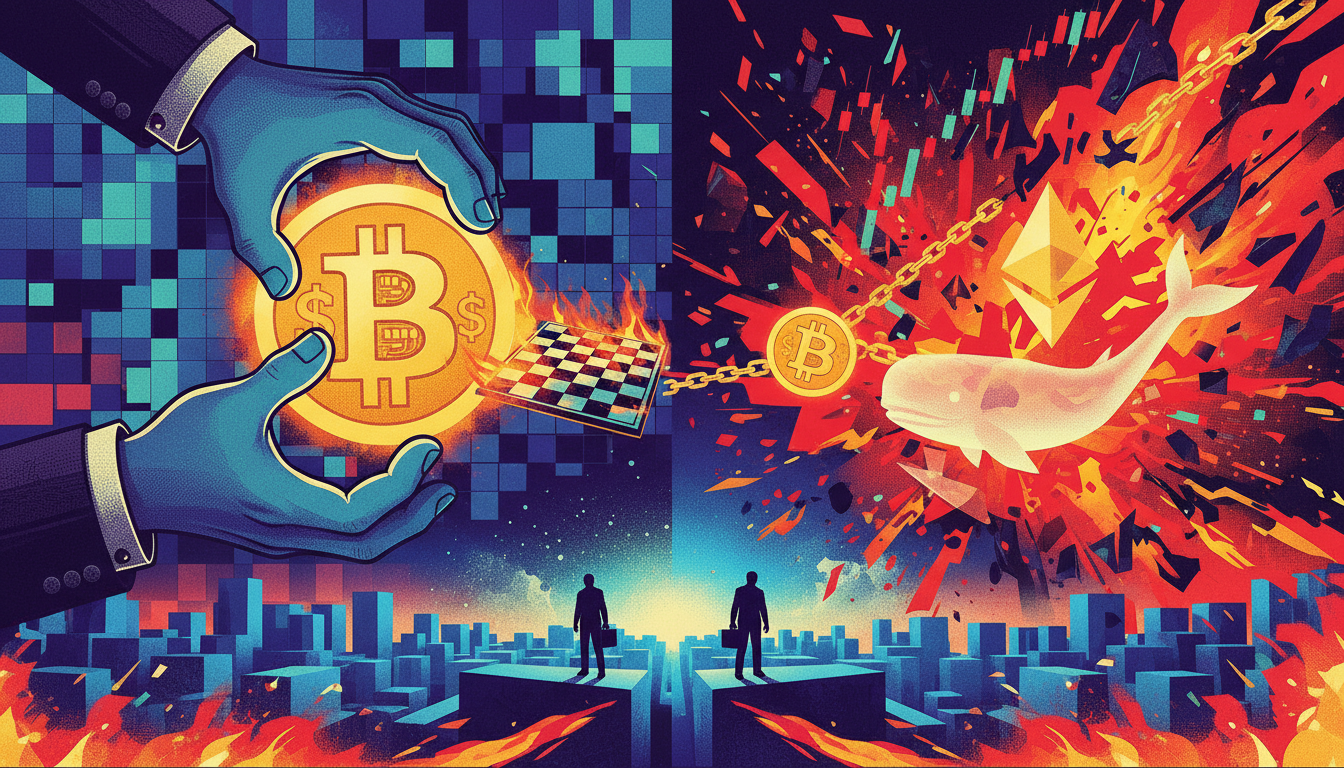
On March 20, 2026, Eastern Eight Time, a significant on-chain transaction quickly became the focus of the market: a wallet address suspected by the community to be related to ShapeShift founder Erik Voorhees made two major purchases, utilizing 30.72 million USDT to aggressively buy ETH in a single day, acquiring over 20,000 ETH and emptying its entire balance of USDT for ETH. At a time when traditional institutions generally suggest a “2% light allocation” for participating in crypto assets, such an aggressive behavior, almost fully invested, starkly contrasts “institutional caution” and the “native whale gamble.” The following article will sequentially analyze the details of on-chain behavior, the tearing of market sentiment, and the interplay of macro and narrative, unpacking the imaginative space enlarged by the market behind this large transaction.
30.72 Million USDT Acquisition in Two Steps: How Whales Achieve Near All-in on Chain
According to the on-chain timeline, the process of accumulation for this address was highly impactful. First, this address bought 14,425 ETH at an average price of about 2130 USD, clearly differentiating in both transaction volume and execution pace from the usual large traders’ “scattered ambushes.” Less than an hour later, about 50 minutes after, the same address made another move, acquiring 5,805.51 ETH at an average price of 2126.32 USD, completing the second round of purchases within a very narrow price range just above 2100 USD.
In total, through both transactions, this wallet added 20,230.51 ETH on that day, elevating its total ETH holdings to 117,814 ETH, with a nominal market value estimated at around 252 million USD based on prices at the time. On-chain data showed the average holding cost for this address was approximately 2162.68 USD, indicating that this accumulation was not “caught at the absolute bottom,” but rather a significant increase in risk exposure based on previous long holdings. From an asset structure perspective, it converted all 30.72 million USDT into ETH, hardly retaining any dollar-pegged stable assets as a buffer. This near All-in stance sent a strong signal to the market in terms of risk preference: this is an address willing to exchange short-term volatility for long-term direction.
It must be emphasized repeatedly that the community currently suspects based solely on partial on-chain associations and rumors that this address “seemingly” belongs to Erik Voorhees-related parties, but no public, authoritative sources have confirmed this attribution. Until identity is solidified, any approaches to infer specific investment intentions based on individual labels or experiential styles carry significant information risk; a more prudent way is to treat it as a high-risk tolerant, significantly capitalized native participant.
Morgan Stanley's 2% Light Allocation Advice Ignored by Native Whales Casting Votes with Their Feet
Contrasting with this nearly all-in on-chain accumulation is the traditional institutions' consistent asset allocation mindset of “participating but restrained.” Wall Street institutions represented by Morgan Stanley typically suggest a crypto asset allocation range of about 0-4% for high-net-worth individuals and family office clients, with 2% considered a compromise between “not missing too much upside” and “being able to endure losses even if it goes to zero.” Behind this advice is a result of risk budgeting, compliance constraints, and asset portfolio optimization models, more of a “risk control-driven position” rather than a position driven by emotional betting on a single narrative.
In this context, Strategy CEO Phong Le's metric is particularly meaningful: if global institutions averaged a 2% allocation for crypto assets, it could potentially lead to an incremental buying of around 160 billion USD. This figure reminds the market that, even if institutions appear cautious on the surface, a collective move from 0% to 2% could create a wave of capital flow that should not be underestimated. It also indicates that institutional restraint is more reflected in a late start and limited proportion rather than being completely absent.
Comparing this “2% model” with the native whale's operation of “100% USDT for ETH” presents a dramatic contrast: one side has a risk control-driven position based on VaR and Sharpe ratio, tightly controlled under layers of approval; the other side shows a faith-driven position demonstrating high trust in a single asset and nearly giving up cash buffers. In social media narratives, this contrast can easily be shaped into two extreme labels: supporters view the whale as “smart money leading the way,” believing it has pre-empted the upcoming increase from institutions; skeptics regard it as “reckless gambling,” worrying that such concentrated exposure could amplify systemic risk if it misses out or faces regulatory headwinds. The amplification effect on platforms like X and Telegram often further escalates this binary opposition, fueling ongoing debates around “institutional caution vs native gambling.”
30 Million Liquidation and AI Concept Surge: The Imaginary “Support Whales” in Misaligned Market Conditions
This accumulation did not occur in a calm market. According to CoinAnk data, within the same time window, there was approximately 33.86 million USD in contract liquidations across the ETH network, with leveraged longs and shorts both incurring real costs amidst intense volatility: longs were continuously forced through their margins, while shorts faced passive liquidations amid rapid surges and rebounds. The intensive liquidation of high-leverage funds constituted a significant backdrop for the severe price pullback and added emotional projection for any large spot transaction as either “market support” or “market dumping.”
Meanwhile, another narrative chain is heating up the capital enthusiasm—Bittensor (TAO) surged by as much as 13.94% in a single day, with AI sector assets continuing to occupy a high-beta central position sentiment-wise. One side is speculative capital chasing AI concepts and favoring high-volatility, small-cap varieties, while another side sees whales increasing their positions in ETH against the grain, displaying a clear misalignment in market conditions: speculative capital votes with their feet betting on the next “OpenAI story,” while large funds double down on Ethereum, a highly mature cornerstone asset.
In an environment interwoven with high-leverage liquidations and concept rotations, such an extensive on-chain spot buy could easily be interpreted by market participants as a “support signal” or “emotional anchor.” For retail investors who experienced liquidations, seeing a large address continuously accumulating amidst volatility often lowers their subjective expectations of further deep drops, increasing their willingness to re-open positions or decrease hedge ratios; for the observation funds still on the sidelines, this type of operation might be perceived as “professional players using cash to absorb panic sell-offs,” thus psychologically providing comfort that “there’s someone underneath catching.”
However, this “emotional anchor” itself may also amplify volatility: if the price rises in response, the market tends to view this accumulation as the starting point for a trend reversal, potentially triggering a chase up behavior; if the price subsequently falls sharply again, the large order previously regarded as a “support signal” would rapidly be interpreted as “the main players inducing purchases before offloading,” becoming an excuse for a new round of intense adjustments. The swings of emotions between “support” and “trap” fundamentally reflect the market's over-reliance on a single on-chain signal.
Identity Cloud and On-Chain Footprints: How the Market “Creates Heroes” and Then Turns on Them
Returning to the incident itself, it is crucial to remain clear on one point: the identity is still shrouded in uncertainty. Currently, the classification of “suspected Erik Voorhees-related address” comes primarily from community conjectures based on partial historical interactions, tags, and rumors, rather than any public, authoritative on-chain statements or confirmations from the parties involved. Lacking strong evidence, equating this address directly with a particular entrepreneur's personal position or deriving strategic judgments about the industry or ETH from it introduces enormous uncertainty into the information chain.
Yet, within the emotional structure of the crypto community, there often exists a tendency to bind such large accumulation behaviors with well-known entrepreneurs or KOLs. Once a name is semi-confirmatively linked to a wallet address, all subsequent actions can easily be wrapped in the narrative framework of “so-and-so has accumulated heavily” or “so-and-so has successfully/unsuccessfully bottomed.” The personal brand is applied to “create heroes” for a series of not entirely visible on-chain decisions, fulfilling the market's demand for stories while reinforcing retail investors' reliance on “following someone.”
From a technical standpoint, the high transparency of the on-chain world allows the historical behavior and holding changes of large addresses to be easily deconstructed and magnified—from establishing a position, increasing holdings to cross-protocol migrations, each step can be pieced together into seemingly complete “investment narratives.” However, most current reporting around this address remains focused on the recent concentrated accumulation and its holding scale, lacking systematic tracking of subsequent fund flows. In the absence of observations around liquidation, diversified transfers, staking for yields, or lending, building a long-term stable “style portrait” based solely on a single large purchase is evidently rash.
For ordinary participants, a more realistic approach is to maintain distance between narrative and fact: focus on whether the address exhibits liquidation, cross-chain transfers, staking for rewards, or other consecutive actions in the future, treating it as a dynamic observation sample rather than attributing it a stable “faith benchmark” status prematurely. Rather than speculating on the motives of a suspected influencer, it is better to concentrate on objectively observable rhythms of on-chain actions and changes in risk exposure.
Strains in Hormuz and Cryptocurrency Hedge Imaginations: How Macro Narratives are Forcefully Interwoven
Widening the perspective to a macro level, the news of South Korea joining the Hormuz Strait safety declaration has been viewed by many observers as yet another signal of escalating geopolitical risks. The Hormuz Strait, as a critical chokepoint for global energy transport, leaves an imprint on oil prices, shipping costs, and even global inflation expectations with each shift in its security situation. In such an environment, traditional safe-haven assets like US Treasury bonds and gold are often repriced ahead of time, while crypto assets frequently occupy a “narrativized” position.
When traditional safe-haven tools have been fully traded, reflecting most of the panic expectations in their prices, crypto assets are sometimes packaged as “new safe-haven tools”: characteristics like decentralization, non-freezability, and strong cross-border liquidity are used to argue their value-bearing capacity in extreme situations. Although there remains significant controversy over this point at the empirical level, in the public arena, it is sufficient to support an intriguing macro story.
Placed in such a macro context, the whale's significant purchase of ETH could easily be tied to the narrative of “long-cycle hedging布局”—even though this motivation has never been publicly confirmed by the related parties. Some voices have begun attempting to link “geopolitical tensions escalating” with “native crypto funds bottoming ETH,” suggesting this is a dual-hedging asset allocation option against the traditional financial system and geopolitical risks. However, from the currently available public information, this relation largely remains at an emotional level rather than being driven by data-conclusions.
Therefore, it is necessary to remind readers to distinguish between “macro correlation” and “macro narrative”: the former implies confirming a stable linked relationship through repeated verification of various event samples against prices, trading volume, and capital flows over a longer time dimension; the latter often quickly seeks to explain price fluctuations with “seemingly reasonable” stories following a single event. In the absence of long-term data support, attributing a whale's accumulation simply to “hedging demand” is likely just a part of post hoc narrative rather than a repeatable investment principle.
From a Large Transaction to a Game: Who is the True “Smart Money”?
In summary, the incident involving a wallet address seemingly related to Erik Voorhees making significant ETH accumulations simultaneously elevates tensions on multiple levels: on one side, institutions like Morgan Stanley provide a light allocation recommendation of 0-4%, centering around 2%; on the other, the aggressive operation of the on-chain whale exchanging 30.72 million USDT for almost all ETH; one side sees contract liquidations totaling 33.86 million USD while the AI field like TAO experiences a nearly 14% surge in a single day, and the other side sees ETH re-priced as a cornerstone asset amidst this volatility. These intertwined clues construct a complex picture of the current long-short game and provide new material to the long-standing question of “who is the smart money?”
In shorter time dimensions, market sentiment is likely to oscillate between “following the whale for bottom fishing” and “fearing a renewed pullback”: if ETH continues to rebound and stabilize at a new level, this large transaction may be regarded as a starting point sample for an upward trend; if the price dips again, the address’s aggressive moves may be criticized as a textbook case of “leveraging too early.” Nonetheless, regardless of the scenario, what truly warrants continued monitoring remains whether this address continues to purchase, begins to reduce holdings, or undergoes structural adjustments, rather than emotionally amplifying a single day’s behavior.
In an environment of incomplete information and unverified identity, building investment decisions on imitating a certain whale address often implies relinquishing control over position management. A more rational path is to return to one’s position discipline and risk tolerance: at what drawdown can rationality be maintained? What length of volatility is one psychologically prepared for? Is the existing asset portfolio overly exposed to a single narrative? These questions, compared to “how much did that address buy,” have a more direct decisive impact on long-term personal asset performance.
Looking ahead to a longer cycle, if institutional average allocations indeed slowly rise from near 0 to 2%, 3% or even higher, while native crypto funds continue to maintain net purchases of core assets like ETH, then Ethereum will face not just a simple “bull-bear switch” but rather a complex market environment and narrative competition comprising multiple cycles: intertwined logics of macro hedging, on-chain yields, ecological expansion, regulatory games, and so on, where a single whale's large order will merely be a moment of focused attention. The true game lies not in who won this transaction, but rather who remains at the table after traversing multiple cycles.
Join our community, let’s discuss and become stronger together!
Official Telegram community: https://t.me/aicoincn
AiCoin Chinese Twitter: https://x.com/AiCoinzh
OKX Benefit Group: https://aicoin.com/link/chat?cid=l61eM4owQ
Binance Benefit Group: https://aicoin.com/link/chat?cid=ynr7d1P6Z
免责声明:本文章仅代表作者个人观点,不代表本平台的立场和观点。本文章仅供信息分享,不构成对任何人的任何投资建议。用户与作者之间的任何争议,与本平台无关。如网页中刊载的文章或图片涉及侵权,请提供相关的权利证明和身份证明发送邮件到support@aicoin.com,本平台相关工作人员将会进行核查。