From October 2025 to March 21, 2026, the altcoin spot market underwent a genuine "volume shrinkage collapse." Once able to maintain a daily transaction level of several hundred billion dollars by the end of 2025, it now only retains the "shadow of tens of billions" on leading platforms. On the main battlefield represented by Binance, the daily transaction volume of altcoins plummeted from a high of 40-50 billion dollars to about 7.7 billion dollars; the total spot trading of altcoins on other major exchanges shrank from 63-91 billion dollars to 18.8 billion dollars, achieving a "halving after halving" compound collapse. Funds have not left the market entirely, but have clearly withdrawn from high beta altcoin sectors, concentrating back onto mainstream assets like Bitcoin, signaling that the market is voting with its feet: amidst the dual impacts of geopolitical risks and the looming threat of interest rate hikes, whether the comprehensive and widespread altcoin season can return has become the core question facing all participants.
Altcoin Transaction Volume Plummets: Liquidity Is Redrawing The Map
After October 2025, the most intuitive measure of the retreat of altcoin liquidity is the systematic collapse of transaction volumes in the Binance Alt sector. According to CryptoQuant data, Binance's daily transaction volume for altcoins fell from a typical range of 40-50 billion dollars to only about 7.7 billion dollars by March 21, 2026, a decline exceeding 80%. This is not a one or two-day flash crash, but a stepwise decline following multiple unsuccessful rebounds: each rebound high has been lower, and each increase in volume has been more fleeting, until the overall transaction curve has sunk to an entirely new low platform.
In congruence, the altcoin transactions on other major exchanges have also collectively "cooled off." The aggregate data provided by Research Brief indicates that the daily trading volume of altcoins on non-Binance leading platforms has shrunk from a wide high range of 63-91 billion dollars to around 18.8 billion dollars. Whether in absolute scale or compression ratio, all point to one conclusion—this is not merely a problem of a single platform or a single coin, but a simultaneous retreat across the entire industry: liquidity has not vanished into thin air, but has been internally reordered and concentrated within the market.
In this reordering, Bitcoin has become the most apparent "liquidity stronghold." On one hand, high-risk altcoins are continually having their positions reduced, rolling down to the bottom of the liquidity pyramid; on the other hand, funds, regulatory attention, and narrative resources are being drawn away towards Bitcoin or at least fewer mainstream assets. This increasing liquidity stratification constitutes the fundamental difference between the current cycle and the "全民山寨季" (mass altcoin season) of 2020-2021—similarly located in the hazy zone of a market transition, this time liquidity has not spread within long-tail assets, but has been locked into a smaller number of leading targets.
Geopolitical Risks and the Shadow of Interest Rate Hikes: Risk Appetite Systematically Discounted
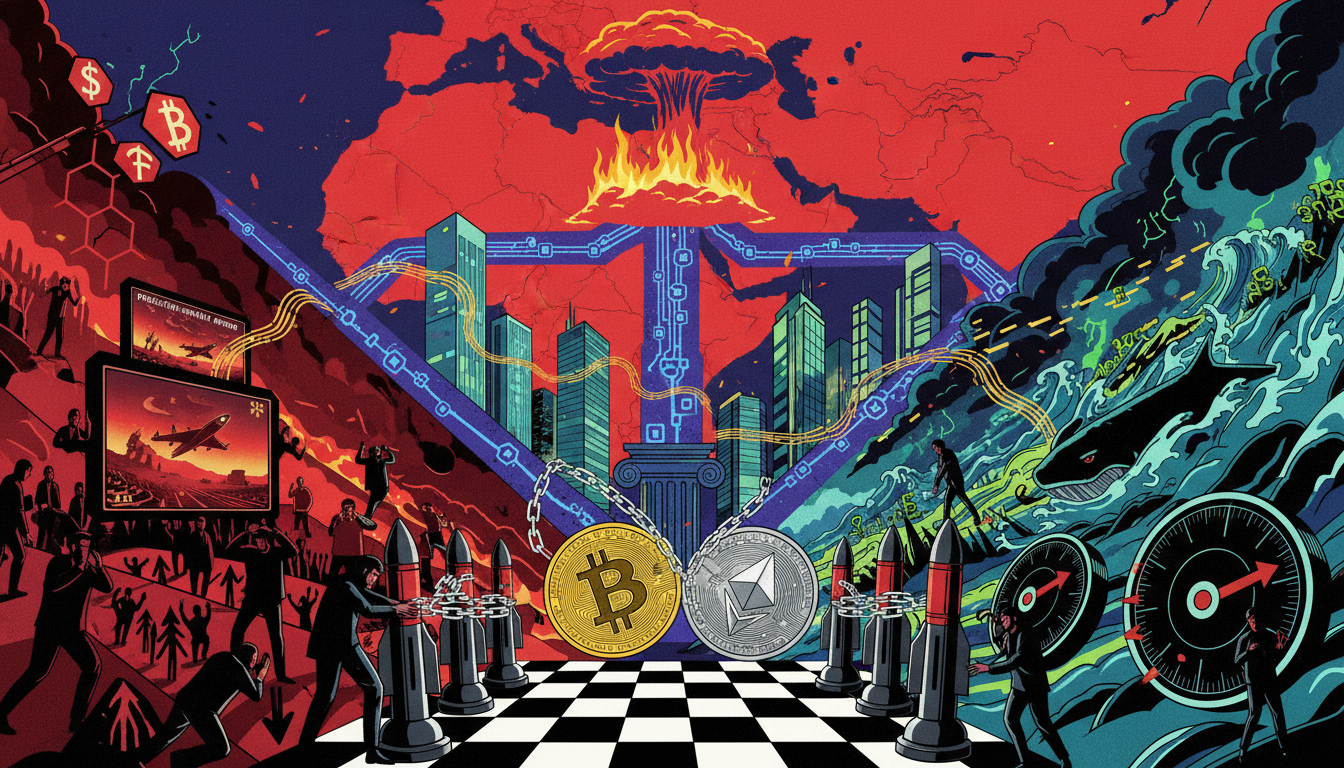
The retreat of altcoins is not an isolated "insider event," but occurs within a macro context of rising risk aversion. The situation in the Middle East is tightening again, with topics ranging from Iran's nuclear material issues to shipping tensions in the Strait of Hormuz, repeatedly raising the traditional market's pricing of black swans. Once geopolitical risks are recalibrated into asset portfolio models, the crypto market can no longer be perceived as an independent playground detached from the real world as it was in past cycles, but is forcibly pulled back within the uniform framework of global asset pricing to face the label of "risk assets" again.
On the monetary policy level, the uncertainty regarding the future interest rate path of the Federal Reserve is also eroding risk appetite. The brief mentions an increase in client inquiries from American banks, reflecting the accumulated anxiety over the direction of interest rates and economic prospects: whether the rate hike cycle has ended, when it will genuinely shift, and whether the economy will experience a soft or hard landing—no consensus has been reached. For high-risk altcoins that rely on liquidity spillovers and long-term growth narratives, this risk of uncertainty elevation equates to a heightened discount rate—future imaginings are discounted at higher rates, naturally compressing valuations.
Under the dual pressure of rising risk aversion and the lingering shadow of interest rate hikes, the market has reordered risk premiums for different assets. High leverage, high volatility, and narratives with high dependency in altcoins have been re-labeled as the easiest sacrifices in portfolios; in contrast, Bitcoin has gained relative advantages in this round of repricing due to its positioning as "digital gold" and "hard asset-like." Capital exiting from the Alt sector is not just a price correction, but a top-down adjustment of risk premiums: the closer an asset is to the risk edge, the more complete the premium discount, and altcoins unsurprisingly bear the brunt of this.
Exchanges Are Quiet and Traffic Is Shifting: Retail Investors and Fast Money Are Exiting
If on-chain data seems abstract, then the dramatic reduction in altcoin transaction volumes on centralized exchanges is the most concrete change annotation. Once, the Alt sector was a paradise where "there are always new stories, always new hotspots," and new listings and surging charts attracted retail and high-frequency capital. But as daily transaction volumes shrink from tens of billions to single-digit billions, market depth and order densities visibly thin out, many coins once regarded as "blue-chip altcoins" no longer have large orders scrambling against each other, and instead are characterized by decreased volume, sideways trading, and silence.
The market commentary that "capital is clearly withdrawing from high beta altcoins" succinctly summarizes the collective shift in participant psychology. Retail investors, after several rounds of "pumping high only to be dumped" and "seeing tops once favorable news is exhausted," have gradually dulled their enthusiasm for chasing new highs and have begun instinctively reducing speculative positions; high-frequency and quantitative funds find that although there is volatility in the Alt sector, the capacity and slippage risks no longer align with strategic needs, leading them to redirect resources towards deeper holdings in Bitcoin and Ethereum or completely spill over into traditional assets while observing from the sidelines.
Traffic and activity do not evaporate into thin air; they merely change paths. Some trading demand has been compressed into fewer leading coins, with derivatives contracts, leveraged products, and various off-market financial tools taking on some of the active volume that originally belonged to long-tail altcoins. For trading platforms, this implies a passive restructuring of business models: altcoin spot trading, once a pillar for revenue and customer acquisition, has retreated to the margins; combinations of leading coins and financialized products have become the focal point of the new competitive landscape. Witnesses have felt the shift from an environment of "there's always someone playing anything" to a stark atmosphere where "only a few pools still have ripples."
Whale Portfolio Adjustments and Institution Turnarounds: High-Risk Assets Systematically Downgraded
The withdrawal of funds from altcoins is not merely a reflexive response from retail and small investors; the adjustments in positions by whales and institutions more clearly outline the long-term migration routes of asset preferences. In this round of environment, leading participants no longer maintain a mainline of “increasing leverage to bet on high-risk altcoins,” but rather dynamically rebalance between Bitcoin, Ethereum, and hard asset-like assets linked to gold to manage overall portfolio volatility and drawdowns.
The XAUT whale sell-off mentioned in the brief serves as a microcosm of this rebalancing logic: when the gold price narrative winds down or related asset valuations are deemed high, some positions choose to realize profits or reduce holdings within liquidity windows that are still favorable, and the released funds may not necessarily return to altcoins but could be reallocated within more capable assets like Bitcoin and Ethereum. At the same time, Erik Voorhees increased his ETH holdings despite being in temporary losses, reminding the market that even seasoned participants and institutional investors are not simply making one-sided bullish bets on risks, but are continuously trying the "buy-verify-adjust" iterative process amidst macro uncertainty.
CryptoQuant analyst Darkfost explicitly points out that "the structural emergence of the all-encompassing altcoin season from 2020-2021 is unlikely to be reproduced in this round." When this type of viewpoint becomes a consensus base among professional institutions, it will directly reflect in the configuration strategies of investment committees and risk control departments: the weight of high-risk altcoins in models is being lowered, liquidity discounts are being raised, and new funds are being subjected to strict screening. This institution-led strategy adjustment, in turn, exacerbates the valuation compression and liquidity shrinkage within the altcoin sector—an asset with diminishing liquidity is less likely to qualify as a suitable investment target for institutions, forming a self-reinforcing negative feedback loop.
GameFi Reduced to a Small Pond: From The Center of the Hype to the Marginal Edges
If the entire altcoin sector is experiencing a systemic retreat, then GameFi is one of the first assets washed up on the beach by the tide. According to Coingecko data, the total market cap of the GameFi sector is currently around 4.515 billion dollars, starkly contrasting with the early "Play-to-Earn (P2E)" narrative boom period when it was often considered the “next hundred billion dollar hype.” Once seen as a track capable of accommodating millions of new users and rewriting game distribution models, it now appears more like a small puddle left on the edges, quickly passed over by mainstream funds within the whole crypto landscape.
Against the backdrop of the overall retreat of altcoins, GameFi embodies nearly all "high-risk tags" that have been repriced by the market: high dependency on narratives and user stories, extreme sensitivity to macro liquidity, short project lifecycles, and unclear cash flow and value anchoring. When risk aversion and interest rate sentiments are elevated, these characteristics make GameFi one of the first objects to be discarded during fund portfolio adjustments—by contrast, even mainstream public chains and infrastructure altcoins can still attain some premium immunity based on "long-term network effects."
The chain reaction of GameFi's shrinking liquidity has transcended the bounds of individual coin prices. On the financing side, projects find it increasingly difficult to present a narrative in the primary market capable of sustaining valuations, and trials for new categories and models are forced to slow; on the user side, lacking sufficient expectations for secondary market returns, players transition from "farming gold" to "watching with detachment," leading to a visible decline in activity and retention rates; on the narrative side, GameFi gradually loses its primary storytelling status of "resonance across the entire market" and can only maintain weak resonance within localized communities and small circles. This predicament partially reflects the shrinkage dilemma faced by the entire altcoin ecosystem: when liquidity and imagination are simultaneously withdrawn, tracks once regarded as "hype" can degrade into tranquil small ponds in a very short time.
Is The Myth of Altcoin Season Ending? Where Will Funds Be Allocated?
Returning to the starting point, the systemic shrinkage of altcoin transaction volumes by over 80% in the past six months, along with the concentration of funds towards Bitcoin and other mainstream assets, is not merely a passing wind in the emotional cycle, but rather a structural reconstruction of the entire market collectively lowering risk appetite under macro uncertainty. In this process, the altcoin sector loses not only price height but also its role and status as the "endpoint of liquidity diffusion": the layering of liquidity between assets is sharper than in any previous cycle.
This also indicates that the expectation tone towards "altcoin season" is likely to undergo a fundamental change over the next several trading seasons—shifting from a previous feast of "collective surges, long tails soaring together" to sporadic localized structural small markets occurring only in sectors with validated narratives and fundamental support. The emergence and duration of these scattered hotspots increasingly depend on two premises: first, the global macro environment and liquidity easing levels, and second, whether projects can provide genuine cash flow and user growth that withstand valuation scrutiny beyond narrative alone.
For different types of participants, the adaptation strategies to this new environment will also evolve along divergent paths. Retail investors who continue to follow the "chasing hype and doubling down on a win" strategy will only consume their principal and patience amidst increasingly dwindling liquidity; a more pragmatic approach would be to shift focus from chasing hype to position management and risk control: setting clear upper limits for high-risk assets within their portfolios, and making decisions guided by the capital curve rather than short-term surge lists. For institutions, amidst continued macro uncertainty, what is truly being prioritized is no longer "which altcoin is more aggressive," but rather risk budget discipline and cross-asset allocation frameworks: how to dynamically maintain an acceptable volatility range among Bitcoin, Ethereum, gold-like assets, and a few high-growth bets.
In this sense, the "myth of altcoin season" has not completely ended, but it has degraded into small events tied to specific windows, specific sectors, and specific demographics, rather than a mainline narrative sweeping the whole market. Under higher risk premiums and stricter liquidity constraints, funds will ultimately choose assets that can bear more uncertainty amidst turmoil—and at this moment, Bitcoin is once again at the center of this capital migration path.
Join our community, let’s discuss and grow stronger together!
Official Telegram community: https://t.me/aicoincn
AiCoin Chinese Twitter: https://x.com/AiCoinzh
OKX benefits group: https://aicoin.com/link/chat?cid=l61eM4owQ
Binance benefits group: https://aicoin.com/link/chat?cid=ynr7d1P6Z
免责声明:本文章仅代表作者个人观点,不代表本平台的立场和观点。本文章仅供信息分享,不构成对任何人的任何投资建议。用户与作者之间的任何争议,与本平台无关。如网页中刊载的文章或图片涉及侵权,请提供相关的权利证明和身份证明发送邮件到support@aicoin.com,本平台相关工作人员将会进行核查。