In the East Eighth Zone time this week, a noticeable change in the crypto market is: the trading volume of altcoins on mainstream exchanges has significantly shrunk, with funds leaning more towards Bitcoin and cash. On the trading board, the originally lively long-tail coin game quickly cooled down, with liquidity starting to concentrate on a few core assets. According to a single data source, the daily trading volume of altcoins on Binance and other major exchanges is about $26.5 billion, of which Binance accounts for about $7.7 billion, nearly 40%, creating a clear distance from the high fever state of previous phases. Under the dual pressures of macro uncertainty and tightened regulations, the market is rapidly reducing risk exposure, leaving a key question: is this retreat in risk appetite a short-term flight to safety, or the starting point of a new risk pricing cycle?
The scene of altcoins' daily trading volume being just over two hundred billion is bleak
From the trading perspective, the altcoin market over the past few days feels more like a "collective hibernation": the order book for long-tail coins on mainstream exchanges has noticeably thinned, price slippage has widened, and after deep orders are withdrawn, the occurrences of large sell-offs or price spikes in a short time have actually reduced, replaced by a state of relatively calm price fluctuations, but extremely low overall trading. Market makers are scaling back, grid and high-frequency strategies are reducing their positions, and many formerly active cryptocurrency pairs are leaving sparse trading columns on daily charts.
According to a single source, the daily trading volume of altcoins on Binance is about $7.7 billion, while the total on other major exchanges is about $18.8 billion, totaling approximately $26.5 billion. This metric is not derived from multiple-source cross-validation, and there exists a risk of deviation in statistical caliber and coverage, which must be interpreted with caution; however, even so, this scale still shows a significant shrinkage compared to the previous excitement. CryptoQuant analyst Darkfost pointed out that high trading volume phases often correspond to local market tops and FOMO releases, while the current low trading appears more like a calm period after an emotional retreat, rather than a direct result of a single negative sell-off. In other words, the market is not knocked down by a single black swan, but actively chooses to reduce trading and leverage exposure under multiple pressures.
Gold's crash, a forty-three-year event, resonates with crypto
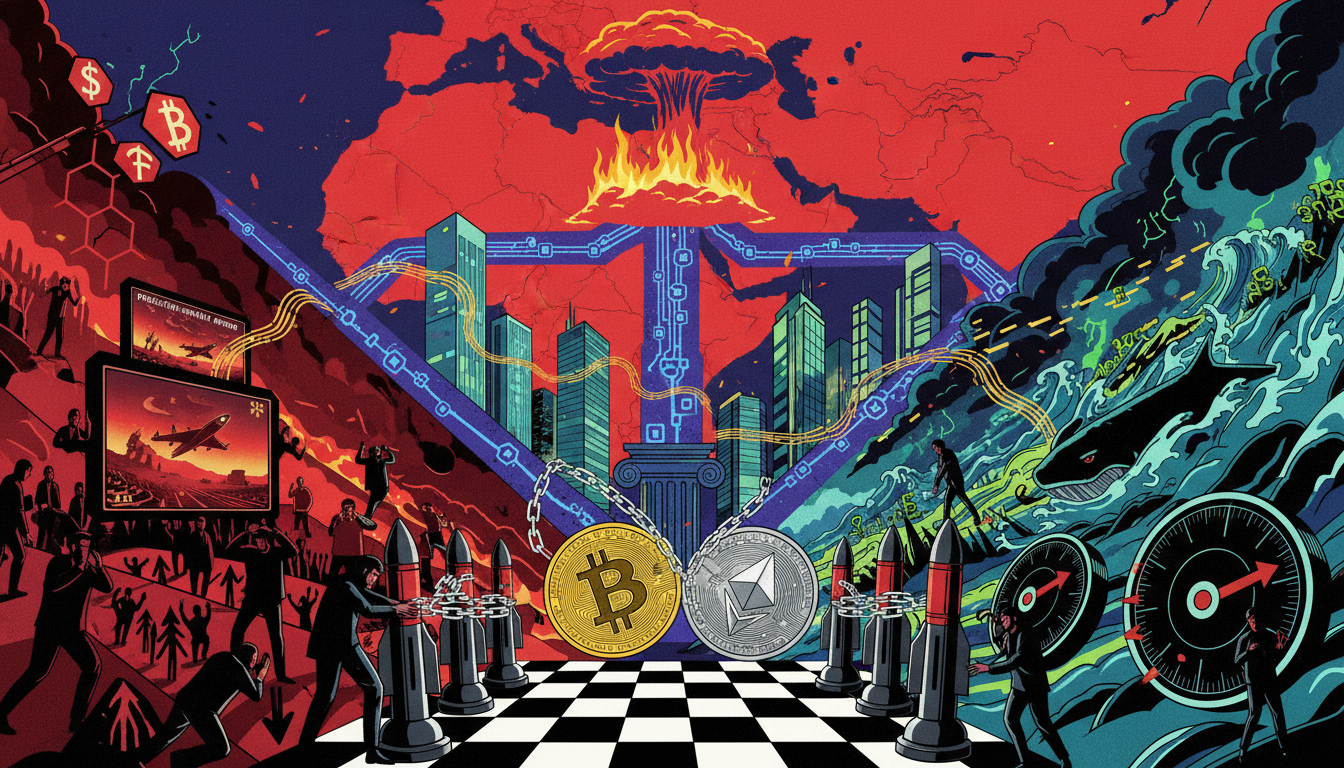
To understand this round of risk appetite contraction, one must pull back to the global asset level. Recently, as a traditional safe-haven asset, gold recorded its largest weekly drop in forty-three years, and this extreme market condition itself is highly dramatic: even the asset regarded as "the last safe haven in turbulent times" is being collectively liquidated by investors, indicating that the market is not simply seeking safer assets but is overall deleveraging, shrinking balance sheets, and compressing risk exposure.
The backdrop is equally tumultuous: the situation in the Middle East continues to escalate, and geopolitical risks are raising concerns about the global supply chain and energy prices; the Federal Reserve is repeatedly weighing inflation stickiness against economic resilience, with expectations of further rate hikes or prolonged high rate cycles heating up; meanwhile, the U.S. stock market has fallen for four consecutive weeks, tech stocks are under visible pressure, and global bond yields have surged, raising long-term interest rates and restoring yield attractiveness for risk-free or low-risk assets. When "risk-free rates" rise and volatility increases, all high beta assets are being collectively repriced.
In such an environment where global assets are all under pressure, the internal rotation path of the crypto market has also become clear: with funds retreating from high beta altcoins to relatively "core assets"—Bitcoin and cash. Altcoins are often the first to suffer when risk appetite declines due to their weak liquidity, high reliance on valuation narratives, and sensitivity to incremental funds; capital first withdraws from long-tail assets, with high-risk assets being prioritized for reduction, before considering whether to lower exposure to Bitcoin, ultimately leading some funds towards cash positions like the dollar or on-chain risk-free revenue tools. The current freeze in altcoin trading volume is essentially an intuitive reflection of this defensive rotation in trading data.
Regulatory hammer drops: billion-dollar black...
Away from the macro cold winds, the regulatory "hammer" is also tightening the imagination of the crypto market regarding liquidity and market-making environments. Recently, UK regulators canceled the Zedxion exchange associated with Iran's Islamic Revolutionary Guard Corps, with the timeline roughly as follows: first confirming its ties to sanctioned entities and fund flows, and then initiating withdrawal and cancellation procedures on the grounds of national security and compliance with financial sanctions. On the surface, this is just another non-compliant platform being removed from the scene, but the narrative behind it is much more than that.
According to publicly disclosed information, Zedxion is accused of handling about $1 billion in sanctioned funds, which accounted for about 56% of its platform's trading volume. This set of numbers directly amplifies the market's association with "fake liquidity" and "money laundering channels": when a platform has more than half of its trading volume potentially related to sanctioned funds, trading depth, order sizes, and even some trades themselves could simply be props for concealing fund flows. For altcoin trading, which relies on exchange depth and leverage environments, such cases reinforce a dangerous impression: part of the liquidity is not truly a natural market that can handle selling pressure or buying interest, but a playground for high-risk gray funds.
Under this narrative, the crackdown on gray liquidity by regulatory authorities can easily be amplified by the market into a risk association with the entire exchange system. Market makers will be more cautious in assessing custodial, compliance, and counterparty risks, reducing quotes and leverage on platforms that are regulatory opaque or riskier; institutions and high-net-worth funds will shrink their exposure to long-tail currencies, reducing proactive market-making and lending activities in the altcoin sector. The chain reaction is: the market-making depth and leverage supply for altcoins are simultaneously compressed, leading to a downward trend in overall trading activity. It needs to be emphasized that currently, we can only describe the correlation between regulatory actions and trading volume changes, without being able to, nor should we classify any single regulatory event as the "real cause" of the sudden cold trading.
Transition from FOMO to wait-and-see: risk appetite...
If we extend this round of market conditions to a more complete emotional cycle, a clear evolutionary path can be seen from the high-volume FOMO phase to the current low trading. In the previous phase, the high turnover, high volatility, and frequent new narratives in the altcoin sector were typical emotional spillovers: mainstream coins started first, driving up overall market cap and attention; then long-tail projects, under the influence of narratives and leveraged amplifications, released extremely high trading volumes. CryptoQuant analysts and some institutional perspectives emphasize that high trading volumes often coincide with local tops and FOMO peak heights.
The current phase, however, is clearly different: trading volumes are declining, price volatility is easing, discussions about altcoins on social media are noticeably declining, and more investors are choosing to "wait and see." Retail investors, in the uncertain macro and regulatory environment, are actively reducing their long-tail risk exposure, decreasing exposure to new coins and high-risk sectors, and are increasing the proportion of cash and Bitcoin positions; institutions tend to concentrate their risk budgets on mainstream assets with better liquidity, delaying proactive allocations to small and mid-cap assets. The sentiment shifts from "fear of missing out" to "fear of stepping on landmines," with FOMO being replaced by risk-averse instincts.
In interpreting all this, it is essential to delineate risk boundaries: between trading volume, macro events, and regulatory actions, we can only confirm significant correlations at most, and cannot arbitrarily conclude that "a certain event is the sole cause of changes in trading." Market behavior is often the result of multiple overlapping factors—interest rate expectations, geopolitical risks, regulatory signals, funding costs, exchange competition patterns, etc. Simplifying complex systems into a single causality is not only inaccurate but can also mislead trading decisions.
Potential new battlegrounds for funds during the hibernation period of altcoins
When altcoins enter a "hibernation period," funds do not collectively disappear, but rather rearrange amongst Bitcoin, mainstream coins, and on-chain low-risk revenue tools. Some funds choose to return to Bitcoin, viewing it as a "quasi-core asset" and a relatively safe liquidity pool in the crypto world; others shift towards mainstream coins like Ethereum, which have better liquidity and narrative foundations, while also obtaining annualized returns through on-chain staking, lending, and low-risk strategies to hedge against uncertainties from short-term price fluctuations. Some funds simply maintain cash positions, waiting for clearer macro and regulatory signals.
If we combine historical cycle experiences, a relatively stable rhythm can be found: massive catch-up and speculative rebounds of altcoins often occur after Bitcoin's market is relatively stable or even shows signs of overheating. In such an environment, new or existing funds, driven by anxiety over "missing out on Bitcoin's major upward wave," begin to seek substitute assets with higher beta and higher leverage, reigniting the altcoin sector. However, before the primary upward surge or in phases of high macro uncertainty, funds tend to concentrate first on the assets with the strongest liquidity and narratives, while altcoins are passively marginalized.
Therefore, the current sharp drop in altcoin trading volume is less about being a "finality," and more about being a risk washout and leverage cooling: the bubbles and fake liquidity in long-tail projects are squeezed out, overly reliant short-term leveraged chips are forced to exit, and trading space for high-risk assets is compressed, making way for a healthier next round of risk gaming. What is truly worth watching is how long this cooling period will last and how deep the reallocation of funds towards Bitcoin and mainstream coins will lay the groundwork for future altcoin trends.
The macro cold wind has not stopped, when will altcoins...
Overall, the current sharp cooling of altcoin trading volume is the result of three forces overlapping to compress risk premium: first, the global macro environment is entering a quasi-tightening phase, with escalating Middle East tensions, expectations of Fed rate hikes or prolonged high rates, U.S. stocks weakening for four consecutive weeks, and bond yields rising sharply, all jointly raising the discount threshold for risk assets; second, gold and U.S. stocks being pressured simultaneously triggered a broader asset repricing, leading investors to no longer simply switch between "risk and safe haven," but to reduce leverage overall; third, the regulatory actions represented by Zedxion intensified market doubts about exchanges and market-making environments, further constricting the risk premium space for altcoins.
In such a combined context, altcoins are likely to continue in a state of concurrent low trading and high discernment in the short term: on one hand, overall trading volume and leverage scales are unlikely to recover rapidly, with liquidity more concentrated on a few leading assets; on the other hand, funds will be more selective when choosing altcoin targets, willing to pay a certain premium for high-quality, strong narratives, strong cash flow, or strong ecological status projects, while becoming more indifferent to pure emotional coins lacking fundamental support. Bitcoin and other high liquidity assets will likely remain the preferred berths for funds in the short term.
Looking ahead, three clues are particularly important to monitor:
● Signals of macro policy shifts: including any clear statements from the Fed moving from "higher for longer" to "expectations turning dovish," and any phase turning points in global inflation and employment data, directly affecting the risk-free rate and the valuation center of risk assets.
● Easing of regulatory uncertainties: If future regulatory focus shifts from "brutal sweeping crackdowns" to "building a compliant framework with clear rules," and provides clearer boundaries for exchanges, market-making, and compliant funding channels, the liquidity and leverage environment of the altcoin sector may gradually recover.
● Re-warming of trading volume and sentiment: When we see again trading volumes increasing, volatility amplifying, and social sentiment heating up, it means not only that opportunities are reemerging but also serves as a reminder for participants to be wary of the risk structure of "volume at the top, price on the way." Understanding the interaction between volume, price, and sentiment, rather than simply chasing short-term hotspots, may be the key capability to traverse the next round of the altcoin cycle.
Join our community to discuss together and become stronger!
Official Telegram community: https://t.me/aicoincn
AiCoin Chinese Twitter: https://x.com/AiCoinzh
OKX benefits group: https://aicoin.com/link/chat?cid=l61eM4owQ
Binance benefits group: https://aicoin.com/link/chat?cid=ynr7d1P6Z
免责声明:本文章仅代表作者个人观点,不代表本平台的立场和观点。本文章仅供信息分享,不构成对任何人的任何投资建议。用户与作者之间的任何争议,与本平台无关。如网页中刊载的文章或图片涉及侵权,请提供相关的权利证明和身份证明发送邮件到support@aicoin.com,本平台相关工作人员将会进行核查。