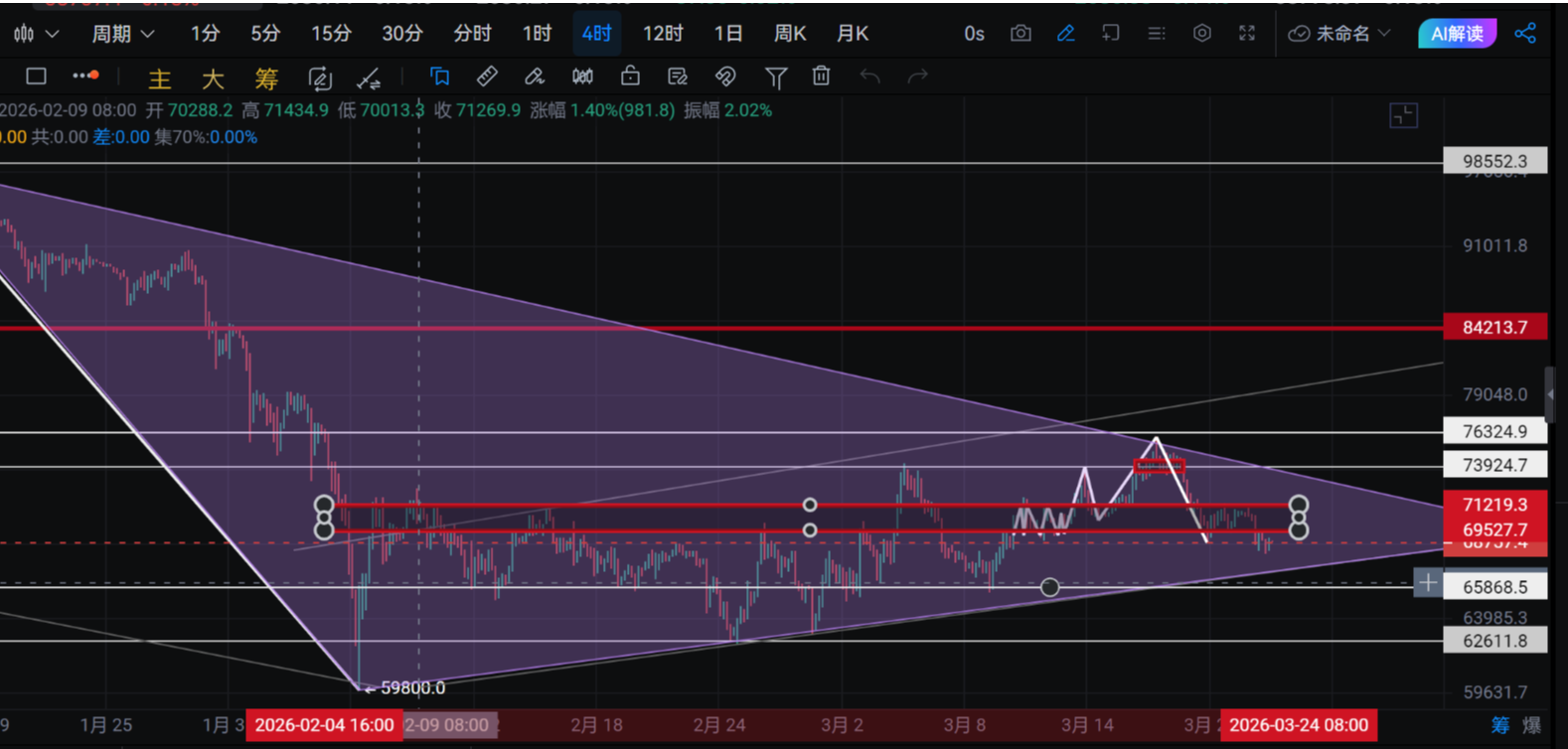
On March 22, 2026, Beijing time, MicroStrategy founder Michael Saylor once again raised his "orange flag" on social media—posting a Bitcoin price Tracker chart and captioning it "The Orange March Continues". This simple slogan was quickly associated by the market with his past accumulation pace: according to a single historical pattern source, traders began to bet that MicroStrategy might announce a new round of Bitcoin accumulation plans the next day. During the same expected timeframe, the crypto market experienced dramatic fluctuations in both funds and sentiment: a SIREN related address suspected a large transfer of about 1 billion dollars, along with a 131%-152% surge within 24 hours, pushing the market cap to about 1.65 billion dollars; the Hong Kong-listed company BoYa Interactive announced it plans to purchase no more than 70 million dollars in crypto assets, publicly stating it aims to "seize the opportunity in the downturn of the cryptocurrency market." Amidst the interplay of expectations, betting, and severe volatility, a core suspense emerged: who is quietly increasing their positions under Saylor's orange flag, and who might become the "last baton" holder in this surge.
The Signal of Orange March: How Saylor Turns Personal Talk into Market Rhythm
Since 2020, MicroStrategy has begun incorporating Bitcoin into its corporate balance sheet, and has pushed this decision to its extreme version—up to now, the company has accumulated about 200,000 BTC, repeatedly defining it in public statements as the company's "treasury asset," not just a typical financial investment. This long-term narrative of "betting the corporate treasury on Bitcoin" is very strong, making Saylor's role in the crypto world far beyond that of a CEO of a listed company; he appears more like a "faith amplifier" continuously endorsing Bitcoin with the balance sheet.
Accompanying this aggressive allocation is Saylor's distinctive "chart + slogan" rhetoric: he is accustomed to releasing screenshots of Bitcoin price movements at key moments, paired with high-recognition slogans like "Bitcoin is digital energy" and "Holding is winning." This time, "The Orange March Continues" follows this style—a picture of the Bitcoin price curve is still there, but it adds a temporal label with "Orange March." After similar expressions in the past, MicroStrategy quickly disclosed announcements of additional BTC holdings, leading the market to recall a simple pattern: first comes a social media shout, followed by the accumulation announcement.
With this premise, the March 22, 2026 "The Orange March Continues" was rapidly interpreted as a "buying alert": according to a single historical pattern source, some traders bet that MicroStrategy would reveal a new buying plan the next day. There were no precise details regarding the specific scale and price, but the pattern itself was enough to ignite imagination—once a large company buys the dip, Bitcoin has room for upward acceleration. Thus, surrounding this "possible action," short-term leveraged sentiment began to self-amplify: some anticipated ahead and positioned themselves, hoping the announcement would catalyze market moods; others seized the high opportunity to leverage, betting on "boarding with Saylor"; yet others viewed it as a cash-out opportunity, preemptively freeing up liquidity for potential "good news cashing in." Saylor's slogan, in this "signal first—announcement later" rhythm, became a market manipulated into a short-term betting arena centered around MicroStrategy, amplifying price volatility while compressing the time window for rational judgment.
SIREN Whale Reallocation: Billion Dollar Transfer and High Beta Surge
Almost simultaneous with Saylor's orange flag, blockchain monitoring detected a large asset transfer of about 1 billion dollars from a SIREN related address within a short period, while the SIREN token recorded a 131%-152% increase within 24 hours, with the total market cap rising to about 1.65 billion dollars. The overlap of large transfers and surges happening within the same time frame made this event quickly packaged as a model of "smart money reallocation": funds acted like a gunshot, and prices were consecutively pushed up in the following race.
It is worth emphasizing that the market currently lacks specific purposes and recipient information regarding this massive transfer, making it impossible to ascertain whether it is an internal address consolidation, an over-the-counter transaction settlement, or new funds officially entering the market. However, in the highly emotional crypto environment, "unknown" itself is magnified into a narrative space: large transfers are often intuitively attributed to "institutions in action" and "whales betting on a new round of market," subsequently driving more follow-through and momentum trading into the market, turning numbers that are merely on-chain coordinates into psychological triggers for price fluctuations.
SIREN's trends and the Bitcoin narrative also exhibit a typical "main storyline—high beta" linkage structure: when events such as Saylor, MicroStrategy, and BoYa Interactive collectively strengthen the main storyline of Bitcoin, some funds opt to seek amplified profit expectations on tokens with higher volatility and leverage. Bitcoin is seen as the direction, while high beta targets like SIREN are viewed as amplifiers—as long as the direction is upward, it bets on magnifying amplitudes. Thus, the mainline belief and secondary speculation intertwine: the Bitcoin narrative provides a foundation of emotions, while high beta tokens showcase more extreme rises and falls in the short term.
Yet on the factual level, we cannot prove that there is a direct causal relationship between the SIREN's large transfer and the price surge. A more cautious perspective is derived from liquidity, chip concentration, and speculative preferences: large address migration may alter the distribution of tradable chips in the short term, weakening or strengthening liquidity on a particular side, indirectly magnifying the price sensitivity to buying and selling orders; a highly concentrated chip structure is prone to extreme volatility under the guidance of a few wills; and against the backdrop of a warming Bitcoin narrative and stacked expectations, the market's tolerance for high risk and high return rises—these factors combine to form a more substantive potential risk landscape behind the current SIREN surge.
Hong Kong Stock Funds Testing the Waters: BoYa Interactive's Balance Sheet Experiment
In contrast to on-chain high-frequency speculation, BoYa Interactive's choice resembles a slow-moving balance sheet experiment. The company disclosed in its latest announcement that it plans to use no more than 70 million dollars to purchase cryptocurrencies, making it clear in its wording that this is to "take advantage of the opportunity in the downturn of the cryptocurrency market." A gaming company listed in Hong Kong chooses to enter the market against the trend during times of amplified volatility and differentiated public opinion, releasing not just a short-term trading signal, but a recalibration of the long-term value of Bitcoin and other leading assets against the company's risk hedging needs.
From a business logic perspective, gaming companies have relatively stable cash flow but clear cyclicality. Faced with macro uncertainties and industry competition, allocating assets with lower correlation to the main business that have global pricing attributes can be viewed as a performance volatility hedge and asset diversification attempt. Within this framework, BoYa Interactive is betting that the currently described "depressed" crypto market is likely to restart an upward cycle under the push for institutionalization and compliance in the future, and an early allocation may bring excess capital returns to the company. Of course, this bet is also accompanied by the potential drag of high volatility and high policy sensitivity in cryptocurrency assets.
When entering the market, a Hong Kong listed company must also seek balance in its compliance path: on one hand, it needs to make full information disclosure through the announcement system, explaining to shareholders the investment purpose, upper limits, and potential risks; on the other hand, it needs to communicate sufficiently with auditing institutions and regulators regarding asset classification and accounting treatment—whether crypto assets are viewed as inventory, financial assets, or long-term investments will directly impact the presentation of the balance sheet and profit statement, as well as the reflection pace of future impairments and volatility. In a regulatory framework still evolving, enterprises need to strike a balance between "not taking excessive risks" and "maintaining flexible space," rather than blindly chasing hotspots.
Comparing BoYa Interactive with MicroStrategy reveals a kind of cross-regional implicit imitation chain: the latter embeds Bitcoin into its corporate balance sheet in an extreme manner, turning "holding coins" into part of the company brand; the former attempts to replicate a lightweight template of "crypto asset integration into the balance sheet" in the Asian market under relatively moderate amounts and descriptions. The issue is, as more publicly listed companies incorporate crypto assets into their financial reports on different scales, Bitcoin's price fluctuations will no longer be merely a "cryptosphere's own affair," but will gradually seep into the valuation system of traditional capital markets—this could potentially initiate a new institutional cycle while elevating the transmission efficiency of systemic risk.
Hedge Narrative and Geopolitical Shadows: Bitcoin Pushed to the Foreground in Uncertainty
Behind these corporate and on-chain actions lies a more macro level of shadow: the geopolitical tension surrounding Iran has been frequently mentioned by the market and media as a new round of catalytic background for Bitcoin's "digital gold" hedge narrative. Currently, the conditions and timetable for a ceasefire are not clear, and the future evolution of the situation is difficult to accurately predict; this open-ended risk provides fertile ground for the logic of "holding non-sovereign assets"—in an environment where sovereign credit, regional security, and traditional financial assets all face uncertainties, part of the funds are inclined to view Bitcoin as a component of their hedge portfolios.
Historical experience shows that during certain geopolitical conflict periods, Bitcoin's performance compared to traditional safe-haven assets such as gold and U.S. Treasury bonds does not always move in the same direction: sometimes it may pull back together with risk assets, while other times it may exhibit independent performance against the backdrop of monetary easing and liquidity flooding. This difference reminds us that Bitcoin's "hedging attributes" are highly stage-specific and often entangled with cyclical narratives of speculative funds amplifying—when more participants believe it is a hedging tool, the price can be driven up rapidly by this belief; yet when liquidity tightens or regulatory pressures rise, the hedge label may be quickly discarded and regarded as a high beta risk asset.
At this current juncture, Saylor's high-profile statements and institutional entries can easily be integrated into the storyline of "macro hedging": amid the rising geopolitical and macro uncertainty, Bitcoin is being repackaged as a digital asset against inflation and geopolitical risks. A social media slogan or a balance sheet resolution will be viewed as an enhancement to this narrative. However, viewing it from another perspective, these actions may also merely be passively drawn into a cycle of rapid risk appetite rotation: institutions seeking returns, the market seeking narratives, and Bitcoin happens to be at the intersection of these two forces. Whether it reinforces the grand narrative of "macro hedging" or gets caught up in a new round of high volatility cycle driven by emotions remains undetermined, but the risk has begun to be priced.
The Other Side of Risk Resonance: From USR to Exchange Scandals
While the market celebrates accumulation expectations and price surges, the cracks of risk are quietly expanding on the other side. Regarding the USR event, the Resolv team issued a statement saying "there has been no loss of underlying assets," with the core purpose of this statement being to stabilize users' confidence in the protocol's security—while the technical investigation has yet to provide a complete picture, any information regarding whether "assets are safe" will be scrutinized under a magnifying glass. Yet even without confirming losses, trust is often already shaken: once stable yield products or protocols show any signs of trouble, the market instinctively associates them with "black swans," rapidly amplifying systemic distrust.
Centralized platforms are equally at fault. The Bithumb exchange has recently seen its CEO's re-election voting event repeatedly linked to last month's Bitcoin misdistribution scandal—though the complete timeline and specific responsibility allocations remain unclear, the image of overlaying governance disputes with operational accidents has a visible damaging effect on market confidence. For most users who rely on centralized platforms for entry and exit, "the system will not misallocate coins" and "internal governance is stable and reliable" are basic assumptions; once this assumption is shaken, the spillover effects not only raise concerns about a single platform but also trigger a reassessment of risks across the entire centralized trading system.
When we place these protocol security events and exchange governance issues alongside Bitcoin's accumulation expectations, we can observe a unique tension characteristic of transitional bullish and bearish phases: on one side is the fear of "safety collapse"—any mistake in a protocol, platform, or governance could trigger a stampede; on the other side is the fervor of "faith amplification"—Saylor increasing positions, publicly listed companies buying in, whales transferring funds; these actions are packaged as the prelude to the next major upward wave. Fear and greed co-exist, gaps in trust and faith overlap, and this stark contrast itself marks the hallmark of high volatility dynamics.
Filtering True Buyers Amid Expectations and Noise
Putting these fragments together, the current picture is quite clear: Saylor's high-profile declaration "The Orange March Continues," rising expectations for MicroStrategy's new round of accumulation; SIREN surging 131%-152% within 24 hours after a large transfer of about 1 billion dollars, its market cap nearing 1.65 billion dollars; listed companies such as BoYa Interactive starting to test the waters by allocating up to 70 million dollars into crypto assets; meanwhile, risk warnings like the USR incident and Bithumb scandal continuously emerge. Faith and speculation, institutions and whales, security anxiety and imaginations of wealth, are jointly forming the backdrop of this high-volatility cycle.
But beneath the bustle, the gap of key information is equally vast: we cannot confirm whether MicroStrategy will really announce an accumulation in the short term, nor can we infer its potential buying scale and price range; the approximately 1 billion dollar large transfer from SIREN lacks clear purpose and recipient, the true driving force behind the price surge remains ambiguous; the technical investigation progress of the USR incident has not been made public, and Bithumb's internal governance and responsibility allocations also lack complete information. In these blank spaces, the market can only rely more heavily on emotions and narratives for pricing rather than on solid data and transparent decision-making logic.
For ordinary participants, a more realistic strategy may not be to try to outsmart the "smart money," but to differentiate dimensions: operationally distinguishing between long-term allocations and short-term games—the former revolves more around Bitcoin's long-term supply and demand patterns and macro logic, making decisions based on public data like corporate financial reports and on-chain holdings; the latter must clearly treat events like MicroStrategy's slogans and SIREN's surges as signals for high-volatility trading, setting clear positions and stop-losses, rather than losing risk boundaries amidst a sea of orange slogans. At the same time, maintaining a defensive stance regarding protocol security and centralized platform governance risks: aiming to disperse exposures across platforms and protocols, and examining the real structure behind "stable yield" rather than solely looking at the advertised annualized numbers.
Looking ahead, if MicroStrategy indeed announces a new round of accumulation and more Asian listed companies follow suit by writing crypto assets into their balance sheets, Bitcoin may enter a new chapter of "corporate balance sheet cycles": driven by corporations rather than just miners, retail investors, and traditional funds for marginal demand. However, it is equally important to recognize that as corporate weights rise, the risk premium of Bitcoin will also be repriced—price fluctuations will no longer be just internal shocks within the crypto world, but may seep into the broader financial system through channels like financial reports, stock prices, and credit ratings. When the orange flag is raised again, what truly needs to be recognized are those willing to continuously buy and endure volatility over long cycles as "true buyers," rather than the last holders swept along in single slogans and short-term surges.
Join our community to discuss and grow stronger together!
Official Telegram group: https://t.me/aicoincn
AiCoin Chinese Twitter: https://x.com/AiCoinzh
OKX welfare group: https://aicoin.com/link/chat?cid=l61eM4owQ
Binance welfare group: https://aicoin.com/link/chat?cid=ynr7d1P6Z
免责声明:本文章仅代表作者个人观点,不代表本平台的立场和观点。本文章仅供信息分享,不构成对任何人的任何投资建议。用户与作者之间的任何争议,与本平台无关。如网页中刊载的文章或图片涉及侵权,请提供相关的权利证明和身份证明发送邮件到support@aicoin.com,本平台相关工作人员将会进行核查。