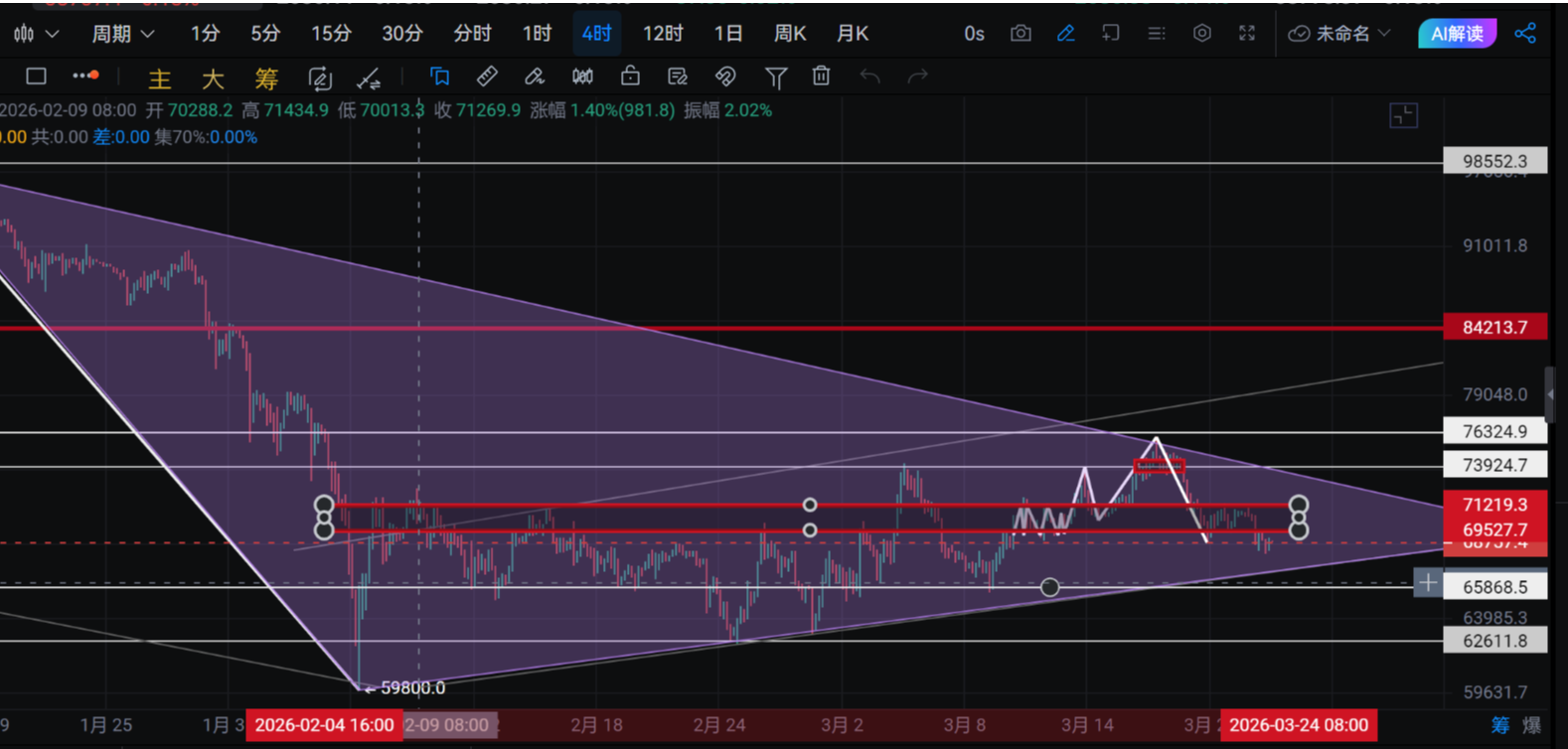
This week, in Eastern Time Zone, the game between the United States and Iran over the Strait of Hormuz escalated once again: the U.S. declared it would strike at Iran's critical infrastructure if necessary, demanding the maintenance of this global energy artery, while Iran responded with a list of retaliatory measures, publicly placing the option to "close the Strait of Hormuz" on the table. If the energy corridor comes under pressure, the risk premium for crude oil and shipping will rise, often pushing global inflation expectations higher, redefining the lines between risk assets and safe-haven assets. In this round of tension, the signal of "attacking IT facilities" in the retaliatory measures, as well as the potential risks of computing power in the Middle East, combined with the anomalous operation of theSIREN token concentration controlling approximately66.5% of the supply, about 1.04 billion U.S. dollars, have made the crypto market alert: if the energy and inflation narrative is reignited, which on-chain assets will become the next haven for risk aversion.
The Chain Reaction of the Strait of Hormuz Being Choked
The direct trigger for the current situation is the U.S. openly threatening to destroy key infrastructure like Iran's power plants while demanding Iran ensure the "absolute smoothness" of the Strait of Hormuz. From the U.S. perspective, controlling energy channels means having dominance over global supply chains and ally security, thus using high-pressure methods to force Iran to "restrain" at this critical point and compress Iran's negotiation space through a show of military strength. However, this deterrence using infrastructure as a bargaining chip itself touches on Iran's security red line, pushing the cost of escalating conflicts to the foreground.
In response, Iran provided a list of "four retaliatory measures" that includes the most symbolic and directly related to the global market: the option to "close the Strait of Hormuz," while also incorporating "attacking IT facilities" into the framework of retaliation. The briefing did not disclose details of the other three measures, but in practical operations, as long as Iran implements military deployments, administrative orders, or high-risk warnings to partially tighten the passage of oil tankers and merchant ships, the market will first react at the expectation level, treating the potential blockade as already starting to be priced in.
Once any degree of blockage occurs at this critical point, the marginal supply of global crude oil and liquefied natural gas will be immediately reassessed by the market. The Strait of Hormuz carries the export capacity of major oil-producing countries in the Middle East to the world, and its risk premium is quickly reflected through oil futures curves, then transmitted downstream through transportation costs and refining costs, eventually manifesting in the prices of industrial and consumer goods. Investors do not need to actually see tankers at a standstill; as long as the "closure risk" narrative is amplified, the insurance rates, hedging costs, and inventory strategies for oil and shipping will change.
U.S. Treasury Secretary Yellen stated, "Sometimes you have to escalate to de-escalate," further proposing the notion of "50 days of rising prices in exchange for 50 years of a non-nuclear Iran" (research brief clearly labeled as a single source). Politically, this line of thinking means: the short-term rise in inflation is seen as an acceptable cost as long as it brings long-term geopolitical advantages. However, from a market perspective, such tolerance of inflation, or even the active acceptance of price shocks signals a recognition that the situation has space for "controlled escalation"—which simultaneously raises the risk of further increases in energy prices and financial asset volatility.
Who Will Cushion the Rise of Oil Prices and Inflation Expectations?
Energy prices are one of the underlying inputs to global inflation. Once crude oil and natural gas prices rise, they first permeate the global trade chain through shipping fuel and land transportation costs, raising costs in segments such as containers, dry bulk, and cold chains, then compounded by refined products entering upstream industries like chemicals, plastics, and fertilizers, layering along the path of "raw materials—intermediate goods—final products." Even if central banks attempt to suppress demand through interest rate hikes, the rigidity of wages and the stickiness of prices for basic necessities will make this round of cost-push inflation difficult to quickly unwind.
In this context, U.S. Treasury Secretary Yellen's statement of "50 days of rising prices in exchange for 50 years of a non-nuclear Iran," even if labeled as a single source, reveals a reality: policy makers exhibit a certain degree of "inflation tolerance" when weighing security and prices. For investors, this implies that traditional inflation-hedging tools (like interest rates) may be partially marginalized in the face of geopolitical security; monetary purchasing power is not an absolute priority against political objectives, exacerbating doubts about the long-term value of fiat currency.
Historical experience shows that when geopolitical conflicts coincide with high inflation expectations, the volatility of traditional assets tends to be amplified synchronously: the stock market will fluctuate under the dual pressure of downgrading earnings expectations and rising discount rates, and the bond market will be constrained by the tug-of-war between inflation expectations and demand for safe assets, showing severe reversals in yield and price in the short term. In such an environment, relying solely on portfolios built from stocks and bonds becomes challenging for true "stability," forcing investors to seek assets that are weakly correlated to sovereign credit and unlinked from the risks of a single economy.
When the purchasing power of fiat currency is continuously eroded under real inflation and policy tolerance, capital typically migrates along two paths: one is towards traditional assets with physical scarcity and global pricing power, such as gold, commodities, and quality energy resources; the other flows to non-sovereign assets, including specific cryptocurrencies, in an attempt to hedge against currency depreciation from a single nation, capital controls, and sanction risks. In this round of resonance between risks in the Strait of Hormuz and inflation expectations, assets like Bitcoin, which are "non-sovereign and globally settled," will naturally be pulled back into the candidates for safe haven assets.
The Resurgence of Safe-Haven Narratives: Can Bitcoin Truly Take the Torch?
In past rounds of geopolitical tension cycles, Bitcoin often sees a simultaneous increase in trading volume and attention at pivotal moments. From emerging markets with substantial capital outflow pressures to regions facing sanction constraints, on-chain funds exhibit strong "local premiums" and buying power during certain periods, forming a classic narrative path of "geopolitical conflict → loss of local currency trust → increased demand for Bitcoin." Although this correlation does not always hold linearly, it has solidified a strong reference in market memory.
The uniqueness of the current U.S.-Iran game lies in how it simultaneously touches upon three main lines: "energy security," "inflation expectations," and "financial sanctions," injecting new fuel into the Bitcoin story of "anti-inflation and anti-sanctions." On one hand, if the U.S. further tightens the dollar channels within the financial system against Iran and its partners, the cross-border settlement attributes of Bitcoin and other on-chain assets will be amplified once more; on the other hand, after the U.S. Treasury publicly releases its tolerance for short-term price shocks, the argument of "using Bitcoin to hedge against long-term inflation" will gain more support, especially under the condition of pressing real yields on traditional bonds.
Compared to gold, Bitcoin possesses intrinsic advantages in liquidity and cross-border transfers: on-chain transfers can circumvent some capital controls and logistics restrictions, achieving minute-level global value transfers, which is particularly prominent under a high-pressure sanction environment. Additionally, the 24-hour continuous trading of the Bitcoin market and its highly decentralized counterparty structure enhance its pricing efficiency during extreme events. However, as a trade-off, Bitcoin faces stricter regulatory scrutiny; KYC/AML requirements and on-chain monitoring are tightening, and its price volatility is much higher than that of gold, with compliance status remaining unstable in some countries.
Therefore, in the narrative of "digital gold" and the risk of short-term volatility, the market's positioning choices will show stratification: some long-term funds may view the current geopolitical and inflation narratives as reasons to increase their Bitcoin holdings, opting to absorb volatility through gradual accumulation and extending holding periods; others may exploit the peaks driven by risk aversion for high-frequency speculation, focusing more on liquidity and derivative leverage opportunities. The final pricing outcome will depend on which segment of capital volume is larger and holds positions longer, as well as whether the U.S.-Iran situation slides from "controlled escalation" to "uncontrolled conflict."
The Landscape of Mining and Computing Power in the Middle East May Be Redrawn
Unlike typical geopolitical conflicts, the current Iranian retaliatory list explicitly mentions "attacking IT facilities," sounding an alarm for mining and data centers in the Middle East region. In Iran and surrounding areas, some Bitcoin mining activities rely on locally relatively low electricity prices and specific policy windows for their survival; once power infrastructure, communication hubs, or data centers become potential targets for strikes, the operational stability of these computing power nodes will face direct threats. Even without substantial damage, just a deterioration in security expectations is enough to prompt miners to reassess the risk-return of "staying local."
The risks posed by the Strait of Hormuz will also affect regional mining costs and long-term planning through energy prices and power supply security. In countries where electricity price structures heavily rely on fossil fuels, rising crude oil and natural gas prices will increase marginal electricity generation costs, while the risk of war will heighten the demand for investment in grid maintenance and backup capacity. For mining operations that rely on large-scale, low-cost operation as their core competitiveness, unstable electricity prices and power supply interruption risks will erode their unit computing power earnings, forcing some mines to consider relocating to jurisdictions with more political and energy stability.
If some computing power in the Middle East is passively taken offline due to infrastructure strikes or cost pressures, the global hash rate and block difficulty will experience periodic fluctuations. In the short term, a decrease in computing power may reduce overall network difficulty, enhancing mining earnings for miners in other regions; in the medium to long term, it may facilitate a redistribution of computing power to regions in the Americas, Europe, Central Asia, or other areas with renewable energy advantages, reinforcing the weight of a few low-risk jurisdictions on the computing power landscape. This increasing geographical concentration, while enhancing operational efficiency, also exposes new systemic risks.
When computing power heavily concentrates in a few countries with stronger regulation and more complete infrastructures, a new tension may arise between the formal decentralization of the Bitcoin network and actual control ownership. On one hand, higher regulatory visibility means mining activities are more susceptible to policy changes, tax adjustments, and even administrative interventions; on the other hand, increasing concentration also makes "collusion of computing power" or "regulation-computing power interaction" potential theoretical risk points. For narratives emphasizing censorship resistance and public goods attributes, this is a long-term game about security, compliance, and decentralization.
The Potential Risk Aversion Sentiment Exposed by SIREN's Whale Movements
In the current atmosphere of geopolitical tension, the on-chain anomalies of the SIREN token are particularly eye-catching: research briefs indicate that its controllers have recently concentrated approximately66.5% of the token supply, corresponding to a market value of about1.04 billion U.S. dollars. Such a high concentration ratio far exceeds the normal operational or liquidity management needs of typical projects; under the premise of being publicly visible on-chain, it has naturally been interpreted by the market as "abnormal operation." Behind this involves not only issues of governance and transparency within the project but also reflects the defensive stance of large funds under the current macro environment.
From a market interpretation perspective, the act of gathering massive tokens from dispersed addresses into a few controlled addresses can be seen as reserving operational space for extreme scenarios: in cases of sudden liquidity drop or price shocks, controllers have higher initiative, whether choosing to strongly protect prices, quickly withdraw liquidity, or implement some degree of "soft reorganization," this is much more operable than when tokens are highly decentralized. In the context of rising geopolitical risks and macroeconomic uncertainties, such arrangements are easily associated with proactive defenses against potential liquidity shocks.
More broadly, the SIREN case also reminds us: during periods of volatility and mixed narratives with mainstream assets, some funds may choose to express their hedging or speculative perspectives through niche tokens or long-tail assets. Some capital may bet on extreme volatility opportunities under "event-driven + liquidity tightening," seeking excess returns by holding high concentration, highelasticity tokens; other funds build more complex hedging combinations on-chain, incorporating such assets into strategy baskets linked to macro events.
However, it is essential to clearly delineate that SIREN's control behavior represents structural risks of the specific token and the gameplay logic of certain funds, rather than reflecting the systemic risk aversion demand of the entire crypto market. The fund flow of Bitcoin, leading public chains, and large stable assets better reflects the real direction of broad risk aversion sentiment. Using the control actions of a single token as a magnifying glass for overall market sentiment will not only exaggerate the importance of specific events but also mislead investors to overlook differences in underlying liquidity and fundamentals.
Investors Seeking Anchors Amid Uncertainty
In conclusion, the escalation of the U.S.-Iran conflict is simultaneously driving four key lines: the energy corridor risk in the Strait of Hormuz raises oil prices and transportation costs, compounded by the U.S. Treasury's signals of inflation tolerance, reigniting global inflation expectations; Iran's option of "attacking IT facilities" puts the mining and computing power security in the Middle East under potential reassessment; against this backdrop, assets like Bitcoin gaining renewed attention as safe-haven narrative assets, while extreme control behaviors of individual tokens like SIREN amplify discussions on "how on-chain funds respond to geopolitical uncertainties" through localized samples.
It must also be emphasized that information on specific military deployments, attack routes, troop scales, and the real-time navigation status of the Strait of Hormuz is highly opaque, with research briefs clearly noting the absence of related details and prohibiting fabrication. The market currently largely bases its actions on "risks and expectations" rather than established facts of blockades and wars, meaning any drastic position adjustments based on single information sources come with a substantial risk of misjudgment. For investors, maintaining sufficient "margin of safety" amidst information noise and emotional volatility is more important than betting on a single extreme scenario.
On the position management and asset allocation front, key indicators to focus on include: the sustained upward momentum of international oil prices and shipping freight indexes, changes in core inflation and inflation expectations for the U.S. and major economies, mid-to-long term trends of global Bitcoin hash rate and block difficulty, and the correlation and price spread structure between Bitcoin and gold. At the same time, observing the on-chain activity of leading crypto assets, net inflows and outflows on exchanges, futures leverage ratios, and financing rates will also help determine whether the safe-haven narrative is merely a short-term emotional trade or represents structural capital migration.
Looking ahead, if the U.S.-Iran situation gradually eases through diplomatic mediation and limited escalation, the risks of closing the Strait of Hormuz may be pushed back to the tail end, and energy prices and inflation expectations may retract some risk premiums, leading to a contraction in Bitcoin's safe-haven premium, with market focus returning to narratives around the halving cycle, regulatory developments, and institutional entries; conversely, if conflicts continue to escalate and come near the line of substantive blockades or large-scale strikes, rising oil prices and renewed inflation will strengthen the allure of "non-sovereign assets," and Bitcoin may gain a higher mid-to-long term pricing center amid sharp fluctuations, while simultaneously enduring a new round of structural risks brought about by tighter regulation and concentrated computing power.
Join our community, let's discuss and get stronger together!
Official Telegram community: https://t.me/aicoincn
AiCoin Chinese Twitter: https://x.com/AiCoinzh
OKX Benefit Group: https://aicoin.com/link/chat?cid=l61eM4owQ
Binance Benefit Group: https://aicoin.com/link/chat?cid=ynr7d1P6Z
免责声明:本文章仅代表作者个人观点,不代表本平台的立场和观点。本文章仅供信息分享,不构成对任何人的任何投资建议。用户与作者之间的任何争议,与本平台无关。如网页中刊载的文章或图片涉及侵权,请提供相关的权利证明和身份证明发送邮件到support@aicoin.com,本平台相关工作人员将会进行核查。