400 million barrels. This is the largest-scale strategic oil reserve release by the 32 member countries of the International Energy Agency (IEA) since its establishment 50 years ago. On March 11, when the IEA announced this decision, Brent crude oil closed at $90.42. Today, 12 days later, oil prices are above $107.
The story begins on February 28. After the United States and Israel launched a joint strike against Iran, Iran threatened to attack tankers passing through the Strait of Hormuz, disabling one of the world's most important oil transport chokepoints. According to IEA data, the current actual flow through the strait is less than 10% of the pre-war level. Brent crude oil skyrocketed from around $65 before the conflict to touch $119.5 on March 9, marking an increase of nearly 80% in just two weeks.
In this context, the IEA deployed its biggest weapon. The question is, why didn't this weapon work?
The Mathematical Illusion of 400 Million Barrels
400 million barrels sounds like a massive number, but when put into context with the gap in the Strait of Hormuz, the proportions are entirely different.
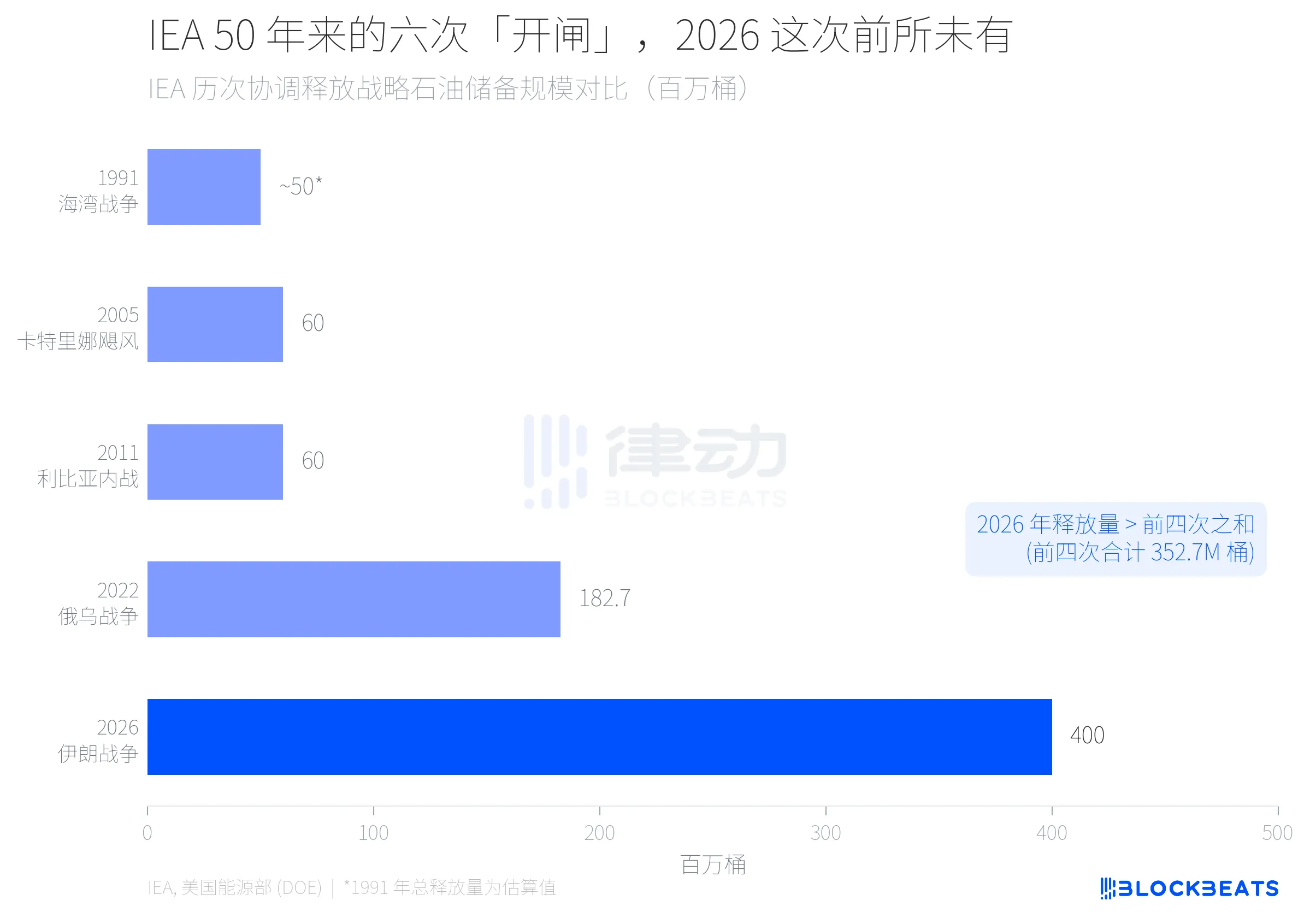
In its 50-year history, the IEA has used its strategic reserves five times before, and this time makes it the sixth. The total amount released in the first four instances was about 352.7 million barrels (50 million barrels during the Gulf War in 1991, 60 million barrels after Hurricane Katrina in 2005, 60 million barrels during the Libyan Civil War in 2011, and 182.7 million barrels due to the Russia-Ukraine war in 2022). This time's 400 million barrels exceeds the total of the first four times combined.
However, scale does not equal sufficiency.
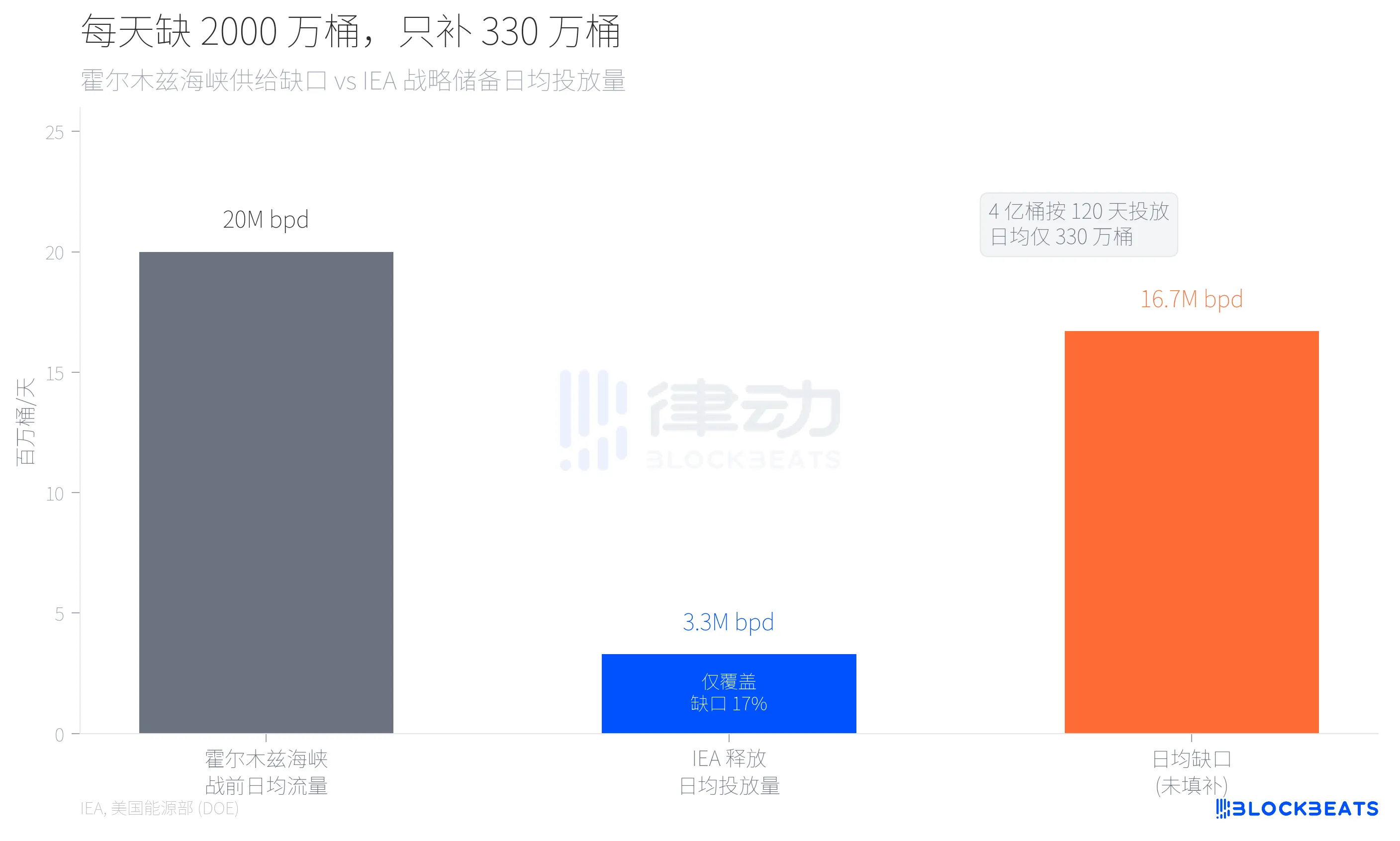
Before the conflict, the daily average transit through the Strait of Hormuz was about 20 million barrels of crude and refined oil, accounting for 25% of global seaborne oil trade. According to an announcement by the U.S. Department of Energy, 172 million barrels will be released within 120 days. Based on this pace, the IEA's total daily release of 400 million barrels is about 3.3 million barrels, covering only 17% of the gap. According to an estimate by JPMorgan cited by Al Jazeera, the maximum production capacity of IEA member countries is also limited to 1.2 million barrels per day, far insufficient to make up for the difference.
Using a more intuitive calculation: According to the IEA's March report, global daily oil consumption is about 103 million barrels. If 400 million barrels were all dumped into the market at once, it would last less than 4 days.
Which Instances of “Opening the Floodgates” Have Actually Worked?
The results of the IEA's five previous reserve releases over its 50 years clearly fall into two categories.
During the Gulf War in 1991, the day the IEA announced the release, oil prices plummeted by about 20%, and the drop reached one-third over the subsequent week. After Hurricane Katrina in 2005, the market also quickly stabilized. A common feature of these two instances is that the source of the supply interruption was being repaired. The onset of airstrikes in the Gulf War indicated that Kuwait's oil fields were likely to recover, and the aftermath of Hurricane Katrina saw refineries gradually resuming operations.
In contrast, 2022 serves as an example. After the outbreak of the Russia-Ukraine war, the IEA released 182.7 million barrels, but Brent crude oil prices did not fall; instead, they rose initially to $113 and took months to slowly decline. The reason is simple: there was no quick prospect for a resolution to the disruption in Russian supply.
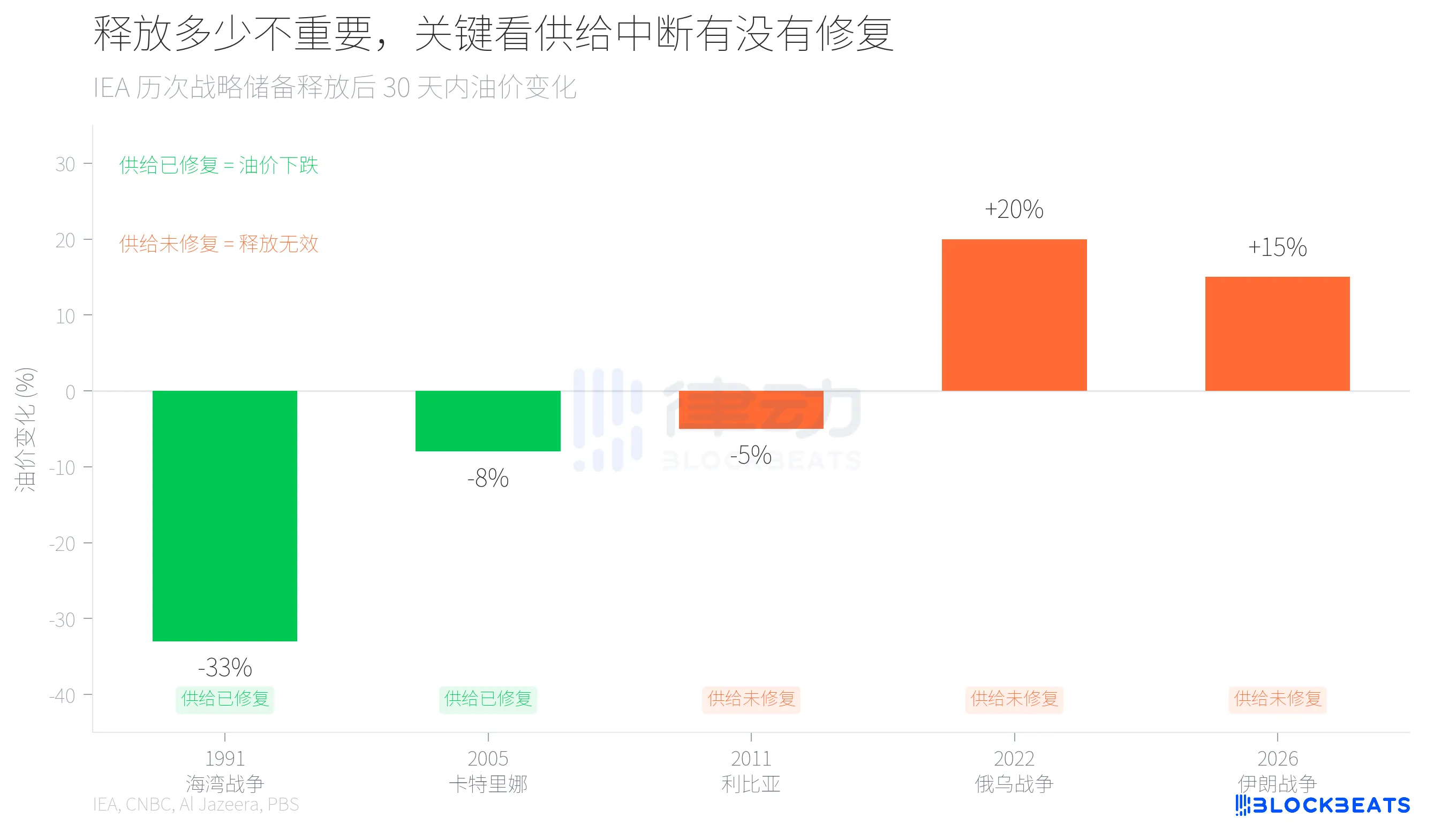
The situation in 2026 is more similar to that of 2022 rather than 1991. The Strait of Hormuz remains in a semi-blocked state, and there are no signs of a ceasefire from Iran. According to an analysis by Stanford University researcher Maksim Sonin quoted by Al Jazeera, “This is not a cure-all; the market trades on expectations, and currently, expectations lean towards concern.” Gregor Semieniuk, an economist at the University of Massachusetts Amherst, more directly points out, “The release can only buy temporary relief; once it’s depleted, the firepower is exhausted.”
What determines the oil price response is not how many barrels were released, but whether the source of the supply disruption has been eliminated. The release of reserves is essentially not about "supplying oil," but about "buying time," using limited ammunition to obtain negotiation windows and flexibility for alternative routes. If time is bought but the source of disruption remains unresolved, oil prices will continue to rise irrespective.
How Much Ammunition is Left?
This leads to a longer-term question: After repeatedly "buying time," is the ammunition stockpile still sufficient?
The U.S. Strategic Petroleum Reserve (SPR) is the largest government emergency oil stockpile in the world. According to data from the U.S. Energy Information Administration (EIA), the SPR peaked at 727 million barrels at the end of 2010. In 2022, in response to skyrocketing oil prices due to the Russia-Ukraine war, the Biden administration released approximately 180 million barrels, reducing the SPR to 347 million barrels by June 2023, the lowest level since 1983. After more than two years of replenishment, it may only recover to about 415 million barrels by March 2026.
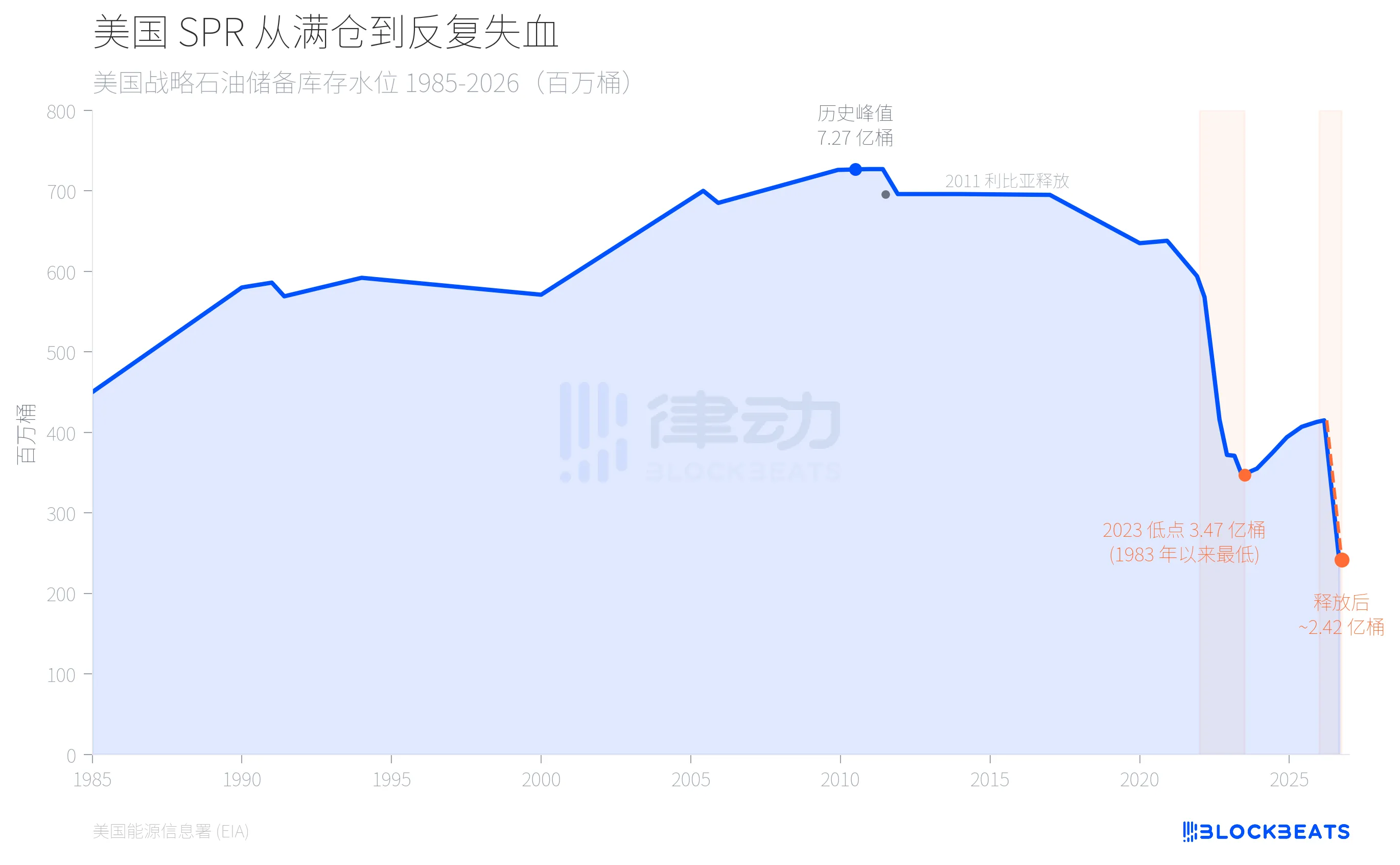
Now, 172 million barrels out of these 415 million are to be released. Following planned execution, the SPR will decline to about 242 million barrels, returning to levels seen in the mid-1980s when the stockpile was first established. The U.S. Department of Energy has pledged to replenish about 200 million barrels within a year after the release, but the last replenishment took over two years to recover from 347 million barrels to 415 million barrels, indicating that replenishment speed clearly cannot keep up with the rate of depletion.
It’s not just the U.S. IEA's 32 member countries collectively held about 1.2 billion barrels of public emergency reserves before this release, with this 400 million barrels directly cutting one-third of the total.
If another supply crisis occurs before the SPR is replenished, will the “last stockpile of ammunition” be sufficient? This question currently has no answer. The market is unwilling to let oil prices drop precisely because it sees this issue.
免责声明:本文章仅代表作者个人观点,不代表本平台的立场和观点。本文章仅供信息分享,不构成对任何人的任何投资建议。用户与作者之间的任何争议,与本平台无关。如网页中刊载的文章或图片涉及侵权,请提供相关的权利证明和身份证明发送邮件到support@aicoin.com,本平台相关工作人员将会进行核查。