Written by: 0xLi Daqi
Introduction: The Media Manifesto of Top Venture Capital in Silicon Valley
In 2026, while the world was still striving to adapt to the profound changes brought by artificial intelligence and decentralized technology, Silicon Valley's top venture capital firm Andreessen Horowitz (a16z) once again set its sights on a field that seemed less directly related to technological investment yet was crucial: media. During an internal all-hands meeting, a16z co-founders Marc Andreessen and Ben Horowitz, along with new media head Erik Torenberg, systematically elaborated their understanding, strategy, and disruptive "offensive" philosophy regarding "new media." This dialogue was not only an internal briefing on a16z's media strategy but also a "new media manifesto" directed at all entrepreneurs, business leaders, and marketers.
As legendary figures in Silicon Valley, Marc Andreessen and Ben Horowitz are renowned not only for their keen investment foresight but also for their willingness to share, think, and summarize, making them thought leaders in the tech industry. From early blog posts to today’s podcast empire, a16z has actively leveraged media to disseminate its investment philosophy, industry insights, and future predictions. This "new media playbook" is a culmination of their years of practical experience, aimed at revealing how organizations and individuals should build their voices and influence in an era of infinite information, exploding channels, and scarce attention.
This article will delve into a16z's key dialogue, aiming to provide readers with a comprehensive analytical report. We will dissect the core concepts of a16z’s new media strategy layer by layer, from the fundamental paradigm shift between old and new media to the core philosophy of "offense over defense," as well as how personal brands can surpass institutional brands, and how spoken culture is revitalized in the digital age. We will also present a clear and systematic view of a16z's media worldview through detailed case studies and comparative tables. This note is not just a record of a conversation but also a profound reflection on how to communicate effectively, build brands, and win the future in today’s complex media environment.
Chapter 1: The Paradigm Shift of Old and New Media: From "Scarcity" to "Infinity"
At the outset of the conversation, Ben Horowitz pointed out the most fundamental difference between old and new media, setting the tone for the entire discussion. He believes that the essence of old media is defense-oriented, while the essence of new media is offense-oriented. This judgment stems from the fundamentally different media environments in which they exist: one is based on "channel scarcity," while the other is based on "channel infinity."
1.1 The "Defense" Dilemma of Old Media
In the era of old media, authoritative information dissemination channels are extremely limited, primarily monopolized by a few mainstream media outlets such as The New York Times, The Wall Street Journal, and CNN. For any organization, whether a startup or a large enterprise, making it onto the pages of these media is a success in itself. However, this scarcity also brings significant risks and constraints.
"We spent years worrying about our performance being leaked... Old media tries to please every audience. Old media is afraid of offending people." — Ben Horowitz
Horowitz recounted an early "crisis" at a16z: an internal performance report was leaked to The New York Times. Due to the nature of venture capital, a newly established fund typically does not demonstrate high early returns, but this was misinterpreted by the media as "the fund performing poorly." Although a16z made various efforts to clarify, under the powerful discourse of authoritative media at the time, these arguments had little effect. This incident deeply made a16z realize the "defense" logic of old media:
- Fear of misunderstanding: Due to the singular and authoritative channels, once negative or inaccurate information is published, there are almost no effective channels to refute or correct. The power of disseminating corrected information is far less than that of the initial report, leading to permanent "harm."
- Pursuit of "not offending anyone": To avoid potential negative coverage, organizations tend to adopt extremely conservative communication strategies. CEOs often aim in public settings to "not say anything that could become news," taking pride in "zero news." This strategy results in a corporate image that becomes clichéd and dull.
- Abstract corporate brand: The focus of communication is on maintaining an abstract, perfect "Corporate Brand," such as General Electric (GE) or IBM. The brand is separated from the people behind it, filled with a sense of "plasticity" and "synthetic nature," lacking the warmth and authenticity of human beings.
The essence of this defensive strategy is to try to minimize risks in a limited and uncontrollable public opinion arena. The result is that the organization's voice is suppressed, individuality is smoothed out, and ultimately, it becomes indistinct in the ocean of information.
1.2 The "Offensive" Opportunities of New Media
The rise of the internet, especially social media and podcasts, has completely disrupted the channel monopoly of old media. Marc Andreessen pointed out that the once narrow media funnel has been "shattered." This creates the possibility for a brand new "offensive" media strategy.
The "offensive" logic of new media is built on several core changes:
- Infinite channels: Anyone can create their own podcast, blog, or social media account, reaching audiences directly. If a16z were to face a similar "performance leak" crisis today, Marc and Ben could quickly appear on 30 different podcasts, each potentially reaching a larger audience than mainstream newspapers did back in the day. They might not even need to respond directly but could shift public attention by discussing more interesting topics, known as "flood the zone."
- "Interesting" is more important than "harmless": In an environment of information explosion, attention becomes the most scarce resource. A boring, dull brand cannot gain any attention. In contrast, a brand that is interesting, opinionated, or even controversial can stand out. New media does not care about pleasing everyone; it only cares about being "interesting."
- Speed and authenticity replace "polishing" and "caution": The publishing process of old media is lengthy and bureaucratic, aiming for "flawless" content. In contrast, new media moves at a rapid pace, emphasizing quick responses and genuine expressions. Speed and authenticity constitute the core competitiveness of the new media era.
1.3 Comparative Analysis of Core Characteristics of Old and New Media
To understand this paradigm shift more clearly, we can summarize the differences in core characteristics of old and new media in the following table:
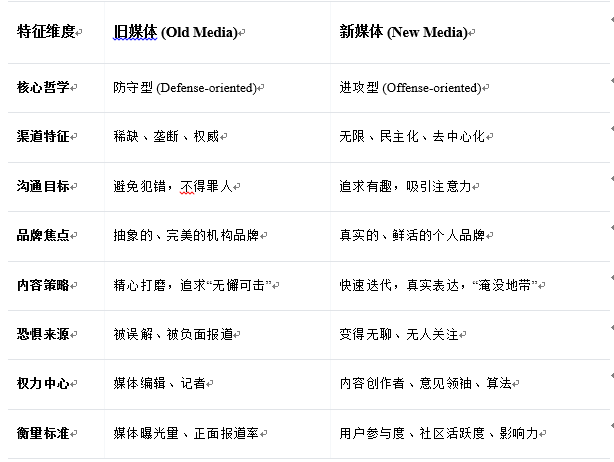
This transition from "defense" to "offense" is not merely a tactical adjustment but a fundamental re-understanding of media, brands, and the essence of influence. a16z's choice is to fully embrace the new world, abandoning the struggle under old rules, because "the entire movement mode of the old world will kill you in the new world, and vice versa." This lays the groundwork for our understanding of their more specific strategies, such as "offense over defense" and "founders as brands."
Chapter 2: "Offense Over Defense": The Survival Rule of New Media
"In new media, offense is always better than defense." Ben Horowitz's assertion is the core of a16z's new media strategy and the most thorough subversion of old world rules. This chapter will delve into three key pillars of the "offensive" strategy: redefining risk, mastering narrative ownership, and leveraging long content to build deep moats.
2.1 Redefining "Risk": From "Fear of Misunderstanding" to "Fear of Being Forgotten"
In the logic of old media, the greatest risk is being "misunderstood" or subjected to negative reporting by mainstream media. An aggressive headline or a misinterpreted article can put an organization in a "survival crisis." Thus, institutions choose to be overly cautious, striving for "flawlessness," and the core of their communication strategy is risk avoidance.
However, in the infinite channel environment of new media, the game has changed. a16z believes that today’s greatest risk is not "being controversial" but "being forgotten." In a world of information overload and scarce attention, being boring equals death. A brand that fails to pique anyone's interest, even if it is flawless, holds no value.
"Old media fears offending people, while new media only cares about whether it's interesting enough."
This shift means that organizations must transition from pursuing "not making mistakes" to striving for "being noticed." Being interesting, opinionated, having personality, and even the occasional controversy becomes essential elements to stand out in a noisy market. As Erik Torenberg said, if you are strong and interesting enough, you inevitably will spark controversy. This is no longer a risk to be avoided but a sign of success, evidence of "power and influence." This shift in mindset forms the psychological basis for adopting an "offensive" media strategy.
2.2 "Flood the Zone": Mastering Narrative Ownership
"Flood the zone" is one of the most actionable tactics in a16z's "offensive" strategy. It means that when facing potential negative public opinion, the best course of action is not to engage in point-to-point defensive responses but to proactively and massively create and disseminate more and more interesting content to divert public attention elsewhere.
The effectiveness of this tactic is based on two features of new media:
- The brevity of attention: Marc Andreessen introduced the concept of "The Current Thing." The focus of online public opinion shifts at lightning speed; a crisis that appears monumental today may be displaced by a new "Current Thing" within 24 hours. This means that the influence of any individual negative event is quite limited in duration.
- Channel autonomy: Unlike in the old media era, where one must rely on third-party journalists, a16z can now initiate new topics anytime through its own podcast, social media matrix, etc. They possess the initiative and control to publish content.
Ben Horowitz provides a vivid description: if a performance leak like the one from before occurred today, he and Marc could immediately appear on 30 podcasts discussing topics far more interesting than dreary financial reports, such as the future of artificial intelligence or the next technological wave. In this way, they can quickly "cover up negative information with more interesting information," effectively "erasing that incident from everyone's memory." This is a high-dimensional attack on a low-dimensional problem, creatively resolving the defensive predicament through offense.
2.3 The Power of Long Content: Using Context to Counter Misinterpretation
Another core of the offensive strategy is effectively utilizing long content to build a "moat" for thoughts. Marc Andreessen shared an important piece of advice Ben Horowitz gave him: "Put all your ideas out there, but do it in a podcast or write it in an article."
This reflects profound insight into the properties of different media forms:
- The risks of short content (like tweets): While disseminating quickly, it is highly susceptible to misinterpretation. Expressing a complex idea in 140 or 280 characters almost inevitably loses context, leaving vast room for "misunderstanding" and "attack." Andreessen admits that almost all "big trouble" he has encountered in public over the past ten years has stemmed from tweets.
- The defensiveness of long content (like podcasts, long articles): An hour-long podcast or thousands of words in an article allows creators to elaborate their ideas, logic, and background fully and systematically. When a viewpoint is presented within complete context, it is difficult to be maliciously distorted. Even if someone tries to misinterpret it, audiences who have listened to the entire podcast or read the full article can easily detect this.
Therefore, consistently outputting long content is itself a powerful form of "offense," providing a necessary protective layer for the dissemination of ideas. This explains why a16z invests heavily in building its podcast and content platforms. They are not merely creating content but are building a solid, hard-to-attack public opinion stronghold for their views and portfolio companies.
Chapter 3: The Rise of Personal Brands: "Founders as Company"
If "offense over defense" is the strategic core of a16z, then "the rise of personal brands" is the organizational and cultural foundation that implements this strategy. Marc Andreessen explicitly states that the old brand model based on abstract institutions is outdated; the future belongs to brands driven by vibrant, real individuals.
3.1 From Abstract "Company" to Concrete "Person"
Andreessen reflects on the past 80 years of "synthetic, plastic, and boring" business communication. In this era, mainstream thought posited that the corporate brand should be a symbol independent of its employees and leaders. The CEO's job was to "refine" this symbol, acting as a flawless "spokesperson" in public, with the ultimate achievement being "not generating any news."
However, the foundation of this model—the narrow communication channel—has been obliterated by the internet. In the new media era, the public longs to hear the voice of decision-makers themselves.
When leaders like Elon Musk express their thoughts directly, unfiltered, on social media, the world is shaken. People's reactions shifted from "How can he say that?" to "Why can't we just hear what they are really thinking?" This direct communication breaks the barriers between institutions and the public, bringing an unprecedented sense of authenticity and closeness. While this does not mean the world will become 100% better, Andreessen firmly believes this represents a significant "net gain."
3.2 "Joe Rogan CEO": A Portrait of the New Generation of Leaders
As the importance of personal brands becomes increasingly prominent, the demands on business leaders have fundamentally changed. Erik Torenberg references the concept of "Joe Rogan CEO" to depict the ideal image of a new generation of leaders. This means a CEO must be interesting and profound enough to hold forth on Joe Rogan's podcast for three hours, as compelling as Alex Karp (Palantir) or Palmer Luckey (Anduril).
This contrasts sharply with the "professional manager CEO" of the olden days. The latter often ascended through cautious office politics, with their core competency being "not offending anyone" and "not making mistakes." Large company boards focusing on choosing CEOs were more concerned with "what flaws he has" rather than "what strengths he has." This selection mechanism inevitably produces a cohort of "vanilla" leaders who would never appear on Joe Rogan's show.
In contrast, most of a16z's investments are in "Founder CEOs." Founders inherently possess the potential of "Joe Rogan CEOs" because:
- They have original ideas: Entrepreneurship springs from a distinct, original thought, which is the natural source of being "interesting."
- They embody the company's vision: They possess the deepest understanding and the most genuine passion for their company's products, technology, and mission, making their narratives the most impactful.
Thus, a16z's new media strategy fundamentally revolves around empowering these Founder CEOs, helping them maximize the conversion of their personal charisma and influence into the brand assets and competitive advantages of their companies. For example, they promote pragmatists like Garrett Langley, the founder of Flock Safety, to the forefront, aiding them in establishing industry influence comparable to that of Anduril.
3.3 a16z's Practices: Systematic Empowerment of Founders
a16z not only advocates for personal brands theoretically but also develops it into a systematic service known as the "Founder Go Direct" initiative. They recognized that relying solely on marketing teams is insufficient; influence must originate from the CEO themselves.
Their specific practices include:
- Close mentoring: Working directly with founders to help them establish their personal voices on social media (particularly on X platform). They successfully pushed the founder of Applied Intuition, Qasar Younis, to publish his first tweet, garnering over 4000 likes, a typical success story.
- "Launch as a Service": Providing a full suite of media services for product launches or funding announcements of portfolio companies, including information strategy, social media copywriting, viral video production, and multi-channel distribution. They have hired a "new media native" like Richard, an 18-year-old genius video producer, to ensure the content has cutting-edge "taste" and "virality."
- Talent cultivation: To address the scarcity of new media talent, a16z established the "New Media Fellowship" program to discover and cultivate Generation Z talents who understand internet culture and possess professional competence, feeding them into their teams and portfolio companies.
Through these initiatives, a16z is turning the idea of "founders as companies" from an observed trend into a replicable, scalable core competency, empowering its portfolio to gain an advantage in the new media battlefield.
Chapter 4: The Operating Mechanism of New Media: Oral Culture, OODA Loop, and Viral传播
After establishing the core ideas of "offense over defense" and "founders as brands," a16z's discussion further delves into the underlying mechanisms that enable new media to operate. Marc Andreessen introduces three key theoretical tools—oral culture and written culture, the OODA loop, and the theory of "viral posts"—to provide deep insights into the dynamics of new media dissemination.
4.1 The Digital Renaissance of Oral Culture and Written Culture
Andreessen employs media theory to categorize human communication patterns into two categories:
- Oral Culture: This is the most primitive mode of human communication, such as storytelling and singing around a campfire. Its characteristics include emotional prioritization, immediate interaction, and infectivity.
- Written Culture: This arose with the invention of writing and the printing press, reflecting books and scientific papers. Its characteristics include abstraction, logic, rigor, and reflection.
In the old media era, there was a clear corresponding relationship between these two cultures and media forms: television was a typical carrier of oral culture, filled with emotion and imagery; while newspapers and magazines represented written culture, relatively calm and detached. However, the emergence of the internet has broken this one-to-one correspondence, creating a complex ecosystem in which oral and written cultures coexist and merge.
Andreessen provides a sharp analysis of this:
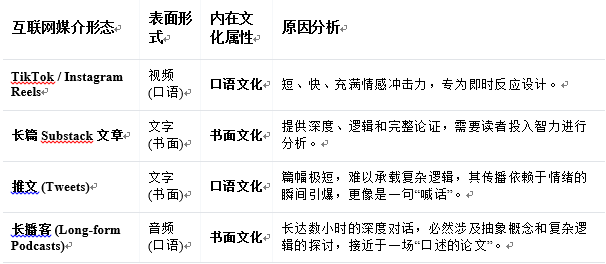
The value of this insight lies in revealing that we cannot formulate content strategies merely based on the superficial forms of media. A successful media strategy must understand the "cultural attributes" behind each form and adjust communication accordingly. To spark rapid emotional resonance, one should adopt "oral culture" strategies; to establish deep thought leadership, one must invest in written culture creation. a16z's efforts in short videos, X platform, and long podcasts exemplify this mixed strategy.
4.2 OODA Loop: Gaining an Edge in Information Warfare
To explain the extreme importance of speed in new media strategies, Andreessen introduces the OODA Loop theory proposed by John Boyd, a U.S. Air Force fighter pilot. OODA is an acronym for a complete decision-making cycle:
- Observe: Perceiving changes in the external environment.
- Orient: Analyzing information and determining one's position in the environment.
- Decide: Deciding how to act.
- Act: Executing the decision.
Boyd argued that in confrontations, victory goes to the side that can complete the OODA loop faster. More importantly, if you can continuously make decisions faster than your opponents, you can "get inside" their loop. This means that when your actions have altered the battlefield environment, your opponent is still making decisions based on outdated information. They will have to interrupt their loop, start observing and orienting anew, thereby entering a state of perpetual passivity. Eventually, this sustained disruption can lead to their psychological breakdown.
Andreessen believes this perfectly explains the predicament of traditional media in the face of the internet. The speed of online public opinion generation and iteration (measured in hours or even minutes) far surpasses traditional media's 24-hour publication cycle. When newspapers are still discussing yesterday's "viral post," the internet has already moved on to the next topic. Traditional media has completely lost its agenda-setting ability, falling into a perpetual "catch-up" state, and its practitioners' frustration and anger stem from this.
This theory suggests to businesses that speed is everything. An organization capable of achieving "rapid response" can take the initiative in today’s information warfare. This requires organizations to be flat, willing to take risks, and willing to empower frontline teams. The newly established media team at a16z is structured around the core principle of "speed."
4.3 "Everything is a Viral Post": The Native Form of the Internet
Finally, Andreessen applies Marshall McLuhan’s theory of "the medium is the message" to the internet, positing a core assertion: "If it’s on TV, it’s a TV program; if it’s on the internet, it’s a viral post."
He believes that "viral posts" are the native content form of the internet. Whether it’s a tweet, a TikTok video, or a YouTube short, its ultimate vitality depends on whether it can achieve "viral dissemination." This dissemination has two distinctive characteristics:
- Emotion-driven: Viral content almost always evokes strong emotions, whether positive or negative. It must "get people cranked up."
- Extremely short lifespan: A viral post typically peaks within 12 hours and then rapidly declines within 24-36 hours, replaced by the next "Current Thing."
This observation leads to an important tactical inference: any single crisis or negative event has an extremely short lifecycle. As long as you can create the next "viral post," you can effectively cover up the previous one. This again confirms the effectiveness of the "flood the zone" strategy and explains why, in the new media era, "defense" is futile—because your defensive target will soon become outdated.
Chapter 5: Building a16z's New Media Machine: Talent, Platform, and Product
The sophistication of theory ultimately needs to be manifested through strong execution capabilities. a16z not only proposed a disruptive new media theory but also invested substantial resources to build a meticulous and efficient "new media machine." This chapter will analyze the three core components of this machine: talent strategy, platform strategy, and productized services.
5.1 Talent Strategy: Finding the "New Media Natives"
a16z deeply recognizes that the key to success in new media lies in "people." Their talent strategy is centered around finding "new media natives" who truly understand the platform's "vibe" and "taste."
"We really ensure that the people we hire truly understand the platform—not just technically how it operates but also the vibe, taste, and spirit of the platform." — Erik Torenberg
This has led to an unconventional view of talent:
- Redefining experience: They hired 18-year-old Instagram expert Hero because he "grew up on Instagram and knows it like the back of his hand." They persuaded another 18-year-old genius video producer, Richard, to drop out of college and join a16z directly. Here, the "native fluency" for platforms is more important than traditional credentials.
- Seeking "both online and professional" rare talent: a16z discovered that the most scarce talent in the market are those who are deeply immersed in internet culture (sufficiently "online") and yet possess professional skills required to work in institutional settings (sufficiently "professional"). These two traits are often contradictory.
- Founded the "New Media Fellowship": To systematically address talent bottlenecks, a16z launched the "New Media Fellowship" program, which received 2000 applications and ultimately accepted 65 individuals. Its aim is not only to recruit talent for a16z but also to nurture and funnel a new generation of media operators into the entire investment ecosystem.
5.2 Platform Strategy: Camping Where the Conversation Happens
a16z's platform strategy is highly focused and strategic. They chose to allocate early resources predominantly to the X platform (formerly Twitter) because:
"The vast majority of our world lives on X. Whether you like it or not, our world exists on X because it's also where all... AI researchers and AI influencers, cryptocurrency influencers are. Everyone in our world is there." — Marc Andreessen
They believe X is the primary battleground for the formation and dissemination of cutting-edge ideas and the core arena for "knowledge synthesis businesses". For a venture capital firm focused on frontier technology investments, winning on X means gaining narrative authority within core circles. Simultaneously, they also recognize the immense potential of TikTok and Instagram in reaching the mass market and have equipped these platforms with specialized expert teams. This layered, focused platform strategy ensures that their voice can impact core elites while covering a broad audience at the same time.
5.3 Productized Services: Empowering the Portfolio with Media Capabilities
The ultimate goal of a16z's new media team is not just to build its own brand but to productize its media capabilities, empowering the hundreds of companies in which it invests with "superpowers."
They launched two core service products:
- "Launch as a Service": This is a one-stop media ignition service for significant announcements (such as product launches and funding announcements) of portfolio companies. It includes information strategy, copywriting, viral video production, and multi-channel distribution. The goal is to "guarantee a viral launch." This service has achieved remarkable success, bringing millions of views to multiple companies.
- "Founder Go Direct": This is a deeper embedded service designed to help Founder CEOs build and operate their personal brands and create sustainable media influence. a16z firmly believes the strongest voice must come from the CEO themselves; therefore, this service requires the deep involvement of CEOs. They have worked with founders like those of Applied Intuition and Flock Safety, helping them build personal influence from scratch with significant results.
By encapsulating media capabilities into standardized products, a16z is systematically enhancing the "media combat power" of its entire portfolio, constituting a deep moat in its post-investment services.
Conclusion: A Media Revolution Still Unfolding
a16z's "New Media Playbook" is not only a tactical manual but also a profound declaration about how power, discourse, and influence operate in the 21st century. It marks a fundamental shift from one-way broadcasting to multi-directional dialogue, from institutional mouthpieces to personal voices, and from the pursuit of perfection to an embrace of authenticity. This internal conversation articulated by the founders of a16z paints a clear picture of the future, with core ideas summarizing as follows:
- Strategically, embrace "offense": abandon the defensive posture under old rules and take the initiative by flooding the zone with interesting and valuable content, mastering narrative ownership. Recognize that in the new media era, the greatest risk is becoming boring and being forgotten.
- Organizationally, bet on "individuals": recognize that the core of the brand is people, especially founders. Systematically empower founders to become the company's most powerful "chief media officers," directly engaging with the world.
- Tactically, master "tools": deeply understand the "cultural attributes" of different media, skillfully apply the OODA loop theory to pursue ultimate speed, and grasp the inherent patterns of "viral dissemination."
However, as Ben Horowitz warned at the end, this transition is extremely challenging, as it requires us to "rethink every instinct you have," since intuitions formed under the old media regime "are all wrong." This requires enormous courage and determination to "let everything go."
At the same time, a16z is also acutely aware that new media is not a utopia. Marc Andreessen referred to the book "Kill All Normies," pointing out the deeply ingrained "anger currents" and "aggressive culture" flowing from gaming communities in internet culture. While enjoying the direct communication dividends brought by new media, how to cope with negative emotions in the "comment section" and online violence is a challenge that every participant must face.
Nonetheless, a16z's choice is clear and resolute: fully embrace the new world and commit to mastering its operational laws. What they are building is not just an investment company but a strong media empire, a thought engine capable of shaping the technology agenda and empowering the next generation of disruptors. This "New Media Playbook" is the ultimate call to all individuals and institutions wishing to establish influence and tell their stories in the digital age: stop defending and start attacking. This revolution has just begun.
免责声明:本文章仅代表作者个人观点,不代表本平台的立场和观点。本文章仅供信息分享,不构成对任何人的任何投资建议。用户与作者之间的任何争议,与本平台无关。如网页中刊载的文章或图片涉及侵权,请提供相关的权利证明和身份证明发送邮件到support@aicoin.com,本平台相关工作人员将会进行核查。