Written by: Xiaoza Law Team
I. Introduction
Recently, the Shanghai High People's Court released the "Guidelines for Regulating the Execution Work of Online Virtual Property (Trial)" (hereinafter referred to as "work guidelines"), with the main purpose of addressing the execution work related to virtual property in practice by the courts in Shanghai,accurately defining virtual currency and clarifying the norms of investigation, control, disposition, and other execution processes.
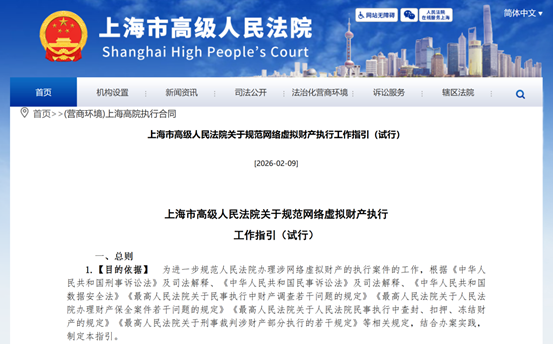
Today, the Xiaoza team will chat with old friends in the crypto circle about the impact of the release of the work guidelines on potential lawsuits in the future. What should be noted under different identities during the execution phase? Let’s unfold these points step by step below.
II. Why Did the Shanghai High Court Release the Work Guidelines?
First, it is necessary to legally characterize this document.
Official legal sources include the constitution, laws, administrative regulations, local regulations, and rules, which have clear legal effect and are binding. Local judicial documents (such as "guiding opinions" or "regulations" issued by local people's courts and people's procuratorates) are not formulated by legislative organs or the highest judicial authorities, hence they do not have formal legal effect and do not belong to formal legal sources.
The work guidelines, as local judicial documents, assist local courts in Shanghai in applying the law in cases involving virtual property, helping to unify standards which the courts in Shanghai will reference in practice.
In other regions like Zhejiang, Beijing, and Guangdong, which also involve many virtual assets, the execution phase cannot reference the work guidelines, but it can be said that the work guidelines released by the Shanghai High Court lay the foundation for future legal norms regarding the execution of virtual property.
Secondly, previously, the central bank and eight ministries jointly issued the "Notice on Further Preventing and Handling Risks Related to Virtual Currencies," defining virtual currency. This time, as a judicial authority, the Shanghai High Court defined virtual currency, private keys, mnemonic phrases, and cold wallets, clearly stating that virtual currency is executable property, resolving previous ambiguous debates about it.
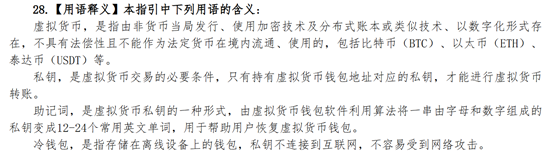
The general principles section of the work guidelines also provides a more intuitive explanation for the purpose of the document. Whether in various stages of civil litigation preservation, civil execution, or criminal execution, as well as property investigation, execution control, and liquidation matters, the work guidelines can be referenced to carry out corresponding execution work.
III. What Problems Can the Release of the Work Guidelines Solve?
In practice, what troubles execution judges the most is how to conduct property investigations when parties provide preliminary clues about virtual currency. How to execute control? How to liquidate and dispose? The answers cannot be found in any previous normative documents.
Based on the principle of "doing more leads to more mistakes, doing less leads to fewer mistakes, better to seal less than to seal incorrectly," execution judges generally refuse to take enforcement measures, often using peculiar reasons like virtual currency being legally unprotected, lacking corresponding legal norms, high execution difficulty, etc. The Xiaoza team has encountered this in practice, where they ultimately refuse to take enforcement measures, and may not even proceed to communicate about liquidation and disposal.
This situation leads to seasoned professionals in the crypto circle exhausting themselves to provide various clues about virtual currency, only to have those efforts amount to nothing. Ultimately, they see the counterpart randomly transferring virtual currencies on the transparent blockchain but feel powerless.
The second part of the work guidelines regarding property investigations is also of great concern to partners, as it is crucial to convince judges to agree to investigate virtual currencies.
The work guidelines clarify that the applicant for enforcement has the right to provide clues about virtual currency property, and limits the timeframe for court investigation and verification, addressing the issue of judges being "too busy" in practice. Generally, it is limited to within 7 days, and in emergency situations, it is limited to 3 days, to promptly feedback investigation results to the applicant for enforcement.
In addition to passively receiving clues, the court can also proactively inquire by its authority or take measures such as searching and summoning the judgment debtor. In cases of refusal to cooperate, the court can pursue criminal liability for failing to declare property statuses or assist in investigation and control. This will greatly enhance the possibility of obtaining the judgment debtor's virtual currencies, breaking through the anonymity of virtual currencies.
For this new era product of virtual property, more rights need to be granted to courts to allow judges to "act boldly." Likewise, if rights are not restricted, judicial authorities will sooner or later encounter cases like the stealing of coins by a certain investigator in Hunan (see previous public account: The Black and White of Criminal Cases in the Crypto Circle: What Crimes Apply to Investigators Who "Steal Coins"?).
The work guidelines clarify the working norms for enforcement personnel, stating that the seizure of virtual currencies must be reviewed by the head of the enforcement bureau of the court and approved by the president of the court, with the holder's wallet and centralized exchange addresses transferred to a cold wallet specially established by the people's court for storage. If necessary, third parties can be entrusted for assistance in custody.
Enforcement personnel are strictly prohibited from storing private keys (or mnemonic phrases) on internet devices, in any cold wallet devices affecting the safety of virtual currencies, or unauthorized usage of private keys (or mnemonic phrases) to log into involved virtual currency wallets. Any work-related secrets obtained in processing cases involving virtual currencies must be kept confidential. Otherwise, enforcement personnel will also be held accountable according to law and discipline.
IV. What Are the "Gaps" in the Work Guidelines?
Based on the Xiaoza team's practical experience in handling crypto-related cases, the courts in Shanghai will standardize the execution norms for virtual currencies, but new problems will still emerge in subsequent cases.
When the applicant for enforcement provides clues related to virtual currencies, under what circumstances will it be deemed clear and specific? Whether the blockchain address needs to be verified through the judgment debtor or obtain the address KYC information, or whether there is objective evidence of actual control over the address by the judgment debtor, this is evidently somewhat difficult for the applicant. If the applicant only provides the public key, how will the execution judge conduct a property investigation...
After the execution judge clarifies the property information, how to establish a trust mechanism between judicial authorities and foreign exchanges that can verify both parties' identity information while preventing the leakage of state secrets and execution work secrets? In practice, enforcement requests are usually submitted through email correspondence or information filling on the official websites of foreign exchanges for freezing or sealing, but there are embarrassing issues such as enforcement personnel being cautious about leaking personal information when needing to upload work credentials, or judicial authorities lacking external email options, resulting in an inability for both parties to establish contact. Additionally, if foreign exchanges refuse to cooperate or the process takes too long, what recourse measures are available to judicial authorities, which is another problem encountered in practice...
Final Thoughts
The release of the work guidelines standardizes the handling of virtual currency enforcement cases by the courts in Shanghai, making the rights of applicants for enforcement and the obligations of the courts clearer. However, the road ahead is still long; with the increasing number of people understanding and applying virtual currencies, judicial documents must also keep pace.
The spring of applicants for enforcement will eventually come!
That is the Xiaoza team's share for today, grateful to the readers.
免责声明:本文章仅代表作者个人观点,不代表本平台的立场和观点。本文章仅供信息分享,不构成对任何人的任何投资建议。用户与作者之间的任何争议,与本平台无关。如网页中刊载的文章或图片涉及侵权,请提供相关的权利证明和身份证明发送邮件到support@aicoin.com,本平台相关工作人员将会进行核查。


