In the late March timeframe of the East Eight Time Zone, amid a backdrop of consecutive attacks on U.S. military bases and Israeli targets and signals from the Iranian military regarding a "new operation with significant effects," Tehran publicly denied all rumors about U.S.-Iran negotiations. Iranian Speaker Ghalibaf pointedly indicated that these so-called "meeting reports" were fake news, deliberately used to manipulate financial and oil markets, drawing global attention. At the same time, a cryptocurrency named BTR experienced a price drop of over 80% within 24 hours according to a single data source, plunging to about 0.039 USD, becoming an extreme example under this geopolitical storm. The escalation of U.S.-Iran conflicts, the public opinion battles over negotiations, and the fake news accusations together form the backdrop of a critical question: to what extent has the volatility in the cryptocurrency market been amplified as the narrative defense and attack in the Middle East intertwine, and who is being used, and who is attempting to manipulate?
Denial of Negotiations and Missile Launches: The Dual Battlefield of U.S.-Iran Tensions
At a tense moment when U.S. military targets related to Israel were under attack, Iranian Speaker Ghalibaf sent out a very tough political signal. He publicly stated, “Iran will not negotiate with the United States, and the related fake news is used to manipulate financial and oil markets.” This statement categorizes the previously circulating reports of "U.S.-Iran contacts" and "secret meetings" as carefully designed tools of public opinion warfare, rather than a true reflection of diplomatic progress, effectively closing off external speculation regarding short-term easing signs.
Almost simultaneously, there was an escalation on the battlefield level. According to public reports, the Islamic Revolutionary Guard Corps launched a new round of attacks on Israeli targets and U.S. military bases in the Middle East, turning geopolitical tensions into fire and explosions using missiles and drones. The military presence and friction around the Strait of Hormuz are already highly sensitive, and such strikes have intensified external perceptions of "continued escalation," naturally raising the risk premium in energy and financial assets.
In this context, the Iranian military further hinted at "new military actions with significant effects," but did not provide any verifiable details. This deliberately withheld ambiguity makes it difficult for the market to judge the specific direction of the conflict, but greatly widens the imaginative space: all scenarios from limited retaliation to regional escalation have been passively incorporated into the pricing scope by investors. The result is that risk cannot be quantified and must be covered through a higher risk discount to account for uncertainty.
Military strikes and tough statements are nested within each other, while the U.S. and Israel's responses, warnings, and defensive deployments constitute another side of the public opinion and action circuitry. While missiles fly through the air, expressions about "red lines," "deterrence," and "consequences at your own risk" repeatedly echo in the media. The mutual constraint between U.S. and Iranian firepower and rhetoric sows the seeds for subsequent financial market sentiment fluctuations—any fragmentary news that seems to indicate easing or escalation could be magnified into a trigger point for severe price fluctuations.
Fake News as a Weapon: The Pull from Meeting Rumors to Price Expectations
On the narrative level, the public statements within Iran themselves contain tension. On one hand, Speaker Ghalibaf delineates a political red line with "no negotiations," even accusing relevant reports of being "fake news" used to manipulate markets; on the other hand, a senior Iranian official reveals that “the U.S. has requested to meet with the Iranian Speaker, but the Supreme National Security Council has not yet considered it.” The former views negotiation rumors as tools wielded by external players, while the latter admits "the request does indeed exist but has not yet entered the decision-making process." The gap between the two creates a blurred area for market narratives.
The logic behind Iran's accusations is not complicated: in a highly financialized global system, a news piece regarding "tension easing" or "sanctions relaxation" is enough to sway short-term capital's expectations towards crude oil, regional assets, or even the local currency. From Tehran's perspective, if news about "U.S.-Iran negotiations about to begin" or "both sides seeking a ceasefire" is released prematurely, it could undermine oil prices and disrupt financial markets in a short period, thus providing arbitrage opportunities for underlying holders. In other words, information itself is utilized as a weapon, indirectly manipulating prices by creating expectations and shifting winds.
In scenes of geopolitical conflict, such tactics are not uncommon. Whether it is optimistic signals about "upcoming ceasefires," or tough posturing on "expanding sanctions," as long as it is announced ahead of real decisions or has never officially been on the agenda, it can create exploratory shocks to the market. Some participants may preemptively build or close positions and then release fragmented narratives through media channels such as "negotiations," "ceasefire," "production cuts," or "increased sanctions," causing prices to undergo a severe back-and-forth, ultimately retreating smoothly when denials or clarifications surface.
For most investors far from the Middle East, the real decision-making channels and communication channels are highly opaque. Besides sporadic official statements and anonymous quotes, it is hard to access complete information. Therefore, any seemingly authoritative claim may be overvalued: a report about a meeting could be interpreted as "easing imminent," while a tough denial may be seen as a prelude to "further confrontation." Under this asymmetry, emotional trading is amplified, with prices sensitive to facts and more susceptible to narratives.
BTR Crashes by 80%: Geopolitical Rumors and the Fragile Structure of Small Tokens
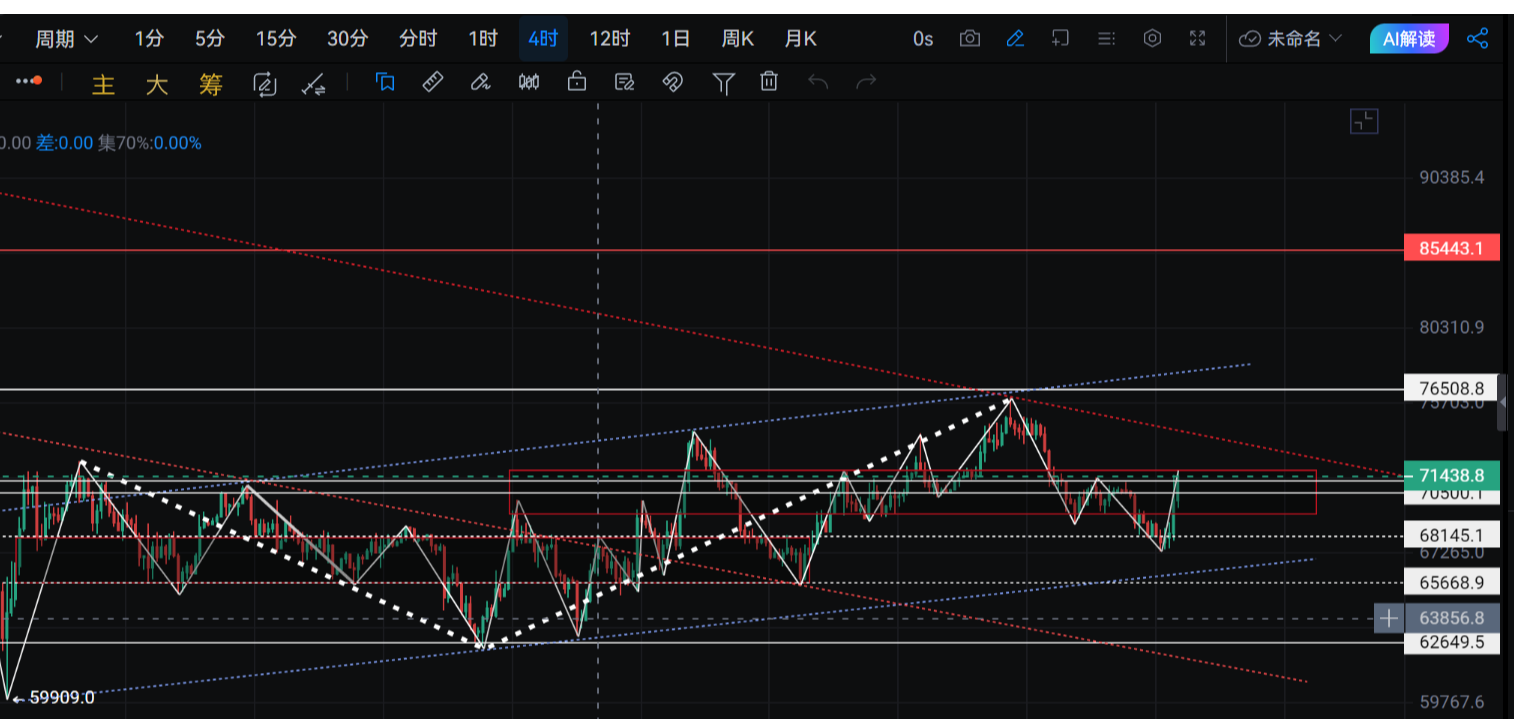
In this time window of escalating narrative defensive and offensive in the Middle East, the extreme fluctuations of the cryptocurrency BTR serve as a magnifying glass for the fragility of risk assets. According to a single market data source, BTR experienced a drop of over 80% in 24 hours, with the latest price around 0.039 USD, reflecting an almost "flash crash-sized" plunge compared to the previous trading day, leaving only fractured price trails. This type of downtrend, which breaks through support levels from a high point, resembles a straight line drop on the chart, with weak rebounds and sharply increased trading volume, typical of panic selling behavior.
Market participants can easily establish associative chains in the narrative: the escalation of the Iranian situation, recurring rumors of negotiations, allegations of fake news being used to manipulate financial and oil markets, combined with imaginations of future sanctions, compliance pressures, or changes in regional relationships, eventually channeling sentiment and positions into certain specific tokens. However, up until now, there is no public evidence that demonstrates a direct, singular causal relationship between BTR and any specific geopolitical event, nor can any piece of news equate to a "verdict" on its price. It functions more as a vehicle selected by capital to vent and liquidate amid macro panic emotions.
Structurally, tokens with small market capitalization or weak liquidity are especially prone to become breeding grounds for crashes and flash crashes under the backdrop of stacked macro negativity and uncertainty. Once a large sell order crashes into the shallow order book, the price plunge will accelerate, triggering more stop-loss and forced liquidation orders, creating a chain reaction. For assets like BTR, even if no specific geopolitical news is directly linked, just a portion of holders choosing to retract in the face of escalating Middle Eastern events leaves what appears to be an "unanchored" collapse in prices.
In the highly asymmetric information environment of Middle Eastern narrative scenes, retail investors are often the last group to access relatively clear information, yet they may be the first to bear severe price fluctuations. When high leverage and high volatility overlap, chasing gains or cutting losses becomes increasingly magnified; in just a few hours, the path from floating profits to liquidation can be extremely compressed. BTR's flash crash is not just an isolated price event but serves as a lesson on "how retail investors can be swept along amidst the deluge of narratives and structural fragility."
From Hormuz to Wall Street: The Global Echo of Risk Premium
Pulling the perspective away from a single token, a broader macro risk transmission chain can be seen. Iran continues to reinforce its control stance over the Strait of Hormuz, a narrow waterway that handles a significant portion of global oil and natural gas transport; should the tense situation escalate further, the market will surely reprice the supply risk. Even without substantial blockades or severe interruptions, the mere expectation of "something might happen" is enough to drive up risk premiums, leaving ripples in energy futures, related currencies, and regional asset prices.
At the same time, clouds on the macro level are thickening. Based on the latest assessments, Goldman Sachs has raised the probability of a U.S. economic recession to 30% by March 24, 2026, which itself is a somber vote on future growth prospects. With geopolitical tensions compounding economic downturn expectations, the overall risk appetite of global capital is naturally shrinking, and the costs of holding high-volatility and high-uncertainty assets are being re-evaluated. The flames of the Middle East and models on Wall Street point to a consensus that "risk assets need to be discounted."
During phases of heightened risk aversion, a rotation often occurs between traditional assets and crypto assets: some funds proactively withdraw from low liquidity, highly speculative altcoins, shifting their positions to cash, assets with lower country risk, larger market cap mainstream tokens, or traditionally recognized safe-haven tools. Within the crypto market, structural differentiation can also emerge—some tracks tightly linked to macro narratives are sold off more harshly, while certain tokens viewed as "risk proxies" endure amplified blows, whereas top assets might exhibit relative resilience during high volatility.
In this sense, the crypto market is acting as a "geopolitical risk thermometer" amid events in the Middle East. Missile launches, attack reports, denials of negotiations, shifts in sanctions—these news fragments are rapidly transmitted through Twitter, social media, and trading groups, soon reflected in the price movements and pulses of trading volume. BTR's plummet is merely one of the most striking readings, and underneath it lies a collective response across an entire asset class to hedge against uncertainty and reprice risk.
Who is Manipulating, Who is Being Used: The Price Mirror Under Middle Eastern Narratives
When public opinion warfare intertwines with price warfare, the motives of different participants are worth dissecting layer by layer. On a national level, Iran's accusation that "fake news is used to manipulate financial and oil markets" essentially emphasizes that external forces may influence oil prices and local currency values by shaping expectations of negotiations, sanctions, and conflicts, thereby affecting its fiscal space and strategic maneuverability. The opposing side may also attempt to leverage narratives such as "Iranian toughness" and "situation escalation" to push the market to increase the pricing of supply disruptions and intensified sanctions, seeking to ride a trend for their long or short positions.
On a financial level, some institutions and big players are incentivized to magnify price fluctuations when narratives are amplified. They may first establish highly leveraged positions and then intensively release opinions, forwarding biased information, using social media and news algorithms to create emotional resonance. Once the price rapidly climbs or plummets in the predetermined direction, they can reduce positions in batches and hedge profits, while retail investors often realize only when "benefits have been realized" or "negatives have been overstated," thus becoming the last link for liquidity completion.
On the timeline, the rhythm of information release and the order of price fluctuations often hide traces of public opinion arbitrage: certain assets appear first with abnormal volume and movements, followed by widespread dissemination of related rumors on social platforms; then, official statements or clarifications arrive late. This "rise/fall followed by clarification" pattern is not uncommon in geopolitically sensitive topics; the key lies in whether ordinary investors possess sufficient alertness to realize that prices often "get the news" earlier than reports.
According to the currently available public information, there is no evidence to prove that official institutions directly manipulate specific cryptocurrencies, including BTR. However, this does not prevent macro narratives from indirectly coercing market direction through emotions and expectations: as keywords like Middle Eastern conflicts, negotiation denials, and sanctions speculations continuously pile up, funds may habitually seek to short or hedge through certain high-volatility tokens, forming a picture of "macro negativity = specific altcoin crash."
In such an environment, investors' information literacy is forced to upgrade. They need to learn to differentiate between official statements, signed reports, anonymous messages, and social media rumors, understanding the reliability and bias of different sources; meanwhile, they should avoid absolutizing any single narrative—whether it is "negotiations are imminent, and all negatives have been priced in" or "the flames of conflict will spread, and risk assets must crash," both are insufficient as isolated decision-making bases. The more densely the noise in the Middle East time, the more necessary it is to apply a calmer framework to examine the distance between price and story.
The Flames of War Undimmed, the Market Not Finished: Survival Strategies of the Crypto Market Under Geopolitical Shadows
Overall, Iran's tough denial of rumors about U.S.-Iran negotiations, the Islamic Revolutionary Guard Corps' actual strikes on Israeli and U.S. military targets, as well as accusations that "fake news is used to manipulate financial and oil markets" collectively construct a high-pressure narrative backdrop. The crypto market, under this background, is forced to reprice risk, and the flash crash of BTR in a single data source serves as an extreme example of the compounding of sentiment, liquidity, and structural fragility.
From the perspective of risk attribution, BTR’s price drop of over 80% to about 0.039 USD within 24 hours mainly reflects the vulnerability of liquidity-weak assets facing concentrated selling and leverage chain reactions in a highly uncertain environment, rather than a simple direct linear causation with any specific geopolitical news that has been confirmed. It acts as a mirror reflecting how the market chooses the weakest link to release pressure when there are too many stories and too much information.
For investors immersed in it, one of the most practical survival strategies during phases of high uncertainty in the Middle East is to control leverage, prioritize liquidity, and cautiously select information sources: avoiding piling high leverage on small-cap, low-depth tokens, and preferably choosing assets with higher safety margins as main positions while maintaining a delayed reaction to all "exclusive news" related to geopolitical conflicts instead of reflexively chasing gains or cutting losses.
Looking ahead, if the Middle Eastern situation continues to escalate, one cannot rule out more "black swan-like" short-term impacts on crypto assets repeating, with panic emotions potentially dominating pricing briefly; conversely, once a phased easing, substantial negotiations, or clear downgrading signals appear, the market might quickly repair itself under the "war-time trading" logic, or even present opportunities for rebounds after overshooting. For participants, what truly needs to be grasped may not be the drop point of the next missile, but how to establish a filtering mechanism between narratives and prices, striving to keep decisions free from emotional coercion amid the unextinguished flames of war and unfinished market conditions.
Join our community, let's discuss and become stronger together!
Official Telegram community: https://t.me/aicoincn
AiCoin Chinese Twitter: https://x.com/AiCoinzh
OKX Benefits Group: https://aicoin.com/link/chat?cid=l61eM4owQ
Binance Benefits Group: https://aicoin.com/link/chat?cid=ynr7d1P6Z
免责声明:本文章仅代表作者个人观点,不代表本平台的立场和观点。本文章仅供信息分享,不构成对任何人的任何投资建议。用户与作者之间的任何争议,与本平台无关。如网页中刊载的文章或图片涉及侵权,请提供相关的权利证明和身份证明发送邮件到support@aicoin.com,本平台相关工作人员将会进行核查。