Author: MapleLeafCap, Co-founder of Folius Ventures
Lived in Shanghai for a year, then another year in Hong Kong. During this time, organized quite a few offline events for investors/projects, but never hosted a hackathon. It's not that I didn't want to, but I felt that hosting a hackathon during the Web3 phase was a bit unrealistic—everyone was building perpetual motion machines in a vacuum, interchanging infrastructure, creating nested protocols, and the resulting products were far removed from ordinary people. You spend 48 hours rapidly prototyping a protocol, then sell it off at a meetup through market makers. And then what? Where are the users? Where's the PMF? (Related reading: Folius Ventures: Web3 is on the verge of an application dividend period, ushering in a golden era for Chinese entrepreneurs)
Moved to Shenzhen in January this year. Aside from the ten or twenty days of turbulence during the Spring Festival and moving, I spent the entire Q1 basically delving into AI. I took a detour—starting with Cursor, but after struggling a bit, I realized there was a clear ceiling, and it wasn't until I switched to Claude Code that I found my path. Now, I primarily use CC, running Codex concurrently to create a multi-agent scaffold. I've played around with Claw, and I’m currently tackling how to set up skill/harness/scaffolding so agents can run autonomously, essentially replicating myself to perform investment research and due diligence.
The last time I coded was fifteen years ago with VBA and Python. My technical background and coding ability are almost non-existent. But that's precisely what excites me— I don’t need to know how, and neither do you.
First, let me share my judgment on the current phase.
We have gone through Chatbot, single Agent, and Agent Workflow, and we are about to enter the Agent Matrix era—one person coordinating hundreds of agents and sub-agents, running non-stop for 24 hours, collaborating to break down complex tasks and output product modules or even the product itself on an hourly basis (or even every 15 minutes). From a sensory perspective, transitioning from Chatbot to stable and efficient high-performance Agents was truly just last November-December, and the latter two phases emerged within just a quarter.
Behind this speed is a quadruple exponential multiplication, layered with recursion and self-improvement acceleration:
Raw Compute: Under brute force stacking, the total compute power of global AI chips increases by 2-3x each year, with more and better chips being deployed.
Model Capability: Under better training, compute power, and algorithms, the intelligence output per FLOP increases by 3-4x each year.
Token Yield: Various prompting/context/memory/harness/scaffolding/unhobbling/orchestration techniques optimizing real units of intelligence from each token yield 2-4x year-over-year.
Agent Fan-out: More agents replacing humans to coordinate more agents, leading to an increase in the high-intensity effective operational time of a single agent, multiplying the intelligence units one person can mobilize by 3-5x each year.
Multiplying these four exponents means that the real units of intelligence one person can mobilize in 24 hours increases by 100x each year. Given such high efficiency, it’s no wonder Anthropic's growth rate remains a frightening 10x per year—from $1B ARR to $14B in just 14 months.
A person standing on the frontier of LLM capabilities, who can fully coordinate intelligent units, can ship products in 48 hours that are no longer just toy demos.
The best demonstration of this speed is the result of a competition:
Anthropic's February hackathon: 13,000 people registered, 500 selected.
Champion Mike Brown—a California personal injury attorney with no engineering background. In 6 days, he used Claude to develop CrossBeam. Originally, 90%+ of California ADU building permits would be sent back on the first submission, taking months, forcing owners to spend high fees sustaining an entire compliance consulting industry. Now? A 20-minute automated assessment is all it takes. A multi-million dollar, excessively bureaucratic real estate administrative outsourcing industry has turned into a piece of almost zero marginal cost code.
Third place Michał Nedoszytko—a Polish cardiac intervention expert with no coding experience. Between hospital shifts and flights to San Francisco, he hand-coded Postvisit.ai in 7 days. He transformed complex, hard-to-understand medical exam reports that easily led to patients’ non-compliance into a straightforward rehabilitation guide. He encapsulated the extremely rare and expensive “top medical expert brain” into an API that can be called upon infinitely by all of humanity.
Keep Thinking award Kyeyune Kazibwe—a frontline road technician from Uganda. Traditional road surveying requires procuring million-dollar lidar surveying vehicles. He simply attached a basic dashcam that costs dozens to the front of his vehicle, using AI for multi-modal visual analysis to convert the video stream on-site into a “infrastructure repair budget heatmap” with GPS coordinates. The million-dollar surveying systems that third-world countries could never afford were reduced to a dashcam + a few dollars of API call fees.
A lawyer, a cardiologist, a Ugandan roadworker. Of the top five, only one had a programming background.
YC Winter 2025: 25% of the batch has 95% of the codebase generated by AI. This ratio was almost zero last year.
Then some examples that are not hackathons: Peanut (Chen Yunfei)—an economics major, former PM at a large company, can’t write a line of code. He used Cursor for an hour to create the "Kitten Light," a lighting app specifically for photographing cats. A Xiaohongshu note with 1.18 million views, 73K likes, and 30K downloads, topped the App Store paid rankings for over a month.
Then there’s Zach Yadegari, 18, from Long Island, two high school students created Cal AI— a photo-calorie tracker with 90% accuracy. 15M downloads and annual revenue of $40-50M, acquired by MyFitnessPal this March.
Looking at these cases together, the pattern is very clear:
The winner is not the one who can code the fastest, but the one who understands the problem best.
500 programmers lost to a lawyer.
In a more extreme scenario, what can really be accomplished in 48 hours?
Let’s take one person at the very forefront and do the math. Boris Cherny, creator of Anthropic Claude Code: by the end of 2025, a month’s output will equal 2.5 years of work from a classical senior engineer. His pace is 20-30 pull requests per day with virtually no hand-written code.
Currently, 90% of the code at Anthropic is written by Claude Code, not by humans.
If you compress this number into a 48-hour sprint: a single weekend would equate to half a year’s work.
Let's place this in historical context. In 2010, Systrom and Krieger spent 8 weeks creating Instagram's MVP, gaining 25,000 users on its first day, and was sold to Facebook for $1 billion two years later. The engineering effort for those 8 weeks could now be completed by a Boris-level person in a weekend.
Looking further back, WhatsApp had 32 engineers who took five years to achieve acquisition for $19 billion. According to quadruple exponential forecasts by the end of 2026—one person, in 48 hours, could nearly match all the engineering input from those five years.
Two states compared:
Classical: One person in 48 hours ≈ Toy demo
Now: One person in 48 hours ≈ The engineering output of Instagram MVP
One year later: One person in 48 hours ≈ The entire engineering effort that led to WhatsApp’s $19B acquisition
By 2026, examples like this will abound:
Completed in 8 hours using Claude Code, winner of the Anthropic hackathon grand prize
Base44: Maor Shlomo finished Base44 while backpacking in the Philippines and Thailand in three weeks, and sold it for $80 million in cash six months later
Anything: A vibe coding platform created by two former Google employees, launched two weeks later with $2M ARR, valued at $100M
Pieter Levels: Created a flight simulator MMO in 3 hours using Cursor, achieved $1M ARR in 17 days, with zero employees and earning $3.1M annually across all products
Google Principal Engineer Jaana Dogan admitted: Claude Code finished iterating her team's entire distributed agent orchestration system for 2024 in one hour
16 Claude agents running in parallel produced 100,000 lines of a Rust C compiler in two weeks, passing the 99% GCC torture test, capable of compiling the Linux kernel, at a cost of $20,000
Controlled METR testing: Opus 4.6 has a 50% probability of completing a software task that requires humans 12 hours to complete. Sixteen months ago, this number was 21 minutes.
Karpathy—the inventor of the term "vibe coding"—recently confessed: "I've started to notice my ability to code by hand is slowly diminishing." Even he can’t go back.
Node.js creator Ryan Dahl said something spine-chilling: "The era of humans writing code is over."
The bottleneck for creation is no longer code.
A worthwhile problem to solve, a low-cost way to reach users, and the drive to push oneself forward. Code? Code is Free.
The smartest group of people in the world is learning from each other how to push this boundary.
The information flywheel has spun up in the English-speaking world: Karpathy tweets a thread, and the entire industry discusses it. A demo from an unknown developer gets quoted progressively to millions of views. A single remark from Altman/Karpathy/Dario instantly turns into discourse. Twitter/GitHub/YouTube long-form formats jump back and forth—this is my daily routine.
AI hackathons are happening one after another in the United States: Anthropic's hackathon with 13,000 registrants was just the beginning; various regions, companies, and communities are intensively organizing vibe coding competitions to let builders experiment with the boundaries.
What about all this in China?
Model capabilities are indeed catching up. The new four dragons (Minimax / Zhicheng / Moonshot / DeepSeek) + Byte's Doubao, with DeepSeek driving prices down to 1/20, directly changing the industry landscape. However, Q1's overall focus was entirely on model releases + Spring Festival battles. Byte was busy with Doubao 2.0 and Seedream 2.0, Tencent invested over 4.5 billion in Yuangbao red envelopes. Not a single large firm hosted a flagship AI hackathon in Q1.
The information flow is even more fractured. Jike is too niche, Zhihu is too heavy and slow, Bilibili is video consumption, not social, WeChat is a closed island—public accounts are one-way broadcasts, group chats are information black holes, and external links are directly blocked.
China has model capabilities that are catching up with the world's frontier and the largest AI user base globally, yet there is no place for builders to learn from each other how to use this. This is an absurd mismatch.
China urgently needs a public square for AI builders.
Then I had a surprising realization.
Xiaohongshu.
Looking back at all the case studies of hackathon winners—lawyers, cardiologists, road technicians—the common denominator is: an extremely deep understanding of problems + an extremely proactive approach to solving them.
Once we agree that the true winners of vibe coding/agentic engineering are not programmers, but domain experts, we can see that Xiaohongshu is in a unique position.
The current reality for Chinese developers is: if you've created a product and want to discuss it, release it, gather feedback, and communicate with users locally— you have to jump between 4-5 platforms: places for discussion but no users, places with users but no discussion; builders and end-users are separated by a wall.
I went through the major platforms in China and asked a question: which platform allows an AI builder to
Reach high-quality users ✅
Find peers ✅
Be found by action-oriented individuals ✅
Monetize directly ✅
Receive genuine product feedback ✅
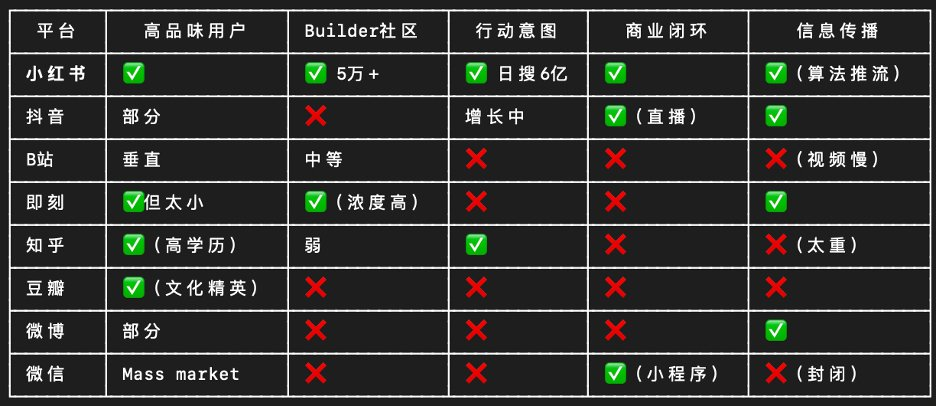
Only Xiaohongshu ticks all five boxes.
Jike has a high concentration of builders, but the scale is too small (MAU in the millions vs Xiaohongshu’s 350 million), lacks action intent and commercial closure—builders communicate there, but the users are absent.
Douyin has scale and monetization, but users come for short videos, not for solutions.
WeChat has everyone, but public accounts are one-way broadcasts, group chats are closed islands, and external links are directly blocked.
Zhihu has search and high-quality users, but is too heavy and slow, with almost no builder community.
Douban has the highest quality taste but is half-dead as a platform. Weibo has speed but its audience is entertainment, not product-focused.
What about overseas? Instagram/Pinterest are theoretically positioned similarly, but the minds of AI builders have already been occupied by X/Twitter—Karpathy is there, Anthropic is there, all the hackathon results are disseminated there. Inst and Pinterest do not and will not have AI product communities.
Xiaohongshu, precisely because there is no Chinese equivalent to "AI Twitter," has the opportunity to occupy this position on a completely different dimension.
By the way, Byte is also very interesting. Doubao's ecosystem has a large scale, Coze Space has 4.58 million MAUs and is building a builder platform. Their model capabilities are among the fastest (Seedream/Seedance series), and their overall execution is undoubtedly the strongest in China. However, Byte's advantage currently lies in the tools and models—it is an arms dealer providing weapons for builders, not a distribution platform for users.
The irreplaceability of Xiaohongshu lies in its simultaneous presence of builders and 350 million end-users on the same platform. This is something Byte does not have, and likely no other company in China can offer.
If Xiaohongshu seriously pursues this endeavor, what will happen?
Xiaohongshu's 350 million users constitute China's most discerning consumer group: 90% under the age of 34, over 65% from first and second-tier cities, over 50% hold a college degree, and household incomes exceeding the urban average by 30-50%. Conversion rates are 5-12%, with some brands reaching 21.4%—the highest among social platforms in China. This is not a mass-market platform; it represents a concentrated batch of young users with taste, purchasing power, and a willingness to pay for good products.
If your product is ugly, the experience poor, or the solution unreal, the comments section will tell you directly. This is not a bug, but the world's best free product feedback, and currently the only place where builders and end-users naturally collide on the same platform: discover needs, create products, distribute, and explode—the entire chain has never emerged from this platform.
Supporting this view, AI and geek content have spontaneously exploded on this platform. Technology content has grown year-on-year by over 100%, the creator scale has increased by over 200%, there are over 50,000 active independent developers, and Build in Public related content exceeds 1.1 million posts. This surge was not initiated by Xiaohongshu but came from builders themselves who realized there were users, feedback, and distribution opportunities.
For example: Xian Xinglang, born in 2008, a high school freshman, transferred from Shunde, Guangdong to Hong Kong. He came across AI programming posts on Xiaohongshu and started self-studying with Cursor. He noted the pervasive "ox and horse" labor feelings on the platform—there were channels available, but no tools—so he created "Ox and Horse Clock," helping workers calculate their earnings in real-time. Another emotional management app, EmoEase, took 18 hours to develop and climbed to the 5th position in the App Store's paid tools chart. He posted on Xiaohongshu about his inability to pay the $99 annual developer fee, and the founder of Manus, Xiao Hong, saw it and sponsored him directly.
Follow the chain: browsing AI content on Xiaohongshu, identifying emotional demands on Xiaohongshu, distributing demos on Xiaohongshu, being seen by users on Xiaohongshu. The whole process unfolded before he even completed high school.
Reflecting on the case where a lawyer triumphed over 500 programmers at Anthropic—what stood on the stage was not the most beautifully written code, but the one who executed most accurately.
Engineer/Product/User flywheel:
Builders on Xiaohongshu Build in Public →
350 million users directly trial and evaluate →
Comments section = the most efficient user research →
Product iteration →
A hit product attracts more builders →
Accelerating the flywheel.
If this flywheel spins up, Xiaohongshu is not just "China’s largest seed-planting platform," but the only integrated platform in China for discovering, validating, and distributing AI products.
Xiaohongshu seems to have discovered this opportunity as well.
Recently, I came across that they will hold a 48-hour AI hackathon peak event in Zhangjiang, Shanghai, in early April this year. I did a bit more digging into the profiles of the participants and found a batch of Gen Z geeks that excited me even more than I had expected. Why? Because today’s successful individuals are getting younger, young enough to raise eyebrows.
Take a look at the real slice of life across the ocean from March: the two 17-year-old high schoolers mentioned earlier in Cal AI, Zach and Henry:
Zach Yadegari, self-taught programming since 7. Started teaching programming to others at 10 and beat college students in hackathons by the age of 12.
As a freshman in high school, he created "Totally Science"—a website that helps classmates bypass school WiFi restrictions to play games—and sold it for $100K at 16.
After the sale, he didn't take a gap year; instead, he partnered with his old friend Henry Langmack, whom he met at a programming summer camp, to brainstorm a new idea.
His motivation was incredibly simple: Zach started working out to impress girls. Every time he opened a calorie app, he had to manually log inputs, which he found tedious. So the three of them decided to create something that could calculate just by taking a photo. Startup capital: $2,000, spent entirely on social media testing.
In 2024, when co-founding Cal AI, Zach was just 17.
First month income was $28K, second month $115K, and projected revenue in 2025 is $30 million. Zach expects to reach $50 million by 2026. Ultimately, he was acquired by industry giant MyFitnessPal.
While traditional SaaS teams might need to hire dozens of senior engineers and spend 7-10 years to reach $50M ARR and eventual acquisition, these two 17-year-olds completed it during breaks and weekends in a year.
What a ridiculous and appealing compression in business time.
Why are today's winners getting younger?
The "atomization" of skill barriers: AI has leveled the experience gap
In the past, starting a software company required years of programming accumulation and a large engineering team.
Now: AI has become an "external brain." An 18-year-old geek can write code that previously required a team of ten people, as long as they have good prompt engineering skills and structural intuition.
Conclusion: Experience is no longer a moat; speed in imagination and tool utilization is. Young people shed the burden of "legacy technology"; picking up AI is as natural as breathing.
The intuition of "digital natives": They better understand the pulse of algorithms
Cases like Cal AI, which rely on social media for cold starts, are hard for veteran entrepreneurs to replicate.
Reason: Gen Z were raised in algorithms. They intuitively know what type of video can retain viewers in the first three seconds and what kind of UI screenshots can explode on Xiaohongshu.
Advantage: They don't need to hire expensive marketing consultants because they themselves are the target users. This "product sense" is instinctive social intuition.
"Small teams, big leverage": Refusing to think like big companies
While traditional elites pursue entrance into large firms and face several reporting layers, young people realize: a solo SaaS can also become a multi-million dollar company.
Mindset: Young people tend to become indie hackers. They pursue $50M ARR rather than managing 500 employees.
Result: This extreme flexibility allows them to rapidly iterate products within 24 hours based on community feedback (e.g., from Xiaohongshu's comments), while large firms might require three months of meetings.
Extremely low costs of failure: They dare to "fire while moving"
Veteran mindset: consider compliance, structural stability, and 100% accuracy.
Gen Z mindset: Zach's initial accuracy for Cal AI was also not 100%, but he boldly launched it. He knows AI will evolve, and users will provide feedback.
Logic: While they are young, they can afford to fail ten times; as long as the eleventh time hits a pain point like Cal AI, they can achieve financial freedom.
Previously, entrepreneurship was a 'marathon,' requiring stamina, endurance, and decades of accumulation;
Now, AI entrepreneurship is more like a 'ball-throwing machine.' As long as you react quickly and pose correctly, each throw could be a multi-million dollar ARR opportunity.
The world is rewarding those who are more curious, more daring to dive in, and better at algorithmic aesthetics.
And those 16-year-olds who have won the WWDC award seven times on Xiaohongshu; the 10-year-olds with 300,000 followers and the youngest AI creators; along with the middle school students who have hand-crafted robots, are undoubtedly our key targets for seed investment. In the AI era, the successes of Zach Yadegari (18) and Henry Langmack are neither coincidences nor simply luck but a total reshuffling of intergenerational competitive advantages.
Inflation of coding ability has finally handed the entry ticket to the commercial world to a generation still in middle school.
Can the success of Cal AI be replicated in China?
Based on the path that Zach and others took, I summarized three methodologies behind it:
Minimal product intuition (Frictionless)
Don't build complex systems; just fix one "incredibly annoying" minor issue. MyFitnessPal failed because "manual entry was too tiring," while Cal AI succeeded with "just snap a pic." Reduce any clicks users need to make from "experiencing demand" to "getting results."
"Ghost teams" and API leverage
Formula: Mature API + smooth UI + powerful hooks = blockbuster applications. Zach did not train large foundational models himself. Instead, he called OpenAI or other CV (computer vision) APIs, focusing all efforts on user experience (UX) and growth.
Matrix-style "stealth promotion"
Cal AI hired hundreds of nano-influencers for "native content" bombardments. They don't post hard sells but daily videos like "What I ate today; AI says this meal has 800 calories." This is a traffic engineering strategy that can be executed in bulk as long as there’s an SOP (standard operating procedure).
Then you'll find that every step of "The Zach Way," for some reason, can perfectly find its foundational support on Xiaohongshu:
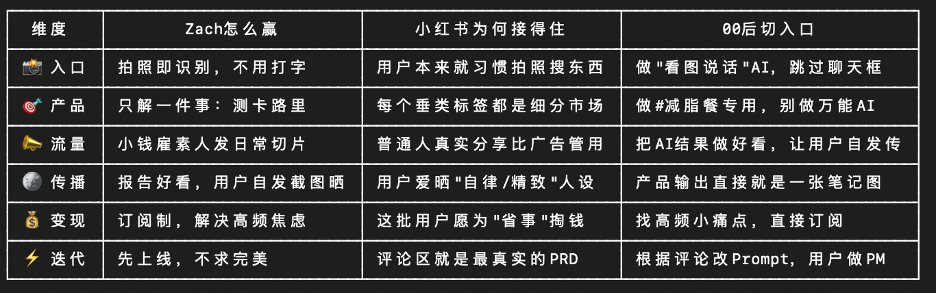
This table illustrates not only that Xiaohongshu is suitable for AI products but that it is currently the only place globally where each step of the successful path of Cal AI can be supported by the platform's inherent capabilities.
So, the biggest wildcard in this hackathon is most likely a middle school student from the Gen Z generation—not building aircraft carriers but utilizing the most mature APIs. With their native web sense, they could navigate this traffic matrix on Xiaohongshu and create a product that adults might not even comprehend, but upon launch could directly explode the comments section.
The subsequent closed-loop deduction: 48-hour product → directly exposed on Xiaohongshu (algorithm-driven, no cold start needed) → user feedback → iteration → traffic/resource support (last year’s grand prize winner received over 150,000+ in promotions) → integration into e-commerce seeding paths → direct monetization.
Looking at the value of this from another angle:
If you are a developer—this is the most efficient market validation venue you can find. You can market yourself, validate ideas, gather feedback, and iterate products in front of 350 million action-oriented users anytime, anywhere. No need to build a site, buy ads, or cold start. Your users are right in the comments section. No one knows where the next black horse will emerge from.
If you are an investor—this is the first showcase of the next breakout product. Anthropic's hackathon produced CrossBeam, while Google x XHS summer hackathon produced PlanCoach (App Store 4.8 rating, over 200,000 likes). Discovering projects here is 100 times more authentic than looking at slides in a pitch deck.
Even bolder deductions: the new generation of YC is certainly on its way, and its form will be completely different.
The timeline has absurdly compressed—48 hours to ship a production product, three weeks to reach 1M ARR, and six months to an $80M exit. The traditional 10-year pipeline is a product of another era.
The issue is that the two foundational assumptions of traditional VC models have been broken: You need a company, and your equity must have value. But solo builders may not have a company at all; their products could just appear and explode through a wave.
Thus, the new paradigm may not be equity investment but directly investing in individuals tied to ARR revenue sharing; funds held in escrow, programmatic draw, only for compute and AI-native marketing. What investors can truly provide is not money but token subsidies, upgrading MVPs to volume-readiness with agent matrix support, and knowing how to run growth.
This direction is already being explored: Calm Company Fund is making Shared Earnings Agreements, TinySeed focuses on bootstrapped SaaS, and Station F’s F/ai collaborates directly with Meta / Google / Anthropic / Mistral to provide $1M+ credits without equity—compute as investment is already happening. AWS provides $1M credits, Google $350K, all non-dilutive.
Sam Altman and Dario are openly betting on when the first one-person billion-dollar company will appear. Dario publicly stated that the probability of the first one-person billion-dollar company appearing in 2026 is 70-80%. Lovable scaled from $1M to $200M ARR in 12 months, achieving a $6.6B valuation, and its speed to reach $100M ARR surpassed OpenAI, Cursor, Wiz, and all historical software companies, calibrating this probability.
Interestingly, on the Chinese side: the Qianhai OPC Mavericks Program just launched on March 20—announced the same day as the Xiaohongshu hackathon. "Eight zeros": free office space of 200 square meters for two years, free housing of 50 square meters, 50P/year of free computing power, free trials for large models, no-collateral loans, high-tolerance seed funds, and a talent reward of 600,000/year, aimed at global solo builders without equity disclosure requirements.
The speed of China's policy response may be quicker than many VCs.
Lastly, regarding mindset.
Honestly feeling quite anxious. This round of AI paradigm shift has a resemblance to DeFi Summer; I currently have a somewhat similar feeling to the crypto atmosphere of 2019/20: something huge is about to hit us, and the rest of the world is still a little asleep.
Friends from the Web3 community might share similar sentiments. Those who have long been immersed in Web3 have advantages in cold-start intuition and nonlinear growth—if this hackathon is worth paying attention to, even signing up might be an unexpected entry point.
Now, every day, the first thing I do upon waking is check Twitter for new breakthroughs, then browse GitHub repos, and watch long-form breakdowns on YouTube, but I feel it’s still not enough—I sincerely hope China also has a high-density AI information aggregation point that can show me thoughts and products not seen on English platforms. Maybe Xiaohongshu can fill this gap to some extent, maybe it can't. But for now, it appears to be the most likely option I see.
What Xiaohongshu currently lacks, I believe, is an open developer API—similar to Twitter v2—allowing third-party developers to capture search intent, read content trends, and build tools. The reason Twitter became an information infrastructure is that it has an API layer, allowing the entire ecosystem of tools to flourish upon it. Another aspect is the openness of content embedding and creator analytics—once implemented, both builders and investors can more systematically track what is exploding and why.
In early April, back in Shanghai, I hope to connect with friends who focus on primary investment in the AI track; before, I was rambling about Web3, but now I am genuinely looking to learn and want to see with my own eyes what this group of vibe natives can create in 48 hours. Zhen Fund and Tencent's recent crayfish event in Shenzhen exploded (i.e. too many people), which indirectly illustrates that the enthusiasm for AI applications is real.
It doesn't necessarily have to be about AI, we can chat about how our generation can avoid being left behind in this time window, haha.
免责声明:本文章仅代表作者个人观点,不代表本平台的立场和观点。本文章仅供信息分享,不构成对任何人的任何投资建议。用户与作者之间的任何争议,与本平台无关。如网页中刊载的文章或图片涉及侵权,请提供相关的权利证明和身份证明发送邮件到support@aicoin.com,本平台相关工作人员将会进行核查。


