Written by: Pine Analytics
Translated by: Saoirse, Foresight News
The current price of TAO is about $275, with a market capitalization of $2.6 billion and a fully diluted valuation of $5.8 billion. The project has received backing from Grayscale (an ETF listing application was submitted to the NYSE in December 2025) and has also been publicly acknowledged by Nvidia CEO Jensen Huang. Additionally, the token supply narrative is very attractive: a total cap of 21 million tokens using a Bitcoin-like halving mechanism. After the first halving in December 2025, the daily issuance will decrease from 7,200 tokens to 3,600 tokens. In one year, the number of subnets has increased from 32 to 128, and the training of Templar's Covenant-72B has also proven that decentralized computing power can run large language models with baseline competitiveness.
This report does not deny the above facts. What we want to explore is whether the economic model of this network can generate real external revenue to support the current valuation scale, and how competitive it is in relation to centralized service providers and self-hosted computing power.
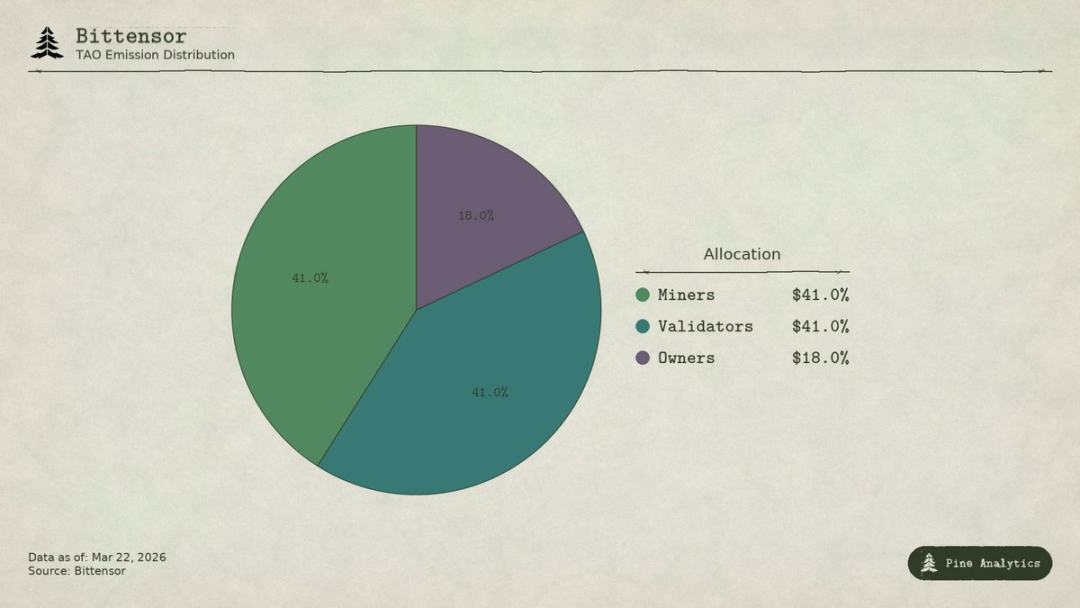
Distribution ratio of Bittensor (TAO) token issuance
How Network Value Flows
Bittensor has four types of participants:
- Subnet owners build specialized AI markets and receive 18% of TAO issuance rewards from their subnet;
- Miners execute AI tasks (inference, training, data processing) and receive 41%, totaling about 1,476 TAO per day, with an annualized value of approximately $148 million;
- Validators score the output of miners and receive 41%;
- Stakers deposit TAO into subnet liquidity pools in exchange for subnet-exclusive tokens.
Under the Taoflow model, a subnet's reward share is determined by the net inflow of staked TAO, and if the net inflow is negative, there are no rewards. The top ten subnets control about 56% of the total network issuance.
TAO is the universal token for the entire network: miners register, validators stake, subnet token purchases, and service payments all require the use of TAO. Theoretically, subnet activities will create structural demand for the underlying token.
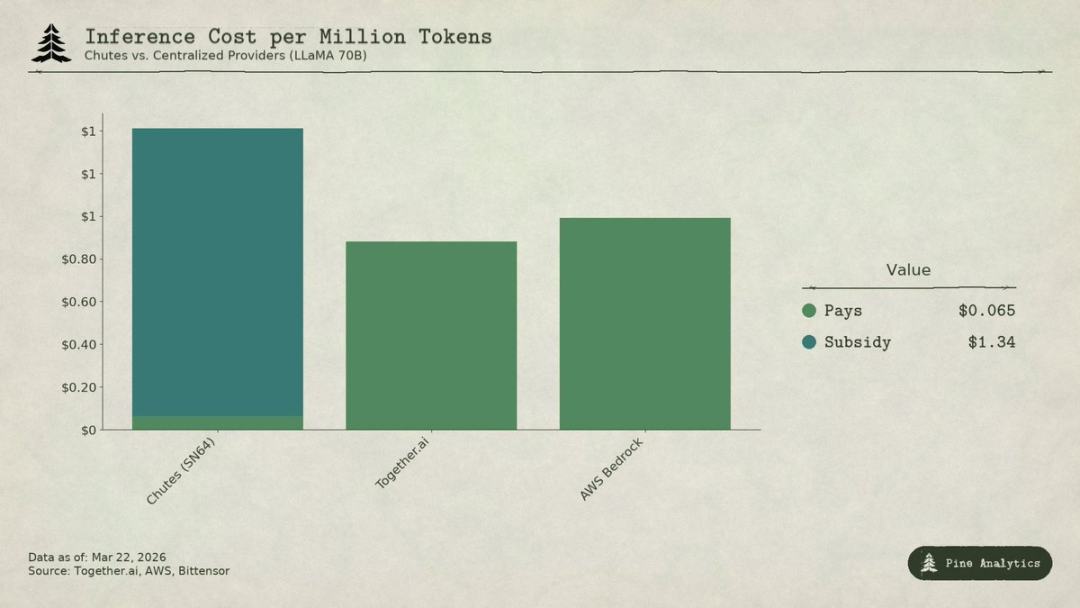
Comparative analysis of inference costs for Bittensor subnet Chutes (SN64) vs centralized service LLaMA 70B model
Current Demand Side Situation
Transparent Supply vs Opaque Demand
The supply side of Bittensor is highly transparent: 3,600 TAO are allocated daily according to a program, halving rules are hard-coded, staking rates (about 70%), distribution ratios, and flow data are all recorded on the blockchain.
However, the demand side is completely opaque. There is no unified dashboard tracking external revenue by subnet; the actual usage of AI services (inference, computation, training) occurs off-chain and will not be recorded on the blockchain. Investors can only infer demand through indirect indicators such as staking flows, subnet token prices, and self-reported data from the project parties. This lack of transparency is structural, not a temporary phenomenon. The blockchain only records token circulation, not API calls.
The following is the most complete demand-side picture as of March 2026.
Chutes (SN64): Low Prices Depend Entirely on Subsidies
Chutes accounts for 14.4% of the total network issuance, the highest among all subnets. Developed by Rayon Labs, it provides serverless inference services for open-source models at prices 85% lower than AWS and 10%–50% lower than Together AI. Its usage data is far ahead within the ecosystem: over 400,000 users (over 100,000 API users), daily request volume exceeds 5 million times, and it has processed a total of 91 trillion tokens. The average token generation over three days soared from 6.6 billion to 101 billion. It is also a leading inference service provider on OpenRouter, with some models outperforming centralized competitors.
However, this low price does not come from operational efficiency but rather from subsidies.
Based on a 14.4% share, Chutes receives about 518 TAO daily, with an annualized value of around $52 million. However, its external annual revenue is only about $1.3 million to $2.4 million (the higher value is self-reported by the team and unaudited). The protocol’s subsidy ratio for this subnet is about 22:1 to 40:1. For every $1 paid by users, the network must issue $22–40 worth of TAO through inflation to provide subsidies.
If subsidies are removed, based on its daily processing volume of approximately 101 billion tokens, the cost price is about $1.41 per million tokens. The current prices in the centralized market are:
- Together.ai’s LLaMA 3.3 70B Turbo is about $0.88 per million tokens;
- DeepSeek V3 is about $0.40–0.80;
- Smaller models can be as low as $0.18.
This means that after removing subsidies, Chutes' price will be 1.6–3.5 times higher than centralized solutions. The so-called 85% cost advantage is entirely reversed; its low price fundamentally relies on TAO holders paying through inflation, rather than structural efficiency brought about by decentralization.
Some may draw parallels to early internet customer acquisition subsidies, but Uber, DoorDash, and AWS established switching costs during their subsidy periods: proprietary platforms, driver networks, and business ecosystems. Bittensor's subnets have no such barriers: models are open-source, interfaces are standardized, and users can switch providers at zero cost. Once the tide of subsidies recedes, there is no lock-up mechanism that can retain users.
Rayon Labs also operates SN56 and SN19, controlling a combined total of about 23.7% of the total network issuance, and neither has disclosed external revenue. A single team almost controls a quarter of the network's incentive distribution.
Targon, Templar, and Other Subnets
Targon (SN4) is the highest-revenue subnet, operated by Manifold Labs, providing confidential GPU computing services to enterprises, with estimated annual revenue of about $10.4 million, corresponding to a valuation of $48 million, and a price-to-sales ratio of about 4.6 times, which is the most solid valuation in the ecosystem. However, $10.4 million is merely projected data referenced by multiple reports and is not an audited figure.
Templar (SN3) completed the Covenant-72B training, with a market capitalization of $98 million, but has zero external revenue. The training API and enterprise sales are still underway and have not yet launched paid products.
The remaining 120+ subnets either have no public revenue or are still in the early stages of product development, primarily relying on token issuance subsidies for survival.
Overall Overview
The total verifiable annual revenue on the demand side of the network is only about $3 million to $15 million. The annual subsidy for just the Chutes subnet (about $52 million) exceeds the upper limit of the entire network's external revenue.
Based on a market capitalization of $2.6 billion, its revenue multiple is about 175–200 times; based on a fully diluted valuation of $5.8 billion, it approaches 400 times. In recent years, valuations for centralized AI computing companies have only raised funding multiples of about 15–25 times projected revenue, and high-growth SaaS companies rarely maintain above 50 times in the long term. Bittensor’s valuation multiple is 4–10 times that of aggressive targets in the industry.
The enormous gap between valuation and demand fundamentals indicates that the market prices TAO almost solely based on supply-side scarcity (halving, staking lock-up), institutional catalysts (Grayscale ETF, anticipated exchange listing), and sentiment in the AI sector, rather than genuine economic output. These are indeed price drivers, but they are entirely separate from the logic of "Bittensor as an AI service network creating sustainable value."
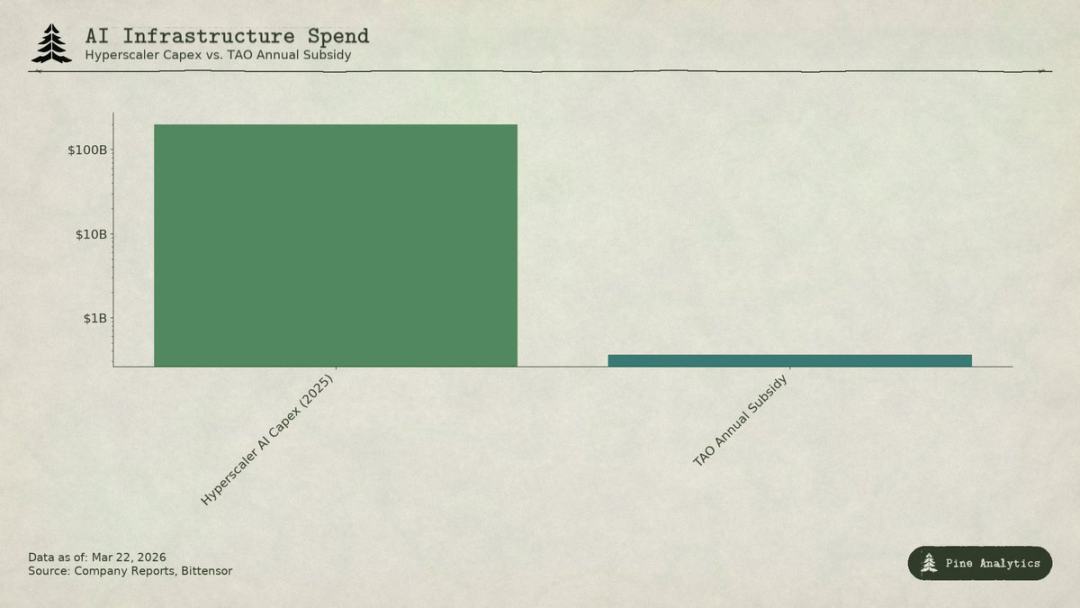
Comparing the AI capital expenditures of super-scale cloud vendors with the annual subsidy size of Bittensor (TAO)
Pricing Dilemma: Squeeze from Both Ends
Subnets are facing pressure from both ends:
- Above: Self-hosting cap
All models on the platform are open source, weights are public, and the comprehensive cost of running a 70B model on a single H100 is only $40–50 per day. Tools like vLLM and Ollama make local deployment extremely simple. Nvidia’s next-generation chips will significantly lower inference costs. Sufficiently large institutions will find self-deployment cheaper.
- Below: Squeeze from cloud giants
Microsoft, Google, Amazon, and Meta are expected to collectively spend over $200 billion on AI capital expenditures by 2025, with hardware priority quotas, dedicated data centers, enterprise customer relationships, and cash flows from other businesses to subsidize AI. Bittensor's entire annual incentive budget (about $360 million) is less than Microsoft’s weekly investment in AI infrastructure. Professional service providers are also using VC to subsidize low-cost competition on open-source models.
Subnet pricing is compressed into an extremely narrow range, while also bearing the unique costs of decentralization: token friction, validation node expenses, subnet owner shares, network latency, and more.
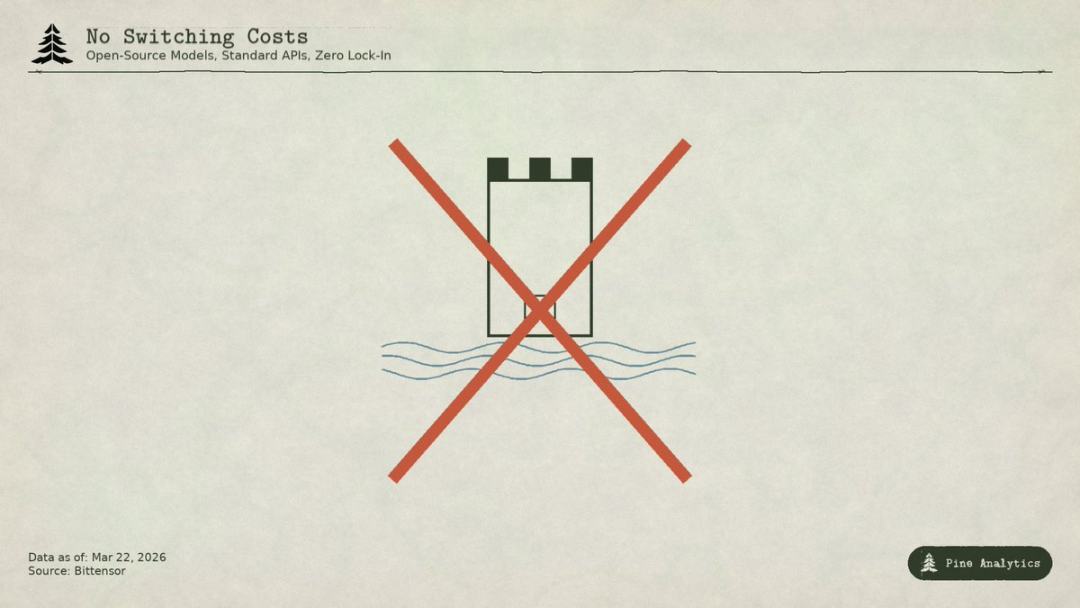
Moat Issues
Even if a subnet provides valuable services, the underlying models and methods are inherently public: Covenant-72B uses the Apache license, and technical papers are duly published. Any competitor can replicate directly without participating in the TAO ecosystem.
Traditional moats (proprietary technology, network effects, switching costs, branding) do not apply:
- Technology is open source;
- Network effects belong to TAO, not to individual subnets;
- Model weights are consistent, and the cost for users to switch is zero.
The community believes the incentive mechanism is the moat, but it relies on continuous large-scale token issuance, while each halving will cause the incentive budget to continue to shrink.
What Exactly is TAO Trading?
With a market capitalization of $2.6 billion, TAO's price does not reflect demand fundamentals; annual revenue of $3–15 million cannot support it under any traditional framework. The market is trading: Bitcoin-like scarcity, expectations for Grayscale ETF, rotations in the AI sector, and the long-term option value of decentralized AI. These are all reasonable speculative factors but are entirely derived from the supply side and market sentiment.
If you hold TAO based on scarcity and narrative, you may still profit even with weak demand; but if you believe Bittensor will become a truly scalable AI service network, currently there is no evidence, and it faces difficult structural barriers to overcome. Investors should clearly differentiate their investment logic.
免责声明:本文章仅代表作者个人观点,不代表本平台的立场和观点。本文章仅供信息分享,不构成对任何人的任何投资建议。用户与作者之间的任何争议,与本平台无关。如网页中刊载的文章或图片涉及侵权,请提供相关的权利证明和身份证明发送邮件到support@aicoin.com,本平台相关工作人员将会进行核查。


