A cloud of "insider trading" regarding war and peace is intensifying on Polymarket, the world's largest prediction market.
Just this Monday (March 23), former U.S. President Trump boldly posted on Truth Social, claiming that the U.S. and Iran had "very good and productive dialogues" about ending the Middle East war, and announced a five-day pause on strikes against Iranian power facilities. This explosive news quickly ignited global financial markets, with oil prices plummeting and stock index futures surging. However, quicker than the market's response was a group of mysterious accounts lurking on Polymarket—they had already placed heavy bets on "the U.S. and Iran will reach a ceasefire next week" hours, if not earlier, before Trump made his statement.
Is this "divine calculation," or "insider trading" crossing the red line? As public opinion ferment, Polymarket urgently updated its market integrity rules, while bipartisan lawmakers in the U.S. Congress rarely joined forces to attempt to rein in this rapidly developing industry.
1. Precise "Early Move": Mysterious 10 Accounts and Million-Dollar Gains
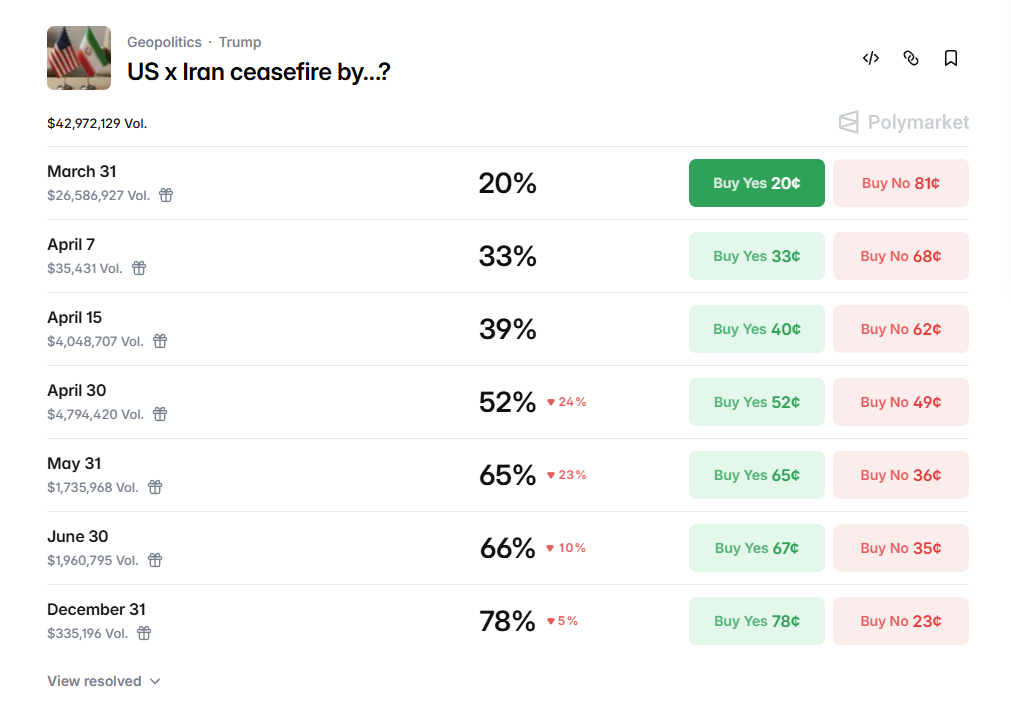
● According to on-chain data tracking, at least 10 recently created accounts on Polymarket's "U.S.-Iran ceasefire" market showed remarkable "foresight." These accounts concentrated their bets that a ceasefire agreement will be reached before March 31 or April 15, with a cumulative bet amount of approximately $160,000. If the ceasefire is achieved by the end of March, this batch of bets could yield potential profits exceeding $1 million.
● The timing of these accounts' positions was extremely sensitive. Most of them entered the market around March 21, when Trump had not yet issued any signals about a ceasefire, and the implied probability of a ceasefire in the market was only around 6%. This means these traders had to bet heavily in a low-probability haze, akin to a "go all in." After Trump's post, the unrealized gains of this batch of positions instantly increased by over $300,000.
● More astonishingly, these accounts are not "novices." One account named “NOTHINGEVERFRICKINGHAPPENS” is akin to a "prophet." This account was established in late February and its first two trades were bets of $7,600 that the U.S. would strike Iran before February 28 and $11,283 that a strike would occur before March 1.
These two trades brought the account over $85,000 in profits. Now, this account is once again making moves, precisely betting on the ceasefire, and its historical record has led the public to greatly speculate about its sources of information.
2. Is it Insider Trading or "Funding Capability"? On-Chain Traces Reveal Doubts
Faced with such precise timing abilities, cryptocurrency market observers and detectives on platform X (formerly Twitter) quickly launched investigations. Ben Yorke, a former researcher at CoinTelegraph, pointed out after analyzing the on-chain behavior of these accounts that the trades exhibited strong characteristics of insider trading.
The doubts mainly focus on two points:
1. Wallet Splitting Behavior: These accounts seem to have adopted a "wallet splitting" strategy, dispersing large funds across multiple newly created wallets to place bets. Yorke pointed out that this practice generally has two possibilities: either large funds to avoid impacting the market, or deliberately obscuring the true ownership of the funds.
2. Cost-Ignoring Positioning: These accounts did not adopt a gradual, testing strategy in building positions, but rather quickly "early moved" near the market price, fearing missing out on the window period. This urgent mindset resembles a race against time after acquiring certainty of information.
In addition to the on-chain doubts, traditional financial markets also showed similar "anomalies." Reportedly, 6,200 crude oil futures contracts suddenly exchanged hands approximately 15 minutes before Trump's post, with a nominal value of about $580 million; the trading volume of mini S&P 500 futures also saw an unusual surge at the same time. The "early move" in prediction markets and the anomalies in the futures market resonated with each other, deepening speculation about "insiders" leaking information in advance.
3. Platform's "Reinforcement": Polymarket Urgently Updates Insider Trading Rules
The pressure of public opinion and regulatory risks quickly forced the platform to take action. On March 23, Polymarket announced a comprehensive update of its market integrity rules and launched a dedicated "market integrity page."
The new rules clearly delineate three core red lines:
● Prohibit Trading Using Stolen Confidential Information: Trading on prediction markets using confidential information obtained through illegal means is prohibited.
● Prohibit Trading Using Illegal Insider Information: Using insider information transmitted through violations of others for building positions is prohibited.
● Prohibit Participation of Influential Entities: Individuals capable of influencing event outcomes (such as company executives, policymakers, athletes, etc.) are prohibited from participating in trades related to relevant contracts.
Polymarket's Chief Legal Officer Neal Kumar stated, "The prosperity of the market relies on clear rules. The reinforcement of these rules clarifies our expectations to every participant." Analysts pointed out that this move may indicate that Polymarket will follow the lead of its competitor Kalshi and conduct a formal investigation into the aforementioned suspicious accounts.
4. Regulatory "Siege": Rare Bipartisan Cooperation, Prediction Market Faces "Removing Fuel from the Fire"
● If the platform's self-discipline is "reinforcement," then the legislative action from the U.S. Congress is the real "removing fuel from the fire." Just as Polymarket was embroiled in insider trading controversies, U.S. Senators Adam Schiff (Democrat) and John Curtis (Republican) teamed up to introduce a bipartisan bill aimed at prohibiting prediction market platforms from offering contracts related to sports.
● This characterization is a devastating blow to the prediction market industry. A significant amount of new trading in recent prediction markets has precisely come from sports event products. If the bill passes, not only will Kalshi's business model suffer a severe blow, but Polymarket's expansion plans in the sports sector will also be completely curtailed.
● Meanwhile, state-level regulatory blockades are also escalating. Multiple states have viewed Kalshi and Polymarket as "sports betting platforms dressed as technology," and have taken legal action to impose restrictions. Although the U.S. Commodity Futures Trading Commission (CFTC), still under the control of the Trump administration, tends to support federal law over state law, concerns among bipartisan lawmakers regarding "war and death" prediction contracts have intensified, placing prediction markets in a dangerous situation straddling the lines of financial regulation, gambling regulation, and insider trading regulation.
5. AiCoin Perspective: Transparent On-Chain Data Leaves "Foxes" Nowhere to Hide
In this cloud of suspicion regarding "U.S.-Iran ceasefire" insider trading, the transparency of on-chain data has become key to revealing the issue. This is precisely the core advantage of the AiCoin platform.
The built-in Polymarket data dashboard of AiCoin provides users with real-time tracking of on-chain transactions, wallet fund flow tracing, and abnormal transaction alerts. In this game of war and peace, ordinary investors who rely solely on lagging news tend to become the "bag holders." Through AiCoin, users can:
1. Pierce the Veil of Anonymity: Use AiCoin's on-chain analysis tools to track the positions and timing of large wallets, identifying whether there are behaviors similar to "concentrated positioning" seen in this incident.
2. Monitor Market Depth: Observe changes in bid and ask orders for key event contracts, assisting in determining whether the capital inflow is due to retail behavior or an "early move" by institutions/insiders.
3. Capture Warning Signals: Combine AiCoin's real-time news with the on-chain monitoring system to receive alerts promptly when the implied probability in the market experiences significant changes, rather than waiting to realize after the news has fermented.
As of the time of publication, the implied probability of a ceasefire by "March 31" on Polymarket has surged from 6% before the event to 24%, with total betting amounts exceeding $21 million. Regardless of the final outcome of this high-stakes gamble, it has already left a profound lesson for this emerging industry: in an absolutely transparent on-chain world, there are no eternal secrets, only stricter regulations and smarter tools. For investors, rather than blindly following so-called "mysterious accounts," it is better to leverage professional tools like AiCoin to find their own certainty amid the fog of information.
Join our community to discuss and become stronger together!
Official Telegram community: https://t.me/aicoincn
AiCoin Chinese Twitter: https://x.com/AiCoinzh
OKX benefit group: https://aicoin.com/link/chat?cid=l61eM4owQ
Binance benefit group: https://aicoin.com/link/chat?cid=ynr7d1P6Z
免责声明:本文章仅代表作者个人观点,不代表本平台的立场和观点。本文章仅供信息分享,不构成对任何人的任何投资建议。用户与作者之间的任何争议,与本平台无关。如网页中刊载的文章或图片涉及侵权,请提供相关的权利证明和身份证明发送邮件到support@aicoin.com,本平台相关工作人员将会进行核查。


