Author: Kathy.xyz
The news that Tether has completed its first audit has been interpreted by the market as "planning to go public," which also caused Circle's stock price to plummet.
I just finished reading the article "Tether is not a stablecoin company" by @snapcrakle, published two days ago, which is the most comprehensive in-depth analysis of Tether in recent times. https://x.com/Snapcrackle/status/2036070394650644722
This article is a translation based on Snapcrakle's original text, with my interpretation added.
TLDR: @tether, established in 2014, originally issued the world's largest stablecoin USDT and has now evolved into a diversified corporate group spanning currency issuance, blockchain infrastructure, energy, and Bitcoin computing power.
Core Business: USDT, the undisputed leader in stablecoins
Tether's core product USDT is the largest stablecoin by market capitalization globally and is a foundational pillar of liquidity in the cryptocurrency market.
As of 2026, key data for USDT is as follows:
Total circulating supply: $186 billion
Global user count: over 550 million
Total on-chain transfers in 2025: $13.3 trillion (approximately 40% of the global stablecoin flow of $33 trillion)
Small payments under $1,000: $156 billion (mainly from emerging market users)
Tether's business model is built on "reserve interest": each USDT corresponds to an equivalent fiat currency reserve (primarily U.S. Treasury securities), and the interest generated by these reserves constitutes the company's core revenue source.
In 2025, Tether achieved over $10 billion in net profit with just 300 employees, making it one of the highest per capita profitable companies globally.
Tether currently holds more U.S. Treasury securities than Germany, making it a significant institutional investor in the U.S. Treasury market.
Industry Landscape: From Stablecoins to Full-Stack Infrastructure
Tether's strategic expansion follows a clear vertical integration logic—starting from currency issuance, extending upward to the blockchain clearing layer, and downward to energy and computing power infrastructure.
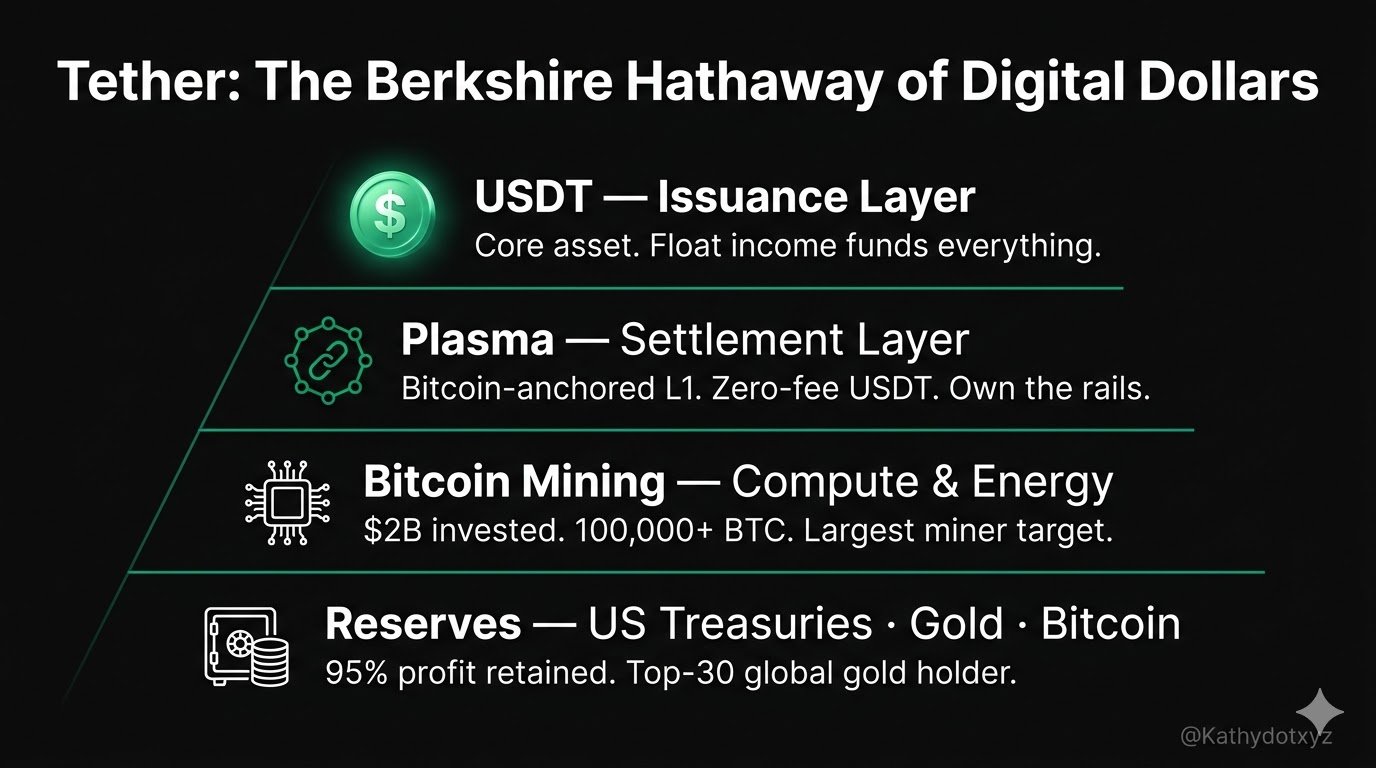
?Issuance Layer: USDT
USDT is Tether's core asset and the source of funding for all its expansions. Through the earnings generated from USDT reserves, Tether can continue to invest in new businesses without relying on external financing.
?Clearing Layer: Plasma @Plasma
In 2025, Tether launched its self-developed Layer-1 blockchain Plasma. Plasma is anchored to Bitcoin and designed specifically for stablecoin payment scenarios: it supports EVM compatibility, zero transaction fees for USDT transfers, and actively removes speculative features such as NFTs and meme coins. The strategic significance of this chain is that Tether no longer relies on third-party networks like Ethereum for USDT settlements and instead has control over the clearing sovereignty of its own currency.
⛏️Computing Power and Energy Layer: Bitcoin Mining
Tether has invested over $2 billion in Bitcoin mining and energy infrastructure and currently holds over 100,000 Bitcoins. CEO Paolo Ardoino has publicly stated that Tether's goal is to become the largest Bitcoin miner in the world by the end of the year. In terms of geographical layout, Tether has established mining sites in Uruguay, Paraguay, and El Salvador.
In the fourth quarter of 2025, Tether also open-sourced its self-developed mining operating system MOS, further strengthening its influence in the mining ecosystem.
?Reserve Layer: Diverse Asset Allocation
Tether retains 95% of its profits for reinvestment, forming a diversified reserve system mainly based on U.S. Treasury securities, supplemented by gold and Bitcoin. This allocation strategy is highly similar to Berkshire Hathaway's "float-driven investment" logic.
Strategic Investment Layout
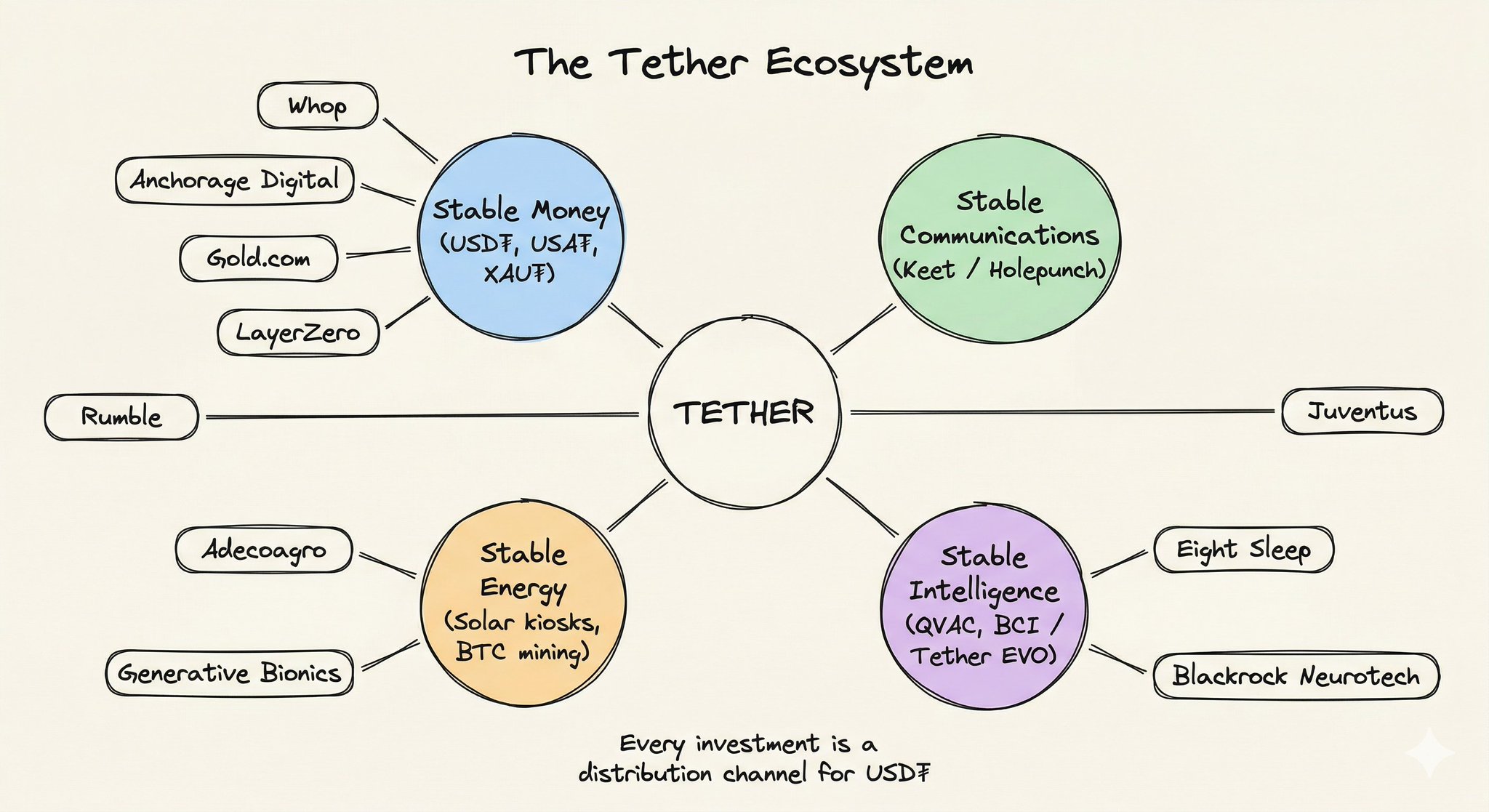
Tether has invested in over 100 companies across a wide range of fields:
Plasma financing: Led by Peter Thiel, raising a total of $500 million, reflecting top-tier capital's recognition of Tether's infrastructure strategy
Energy infrastructure: Establishing renewable energy mining sites in several Latin American countries, linking mining costs with clean energy;
Open-source ecosystem: Cultivating industry ecology through the open-source mining OS (MOS) to enhance influence over Bitcoin mining standards
Emerging market financial services: Investing in several payment channels and crypto banks in Africa and Latin America, connecting downstream channels
Precious metals and Bitcoin infrastructure: Layout for its asset reserves, including holdings in publicly traded companies such as Elemental Altu, Gold.com, Twenty One Capital, and Bitcoin collateral lending platform Ledn, etc.
Emerging technology fields: Highly diversified, including Generative Bionics (AI-driven prosthetics and bionic technology company), Neura Robotics (humanoid robots), Blackrock Neurotech (brain-computer interface medical device company), Rumble (video media platform)
Conclusion: The Path to Tether's Success
The success of Tether has completely deviated from the mainstream investment paths in the West. Its growth is rooted in the demand for U.S. dollars in many third-world countries, successfully converting into the adoption of USDT. This is a complete blind spot for Americans, who are accustomed to the dollar standard.
Tether's CEO @paoloardoino has a highly forward-looking vision, and the bold investments and layouts in recent years have further deepened Tether's moat.
免责声明:本文章仅代表作者个人观点,不代表本平台的立场和观点。本文章仅供信息分享,不构成对任何人的任何投资建议。用户与作者之间的任何争议,与本平台无关。如网页中刊载的文章或图片涉及侵权,请提供相关的权利证明和身份证明发送邮件到support@aicoin.com,本平台相关工作人员将会进行核查。


