Original author: Matt Hougan, Bitwise
Original translation: AididiaoJP, Foresight News
Even considering the concerns raised by the recent "CLARITY Act," I conservatively estimate that by 2030, Circle's valuation could reach $75 billion.
One of the questions we are most frequently asked is: "How to invest in stablecoins?"
Typically, we suggest focusing on the crypto assets that support the stablecoin ecosystem, such as Ethereum, Solana, and Chainlink, or on crypto companies that operate in this space, such as Circle and Coinbase. Due to the difficulty in predicting who will benefit the most from the rise of stablecoins, there is a view that investing in the entire field is a reasonable choice.
However, among the various options, one opportunity stands out: Circle, the issuer of the world's second-largest stablecoin USDC. It is the only listed company that is purely focused on stablecoins. In my view, this is the most straightforward choice.
So, is Circle a project worth investing in?
Today is a fitting time to answer this question, as the stock has recently fallen sharply (down 20% on Tuesday), due to reports that the latest draft of the "CLARITY Act" imposes restrictions on platforms paying interest income to stablecoin users. I believe the market's reaction to this news is somewhat overstated.
To illustrate this point, it is necessary to examine Circle's future from a macro perspective.
Three Key Questions Deciding Circle's Future Direction
1. How large will the stablecoin market become?
The first question concerns the potential growth scale of the stablecoin market. There are various predictions in the market, among which the one widely cited is from Citigroup's research report. The "base case" scenario in that report predicts that by 2030, assets under management in stablecoins will reach $1.9 trillion; the "bull case" predicts $4 trillion.
The relevant news about the "CLARITY Act" has not changed the aforementioned base case prediction. To date, interest income has not been the main driver of stablecoin growth; currently, the vast majority of stablecoins are held in a way that does not generate interest. The popularity of stablecoins lies in their ability to facilitate efficient and reliable global fund transfers, applicable in various scenarios such as trade settlement, collateral for lending, and as an alternative to unstable fiat currencies.
Convenience is the core application value of currency, and this is where stablecoins excel. Currently, the average yield on savings accounts nationwide in the U.S. is about 0.60%, while the average yield on checking accounts is approximately 0.07%. Users do not place their funds in these accounts primarily for the pursuit of returns. If the global financial system continues to move towards blockchain-based infrastructure, I expect stablecoins to play an increasingly important role in this transformation process, regardless of whether they offer interest.
In my judgment, Citigroup's base case prediction is actually quite conservative. Nevertheless, to adhere to a conservative analytical principle, we will still use $1.9 trillion as the basis for subsequent estimates.
2. What market share will Circle's USDC occupy?
Currently, Circle's USDC accounts for 25% of the total stablecoin market, trailing behind Tether's USDT.
(Why not choose to invest in Tether? Because Tether is a private company and cannot be publicly invested in.)
Stablecoin Market Capitalization Distribution
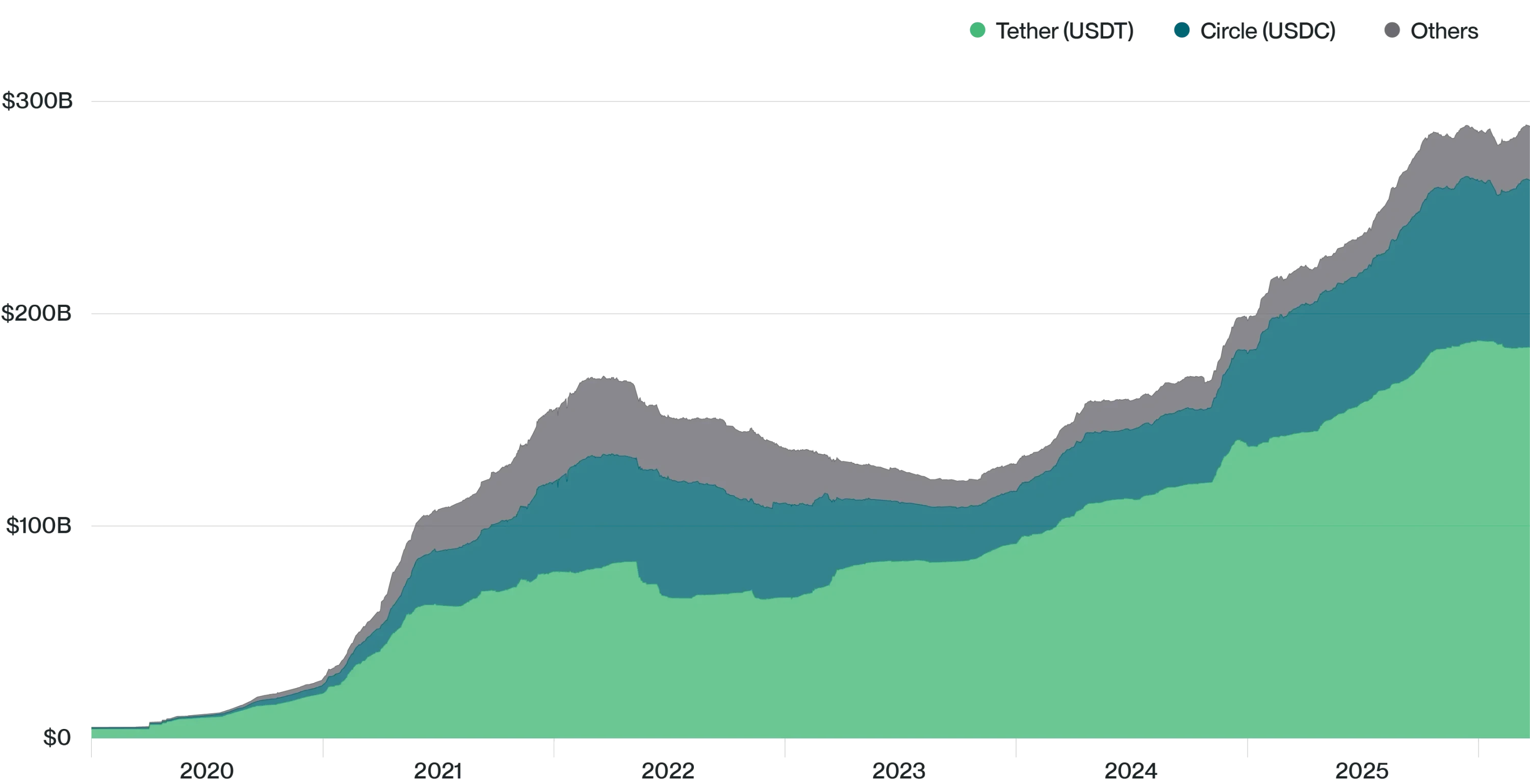
Source: Bitwise Asset Management, data from The Block. Data coverage period: January 1, 2020 to March 23, 2026. Note: "Others" includes BUSD, crvUSD, DAI, FDUSD, FEI, FRAX, GHO, GUSD, LUSD, MIM, PYUSD, TUSD, USDD, USDe, USDP, and USDS.
There is a prevailing view that Circle's market share will gradually decline as large institutions like U.S. banks, Stripe, and Wells Fargo enter the stablecoin space.
I remain cautious about this. Historically, innovative companies often manage to defend their early market leadership well.
For example:
- In 1976, the world’s first index fund was established by then-obscure Vanguard Group. Today, Vanguard ranks first in the field of global passive asset management.
- In 1993, the first exchange-traded fund SPY was launched by State Street Bank, which was not a giant in the asset management industry at the time. To this day, SPY remains the most actively traded exchange-traded fund globally, with assets exceeding $650 billion.
- In 1996, the first series of international exchange-traded funds was launched by an unknown asset management company called Barclays Global Investors. The firm was later acquired by BlackRock for $12 billion, and its business evolved into iShares, which now has assets under management of $5 trillion.
We are already seeing early signs that Circle can fend off competition from well-known companies: in 2023, major global digital payment company PayPal prominently launched its stablecoin PYUSD, but the market response has been lukewarm, with PYUSD's market share barely above 1%.
Of course, there are cases where large companies later overwhelm and squeeze out pioneers. For instance, in the money market fund space, fast-followers like Fidelity, Vanguard, and Federated Hermes captured most of the market share from the original innovators, the Reserve Fund Group. This situation is noteworthy, especially considering the similarities between money market funds and stablecoins: both absorb dollar funds and invest them in high-quality short-term securities like U.S. treasury bills.
Nevertheless, I still do not believe that large banks can easily crush Circle. I think there is also potential for Circle's market share to expand. After all, while Circle "only" holds 25% of the overall stablecoin market, its share is much higher in the regulated stablecoin sub-market (Tether's USDT mainly dominates the offshore market). While it is difficult to obtain precise data on Circle's share in the regulated market, I estimate this ratio exceeds 80%. If we consider that the growth of assets under management in stablecoins will mainly come from the regulated market (as banks, fintech companies, and large enterprises tend to prefer onshore, regulated stablecoins), then Circle's market share is likely to significantly exceed its current 25% level.
However, for the sake of this analysis's conservative principle, I will balance the above two forces and assume that Circle maintains its 25% market share going forward.
3. What is Circle's profit margin level?
The final question is the most complex and critical: how much income can Circle generate from its deposit assets?
Currently, Circle collects all interest income generated from U.S. treasuries that back USDC. At current interest rates, this means its $80 billion in assets under management can produce approximately 4% in annual returns.
However, this figure does not fully reflect Circle's actual income capacity, as we also need to consider the distribution fees it pays to acquire management assets. For example, USDC was jointly developed with Coinbase and serves as the primary stablecoin for that exchange. According to the relevant agreements, Circle pays Coinbase all the interest income generated by USDC held on the Coinbase platform, most of which is then passed on to users. Circle also has distribution agreements with other exchanges. Circle’s reasoning is that by paying fees to some distribution channels, it can kickstart a virtuous marketing cycle, thereby attracting assets directly, at which point Circle can capture a higher proportion of the income or realize asset monetization in other ways in the future.
Overall, Circle currently pays approximately 60% of its income to distribution partners. This means that at current interest rates, its actual "revenue rate" is about 1.6%.
Is this level sustainable? Two factors need to be considered.
The first is the level of interest rates. Circle's interest income is directly tied to market benchmark interest rates. Rate hikes by the Federal Reserve will be beneficial for Circle, while rate cuts will be detrimental.
The second is the competitive landscape. If we envision a market environment where there are hundreds of stablecoins, and users can freely switch between USDC, WFUSD, BAUSD, PYUSD, etc., Circle's ability to maintain its interest income will be constrained. From basic economic principles, competition tends to compress profit margins.
However, I am skeptical about this. Markets that should theoretically be "fully efficient" often are not in reality. Charles Schwab earns billions each year from the spread between the interest rates it pays to depositors and the rates it earns from deposits, despite the fact that customers can easily switch to higher-yield alternatives. But customers do not always take action because the core value proposition is not about returns but about convenience, trust, and business integration. USDC is similar in many ways: users hold USDC primarily because of its widespread applicability and credibility, not interest returns. This user stickiness is unlikely to disappear in the short term.
I would also like to point out that the current draft of the "CLARITY Act" may actually have a positive impact on Circle's profit margins, as the bill increases the difficulty of distributing interest income to stablecoin holders.
In summary, I believe that as competition intensifies, Circle will face greater pressure on its profit margins in the future. The company may even need to adjust its revenue model, which is something Circle is currently actively pursuing. For the purpose of this analysis, I will assume its revenue rate is halved, dropping to 0.8%.
Conclusion
Answering the three questions above does not encompass the entirety of Circle's business. As previously mentioned, Circle has launched its own blockchain, continues to innovate in payment technology, and its non-interest income is also growing rapidly. However, I believe examining the company through these three questions allows for an effective analysis of its stock value in an 80/20 manner.
Based on the above conservative estimates—specifically, a market size of $1.9 trillion, a 25% market share, and a 0.8% profit margin—it can be concluded that, after deducting distribution costs and before other expenses, the revenue would be $3.8 billion. Currently, the company's operating expenses are relatively low, projected at $144 million in 2025. This means that even if those costs grow two to three times by 2030, there would still be about $2.7 billion in post-tax earnings that could be converted into net profit. Valued at the current average price-to-earnings ratio of the S&P 500 index (28 times), Circle would be a company worth $75 billion.
This figure is quite significant, approximately double the company's current value. This performance is decent, but considering the volatility of the market, whether it is worth investing may deserve further consideration.
It should be noted that at every step of the analysis above, I have chosen conservative assumptions. If the growth of stablecoins meets the positive projections of Citigroup's bull case scenario, or if Circle's market share increases (as it has recently shown), or if the company can maintain its current revenue rate or discover new income sources, the valuation outcome will be significantly higher.
Overall, I can envision Circle's value being far higher than my rough estimates by 2030, as well as scenarios where it is lower than that estimate. I believe the value of this analysis lies in showing that Circle's current valuation is within a reasonable range. If the development of stablecoins aligns with general market expectations, then even under quite conservative assumptions, Circle can still be regarded as an attractive investment target.
免责声明:本文章仅代表作者个人观点,不代表本平台的立场和观点。本文章仅供信息分享,不构成对任何人的任何投资建议。用户与作者之间的任何争议,与本平台无关。如网页中刊载的文章或图片涉及侵权,请提供相关的权利证明和身份证明发送邮件到support@aicoin.com,本平台相关工作人员将会进行核查。


