Author: Koroush AK, Cryptocurrency Trader
Compiled by: Felix, PANews
How can beginners advance to top-level traders? Cryptocurrency trader Koroush AK recently published an article summarizing a practical advancement system that covers dimensions such as characteristics, strategies, and mindset. Here are the details.
This is what I wished I could have when I started trading nine years ago... and it is completely opposite to what most influencers teach you. I will provide you with a step-by-step roadmap that explains every stage of a trader's journey. You will clearly see your current position, the reasons for getting stuck, and the first issues you need to address.
Three Dimensions
If you are not making a profit, you may be experiencing one of the following situations:
- A strategy that does not make money
- A strategy you cannot consistently execute under pressure
- Using a strategy that cannot generate sustainable profits
This is the core of my model.
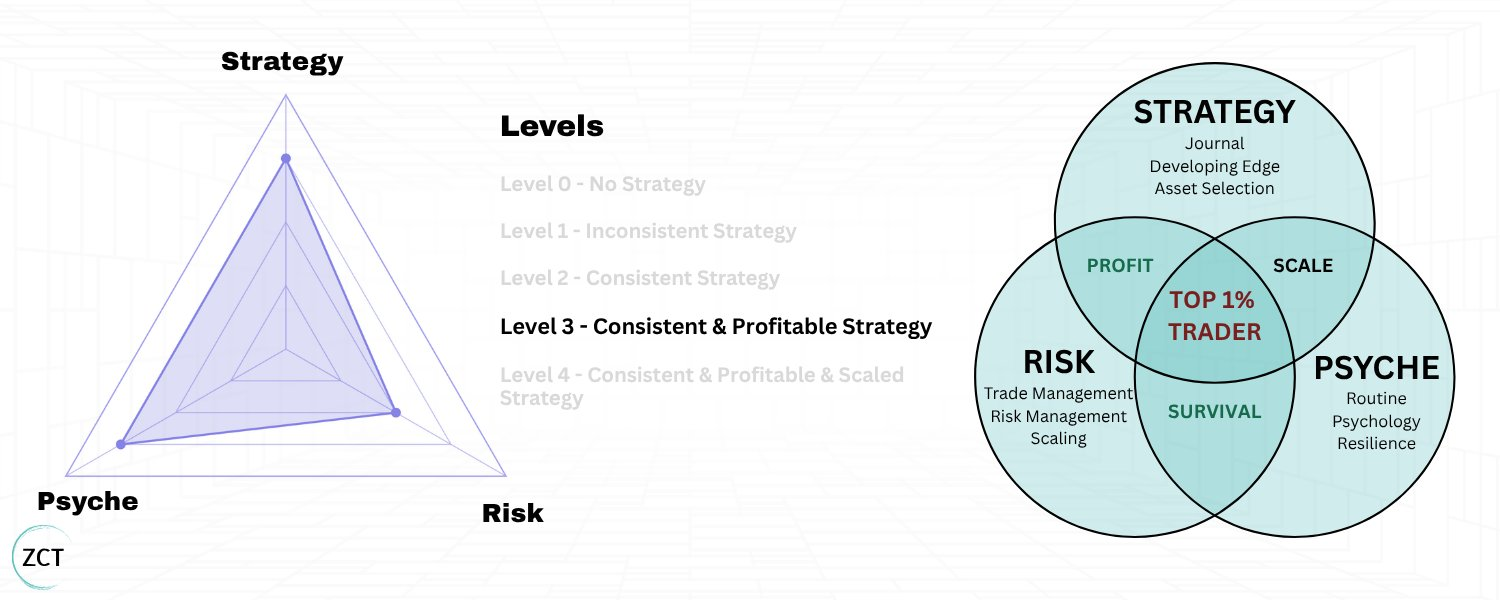
- Strategy: Your trading log, advantage development, and asset selection
- Risk: Your position management, trade management, and scaling
- Mindset: Your psychology, daily habits, and discipline
When these three dimensions overlap in pairs, specific capabilities emerge:
- Strategy + Risk = Profitability
- Strategy + Mindset = Scalability
- Risk + Mindset = Survival
- All three combined = Top 1% Elite Traders
At each level of the roadmap, one of these three dimensions will become a bottleneck. All issues ultimately boil down to one question: Is it strategy, risk, or mindset?
Level 0: No Strategy
This is the starting stage for every trader and is also the stage where many remain for longer than they realize.
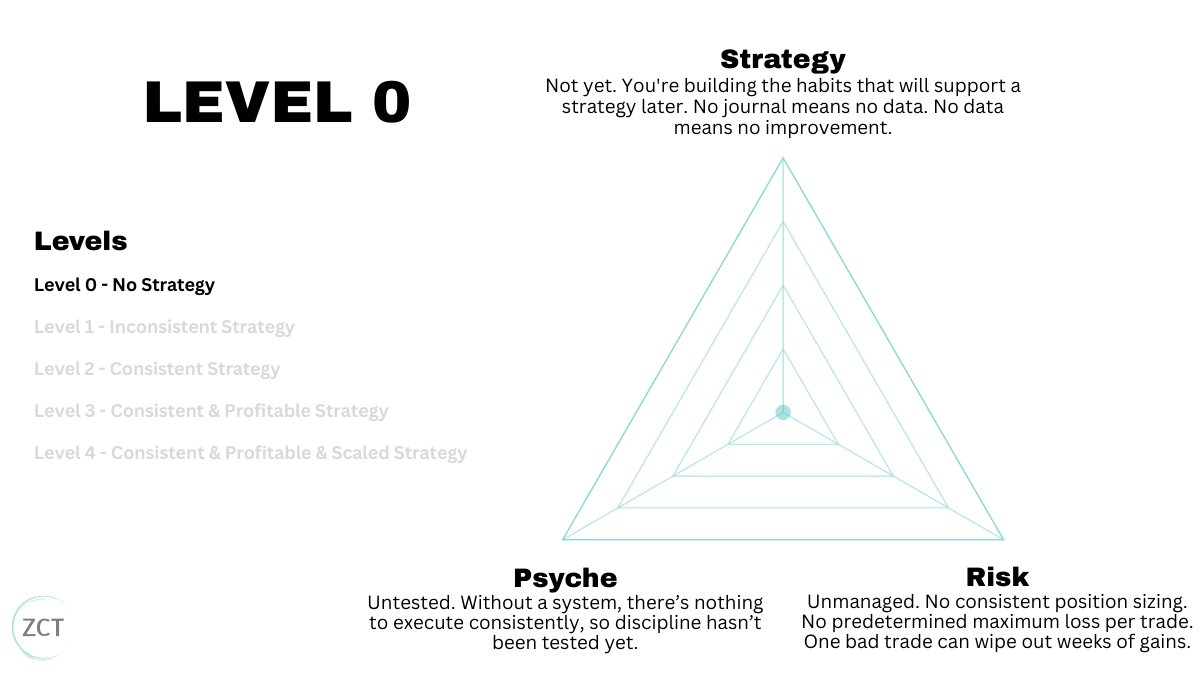
You are at Level 0 if you meet the following criteria:
- No strategy, only some tips and "intuition."
- No clear written rules for entry, exit, or stop-loss
- No trading log, no screenshots, no data
- Position size fluctuates wildly (1% today, 10% tomorrow)
- Profits feel like good skills, and losses feel like bad luck
What to do to move from Level 0 to Level 1:
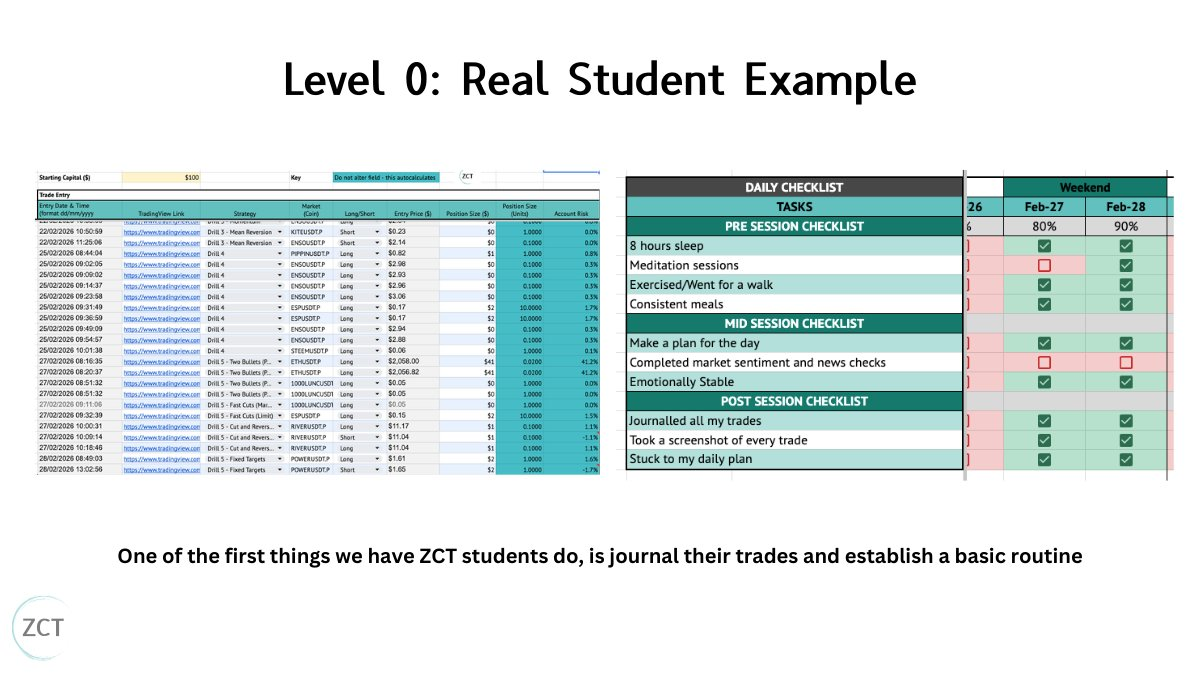
The goal at Level 0 is not to find a strategy. Rather, it is to develop three habits: a regular trading process, a trading log, and persistent resilience.
Strategy:
Start documenting immediately after each trade, including entry, exit, trade screenshots, and emotional state.
Note: The trading log is the most important tool for you as a trader at any stage. Without a trading log, there is no data... and without data, you will never improve.
Mindset:
Every Friday, devote two hours each day, and trade/study trading no matter what.
Ensure adequate sleep, a healthy diet, and regular exercise.
Trading is one of the hardest games in the world. It will test your psychological qualities before providing you with economic rewards. If you cannot sleep on time or eat three meals a day, your chances of success are zero.
Risk:
Maximum portfolio size: $100.
Common mistake: Thinking you need to learn everything before starting. You don't need technical analysis, risk management, or trading strategies right now; what you need is a trading log, a daily habit, and the willingness to persist.
The initial 30 trades are not about making money. They are about laying a solid foundation for everything that follows.
Level 0 Summary:
- Level 0 is not a strategy issue, but a structural issue.
- If you don't have a fixed process, trading log, and stability in trading, even if you are making money, you are still gambling.
- The current goal is not to find an edge but to develop habits that enable you to improve continuously.
- The focus is on: trading daily, recording every trade, and maintaining trading stability.
- Once you have recorded over 30 trades, you can move to Level 1.
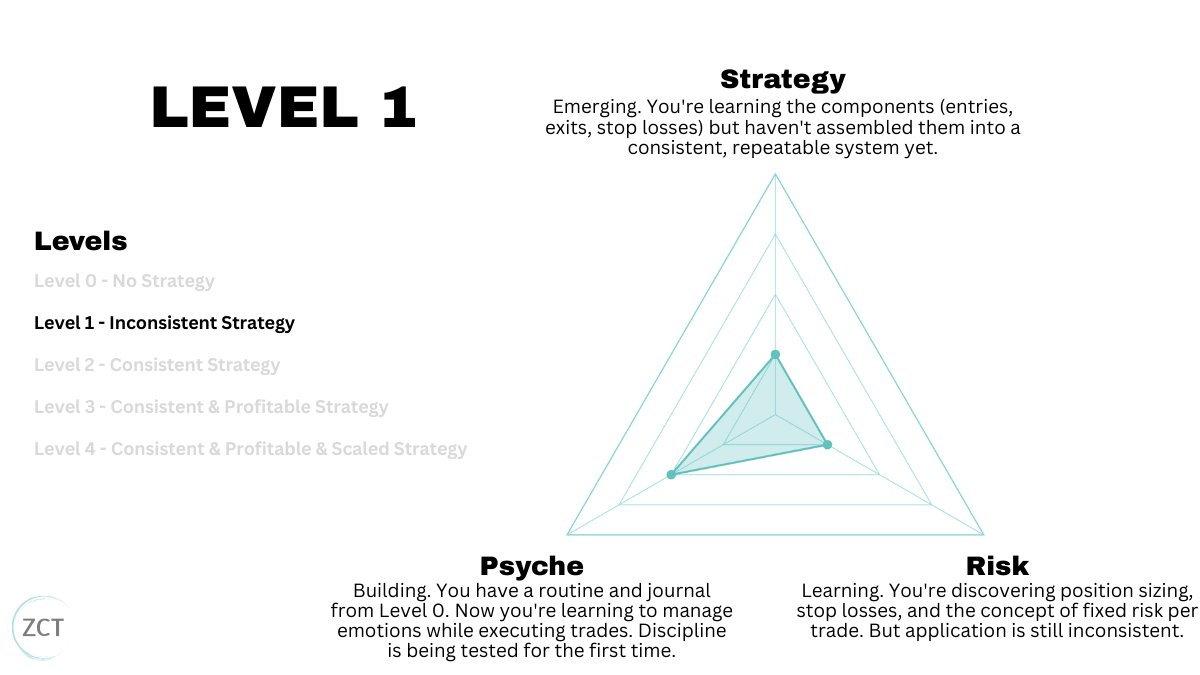
Level 1: Unstable Strategy
Now that you have laid the foundation, it's time to develop the skills that constitute trading strategies.
- Technical analysis provides you with a framework for interpreting prices.
- Risk management offers you a framework for protecting funds.
- Learning trading tools gives you the basic infrastructure for trading.
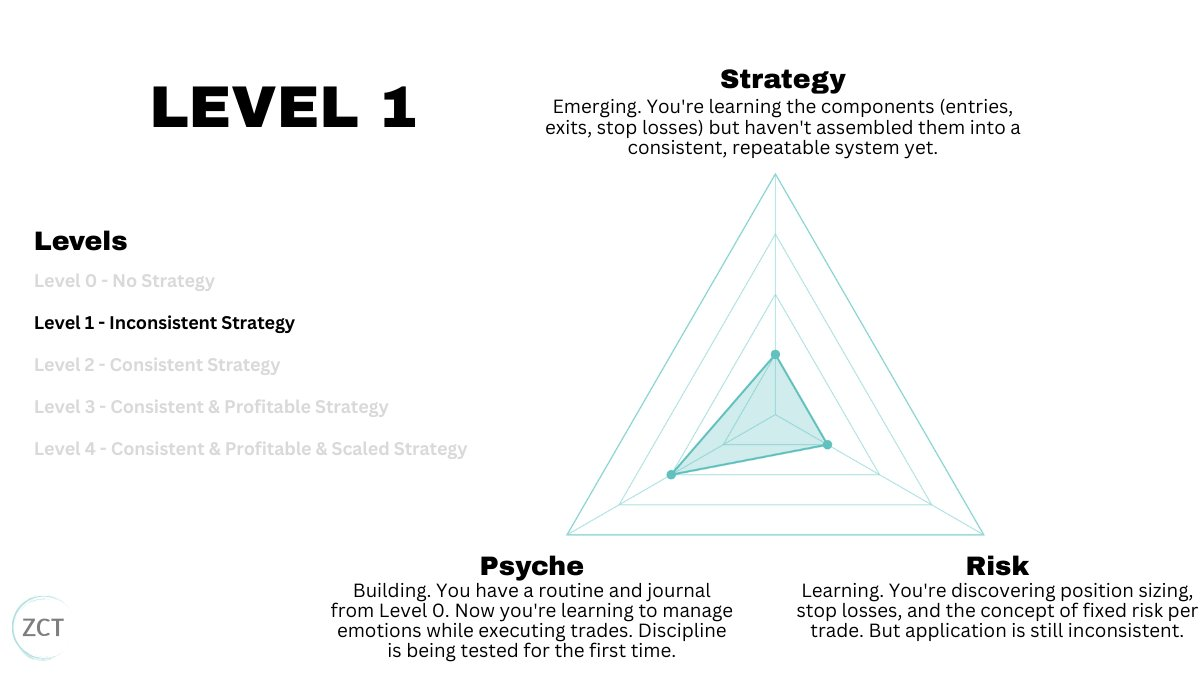
Typical performance at Level 1:
- Learning to read charts: support/resistance, candlestick patterns, market structure
- Setting up your exchange account, understanding order types, ensuring fund safety
- Starting to define entry triggers, stop-loss levels, and take-profit rules
- The risk of each trade gradually stabilizes, but there is still volatility
- The trading log contains data, but execution still shows fluctuation
What to do to move from Level 1 to Level 2:
Strategy:
- Learn price action, support/resistance, and volume. I have seen some traders earn over $10,000 a month just based on these.
- Learn to use your exchange (order types, leverage, trading settings)
- Develop a very basic breakout or reversal strategy. The strategy can be simple, such as “I will buy the breakout as long as a candlestick closes above the resistance level” (the goal at this stage is consistency, not profitability).
Risk:
Maximum portfolio size: $1,000.
No more funds are needed before proving profitability. Set fixed risk for each trade. 1% of the account is a good starting point. Calculate the position size before each trade: position size = maximum risk ÷ (entry price - stop-loss price).
Mindset:
No new focus. Maintain the habits and trading log established starting from Level 0.
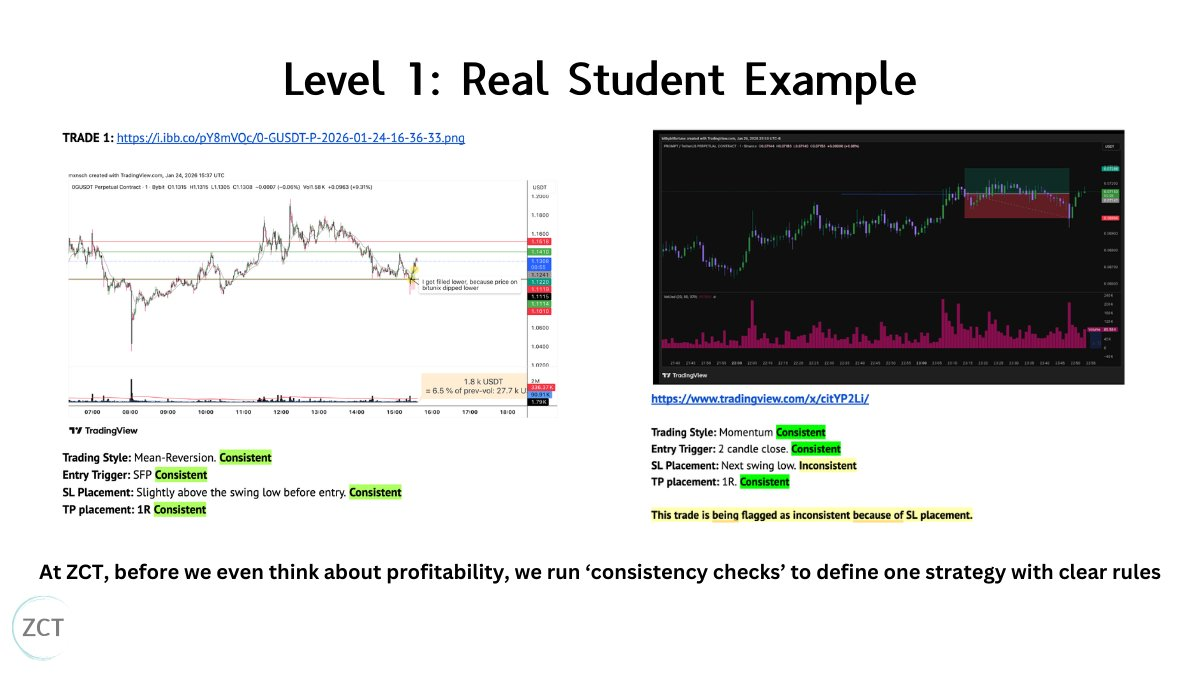
Level 1 Summary:
- Level 1 is the stage where you build your first strategy, but at this point, the strategy is not stable enough.
- Most traders get stuck here because they jump between different strategies instead of refining one.
- The goal is not to make a profit but to understand how the market moves and how your system works.
- Focus: Single strategy, fixed risk, and stable execution.
- Once your rules are clear and repeatable, you can move to Level 2.
Level 2: Stable Strategy
You have established rules and are strictly adhering to them. This is a stage that most traders will never reach. Now, you can begin to pursue profit.
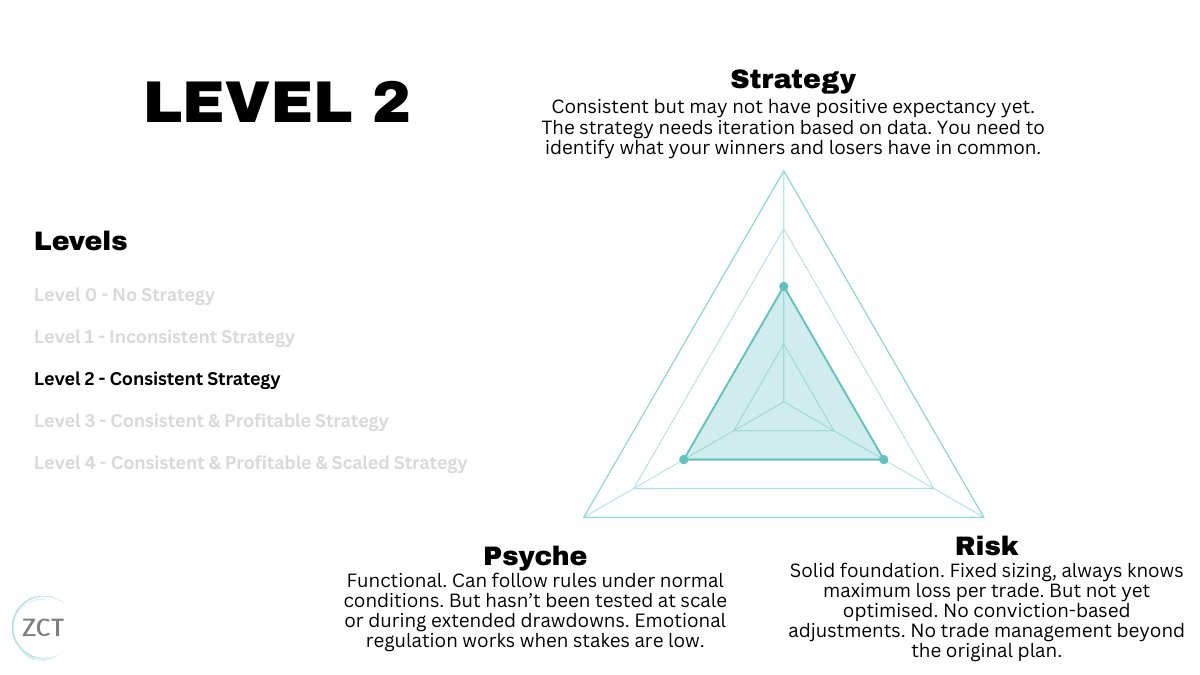
Typical characteristics of Level 2:
- Over 90% of trades follow strategy rules
- Record every trade, including screenshots and notes
- Have a workflow: checklist, report card, emotional self-check
- Data is clear and reliable
- Not yet achieving sustained profitability: equity curve may be flat or slightly negative
You need to transition from following rules to separating variables and refining rules. The improvement process is as follows:
- Losses: Improve ↓
- Reduced losses: Improve ↓
- Break-even: Improve ↓
- Slightly profitable: Improve ↓
- Increased profitability
What to do to move from Level 2 to Level 3:
Strategy:
- Enhance your asset selection ability. This is the most leverage you can gain in your improvements. A 10% improvement in asset selection can optimize your entry points, stop-loss points, and target prices at the same time. However, improving the entry point ability by 10% only optimizes the entry point.
- Develop the ability to identify market conditions. Understand what market conditions favor your strategy (hint: moving averages are very useful for this).
- Understand expected value: (Win Rate × Average Profit) - (Loss Rate × Average Loss)
- Learn to analyze trading log data. Filter trades into profitable and losing ones. Open all profitable screenshots in one tab and all losing screenshots in another tab, searching for patterns (hint: change only one variable at a time). Test over 30 trades and measure their impact, then repeat this process.
Risk:
No new focus. Just remember to keep the maximum portfolio size at $1,000.
Mindset:
Continue to maintain daily habits.
Common mistake: Changing too many variables at once. Or still pursuing the perfect entry point when asset selection is more impactful. Prioritize changes that yield the highest return.
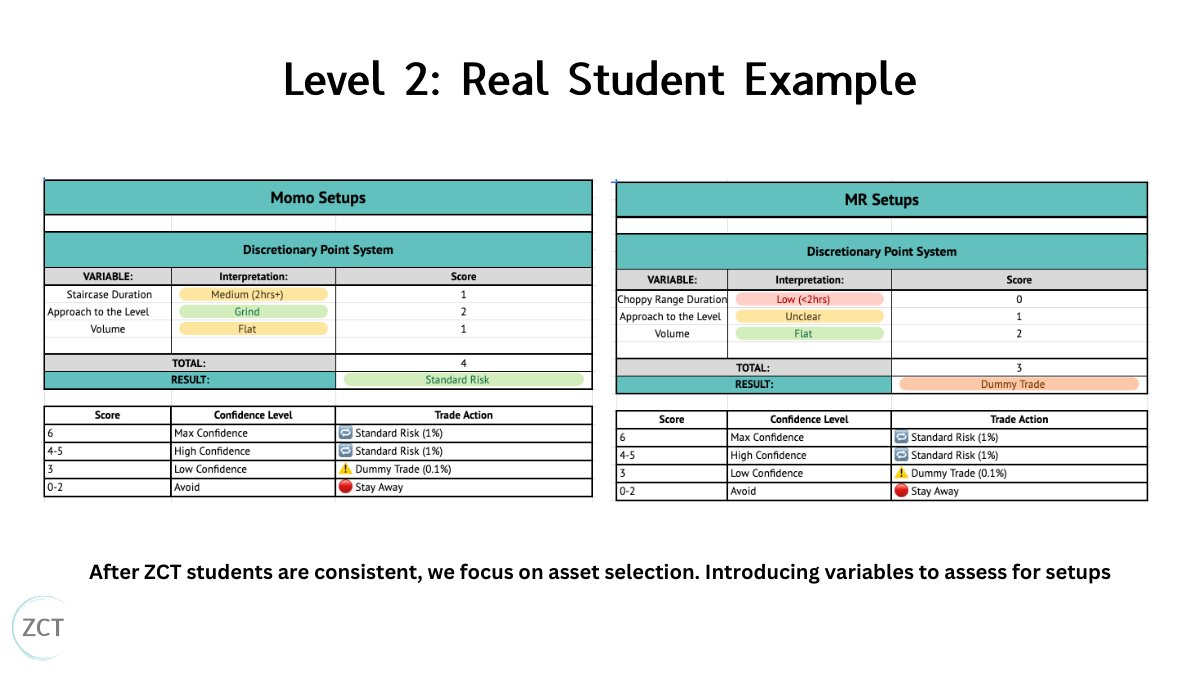
Level 2 Summary:
- The key to Level 2 is continuous improvement to achieve clear data; and clear data can lead to progress.
- Most traders stagnate because they change too many variables at once.
- The goal is to iterate your strategy from break-even to profitability.
- Focus: Analyze your trading logs, test one variable at a time, and refine asset selection.
- Once your expected returns are positive, you can move to Level 3.
Level 3: Stable Profit Strategy
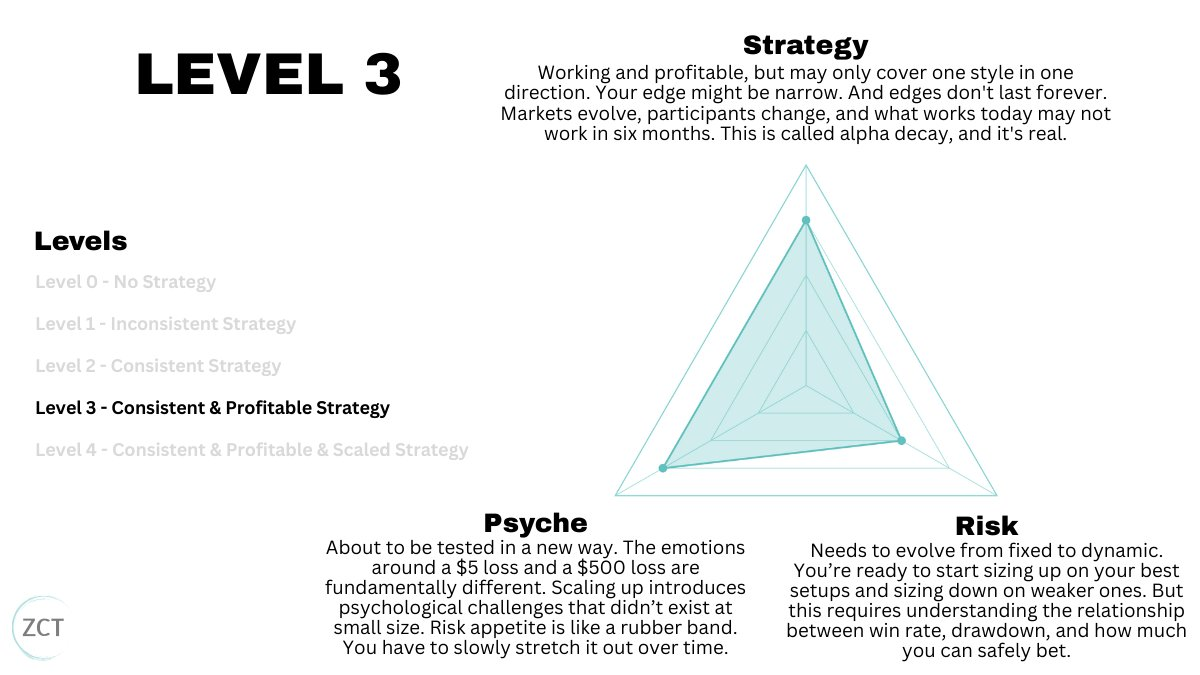
Congratulations, you are now consistently profitable and in the top 5%. This is a true milestone. All the strategies you’ve built are effective but limited to a small portfolio. The question now is: Can you scale without compromising your strategy?
In Level 2, you learned how to trade. In Level 3, you learn how to deepen your advantages and how to actively manage trades.
Typical characteristics of Level 3:
- Positive expected return from over 30 trades
- Equity curve is trending upwards
- Able to distinguish good trading opportunities from excellent trading opportunities
- Beginning to make autonomous decisions based on data
- Currently profitable, but scale has not yet reached a substantial level
Why are you stagnating?
You need two things to move forward:
- Proactive trade management (protect profits, smarter stop-losses)
- Continuous enhancement of advantages (evolving your strategy with market changes). Advantages are not permanent, and diminishing excess returns are real.
What to do to move from Level 3 to Level 4:
Strategy:
Expand your strategy. If you have been trading breakouts, then learn breakdowns. Then explore reversals. Each new trading style provides you with tools to handle different situations and reduces your holding time.
Risk:
Introduce proactive trade management. Start by recording that candlestick that made you lose confidence and write down why. Cultivate identification skills before adding execution actions.
Establish confidence-based position management. Not all trade setups are the same. Score each setup based on key variables. Your best setups can take on higher risks. Your worst setups can take on lower risks.
Mindset:
Prepare for psychological transitions during the scaling process. Losing $5 and losing $500 bring fundamentally different emotional experiences. Scaling brings challenges that were not present with small capital. Risk appetite is like a rubber band; it must be gradually stretched. The psychological challenges of scaling are the hardest part of trading.
Level 3 Summary:
- Level 3 refers to being able to profit, but on a smaller trading scale.
- Most traders stagnate because they fail to enhance their advantages or manage trades actively.
- The goal is to enhance your advantages and prepare to scale.
- Focus: Actively manage trades, expand strategies, and establish confidence-based trading sizes.
- Once the system can withstand pressure, you can move to Level 4.
Level 4: Stable, Profitable, and Scalable
Now, whether trading full-time or part-time, you can generate a substantial income.
In Level 4, you are no longer building a trading machine, but maintaining it, upgrading it, and ensuring it runs at full capacity.
Typical characteristics of Level 4:
- Consistently earning four to five figures in income each month
- Scaling up to a substantial portfolio size
- Applying multiple strategies in different market conditions
- Execution is smooth and highly automated
- Maintaining emotional stability under large positions
- Continuous improvement of advantages, treating it as a habit rather than a project
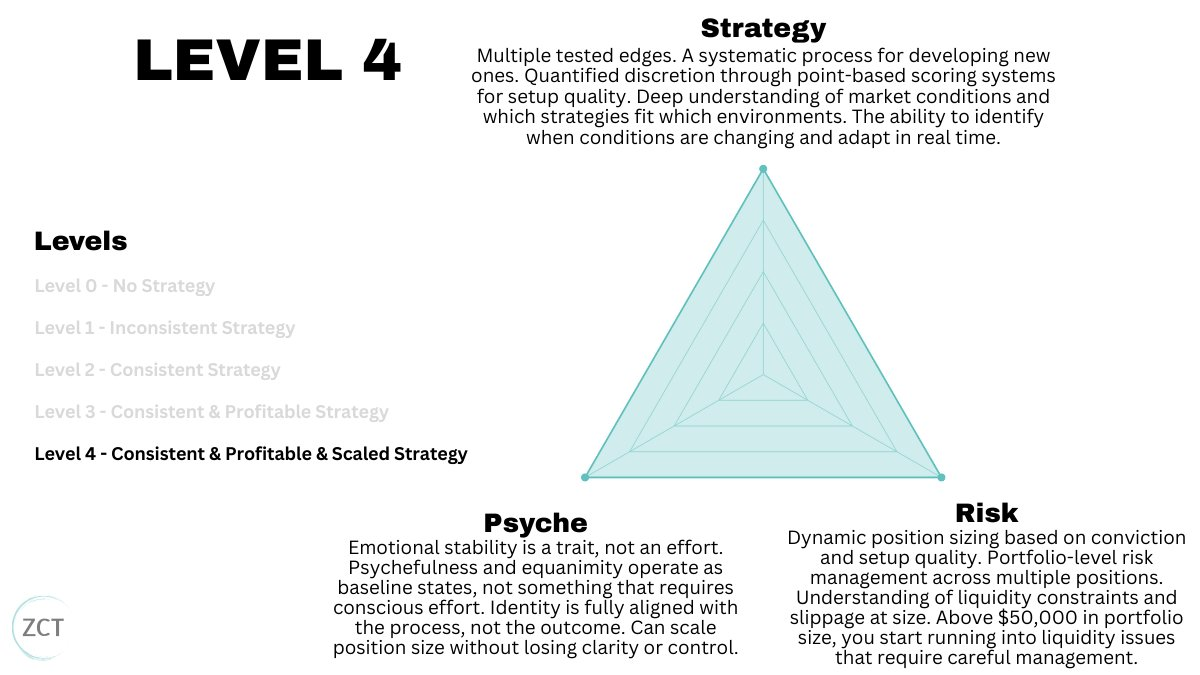
The psychological development at each stage varies.
- At Level 0, develop habits.
- At Level 1, manage emotions for the first time in live trading.
- At Level 2, follow rules under moderate pressure.
- At Level 3, combine system and judgment while maintaining composure.
- At Level 4, execution becomes incredibly smooth.
Ongoing challenges:
Markets are ever-changing. A strategy that works now may not work forever. The true advantage lies in your trading process itself.
Developing the skill of enhancing advantages is more valuable than any single advantage you currently hold.
Focus points for Level 4 traders:
- Psychological control: daily meditation, lifestyle optimization, structured emotional self-checks
- Systematic scaling: $1,000 → $2,000 → $5,000 → over $10,000, upgrade after at least 30 trades at each level
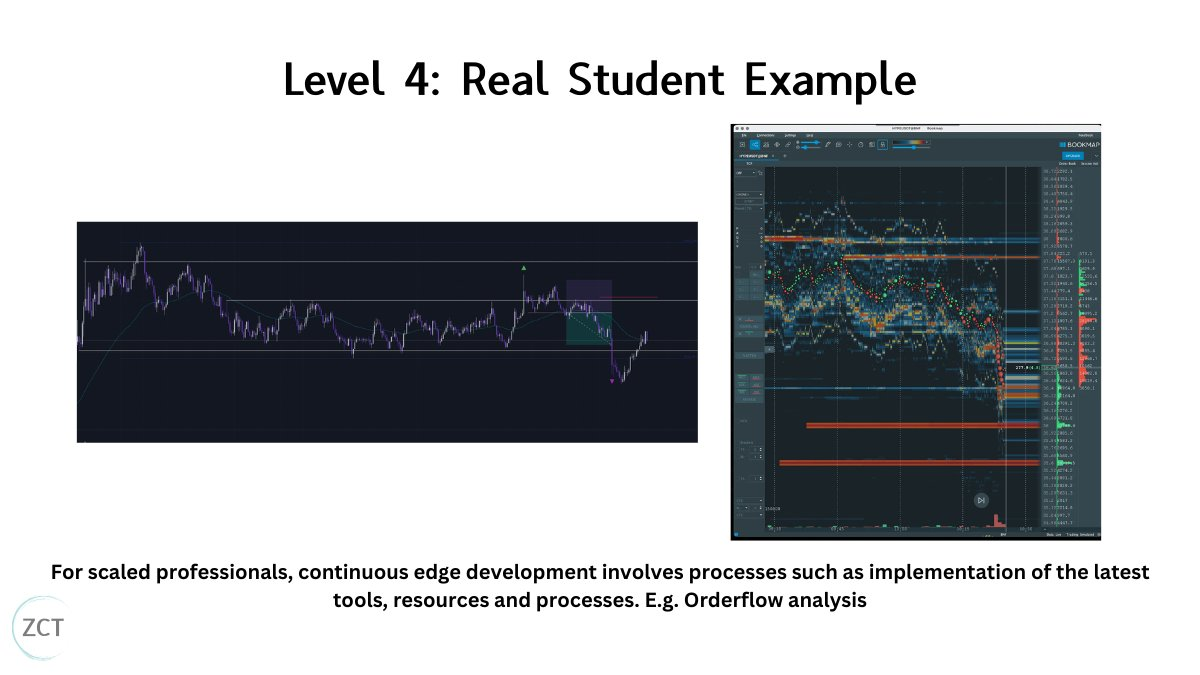
- Continuously enhance advantages through structured testing
- Seek new advantages
- Manage risk at the portfolio level across multiple strategies
- Address liquidity constraints with scale growth
Level 4 Summary:
- At Level 4, trading becomes a scalable source of income, but challenges are endless.
- Most traders fail at this stage because they cannot adapt to market changes.
- The goal is to maintain and enhance your advantages.
- Focus: Continuous testing, disciplined scaling, and portfolio-level risk management.
- The true advantage lies in your ability to continuously develop new advantages.
Further reading: Trader's Stock Trading Guide: Reject "Catching Falling Knives," Integrate Fundamentals, Technicals, and Emotional Bottom Fishing Strategies
免责声明:本文章仅代表作者个人观点,不代表本平台的立场和观点。本文章仅供信息分享,不构成对任何人的任何投资建议。用户与作者之间的任何争议,与本平台无关。如网页中刊载的文章或图片涉及侵权,请提供相关的权利证明和身份证明发送邮件到support@aicoin.com,本平台相关工作人员将会进行核查。


