Author: Luolu
When the Federal Court for the Southern District of New York dismissed the lawsuit against Binance on the grounds of "failure to prove direct connection to terrorism," the significance of this case goes far beyond a mere ruling.
The judge cited the "neutral service provider" principle established by the U.S. Supreme Court in social media platform cases, drawing a critical red line for the crypto industry: platforms that operate under anti-money laundering and sanctions compliance frameworks and treat users equally will not be easily dragged into the quagmire of "aiding crime."
This evokes memories of a landmark moment in the history of internet development—when early social media giants faced frequent lawsuits due to user behavior, it was the "platform neutrality" precedent that built a legal shield for them. Now, the crypto finance sector stands at a similar turning point: compliance is no longer a cost burden on operations but a "golden moat" determining whether a platform can prove its innocence in a regulatory storm.
From Binance investing hundreds of millions of dollars to rebuild its compliance system to industry players like Coinbase and Kraken collectively ramping up KYC and intelligence sharing, a clear signal has emerged—in the "second half" of the crypto asset trading industry, compliance is internalizing from external pressure into core competitiveness, acting as both a shield against legal risks and a cornerstone for gaining user trust.
Defeat in the "Aiding Terrorism Case" Secures "Universe Exchange"
On March 6, a judge of the Federal Court for the Southern District of New York dismissed a civil lawsuit aimed at holding the world's largest crypto asset exchange Binance and its founder Changpeng Zhao accountable, alleging that they helped multiple terrorist organizations carry out 64 attacks worldwide from 2017 to 2024.
In this case, the defendants argued that they simply provided conventional financial services and did not directly participate in or intend to assist specific terrorist attacks.
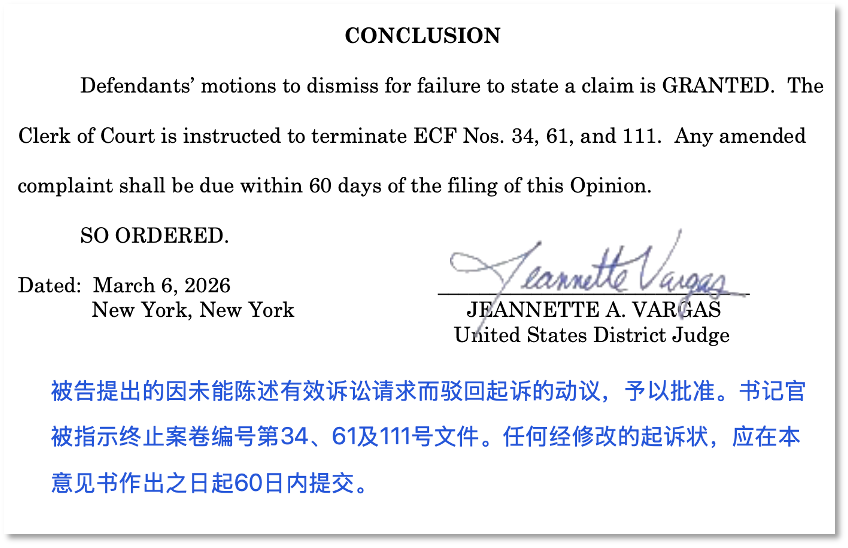
The judge dismissed the defendants' request
Ultimately, presiding judge Jeannette A. Vargas ruled that the 535 plaintiffs, including victims and their relatives, failed to reasonably allege that the defendants "guiltily had a direct connection to these terrorist attacks, intended to facilitate them, or ensured the success of the attacks through their actions."
Vargas extensively cited the U.S. Supreme Court's ruling in Twitter, Inc. v. Taamneh in her decision. That precedent established an important principle: if a company merely provides general, neutral services to the public (like a social media platform or crypto asset exchange), it cannot be deemed to "aid and abet" specific terrorist acts simply because its platform is exploited by bad actors.
This means that if crypto companies can demonstrate compliance with industry standards and legal requirements (such as KYC, AML) and treat all users equally, they can largely place themselves under the protective umbrella of "neutral service providers," avoiding secondary liability.
In this ruling, Judge Vargas allowed the plaintiffs to amend their complaint within 60 days to refile. However, Binance stated in a subsequent public response that any amended complaint would not rectify the fundamental defects pointed out by the court, "Today's ruling confirms that Binance's operations do not support, aid, or abet any form of terrorism."
Indeed, since November 2023, when Binance pleaded guilty to violating federal anti-money laundering and sanctions laws and was fined $4.32 billion, the largest and most heavily fined crypto finance company in the world has begun to increase investments in compliance infrastructure, regulatory participation, and legal governance to avoid re-engagement in legal risks.
According to Binance's public disclosures, they currently have over 1,500 dedicated compliance risk personnel, accounting for about 25% of their global workforce; 593 full-time employees manage compliance business units, and nearly a thousand others fulfill compliance functions across technology, product, and customer service departments.
In the past two years, Binance has not only tightened user identity verification but also adopted multiple measures including transaction monitoring, sanctions screening, behavioral analysis, and geo-fencing to identify suspicious/illegal users and funds.
Over the past few years, Binance has invested hundreds of millions of dollars in rebuilding a multi-layered compliance system, resulting in positive feedback. The most direct data shows that its sanctions risk exposure dropped nearly 97% in 18 months—from 0.284% of total transactions in January 2024 to 0.009% in July 2025.
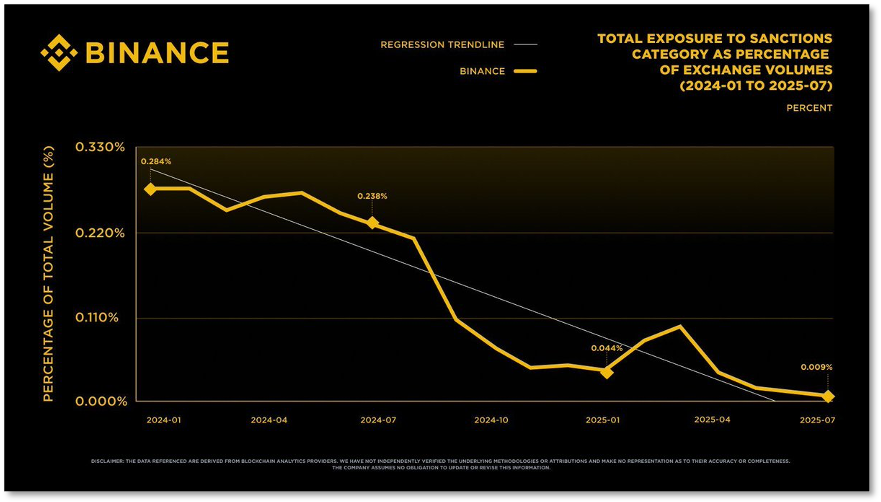
Binance's sanctions-related risk exposure decreased by 96.8% in one and a half years
Additionally, the direct interaction amount with major high-risk exchanges has dropped from $4.19 million to $110,000.
The significance of the defeat in the "Binance Aiding Terrorism Case" lies not only in clarifying this specific case but also in reflecting the phased achievements made by the crypto industry, represented by Binance, in compliance building.
Global Regulatory Tightening Leads Crypto Companies to Rapidly Enhance Compliance
An undeniable objective reality is that although the proportion of illegal trading volume in total cryptocurrency trading volume decreased in 2025—from 1.3% in 2024 to 1.2% in 2025—the illegal cryptocurrency trading volume reached a historic high of $158 billion, growing nearly 145% from 2024.
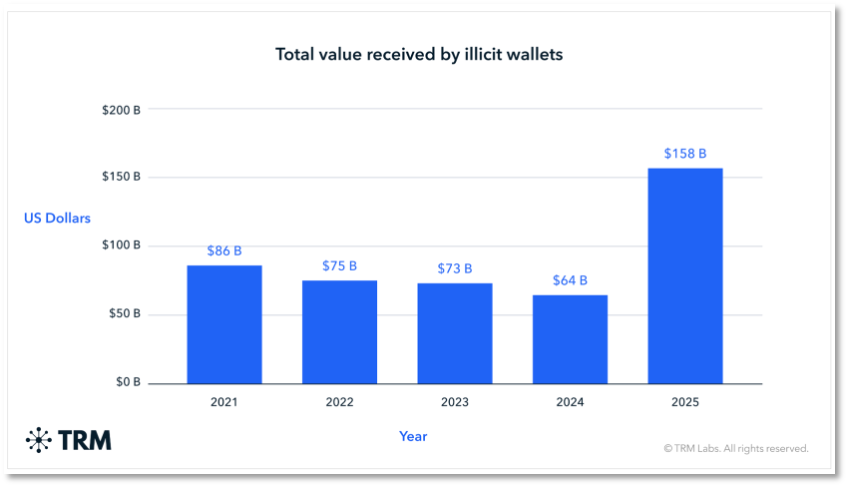
In 2025, the funds received by illegal crypto wallets reached $158 billion
This latest report data from TRM Labs presents new challenges for regulators and crypto financial companies striving for compliance. Related to this data, there are over 740 million global cryptocurrency users.
As illegal risks and user demands increase simultaneously, the expansion of regulatory coverage has become inevitable.
In the seven years since the FATF (Financial Action Task Force) explicitly required virtual asset service providers to register/license in its revised recommendation 15, a report released by the European Committee's anti-money laundering agency MONEYVAL in February this year shows that over 90% of jurisdictions worldwide have designated virtual asset regulatory bodies, with 81% requiring VASPs to be licensed.
The most noteworthy regulatory developments for the crypto industry are the implementation of the EU Anti-Money Laundering and Countering Illegal Activities Act (MiCA) and the U.S. GENIUS Act.
MiCA, fully implemented in 2025 along with the subsequent Transfer of Funds Regulation (TFR), has fundamentally changed the landscape of illegal economics in Europe, dismantling hundreds of previously used shell companies for money laundering and significantly reducing the transfer of funds from "non-custodial wallets" to EU exchanges by 30% in 2025, effectively suppressing illegal crypto activities.
In July 2025, the signing of the GENIUS Act marks the establishment of the first comprehensive federal stablecoin framework. This act authorizes the Department of the Treasury and the Office of the Comptroller of the Currency (OCC) to force issuing institutions to freeze assets. In 2025, this power facilitated the freezing of over $1.2 billion in stablecoins related to North Korean hacking, a record high for the retrieval of illegal funds by the U.S. Justice Department.
In addition to Europe and America, the Asia-Pacific region has seen Hong Kong begin to implement a licensing policy for crypto asset service providers, while Singapore's "Project Guardian" has also established some regulations for asset tokenization.
In the context of tightening regulation, compliance has shifted from a "cost item" to a "moat," forcing crypto finance companies to quickly ramp up investment.
Taking the industry leader Binance as an example, it has aggressively sought licenses or permissions in 20 jurisdictions globally and will officially operate its global platform Binance.com as an entity comprehensively authorized by the Abu Dhabi Global Market (ADGM) Financial Services Regulatory Authority (FSRA) after January 5, 2026.
Not long ago, Binance quietly announced it had obtained ISO 22301 certification, the compliance value of which lies in its high alignment with the EU's Digital Operational Resilience Act (DORA).
DORA requires all financial institutions operating in the EU (including crypto asset service providers) to have strong risk management capabilities for information and communication technology (ICT) as well as end-to-end operational resilience. Through ISO 22301, Binance not only upgraded its internal risk control but also presented a "standard answer" to EU regulators, proving it has aligned with international top standards in technical risk management and business continuity.
Currently, compliance is no longer a solo performance by a single company but a collective shift—even collaboration—across the entire crypto finance industry.
As of 2026, according to public information, North America's largest crypto asset trading platform Coinbase has built a threat intelligence sharing system (Crypto ISAC) that automatically shares high-quality threat indicators, including patterns of cyber attacks against consumers, fraud tactics, and scams bridging between crypto assets and traditional finance; its member institutions include well-known companies in the crypto asset field like Solana, Ripple, Binance, and Kraken.
More crypto asset trading platforms are enhancing their KYC processes, strictly adhering to international standards for "anti-money laundering/know your customer (AML/KYC) obligations," for instance, Kraken is using biometric KYC and Bybit has implemented tiered KYC reviews and established sanctions lists.
Redefining Competitiveness in the "Second Half" of Crypto Finance Through Compliance
From the layout of mainstream crypto finance companies, the compliance construction of the crypto industry has formed trends of intelligence sharing, transparency in reserves, technological sophistication, comprehensive certification, and global licensing.
Undoubtedly, the "compliance arms race" is raising the entry barriers for the entire industry, which not only favors "good money driving out bad" but also benefits the 760 million and counting crypto asset users.
This also means that the competition in the "second half" of the crypto asset trading industry will incorporate "compliance" as an important factor of contention.
To some extent, compliance is the quantitative expression of "trust." Regardless of users' fund scales, a safer trading environment, more transparent asset reserves, and more timely law enforcement collaboration will be crucial factors in their choices.
Binance's growth validates this. When the platform's illegal activity exposure dropped by 96% from January 2023 to June 2025, registered users increased from 130 million to over 300 million, doubling in just two and a half years; by the end of 2025, Binance's spot trading volume accounted for 35%-41% of the global total, nearly five times that of competitors.
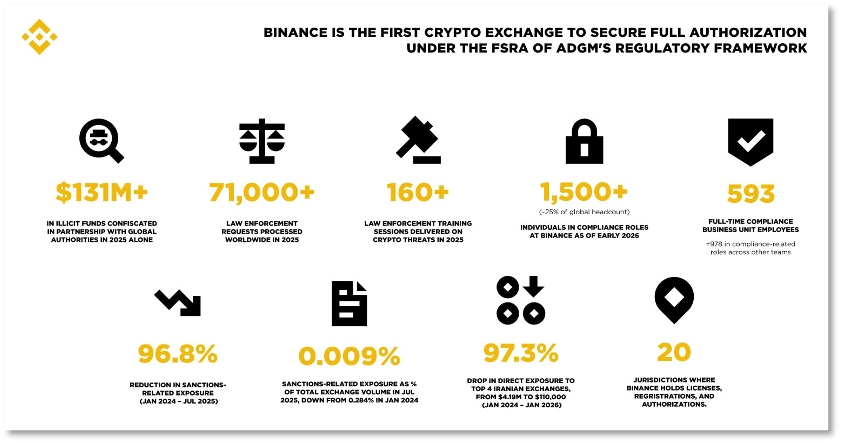
Data on Binance's compliance efforts
The company's co-CEO Richard Teng believes, "By embedding compliance into the DNA of our products, we are proving that the world's largest exchange can also be the safest."
Binance's investment in compliance is still increasing, planning to invest over $200 million annually in compliance infrastructure.
By 2025, hundreds of experts in sanctions, anti-terror financing, and financial crime investigations have joined Binance; the risk control system has intercepted about $6.69 billion in potential fraud risks for 5.4 million users; the compliance team has responded to over 71,000 law enforcement requests at an average rate of nearly 200 per day, assisting in the seizure of over $131 million in illegal funds; and hosted over 160 law enforcement training sessions globally to help enhance enforcement agencies' capabilities in investigating crypto crimes.
To govern the trading environment, on March 25, Binance issued guidelines for market makers, clearly stating that token issuers must disclose market maker information and banning profit-sharing and guaranteed return arrangements. Binance claims it will take swift and decisive action against any violations, including blacklisting non-compliant market makers.
This move has been recognized by industry figures, including Wintermute founder Evgeny Gaevoy, who stated, "I believe exchanges are best suited to set and maintain standards. Binance's initiative is very wise."
Whether it's Binance's multi-layered compliance system, Coinbase's intelligence sharing, Kraken's KYC upgrades, or Bybit's sanctions screening, they all testify to the same logic—crypto finance companies are enhancing their competitiveness through compliance.
As the crypto industry transitions from simply envisioning the "disruption of traditional finance" to more realistic "integration with traditional finance," compliance is no longer a superficial engineering task for obtaining licenses but has to be internalized, equating it with the safety of user assets and the survival of the platform, thus proving to the outside world that systematic compliance management can enable crypto assets to coexist with security.
(Disclaimer: Readers are advised to strictly comply with local laws and regulations; this article does not represent any investment advice)
免责声明:本文章仅代表作者个人观点,不代表本平台的立场和观点。本文章仅供信息分享,不构成对任何人的任何投资建议。用户与作者之间的任何争议,与本平台无关。如网页中刊载的文章或图片涉及侵权,请提供相关的权利证明和身份证明发送邮件到support@aicoin.com,本平台相关工作人员将会进行核查。


