Authored by: DaiDai, Frank, Maikong MSX Research Institute
39 new stocks launched, 38 with positive returns, 4 over 100%, 11 over 50%, what is the stock selection logic?
Q1 has quickly passed, have you made money in the repeatedly fluctuating market?
In 2026, the U.S. stock market has clearly switched to another state. Over the past 3 months, weighted stocks like the "Seven Sisters" have generally retreated by double digits, the index has also been shaky and weak, but the profit-making effect has not disappeared, from energy to optical communication, from military aerospace to AI hardware, Q1 has seen multiple main lines in parallel and rapid rotation, this change is directly transmitted to the supply side of trading, and has also been verified with data in Maikong MSX's latest Q1 new review.
Based on this, Maikong MSX has compiled the list of new launches in the first quarter along with internal data in hopes of serving as a cross-section sample to observe the main trading lines of the U.S. stock market in 2026, helping Web3 and U.S. stock investors to see the real temperature difference in U.S. stock trading this year more clearly.
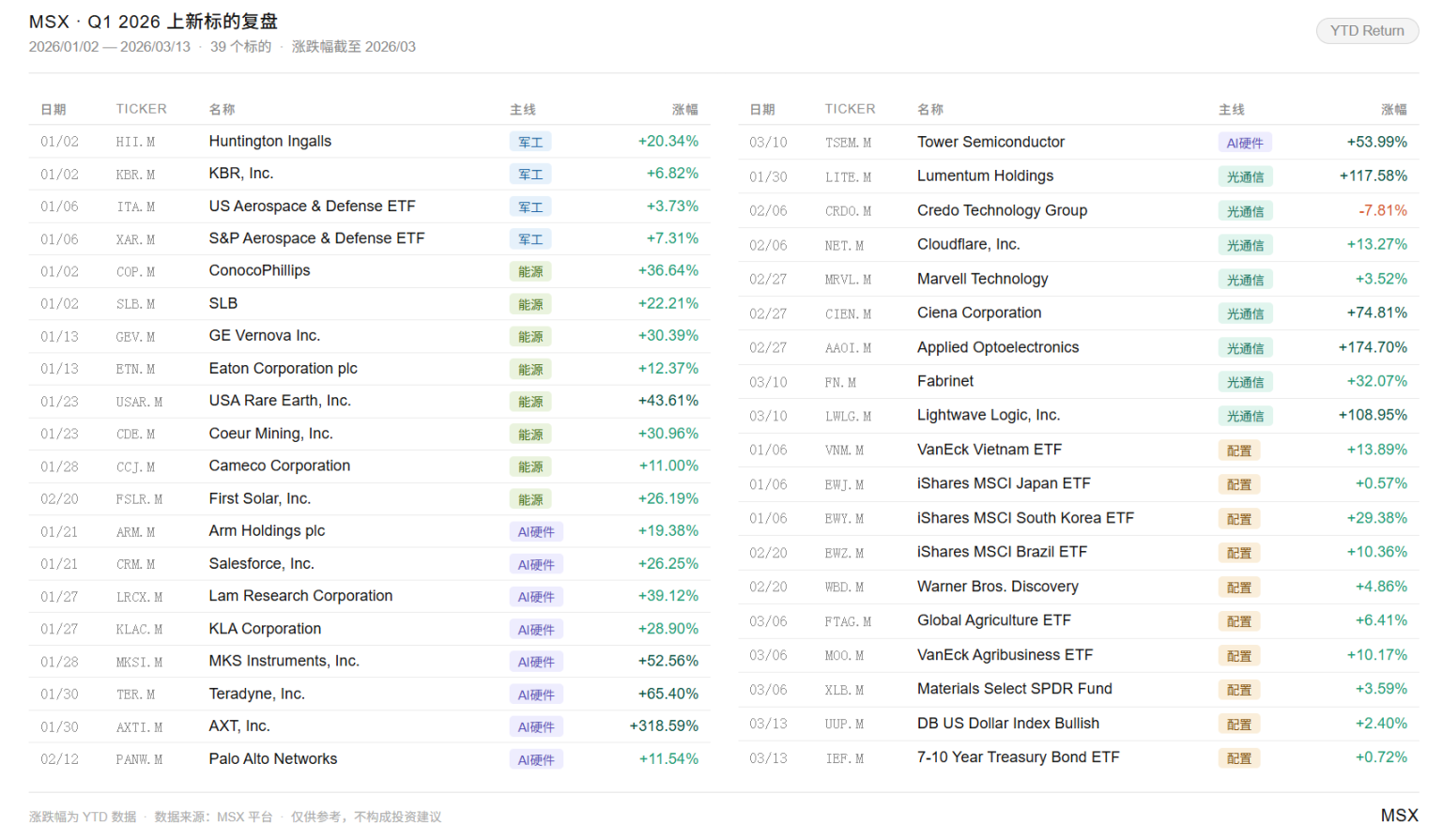
1. From an average increase of 37%, a glance at the main lines of the U.S. stock market in Q1
In the first quarter of 2026, the MSX platform launched a total of 39 new U.S. stock tokens, spanning from January 2 to March 13, covering individual U.S. stocks, industry ETFs, and macro tools, encompassing five main lines: military aerospace, energy resources, AI hardware, optical communication, and regional allocation.
The results show that this batch of targets performed remarkably. As of the time of writing, only 1 of the 39 targets recorded negative returns (CRDO.M, -7.81%), the rest all had positive returns.
Among them, there are a total of 4 targets with annual increases exceeding 100%: AXTI.M (+318.59%), AAOI.M (+174.70%), LITE.M (+117.58%), and LWLG.M (+108.95%), all concentrated in the AI hardware and optical communication main lines; in addition, there are also 7 targets with an increase of over 50%, accounting for nearly one-fifth.
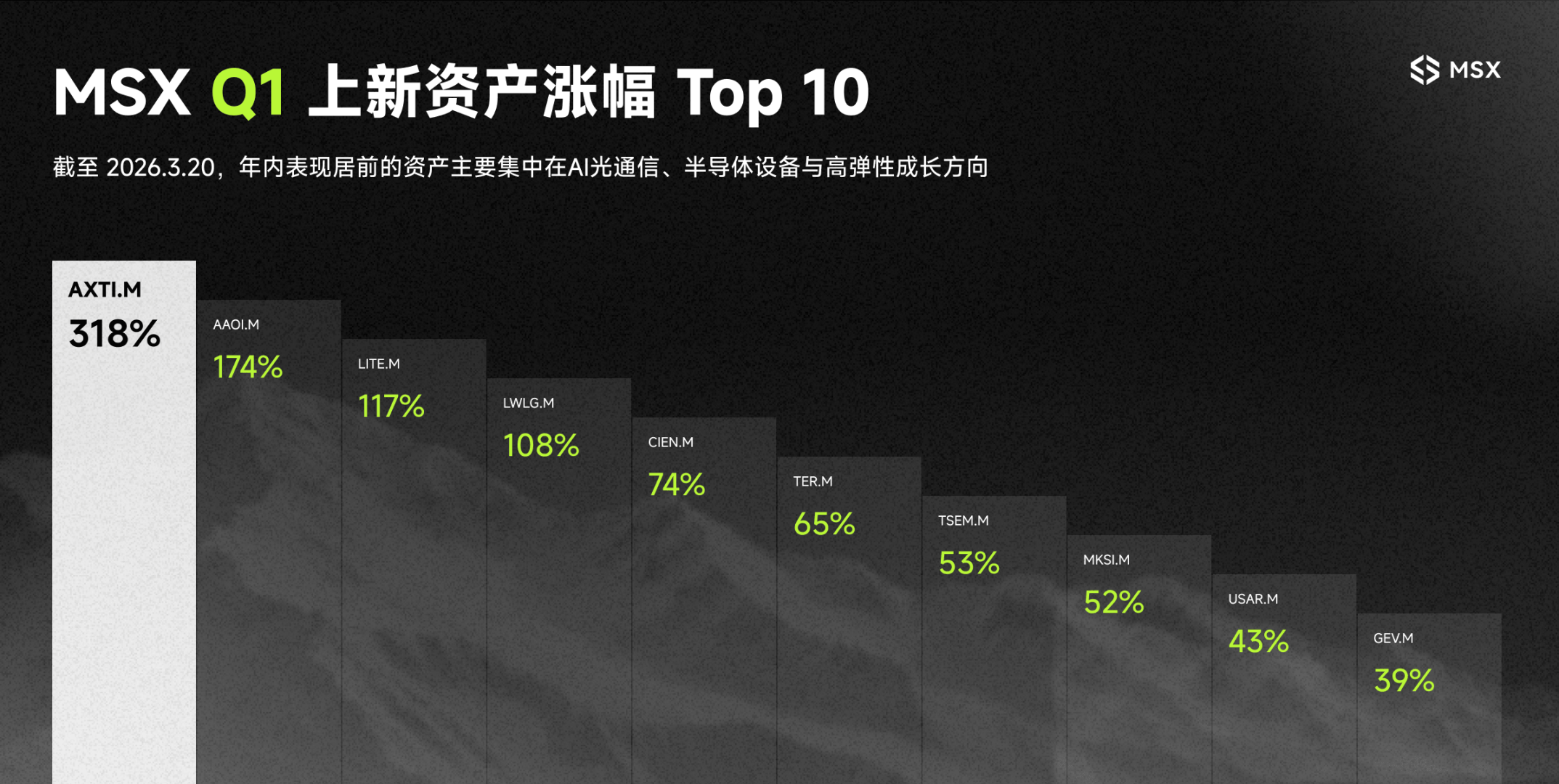
Viewed from an overall distribution perspective, the simple average increase among the 39 targets is +37.6% (the 20th target, HII.M), with the median increase being +20.3%, the mean is significantly higher than the median, which also indicates that the return distribution of this batch of assets presents a clear right-skewed feature, meaning that most targets provided stable, considerable positive returns, while a few high-elasticity targets pulled up a strong return tail at the top.
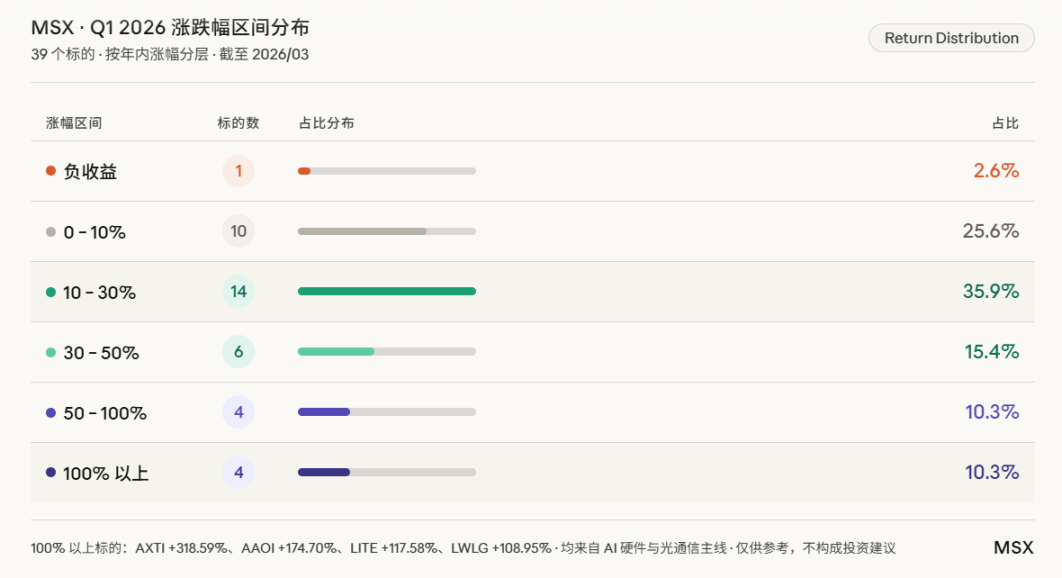
Breaking it down, 14 targets (35.9%) had annual increases between 10% and 30%, which is the most concentrated range in the distribution, forming the backbone of the entire asset pool, providing stable and predictable market Beta, serving as the ballast of the new combination.
Extending upward, there are 6 targets (15.4%) in the 30% to 50% range, 4 targets (10.3%) in the 50% to 100% range, and similarly, 4 targets (10.3%) over 100%. The total of these three high-return ranges signifies that more than one-third of the targets experienced annual increases exceeding 30%, and this result precisely stems from pre-emptive investments in the correct industrial main lines of AI hardware and optical communication (detailed in the next section).
It is worth separately noting the tail and head data.
On one hand, there is only 1 target with negative returns (CRDO.M, -7.81%), accounting for 2.6%, which can almost be ignored, especially in Q1 when styles switched quickly and sectors rotated frequently; such a positive return coverage itself indicates that the stock selection direction was generally accurate.
On the other hand, the 4 doubling stocks, AXTI.M (+318.59%), AAOI.M (+174.70%), LITE.M (+117.58%), and LWLG.M (+108.95%), are all concentrated in the AI hardware and optical communication main lines, which is no coincidence and further indicates that what really widens the return gap is not the "wide net" approach, but first pinpointing the direction and then finding the most elastic expression within the sub-chain.
In other words, the most noteworthy aspect of this Q1 new list is not just the overall good profit-making effect, but rather it presents a very typical structure: the backbone targets provide relatively stable Beta, while a few high-elasticity targets contribute excess returns; the coexistence of these two types of assets collectively forms a genuinely "A-grade" report card.
2. AI Hardware and Optical Communication: Why are they the strongest dual main lines in Q1?
Looking at the average returns from the five main lines, AI hardware and optical communication undoubtedly comprise the two strongest offensive main lines in the U.S. stock market in Q1.
Among them, the 9 targets in the AI hardware direction had an average annual increase of 68.4%, and even after excluding the extremely high increase of AXTI.M (+318.59%), the mean still reached 37.1%, indicating that the excess returns of this line are not supported by a single dark horse but rather that the entire sub-industry chain achieved a relatively systematic payout in Q1.
This point is actually crucial. It means that the market's trading of AI is no longer stagnant at the superficial narrative of large models or a few super-leading finds, but is continuing to spread toward more fundamental layers such as semiconductor equipment, testing equipment, manufacturing links, and industrial chain support, meaning that capital has begun to shift from "buy imagination" to "buy realization path," which is precisely why the AI hardware chain achieved higher win rates and greater elasticity in Q1.
Following closely, the optical communication direction achieved an average increase of 64.6%. The strength of this sector does not entirely rely on a single extreme value to boost it, but rather presents a blossoming state, with a more uniform distribution—AAOI.M (+174.70%), LITE.M (+117.58%), LWLG.M (+108.95%), CIEN.M (+74.81%) and others successively gaining strength.
This essentially reflects that as the construction of AI data centers accelerates, the demands for optical interconnect, optical modules, network links, and related infrastructure are witnessing a concentrated release, confirming the comprehensive explosion of demands for optical interconnect from AI data centers.
When viewed together, if AI hardware represents "computing power realization," then optical communication seems to reflect "how data is truly delivered after the expansion of computing power," and in 2026, as AI infrastructure gradually transitions from concept to engineering rollout, the importance of the latter is clearly rising rapidly.
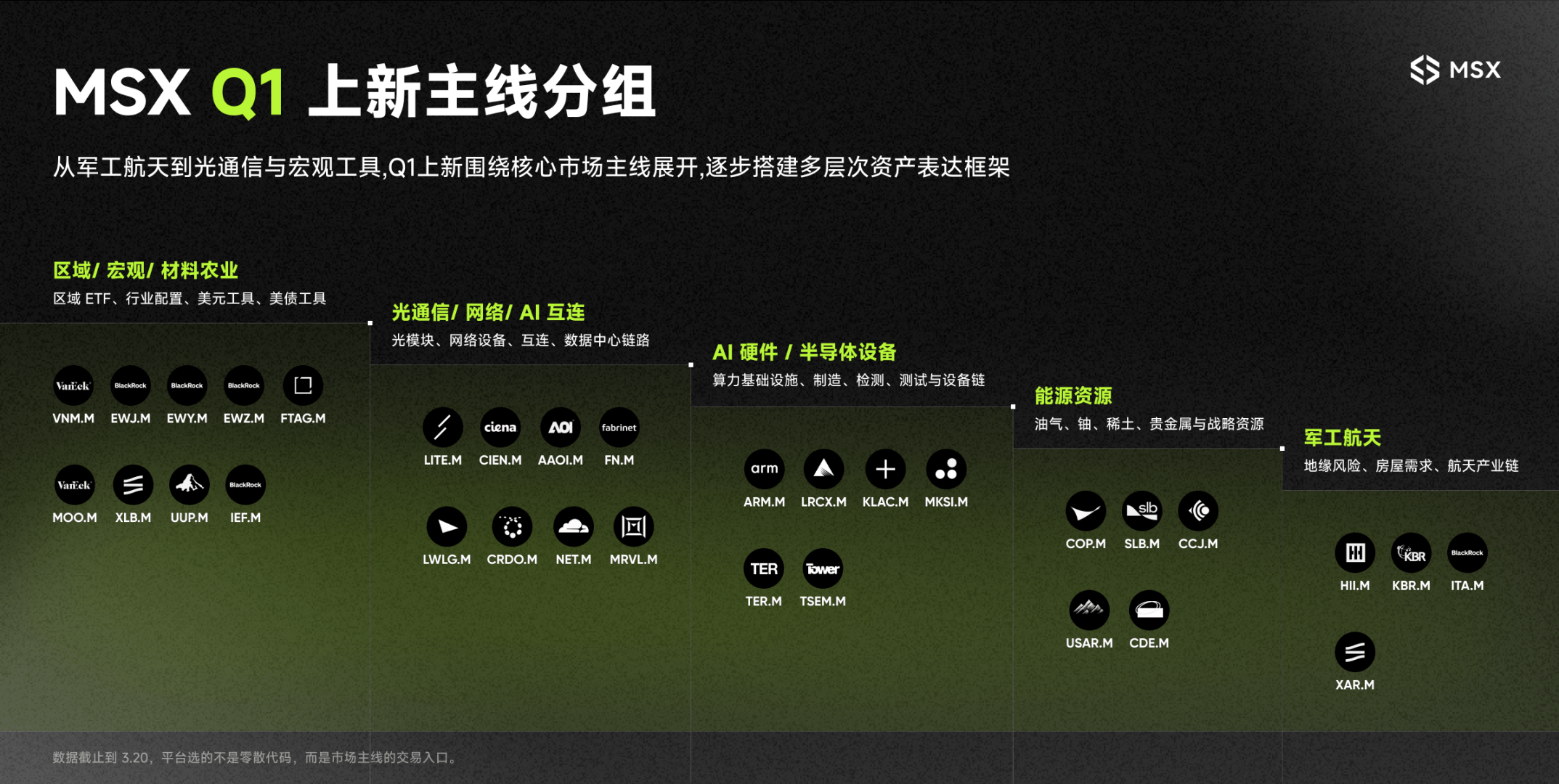
In contrast, the energy resource direction had an average increase of 26.7% among 8 targets, although not as striking as the first two, it remains quite robust, with various sub-divisions like oil and gas, uranium, rare earth, and precious metals each possessing independent driving logic.
They are not the kind of main line that experiences point explosions, but rather are the most diversified theme within the entire asset pool, yet anchoring the strongest resilience, supported by the continuous fermentation of multiple macro logics such as inflation, geopolitics, supply chain restructuring, and resource security.
As for military aerospace and allocation tools, the average increases were 9.6% and 8.2%, respectively, seemingly trailing behind the first three main lines; however, this does not mean they are "underperforming," as both fulfill entirely different roles within the combination:
- Targets in the military aerospace direction are event-driven, profit releases depend on the rhythm of geopolitical conflicts, budget changes, or policy catalysts, and do not inherently possess the property of linear increases;
- The allocation tools direction encompasses regional ETFs from Vietnam, Japan, South Korea, Brazil, and also includes dollar and U.S. Treasury tools, whose core value lies not in pursuing extreme increases but rather in providing broader market expressions and positioning balance tools;
In some sense, the allocation tools line, with the most targets and the lowest average, further illustrates that MSX did not merely focus on the most popular tracks while building the asset framework to pile up elasticity but has consciously maintained sufficient allocation flexibility and hedging space beyond aggressive strategies.
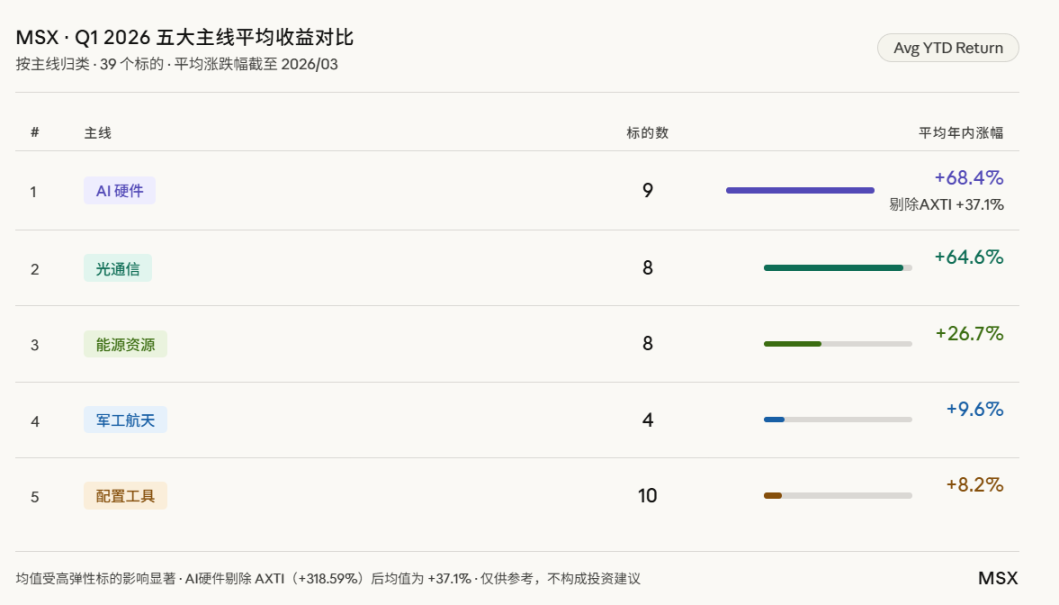
This is also the consistent logic of MSX's new stock selection and investment—not putting all chips on a single hottest main line, but rather consciously layering between high-elastic assets and allocation tools, allowing aggressive, allocation, and defensive functions to coexist.
3. What is the true logic of stock selection and investment?
If only looking at the results in retrospect, this new launch list in Q1 can certainly be simply concluded as "accurate selection."
However, more important than the result is the underlying methodology, which is whether an asset can be included on the platform, which hinges not only on whether it will increase in the short term but also on whether it can represent a view that can be continuously traded, combinatively used, and switched with market rotations.
In fact, the time distribution of launches shows clues; MSX's progress in Q1 was not a one-time roll-out but clearly bore characteristics of dynamically following market stages:
- New launches in January focused on military aerospace, energy resources, regional ETFs, power equipment, and semiconductor equipment, which built the underlying framework related to macro, geopolitics, manufacturing, and resource security;
- February started to visibly delve deeper into the AI infrastructure sub-chain, shifting focus to optical communication, interconnection, network security, and more elastic semiconductor varieties;
- In March, it further supplemented agriculture and materials ETFs, continued to refine the optical communication and semiconductor landscape, while adding dollar and U.S. Treasury tools, allowing the entire asset framework to gradually expand from "attack pool" to a toolbox with switching capabilities;
This rhythm in timing itself indicates that Maikong MSX's stock selection new launches do not have a static list but are a set of dynamically updatable asset frameworks that change with the variations of market main lines.
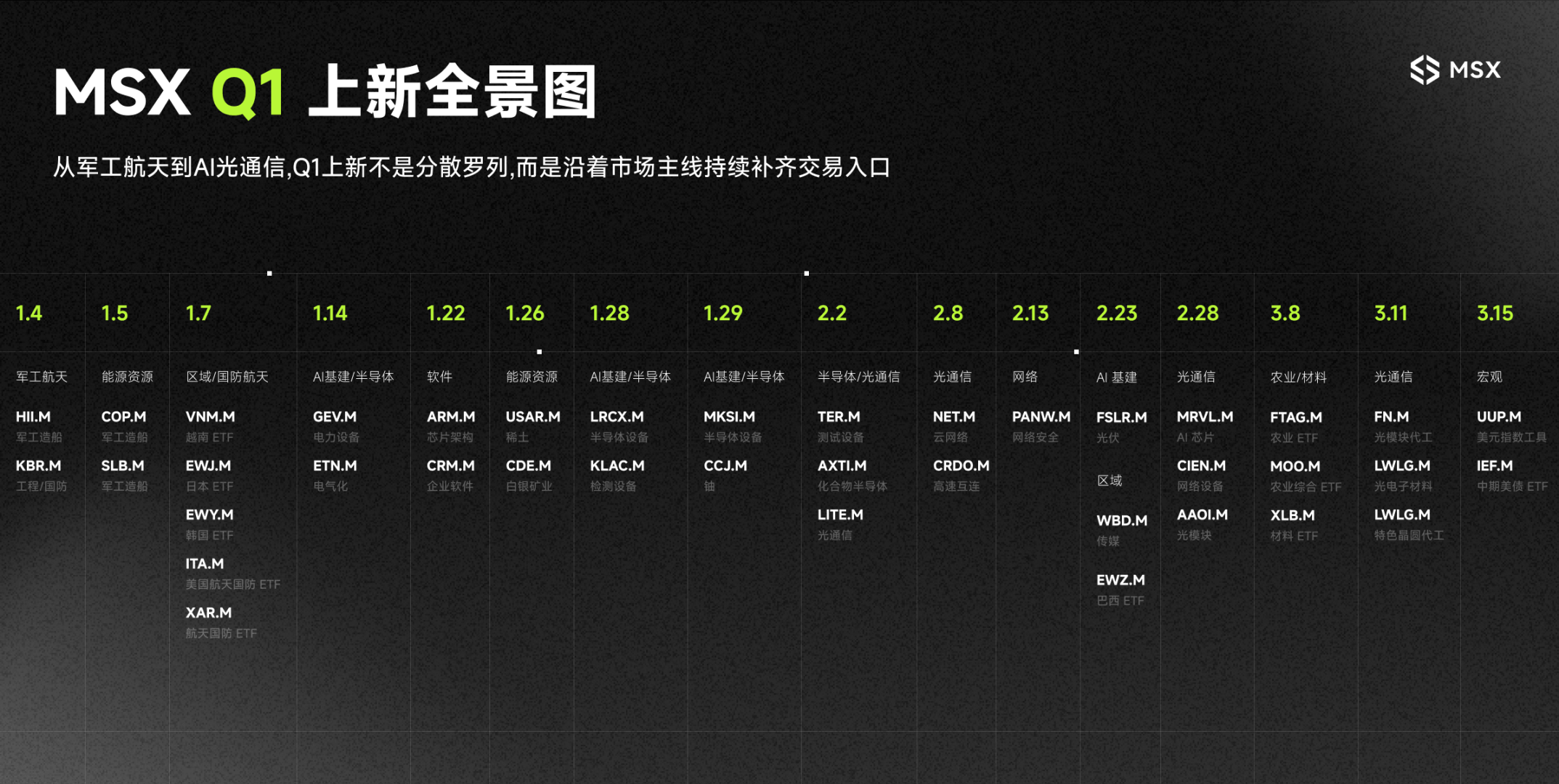
From the perspective of specific targets, this intent of expressing viewpoints becomes even clearer.
For example, COP.M and SLB.M represent not just traditional energy stocks but a combination expression of oil prices, capital expenditures, and geopolitical risks; CCJ.M and USAR.M correspond to more than just fluctuations in resource prices but are long-term themes of strategic resource security and supply chain restructuring; LITE.M, CIEN.M, FN.M, and AAOI.M relate to the industrial logic of "interconnection leading" against the backdrop of upgrading AI data centers; while macro tools like UUP.M and IEF.M further complement the positioning management needs under the macro environment of a strong dollar, interest rate defense, and more.
From this angle, what is truly new in stock selection is not just the stock tokens or ETF tokens themselves, but rather a judgment that can be traded, combinatively used, and switched with market rotations.
Final Thoughts
If we place Q1 2026 in a longer cycle perspective, the market has clearly become unsatisfied with the "chasing trends" logic driven by a single narrative.
Whether in military aerospace, strategic resources, AI infrastructure, regional allocations, dollar, or U.S. Treasury tools, what funds truly need is a system that can freely switch asset expressions in different market environments.
In this sense, the precise new launches by MSX in Q1 are not just a routine product expansion but are progressively building a cross-theme, cross-style, and cross-cycle asset framework around the current market main lines, which can also create a more authentic observation sample that is closer to the real market structure for everyone:
Which directions are worth laying out in advance? Which sub-segments possess higher elasticity? Which tools can assume allocation and defensive functions when volatility arrives?
I hope to provide a perspective worth considering for everyone.
免责声明:本文章仅代表作者个人观点,不代表本平台的立场和观点。本文章仅供信息分享,不构成对任何人的任何投资建议。用户与作者之间的任何争议,与本平台无关。如网页中刊载的文章或图片涉及侵权,请提供相关的权利证明和身份证明发送邮件到support@aicoin.com,本平台相关工作人员将会进行核查。


